He was proclaimed king at York twice and driven out twice, was baptised with an English king as his sponsor, ruled Dublin for almost three decades, lost a son and his throne at Tara in 980, and then went as a penitent to the island monastery of Iona, where he died. Olaf Sihtricsson – Amlaíb Cuarán in Irish sources, Óláfr kváran in Old Norse – is one of the best-documented Viking rulers of the tenth century, and yet much remains open: when exactly he reigned at York, which coins he struck, and whether a hero of English romance carries his nickname. This article sorts out what the annals, the Anglo-Saxon Chronicle and the later stories actually say.
Olaf Cuarán belonged to the dynasty that historians, following Irish usage, call the Uí Ímair, the "descendants of Ímar". Ímar was a ninth-century Viking leader whom the Irish annals call king of the Northmen of Ireland and Britain. Whether he is the same man as the saga figure discussed in our article on Ivar the Boneless is a scholarly hypothesis, not an established fact. What is certain is that Ímar's descendants laid claim in the tenth century to two towns separated by more than three hundred kilometres and a stretch of sea: Dublin on the east coast of Ireland and York in northern England.
Olaf's father was Sihtric, Irish Sitriuc, nicknamed Cáech, usually rendered "one-eyed" or "squinting". Sihtric recaptured Dublin in 917, later became king at York and died in 927. Version D of the Anglo-Saxon Chronicle records that in 926 Sihtric married a sister of King Æthelstan at Tamworth. Whether this woman was Olaf's mother is claimed only by late sources such as the thirteenth-century chronicle of John of Wallingford. Some historians think it possible; it cannot be proven. Olaf's mother is therefore unknown, and so is his year of birth. Estimates of around 920 or shortly after rest solely on the length of his career.
The name is confusing because there are several Olafs. His cousin Olaf Guthfrithsson, Irish Amlaíb mac Gofraid, led the army defeated by Æthelstan at the Battle of Brunanburh in 937 and died in 941. The much earlier Olaf the White ruled Dublin in the ninth century. English sources call all three "Anlaf", which still makes it hard to know which report belongs to whom.
Cuarán is an Irish word for a kind of shoe. It is usually translated "sandal" or "shoe" and derives from Old Irish cúar, "bent, crooked". "Sandal" is probably too loose: the word seems to mean a particular style of leather shoe. According to the summary I was able to consult, the historian Benjamin Hudson points to a twelfth-century Irish satire describing a cuarán as leather folded seven times with a pointed toe. Why a Viking king was named after his footwear is unknown. Mockery, a personal habit of dress or a Dublin fashion are all conceivable; none is attested.
The nickname first appears in the Annals of Ulster in the account of the battle of Slane in 947. The Anglo-Saxon Chronicle renders it "Curran", and Old Norse turns it into kváran. An Irish word becoming the fixed name of a Scandinavian king fits the world of the Norse-Gaels, where Norse and Irish language, names and customs ran into one another.
There is no saga about Olaf and no biography. What we know is scattered across brief year-by-year entries written by monks in Ireland and England. The most important group are the Irish annals. The Annals of Ulster survive in fifteenth-century copies but rest on records that were often kept close to the events. Alongside them stand the Annals of Tigernach, the Chronicon Scotorum, the Annals of Clonmacnoise (preserved only in a seventeenth-century English translation) and the Annals of the Four Masters, a compilation of the 1630s whose dates for this period are often a year or two off modern reckoning. Even the Annals of Ulster file the year of Tara as "979 alias 980".
On the English side there is the Anglo-Saxon Chronicle, which survives in several versions. For the north, versions D and E are especially useful because they absorbed material from the York area. Add the Latin chronicler Æthelweard, writing in the late tenth century, and histories of the twelfth and thirteenth centuries such as the Historia Regum attributed to Symeon of Durham, William of Malmesbury and Roger of Wendover. These later works supply details missing from earlier texts, but their sources are not always clear.
A third layer is poetry and literature. The Irish poet Cináed ua hArtacáin, who died in 975, seems to have enjoyed Olaf's patronage. In Icelandic sagas such as Njáls saga and Gunnlaugs saga, Olaf appears mainly as the father of the Dublin king Sigtrygg Silkbeard. And in the twelfth century a hero called Cuaran turns up in French-language stories written in England – more on that below.
According to the Annals of Clonmacnoise, Olaf was already in Britain in 940. When his cousin Olaf Guthfrithsson died in 941, he took over at York, apparently together with another cousin, Ragnall Guthfrithsson. The kingdom of York, described in our article on Jorvik, was more than the city at this point: for a time it reached into the Five Boroughs of the east Midlands – Leicester, Lincoln, Nottingham, Stamford and Derby. It lost them in 942 to King Edmund, Æthelstan's successor.
The Chronicle describes a confused situation under 943. An Anlaf stormed Tamworth, was then besieged at Leicester together with Archbishop Wulfstan of York, and escaped by night. Afterwards he made peace with Edmund and was baptised, with Edmund as his sponsor. In the same year Edmund also stood sponsor to Ragnall at his confirmation, receiving him "at episcopal hands". The Chronicle does not say here which Anlaf was baptised. Scholars usually take the entry to refer to Olaf Cuarán, because Olaf Guthfrithsson was no longer alive. To add to the confusion, the entry in the version I consulted also reports the death of a "King Anlaf".
Such baptisms were political acts. Whoever raised a king from the font became his spiritual father and ranked above him. For Olaf, baptism was the price of peace; for Edmund, a sign of overlordship. Whether Olaf had been a pagan before or had already been raised a Christian cannot be said.
The peace did not last. In 944, the Chronicle says, Edmund brought all Northumbria under his rule and expelled two kings, "Anlaf the son of Sihtric, and Reynold the son of Guthferth". Here the identification is unambiguous. Æthelweard tells it slightly differently: Archbishop Wulfstan and a Mercian ealdorman, a senior royal official, deposed the two kings.
Five years later Olaf came back. Version E of the Chronicle notes laconically under 949 that Anlaf Curran came to the land of the Northumbrians. Whether the Northumbrians invited him or the English king Eadred agreed is debated. In 952 the Northumbrians drove him out again and accepted a king named Eric.
This Eric is usually identified with the Norwegian prince Eric Bloodaxe, discussed in our articles on Eric Bloodaxe and his wife Gunnhild. The identification is widespread but not undisputed, since the English sources give neither father nor origin. The order of events can only be reconstructed in outline. An Eric appears at York around 947/948: the Chronicle reports under 948 that Eadred ravaged Northumbria because the Northumbrians had taken Eric as their king. Whether Eric already ruled briefly before Edmund's death in 946 is debated. After Olaf's second reign from 949 to 952, Eric returned. With his end in 954, York passed permanently to the English kings.
Most accounts date Olaf's York reigns to 941–944 and 949–952. That is a reconstruction from a handful of sentences. The historian Kevin Halloran has even suggested that Olaf Guthfrithsson never ruled York, which would mean there was only one king of that name there – Olaf Cuarán. It is a minority view, but it shows how thin the evidence is.
"After this Anlaf obtained the friendship of King Edmund, and King Edmund then received King Anlaf in baptism; and he made him royal presents. And the same year, after some interval, he received King Reynold at episcopal hands. … This year King Edmund reduced all the land of the Northumbrians to his dominion, and expelled two kings, Anlaf the son of Sihtric, and Reynold the son of Guthferth."
Anglo-Saxon Chronicle, entries for 943 and 944, public-domain nineteenth-century translation (wording apparently that of J. Ingram, 1823; checked against an online reproduction)
While Olaf fought for York, Dublin was not left empty. The town, whose history is told in our overview of the Vikings in Dublin, was by the tenth century a fortified trading place with a harbour, workshops and a mixed population. In 944 the Irish high king Congalach Cnogba sacked it. Afterwards, around 945, Olaf took power after his cousin Blácaire had been driven out.
His first spell in Dublin was short. In 945, together with Congalach, he defeated part of the army of Ruaidrí ua Canannáin, a rival for the high kingship. In 946 he raided Kilcullen in what is now County Kildare. But in 947 Ruaidrí beat him at Slane with heavy losses, and Blácaire returned. After Blácaire's death in 948 his brother Gofraid ruled until he died of disease in 951. From 952, after the final loss of York, Olaf was king of Dublin again, and this time he stayed until 980.
That second reign lasted about 28 years, unusually long for a Viking king of his time. It was possible because Olaf grew into Irish politics instead of disrupting them from outside. Dublin was no longer a foreign body but one of many players in the contest for the kingship of Tara, the symbolically highest kingship in Ireland, and for the province of Leinster, on whose border Dublin lay.
The annals portray Olaf as a warlord who worked above all through alliances, with friends and enemies changing as the situation demanded. A chief opponent was Domnall ua Néill, the northern high king, who besieged Dublin for two months in 968. In 970 Olaf fought Domnall's northern army at Kilmona. In 977, according to the annals, Olaf's men killed two of Domnall's sons, Congalach and Muirchertach. Leinster both bound and divided him: in 967 Olaf and Cerball mac Lorcáin killed the Leinster king Muiredach mac Faeláin, and in 978 kings of Leinster fell in battle at Belan.
Monasteries were targets in this warfare, but not out of religious hatred. Great Irish monasteries such as Kildare and Kells were wealthy settlements with stores, cattle and people. Olaf raided Kildare in 964 and attacked Kells in 969. Irish kings did much the same when it suited them. A campaign aimed at plunder, hostages and tribute, that is, regular payments from a subject territory. Captives could also end up in the slave trade through Dublin, a subject covered in our article on slavery in the Viking Age. Whether particular raids of Olaf's served that purpose, the annals do not say.
How large Olaf's armies were is unknown; the annals give no figures worth taking seriously. At Tara, according to the Annals of Ulster, men "of the Isles" fought alongside the Dubliners – probably from the Hebrides or the Isle of Man. That points to a network around the Irish Sea that Olaf could call on.
Olaf's marriages were politics. One wife was Dúnflaith, daughter of the northern king Muirchertach mac Néill and sister of the same Domnall ua Néill who later became his enemy. Her son Glúniairn, Old Norse Járnkné, "Iron-knee", succeeded Olaf in Dublin in 980. Another wife was Gormflaith, daughter of the Leinster king Murchad mac Finn, who was killed in 972. Gormflaith bore Sihtric, who as Sigtrygg Silkbeard ruled Dublin at the time of the Battle of Clontarf in 1014. She later married Brian Boru. The Icelandic Njáls saga knows her as Kormlöð and casts her as the driving force behind the war of 1014 – a literary image, not a portrait.
Other children are known or suspected. His son Ragnall fell at Tara in 980. A daughter, Máel Muire, married the victor of Tara, Máel Sechnaill. A son Harald is regarded by some scholars as the grandfather of the later king of Man, Godred Crovan, which is a hypothesis. With Gyða, caution is needed: Snorri Sturluson relates in his saga of Olaf Tryggvason that the Norwegian married a widow called Gyða in England and, as far as I know the passage, calls her a sister of Olaf Kvaran. Hudson, according to a secondary summary, preferred to see her as a daughter. The story comes from a thirteenth-century saga and is not attested elsewhere.
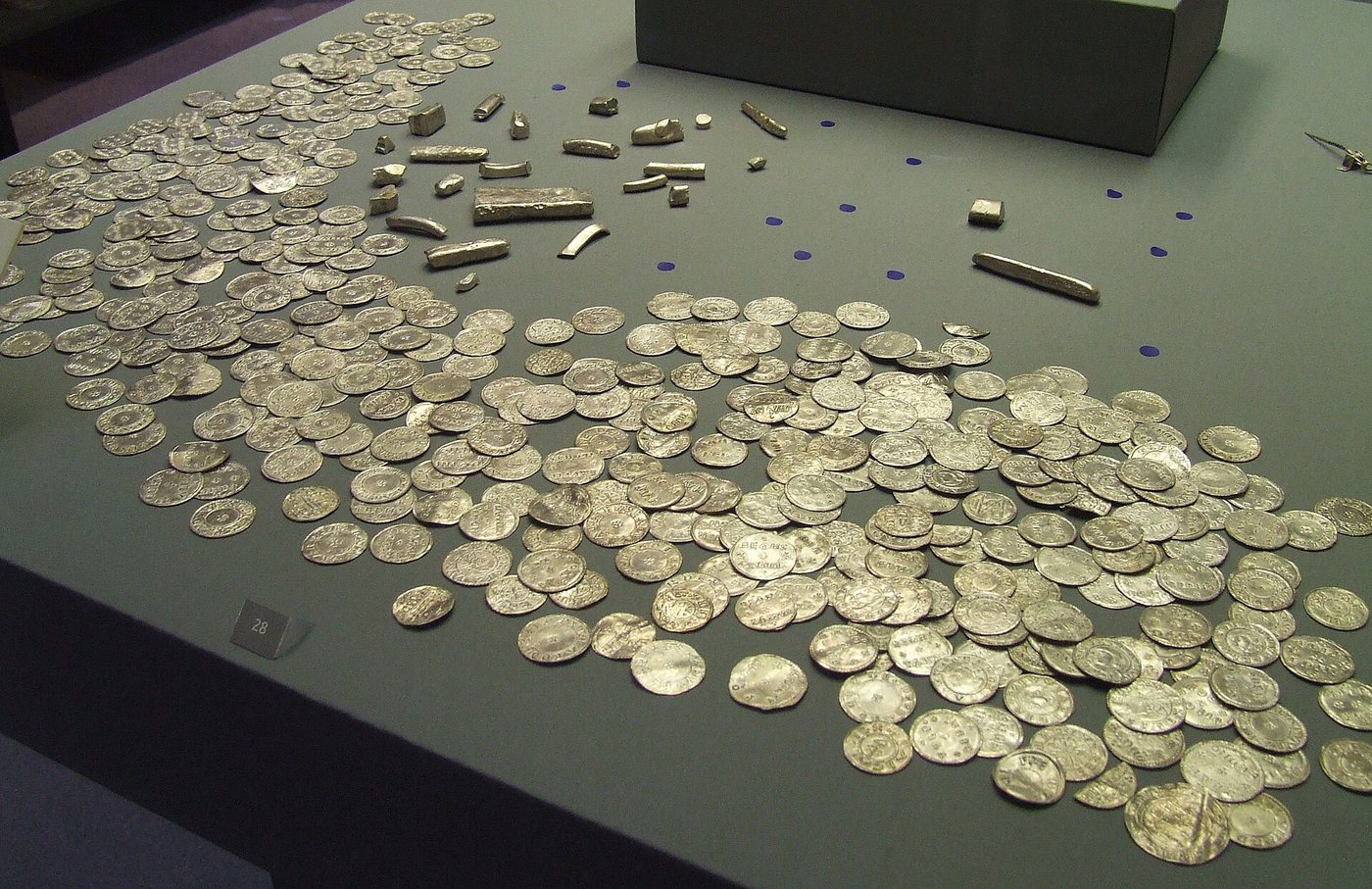
At York the Norse kings struck silver pennies bearing their names. There are several types with the name ANLAF, among them one with a triquetra – a threefold interlaced knot – on the obverse and a kind of standard on the reverse. Collections attribute such pieces to Olaf Cuarán's first York reign. But because Olaf Guthfrithsson also struck coins at York and both are simply "Anlaf", the attribution of individual types is disputed. Dublin itself did not yet mint its own coins in Olaf's lifetime; trade there ran on silver by weight, as our article on hacksilver shows. The first Dublin coinage is usually placed around 997, under his son Sigtrygg.
Of Olaf's court we know little. That the poet Cináed ua hArtacáin, one of the leading Irish poets of his day, enjoyed his patronage is considered likely. The statement that Norse skalds also composed at his court appears in general accounts, but I know of no skaldic poem on Olaf Cuarán preserved under a poet's name. The skald Gunnlaug Serpent-Tongue, whose story is told in Gunnlaugs saga, visited not Olaf but his son Sigtrygg.
The end came in 980. The Annals of Ulster report that Máel Sechnaill son of Domnall won the battle of Tara against the foreigners of Áth Cliath – Dublin – and of the Isles. Among the dead was Ragnall, "son of Amlaíb, the son of the king of the foreigners". Máel Sechnaill, who became Irish high king the same year, then moved against Dublin and, according to later accounts, imposed tribute on the town.
Olaf abdicated or was forced to. The Annals of Tigernach report that Amlaíb son of Sihtric, "high-king over the Foreigners of Dublin", went to Iona after the battle in repentance and pilgrimage and died there. Iona, a small island off the west coast of Scotland, was the mother house of the Columban monasteries and one of the holiest places of the Gaelic world. Vikings had attacked it several times around 800.
His death is dated to 980 or 981, depending on which annalistic reckoning one follows. The annals do not say that Olaf became a monk. They speak of penance and pilgrimage, which can mean life near a monastery without formal vows. In Dublin he was succeeded by Glúniairn, under the overlordship of Máel Sechnaill.
Olaf's name lived on along two paths. The first runs through his family. His son Sigtrygg Silkbeard became a saga figure, and with him Olaf travelled into northern literature as "Óláfr kváran". In the nineteenth and twentieth centuries an Icelandic family even adopted the surname Kvaran; its best-known member is the writer Einar Hjörleifsson Kvaran.
The second path is more tangled. In the twelfth century the Anglo-Norman poet Geffrei Gaimar tells in his Estoire des Engleis, the "History of the English", of a Danish prince who grows up as a kitchen boy called Cuaran, marries a princess and finally wins back his inheritance. The boy turns out to be Haveloc. Around 1190–1220 this became the Lai d'Haveloc, a short French verse tale, and around 1300 the Middle English romance Havelok the Dane.
The shared nickname has led many scholars to suspect a memory of Olaf Cuarán behind Havelok. One argument is that Olaf appears in Welsh sources as "Abloyc", which resembles the name Havelok. The story might have reached England via Cumbria or Lincolnshire. The literary scholar Scott Kleinman objects that Olaf's life and Havelok's story otherwise have little in common. The link is therefore a scholarly hypothesis, not a finding.
In modern entertainment Olaf Cuarán plays hardly any role. I know of no leading character in a major television series or well-known novel who explicitly represents him. Readers interested in screen versions of the period will find the world his family came from – two generations earlier – in our fact check of "The Last Kingdom".
No, at least none that is documented. Olaf's world was the Irish Sea, with its coasts in Ireland, Wales, Cumbria, Scotland and the islands, plus northern England. But I know of no concrete trace connecting Olaf or his court with the Rhine, Aachen or the area around Alsdorf, and I will not invent one. For connections between Vikings and England, see our overview of the Vikings in England.
How long did Olaf Cuarán rule Dublin? Twice: briefly around 945–947 and then from 952 to 980, roughly 28 years in one stretch. Counting his years at York, he was a king for more than three decades, though not continuously.
Was Olaf Cuarán a Christian? According to the Anglo-Saxon Chronicle he was baptised around 943 with King Edmund as sponsor, provided the entry refers to him, as scholars generally assume. At the end of his life he went to Iona as a penitent. How he lived his faith day to day is not recorded.
What is his connection to Brian Boru? His wife Gormflaith married Brian Boru after Olaf's death, and Olaf's son Sigtrygg Silkbeard stood on the opposing side to Brian in the conflicts around 1014. As far as the sources go, Olaf and Brian never met as opponents.
Why do English sources call him Anlaf? "Anlaf" is the Old English rendering of the Norse name Óláfr, just as Irish "Amlaíb" is. Because several kings bore the name, modern historians tell them apart by patronymics or nicknames.
Are there finds directly linked to him? The closest are silver pennies from York bearing the name ANLAF. Which of them he issued and which his cousin did is disputed for some types. No grave or personal object of Olaf's is known.
Viking Dublin · The Norse of Jórvík · Brunanburh 937 · Erik Bloodaxe · Norse Kings.
All History & Finds articles →
Olaf Tryggvason ruled Norway for only about five years – yet he became one of the loudest figures of the Viking Age. A …
Read more →Oleg, in the Primary Chronicle the prince who takes Kyiv in 882, marches on Constantinople in 907 and dies of a …
Read more →In the late 10th century an island in the middle of Opole carried a stronghold with a timber-and-earth rampart, and its …
Read more →The Ordovices lived in the mountains of north and central Wales and were among the few tribes of Britain that held Rome …
Read more →