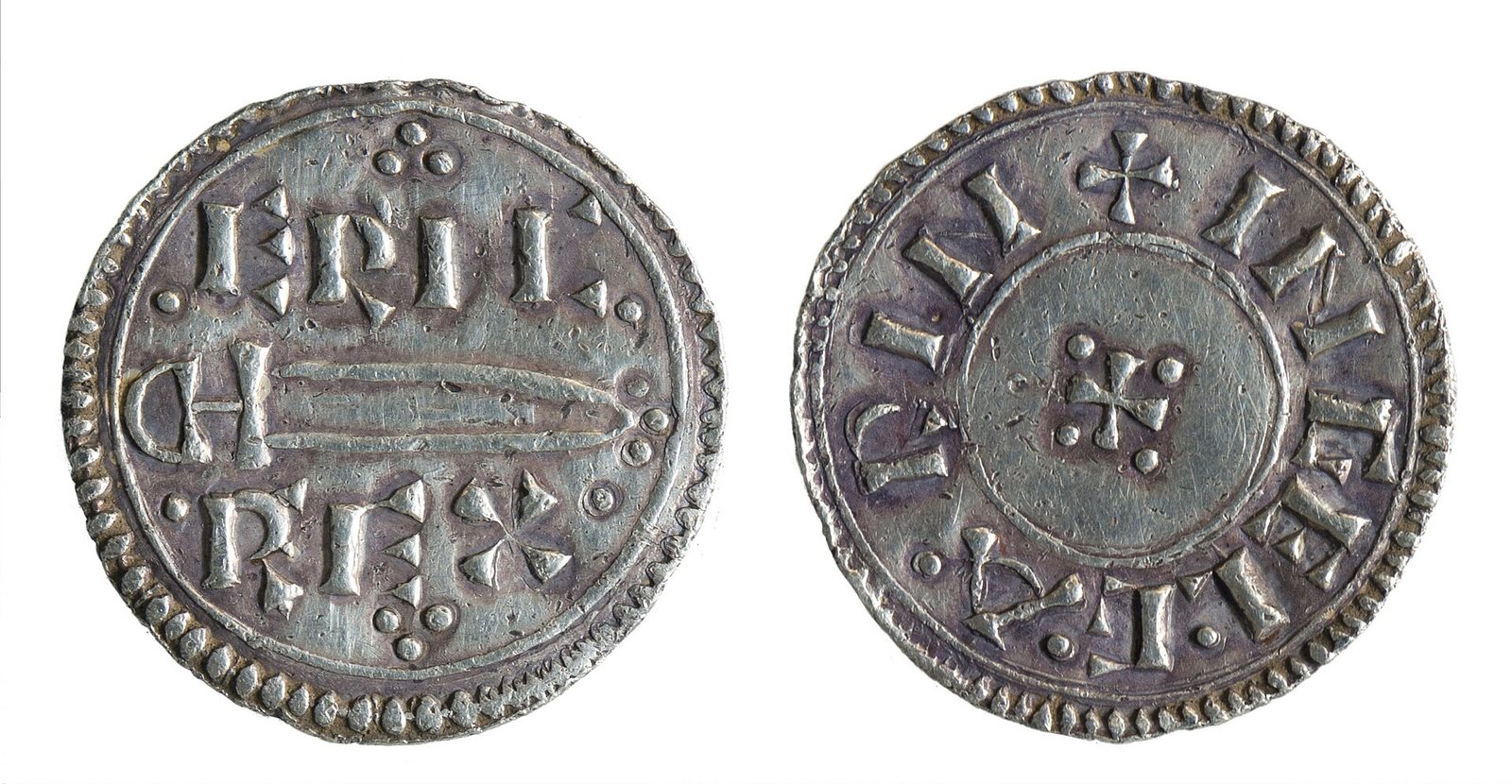
In the sagas Gunnhild is the most dangerous woman in Norway: beautiful, clever, skilled in magic, vengeful, the real power behind Eric Bloodaxe and later behind her sons. She poisons, curses, takes the shape of a bird and, according to one tradition, ends her life drowned in a Danish bog. Yet almost everything we read about her was written two or three centuries after her death, in Norway and above all in Iceland. Even her origins are disputed. This article follows the traces: what the sources tell, where they contradict each other, what scholars consider likely, and why a bog body that received a splendid coffin as "Queen Gunnhild" in 1835 turned out to be some fifteen hundred years older.
Gunnhild, Old Norse Gunnhildr, was the wife of Eric Bloodaxe (Eiríkr blóðøx), the son of Harald Fairhair who ruled Norway briefly around 930 and later reigned in York. Her epithet konungamóðir means "mother of kings". It goes back to the years after 961, when several of her sons ruled large parts of Norway together, chief among them Harald Greycloak (Haraldr gráfeldr). The man at her side has his own article, Eric Bloodaxe; this one is about Gunnhild herself.
Her dates are not recorded. A birth early in the tenth century and a death around 980 are estimates; the Norwegian historian Claus Krag, writing in the Store norske leksikon, says only that she lived "around 950".
Her literary portrait is sharp. Egils saga calls her "the fairest and wisest of all women, and much skilled in magic" (allra kvenna vænst ok vitrust ok fjölkunnig mjök, ch. 37). Beauty, intelligence and magic recur in nearly every account of her, usually joined by cruelty.
No account of Gunnhild survives from her own time. No inscription names her, and no English chronicle mentions her, even though the Anglo-Saxon Chronicle knows a King Eric in York. What remains are four groups of later texts.
The first are the so-called Norwegian synoptic histories, short accounts of the kings from the second half of the twelfth century: the Latin Historia Norwegie, whose date is disputed, the Latin history of the monk Theodoricus (around 1180) and the Old Norse Ágrip af Nóregskonungasögum (around 1190). The second are the great kings' sagas of the early thirteenth century, Fagrskinna and Snorri Sturluson's Heimskringla (around 1230). The third are sagas of Icelanders, stories about Icelandic families in which Gunnhild appears as a secondary figure: above all Egils saga, Laxdæla saga and Njáls saga. Orkneyinga saga and Jómsvíkinga saga add further material.
The fourth group is the oldest but the hardest to pin down: skaldic stanzas, praise poems and occasional verses quoted in the sagas, some of which may go back to the tenth century. A stanza that Egils saga puts in Egill's own mouth blames Gunnhild for driving him out of Norway, without giving reasons. The skald Eyvindr skáldaspillir, on the other hand, places the blame for the killing of Earl Sigurd of Hlaðir on her sons alone. The authenticity and age of these verses are long debated. For the genre see Sagas of Icelanders.
The best-known version of her origins is told by Snorri in the saga of Harald Fairhair. Young Eric sails north, through Finnmark and on to Bjarmaland, the land by the White Sea. On the way back his men find a girl of unmatched beauty in a hut of the Finns, as Norse texts call the Sámi. She says her name is Gunnhild, that her father is Özurr tóti of Hålogaland, the region in the north of Norway, and that she is there to learn sorcery from two Finns. Both want to marry her. Gunnhild hides Eric's men, puts the sorcerers to sleep, pulls sealskin bags over their heads, and the men kill them; and Eric takes Gunnhild south and marries her with her father's consent.
Samuel Laing's translation of 1844 renders the moment of discovery like this: "his men found a girl in a Lapland hut, whose equal for beauty they never had seen." Other texts tell it differently. Fagrskinna says only that Gunnhild was fostered and brought up by Mǫttull, a king of the Finns. Egils saga also places the marriage on a Bjarmaland voyage and names her father Özurr tóti. Ágrip calls him Özurr lafskegg.
The story is cleverly built. From her first appearance Gunnhild has learned magic and removes powerful men by cunning. The Australian historian Matthew Firth regards the encounter as a literary construction. In Old Norse literature the far north, the Sámi and sorcery belong closely together; the article The Sámi in the Norse sources shows how often Sámi figures appear there as people with magical knowledge. An Özurr tóti, incidentally, is attested nowhere outside these stories.
A single source tells something entirely different. Historia Norwegie makes Gunnhild the daughter of the Danish king Gorm the Old and his wife Thyra; Eric is said to have met her at a feast at Gorm's court. That would make her a sister of Harald Bluetooth. Her supposed parents are covered in Gorm the Old and Thyra Danebod.
This version has many supporters among historians. Claus Krag writes that almost all recent historians consider the Danish origin correct, because Historia Norwegie is partly independent of the Icelandic tradition. Guðbrandur Vigfússon already rejected the Özurr version in the nineteenth century. There is also a political argument: a marriage between the house of Harald Fairhair and the young Danish royal dynasty fits a period in which both were expanding their power. And after their father's death Eric's sons did seek protection with Harald Bluetooth, natural with an uncle. Firth names the sons' names as a further argument; Krag reads the name of the eldest, Gamli, as a naming after his grandfather Gorm. That is a hint, not proof.
There is, however, a weighty objection, which Firth points out. Ágrip, Theodoricus and Jómsvíkinga saga agree that Harald Bluetooth offered the widowed Gunnhild marriage. Had she been his sister, such an offer would have been unthinkable. One of the two claims must be wrong, perhaps both. English Wikipedia notes that the recent editors of Ágrip and Theodoricus follow the Welsh historian Gwyn Jones in treating these texts' statements on her origins as unreliable. I have not read Jones's own account of 1968 and know his position only from that summary.
In short: many consider the Danish origin more likely because it does not sound like a folktale and makes political sense. It is not secure, and none of the sources is contemporary.
Harald Fairhair is said to have chosen Eric, his favourite son, as overking. After Harald's death, around 930 to 933 in the traditional chronology, Eric prevailed against several half-brothers; the sagas credit him with killing a number of them. Gunnhild appears as a queen who shares in government and pursues his enemies. Real politics and the later image of the wicked counsellor cannot be separated.
Around 934 or 935 Eric's youngest half-brother Hákon returned from England, where he had grown up at the court of King Æthelstan. The great farmers backed him, and Eric left. See Hákon the Good. For Gunnhild it began twenty years of wandering between the British Isles, Orkney and Denmark, until her sons finally defeated Hákon. The sagas keep her as Hákon's adversary throughout; Ágrip even attributes his death in 961 to her sorcery.
Gunnhild is at her most vivid in Egils saga, where she is the chief enemy of the Icelandic poet Egill Skallagrímsson. The enmity begins at a feast on the island of Atley. According to the saga the host, Bárðr, one of the king's men, and the queen mix poison into Egill's drinking horn. Egill carves runes on the horn, reddens them with his blood, and the horn bursts (ch. 44). He kills Bárðr and escapes. See Rune magic.
Later Gunnhild urges her brothers Eyvindr skreyja and Álfr askmaðr to kill one of Skalla-Grímr's sons, ideally both. Because Eyvindr cannot get close to Egill's brother Þórólfr, he kills Þórólfr's follower Þorvaldr ofsi at a sacrificial feast and is outlawed for it (chs. 48–49). The claim, sometimes repeated, that Egill killed both of Gunnhild's brothers is not in the saga: Egill does attack Eyvindr off Jutland, but Eyvindr saves himself by swimming ashore.
The climax comes in chapter 57. Egill has lost an inheritance dispute and has been outlawed; he kills his opponent Berg-Önundr and, on the island of Herðla, today Herdla near Bergen, kills Eric's young son Rögnvaldr with his companions. Before leaving Norway he raises a níðstöng, a níð-pole, on a rocky headland: a hazel pole with a horse's head set on it, turned towards the land. Into the pole he cuts runes carrying a formula of execration.
Hér set ek upp níðstöng, ok sný ek þessu níði á hönd Eiríki konungi ok Gunnhildi dróttningu … sný ek þessu níði á landvættir þær, er land þetta byggva, svá at allar fari þær villar vega, engi hendi né hitti sitt inni, fyrr en þær reka Eirík konung ok Gunnhildi ór landi.
"Here I raise a níð-pole, and I turn this insult against King Eiríkr and Queen Gunnhildr … I turn this insult against the land-spirits that dwell in this land, so that they all go astray, and none may find or reach its home, until they drive King Eiríkr and Gunnhildr out of the land."Egils saga Skalla-Grímssonar, ch. 57; Old Norse wording read in sections through a retrieval tool from a normalised online text (bookdown.org), not in a printed edition; English version my own translation
The formula is remarkable because it does not curse the king directly but turns the landvættir, the guardian spirits of the land, against him. The word níð denotes an insult meant to destroy a person's honour and standing. Whether such poles existed in the tenth century is a separate question. Níð-poles are mentioned in several sagas and in medieval law; that Egill raised this particular pole against this particular couple we know only from a saga written some three hundred years later. Eric and Gunnhild do leave Norway soon after, for political reasons; the saga lets its readers think of the land-spirits.
After his expulsion Eric turns up in York, the centre of the Scandinavian-influenced kingdom of Northumbria. The Anglo-Saxon Chronicle names a King Eric there for 947/948 and again for 952 to 954; whether this Eric is the same man as Eric Bloodaxe has been questioned by the historian Clare Downham. On the town itself see Jórvík. That Gunnhild was with him in York rests on Norse tradition alone; English sources say nothing about her.
York is also the setting of the most famous Gunnhild scene in Egils saga. Chapter 59 opens with the sentence: "It is said that Gunnhildr had a seiðr performed, and caused by it that Egill Skalla-Grímsson should never find rest in Iceland until she had seen him." Seiðr is a form of magic that the sources often connect with women, with prophecy and with harmful sorcery; the article Seiðr explains the term. Egill puts to sea, is shipwrecked at the mouth of the Humber and lands in Eric's kingdom. His friend Arinbjörn, Eric's foster-brother, brings him before the king and wins a respite.
During the night Egill is to compose a praise poem for Eric, but a swallow sits at the window twittering without pause. Arinbjörn takes up position at the window and at daybreak sees a hamhleypa, a being that goes about in a borrowed shape, slip away. The saga does not name her at this point, but every listener knew who was meant. At dawn Egill recites Höfuðlausn, "Head-ransom", and is spared. Whether the poem is really Egill's work is disputed; its end rhyme is unusual for tenth-century skaldic verse, and some scholars consider it later.
According to a later English tradition, Eric fell at Stainmore in the Pennines in 954. The sagas have the news reach Gunnhild and her sons, who then leave England. According to Snorri they go to Orkney, establish themselves there and take tribute from the earls. Orkneyinga saga tells of Gunnhild's daughter Ragnhild, who there marries several members of the earls' family in turn and, in the saga's account, has a hand in the murder of two of them. Her first husband was Arnfinnr, a son of Earl Þorfinnr Skull-splitter. See The earls of Orkney.
From Orkney Gunnhild went with her other children to Denmark, to Harald Bluetooth, who according to the saga granted them lands. From there the sons raided Hákon's Norway. The eldest, Gamli, fell in one of these fights, the saga says. Around 961 came the battle of Fitjar on the island of Stord; Hákon won, but was struck by an arrow and died of the wound. The way was open for the Eiríkssynir, the sons of Eric.
After Fitjar Gunnhild's sons ruled Norway, mainly the west; their power did not reach everywhere. Harald Greycloak was the strongest of the brothers. Heimskringla also names Guthormr, Ragnfrøðr, Erlingr, Guðrøðr and Sigurðr slefa, as well as the daughter Ragnhild.
The sagas paint these years as harsh rule. In 962 the brothers have Earl Sigurd of Hlaðir killed, and his son Hákon becomes the family's most dangerous opponent. Snorri reports famine. He also tells how, after the death of King Tryggvi, Gunnhild hunts the pregnant widow Ástríðr, who flees to Sweden with her newborn son, the future Olaf Tryggvason. Claus Krag considers this persecution story a construction, and for the killing of Sigurd the skald Eyvindr, as mentioned, blames the sons alone. The saga makes the mother the driving force.
Around 970 Harald Greycloak was lured to Denmark and killed at Hals on the Limfjord; the plot is attributed to Earl Hákon, who had allied himself with Harald Bluetooth. Their rule collapsed. According to Snorri, Gunnhild went to Orkney again with two of her sons. After that the sources fall quiet.
Two sagas show Gunnhild as an older woman with a young lover. In Laxdæla saga (ch. 19), and at greater length in Njáls saga (chs. 3–6), the Icelander Hrútr Herjólfsson comes to Norway to claim an inheritance. Gunnhild takes him in, makes him her lover and helps him obtain his money. When he wants to return to Iceland, she asks whether he has a woman there. He says no, although he is betrothed. Gunnhild gives him rich gifts on parting and at the same time curses him: with the woman he has set his heart on in Iceland he shall have no pleasure.
The curse is fulfilled. Hrútr's marriage to Unnr, the daughter of Mörðr gígja, remains unconsummated; Unnr leaves him on her father's advice, and the quarrel over her dowry starts a thread that runs deep into the saga. See Njáls saga.
The episode is certainly not court chronicle. It combines two motifs that Icelandic storytellers valued in Gunnhild: the sexual freedom of a powerful woman and her magical power over men. Jóna Guðbjörg Torfadóttir stresses that the Icelanders in these stories gain considerably from their closeness to the queen.
How Gunnhild died is unknown. Three texts tell a dramatic version. According to Ágrip, Theodoricus and Jómsvíkinga saga, Harald Bluetooth offered her marriage after her son's death. Gunnhild travelled to Denmark, was seized there and drowned in a bog. Theodoricus, as Firth notes, closes his account by remarking that this put an end to her crimes and sorceries.
Krag considers the story unlikely and suggests that Gunnhild may have spent her last years on Orkney, where her daughter had married into the earls' family. The bog story fits the image of the witch who finally meets her punishment remarkably well, and, as shown, it sits badly with the idea that Harald was her brother. Bogs as places where people were deposited in prehistory are the subject of Sacrificial bogs; for Gunnhild herself no archaeological evidence is known.
In 1835 peat cutters on the Haraldskær estate near Vejle in eastern Jutland came upon the body of a woman, remarkably well preserved. According to Archaeology magazine, the find spot lay in a bog called Gunnelsmose, "Gunhild's bog". The estate's name, Haraldskær, contains the name Harald. The conclusion seemed obvious: here lay Queen Gunnhild, drowned on Harald's orders.
King Frederick VI of Denmark had an elaborately carved coffin made for the supposed queen. It inspired poems and plays. But as early as 1842 the archaeologist Jens Jacob Asmussen Worsaae objected and argued that the dead woman belonged to the Iron Age. A radiocarbon date from 1977 placed her death around 490 BC, some fifteen hundred years before Gunnhild. The Haraldskær Woman is displayed today in St Nicolai's Church in Vejle, still in her royal coffin (one Wikipedia page names the Vejle cultural museum instead; I could not resolve this).
Almost all the texts that describe Gunnhild at length were written in Iceland or draw on Icelandic tradition. For Icelanders, Gunnhild was the enemy of their great poet Egill, and the Egill tradition shaped her image strongly. Krag also sees in her the sagas' stock wicked woman. Firth sums up that beyond a stable core the accounts of her life are "contested, embellished, or simply incredible". That core is: she was Eric's wife, a queen, and the mother of kings.
The charge of sorcery deserves a second look. Nicola Ibbott's master's thesis (Durham 2020) follows the image through the sources and finds the same themes everywhere: cruelty, magic and active politics. Her conclusion is that these portrayals reveal more about the attitudes of twelfth- and thirteenth-century authors than about a tenth-century queen. A woman who really did wield political influence became a witch in memory, because the storytellers could hardly explain her power otherwise. Sigurður Nordal, according to Torfadóttir, already read the magical image in this way. For the wider picture of female power in the Viking Age, see Women in the Viking Age.
What does "konungamóðir" mean? "Mother of kings". It refers to her sons, who ruled Norway after 961.
Was Gunnhild Danish or Norwegian? That is open. Most sagas make her the daughter of Özurr of Hålogaland, Historia Norwegie the daughter of Gorm the Old. Many historians prefer the Danish version, but it cannot be proven.
Was Gunnhild really a sorceress? The texts ascribe magic to her, often only as rumour ("it is said"). Whether the historical Gunnhild practised magic cannot be shown; scholars usually read the image as a way of explaining her political power.
What does Gunnhild have to do with Egill? In Egils saga she is his chief enemy: the poisoning attempt on Atley, the commission to her brothers, Egill's níð-pole against the royal couple and the spell that drives him to York.
Where is Gunnhild buried? That is not known. The Haraldskær bog body was taken for her in the nineteenth century, but it dates from the Iron Age.

Erik Bloodaxe · Egill Skallagrímsson · The Norse of Jórvík · Harald Bluetooth · Seiðr – the magic.
All History & Finds articles →
In January 878 Guthrum fell on the court of the West Saxon king, lost the battle of Edington in May, accepted baptism …
Read more →In the first and second centuries the Gutones lived on the lower Vistula, and Tacitus singled them out for an unusually …
Read more →Haakon Haraldsson, youngest son of Harald Fairhair, is said to have been sent as a boy to the English king Æthelstan …
Read more →Hedeby was not a fortress and not a royal seat. It was a place where goods changed hands – the most important one in …
Read more →