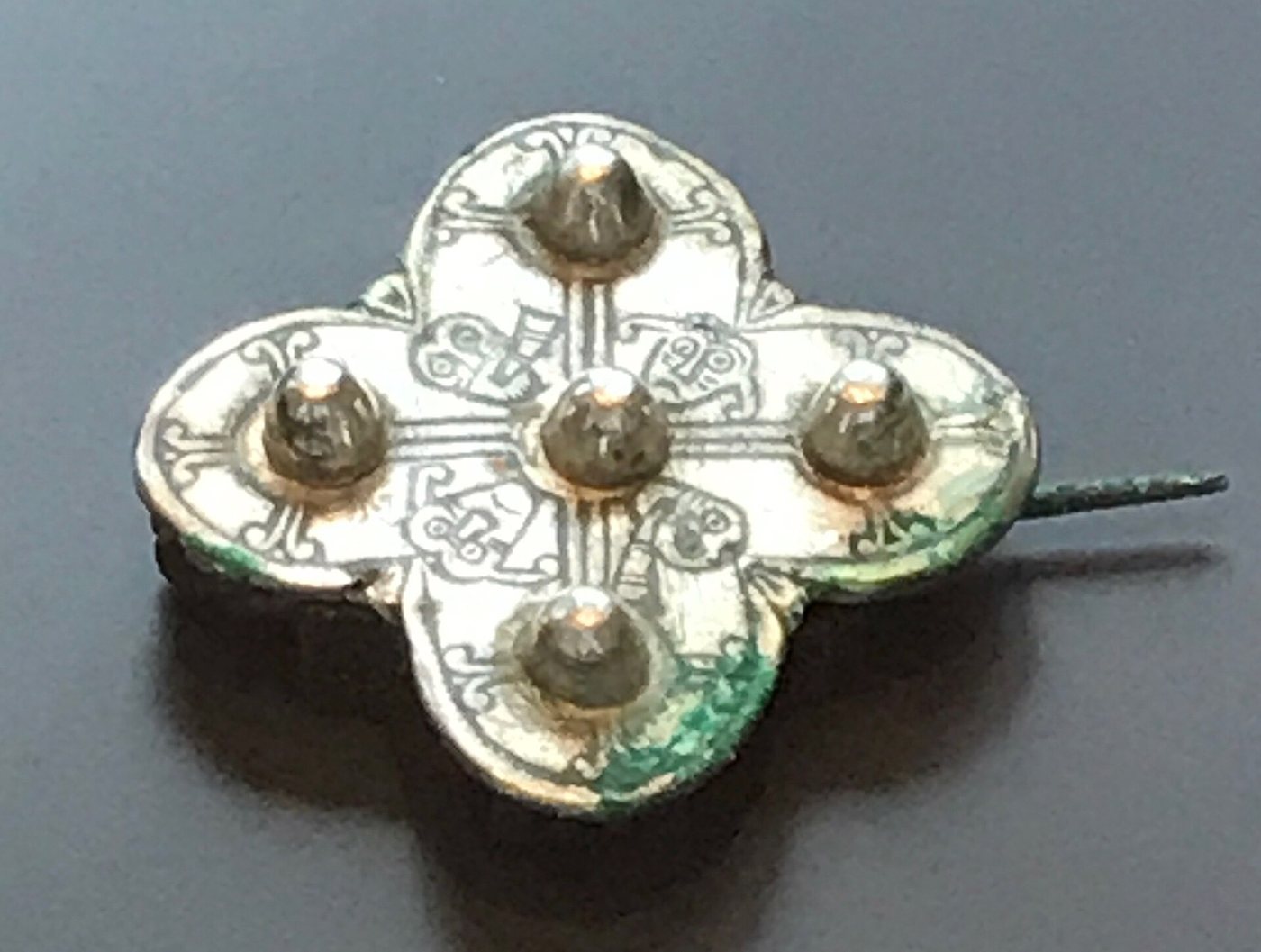
On a cross from the Isle of Man, a man with a Gaelic name honours his foster-mother, who also has a Gaelic name, in Norse runes. On Lewis, villages still carry Norse farm names, yet the people there have spoken Gaelic for centuries. And the ancestor of the great clans of the Isles bore a Norse name, while his father and grandfather were named after Irish saints. Scholars gather such evidence under the label “Norse-Gaels”. As far as the sources reach, the people themselves never used it.
The word itself has its own history, told in our article on the Gall-Goídil: the Irish term “foreign Gaels” for war bands of 856 to 858, their leader Caittil Find, the debate over their origins, the path of the name to Galloway. None of that is repeated here. This article asks a different question. What is left if you set aside the warriors of the annals and look for a culture, meaning language, names, houses, graves and churches?
The answer differs from the usual story of a harmonious hybrid society. In today’s use, “Norse-Gael” is an outsider’s collective term. It covers conditions that varied from island to island and century to century. On Man, in Argyll and on Lewis, “mixed” did not mean the same thing. A farmer on Uist around 1000 and a court poet around 1200 would probably have made little of sharing one pigeonhole. That cannot be firmly proved, because statements by the people themselves are almost entirely lacking.
The names alone show two points of view. Seen from Norway, the Hebrides and Man lay to the south and were called Suðreyjar, the Southern Isles, as opposed to Orkney and Shetland in the north. Seen from the Gaelic side, they were Innse Gall, the islands of the foreigners. The strip of mainland facing them was Airer Goídel, the coast of the Gaels, which became Argyll.
Andrew Jennings and Arne Kruse set this pair of names side by side in their paper “One Coast – Three Peoples” (2009). It matters for everything that follows: islands of the foreigners here, coast of the Gaels there. People who talk this way see not a blend, at first, but two parties facing each other.
The contrast is sharpest in the Outer Hebrides. According to Jennings and Kruse, apart from a few possible exceptions, no place-name on Lewis or Uist can safely be called pre-Norse. They speak of complete discontinuity in the name stock. Even the island names look odd: Ljóðhús and Ívist lack the usual Norse ending -ey for island. The authors take them to be native names given a Norse shape, probably during early exploration. What those names originally meant is unknown.
Who lived there before is also disputed. Jennings and Kruse regard the area north of Ardnamurchan, a peninsula on the Scottish west coast, as Pictish-speaking before the Vikings. In the abstract of a 2023 chapter, Thomas Clancy considers that probable, while noting that Gaelic-speaking ruling families and churches spread north from the late seventh century. How far that changed what ordinary people spoke remains open.
The ratio of farm names provides a cross-check. In the nineteenth century, the scholar F. W. L. Thomas counted about four Norse farm names to one Gaelic on Lewis, and on Islay about one Norse to two Gaelic (as reported by Alan Macniven). Norse names remain part of daily life there, such as Tàbost, from Norse Hábólstaðr, “high farm”, according to Richard Cox, and Suaineabost, “Sveini’s farm”. Nothing more is known about this Sveini, but the name has stayed.
None of this automatically means the older population vanished. Jennings and Kruse think a broad replacement likely and suggest that Gaelic at first had low status on the islands, perhaps as the language of the unfree. That is a reasoned guess, not a finding. Richard Cox wrote the study of the Gaelic names of Carloway on Lewis. He regarded many of them as coined during the Norse period; I know this only as reported by Jennings and Kruse, since I could not consult his book.
For a long time scholars assumed a clear divide: strongly Norse in the north, Gaelic continuity in the south. Alan Macniven has challenged that for Islay. About 60 per cent of its names are formally Gaelic today and only about a fifth contain obviously Norse elements. These figures, he argues, come from late sources and mislead. Norse names hide behind Gaelic forms: Loch Gruinart from *Grunnfjörðr, “shallow firth”; Conisby from *Konungsbýr, “king’s farm”; Persabus from *Prestabólstaðr, “priest’s farm”. The asterisk marks forms that are reconstructed, not recorded.
One small record shows how such names could disappear: in 1631, Ballemertine, today’s Ballimartin, “Martin’s farm”, appears in place of an older Norse Stainepoll. Macniven concludes that Old Norse became the main language of communication on Islay during the Viking Age, and that the north-south divide is “more illusory than real”.
John Holliday reaches a similar picture for Tiree. Of 31 townships in the Crown Rental of 1509, 22 have names of Norse origin. He reckons with about three centuries of Norse as the high-status language and a slow return of Gaelic, disruptive only locally. These are interpretations built on names, and name scholars do not agree: anyone who thinks Gaelic was spoken throughout will read the same evidence differently.
This leads to the real puzzle, which Clancy states clearly. By the later Middle Ages the Hebrides were firmly Gaelic-speaking. If Norse did displace Gaelic for a time, how long did that last, and how did Gaelic return? No chronicle records this change. Nobody knows when the last Norse conversation took place on any given island. The archaeologist Iain Crawford, according to English Wikipedia, suspected that Norse survived in some form on Lewis and Harris into the fifteenth century, and Holliday thinks something similar possible for Tiree.
The names at least show the direction of travel. On Islay, Macniven finds no convincing cases of Gaelic names taken into Norse. The reverse is common. Loch Langabhat puts Gaelic loch in front of Norse langavatn, “long lake”, so the lake is named twice over. Clach Steinn in Ness is the same: clach and steinn both mean stone. Cox explains such cases by saying names do not work through their dictionary meaning. Whoever took over the name no longer understood it as words. These doublets therefore suggest that the Norse meaning had faded.
There are also signs of real bilingualism. On Tiree, Holliday points to Coirceal, from Norse korki, “oats”, alongside Druim a’ Choirce, the same thing in Gaelic. Only someone with both languages translates like that.
Cox distinguishes between loan-names and loanwords. Modern Gaelic has acaire (anchor) from akkeri, sgeir (skerry) from sker, sgarbh (cormorant) from skarf, trosg (cod) from þrosk. The examples I saw on his pages cluster strikingly around coast, seabirds and boats; that is not a statistic for the whole vocabulary. That Sgeir nan Sgarbh, “skerry of the cormorants”, is built by Gaelic grammar shows how firmly these words settled in.
In 2004 Thomas Stewart described an oddity: among the borrowings, words beginning with s plus a stop consonant, types like sgeir, are more frequent than expected. His proposal is that these were not Gaels borrowing foreign words, but Norse speakers moving to Gaelic and bringing their words along. Macniven reads the evidence in a similar way. It fits a population that changed its language without changing its descent. It does not prove it.
The most personal evidence stands on the Isle of Man. Cross no. 130 at Kirk Michael carries Norse runes which, in the usual reading, say: Mal Lumkun raised this cross for Mal Muru, his foster-mother, daughter of Dufgal, the wife whom Athisl had. Mal Muru is Irish Máel Muire, “servant of Mary”. Dufgal corresponds to Irish Dubgall, which itself contains the word for foreigner. Athisl sounds Norse. A patron whose name is taken as Gaelic, a Gaelic foster-mother, her husband probably with a Norse name, the language Norse, the monument a cross.
A second line on the same stone says, roughly: better to leave a good foster-son than a bad son. Fosterage of this kind is exactly what later Irish sources held against the early Gall-Goídil. Here it appears without reproach, in the family’s own words.
Some island surnames continue this trail, but caution is needed. Macaulay comes through MacAmhlaidh from Norse Óláfr. Mac Leòid is thought to be Norse-derived. Descent cannot be read from this: according to the English Wikipedia article, a Y-DNA study links many Hebridean Macaulays to south-west Ireland, which Jim Wilson and Alistair Moffat have speculatively explained through enslaved people carried off by Vikings; see our piece on Viking slavery. The popular descent from Olaf the Black, king of Man, counts as unsupported for the Macaulays and as tradition for the MacLeods. A Norse name proves only that someone in the family once liked it or found it useful.
On daily life the written sources are almost silent. The Chronicle of the Kings of Man, written around 1261/62, probably at Rushen Abbey, gives Lewis only this aside:
“Reginald gave his brother Olave a certain island called Lewis, which is said to be more extensive than the other islands, but thinly peopled, because it is mountainous and rocky, and almost totally unfit for cultivation. The inhabitants live mostly by hunting and fishing.”Chronicle of Man and the Sudreys, inserted under the year 1217; translation by Alexander Goss in the Munch edition (Manx Society 22, 1874), Latin “Lodhus” for Lewis
That is how a monastery on Man viewed a distant island, not a survey. The finds from Lewis, including the chessmen from Uig, the burial at Cnip and the silver hoards from Stornoway and Dibidale, at least suggest there were more than hunters there. None of them says how many people lived on the island.
The evidence gets firmer further south, on South Uist. At Bornais a team led by Niall Sharples of Cardiff University has excavated a large settlement, and Cille Pheadair on the same island offers a second longhouse farm. The publications describe plentiful bones of animals, fish and birds, carbonised plant remains, many iron tools and items of dress in copper alloy, bone and antler. According to Sharples, the Norse inhabitants drew on a wider range of resources than those before them. Bornais also had what he calls the only known comb-making workshop from a rural settlement in Britain.
The reach of these farmers is more striking still: pottery from the Bristol Channel, green porphyry from Greece, amber, art in the Ringerike style, coins from Scandinavia, England and the Low Countries. Connections ran south to the Irish Sea ports and north to Shetland and Norway.
And here lies a limit worth stating openly: houses, combs and fish bones speak no language. No find shows whether people at the Bornais hearth talked Norse, Gaelic or both. A hybrid culture cannot be read off these floors. The farms look Norse; that tells us about building habits and networks, not about the mother tongue of the woman by the fire.
Graves show the change more clearly. At Kilbar on the island of Barra, a slab with a carved cross came to light, dated by National Museums Scotland to the tenth to early eleventh century. It has a damaged runic inscription as well: this cross was raised in memory of Thorgerd, daughter of Steinar. Norse names, Norse runes, a cross in Celtic style. On Iona lies an eleventh-century grave slab that Kali, son of Ölvir, laid over his brother Fugl. By then, men with Norse names were being buried in the churchyard of St Columba.
There were precedents: Olaf Cuarán, king of Dublin, is said to have retired to Iona around 980 and died there. When and how the wider population became Christian is harder to say. Clancy addresses exactly this link between language contact and conversion; I could not read the full text. Macniven dates the roughly forty furnished pagan graves of the Hebrides mostly to the second half of the tenth century. So the overlap probably lasted longer than the row of cross-slabs suggests.
Administration followed politics, and its name outlived both. The diocese of the Isles, the diocese of Sodor from Suðreyjar, came under the new archbishopric of Nidaros, modern Trondheim, from the 1150s; before that York seems to have been responsible. The original seat seems to have been St Patrick’s Isle at Peel. Only when Man came under English overlordship and the diocese split did the seat for the Isles move to Snizort on Skye and later to Iona.
At the same time the island lords opened up to the new European orders. Rushen on Man was a Cistercian house founded at the invitation of King Olaf. Ranald, Somerled’s son, counts as founder of the Benedictine abbey on Iona, established around 1203 (per Historic Scotland, via Wikipedia); a community of Augustinian nuns arose in the same context, and its first prioress is said to have been Ranald’s sister Bethóc. The Annals of Ulster report under 1204 that Abbot Cellach built a monastery in the middle of the enclosure “without any right”. A hosting of the northern Irish clergy under the bishops of Tír Eógain and Tír Conaill, with abbots from Armagh and Derry, razed it, and the abbot of Derry took over Iona “by selection of Foreigners and Gaidhil”. The entry names neither Ranald nor the Benedictines; linking it to their foundation is interpretation. If it holds, the quarrel was not between “Vikings” and “Celts” at all, but between new European orders and the Irish Columban church.
Somerled shows the problem of labels most clearly. His name is Norse, Sumarliði, usually explained as “summer traveller”. The Annals of Ulster call him Mac Gilla-Adhamhnain; his father and grandfather are taken to be Gille Brigte and Gille Adomnáin, “servant of Brigid” and “servant of Adomnán”; Adomnán was abbot of Iona. By about 1140 he had married Ragnhild, a daughter of King Olaf of Man of the Crovan dynasty. The Chronicle of Man calls him Sumerled, lord of Argyll, and makes this marriage the cause of the ruin of the kingdom of the Isles. That is partisan.
Early modern tradition and clan histories made him a Celtic hero who drove out Scandinavians. Recent scholarship, as far as I could survey it through English Wikipedia, sees him in the same cultural environment as his brother-in-law and rival Godred. His wars against the Scottish kings now count as dynastic risings rather than the resistance of an ethnic group. An analysis by the geneticist Bryan Sykes, known through press reports of 2005 (Wikipedia dates it to 2004), and a further study of 2011 found a Y-chromosome type common in Norway among five clan chiefs and bearers of the names MacDonald, MacDougall and MacAlister; I have not seen a peer-reviewed publication. That says something about one male line and nothing about culture, and the figure of 500,000 descendants is an extrapolation from small samples.
According to the Annals of Ulster, in 1164 a delegation of the community of Iona came, “by advice of” Somerled and the men of Argyll and the Isles, to win the abbot of Derry, Flaithbertach Ua Brolcháin, for the abbacy of Iona. The successor of Patrick at Armagh, the Irish king Ua Lochlainn and the nobles of Cenél nEógain prevented it. A ruler with a Norse name doing politics for the church of Columba: that fits no ethnic scheme. In the same year he landed with an army at Renfrew, with 160 ships according to the Chronicle of Man, a figure nobody need take literally, and fell there along with a son. His sons became the ancestors of the MacDougalls and MacDonalds.
Politically this was a sea kingdom. Godred Crovan conquered Man (the chronicle puts his first attack in 1056, the 1874 edition notes 1075, and recent accounts give about 1075 or 1079 for the conquest), and the chronicle claims he kept the Scots so subdued that nobody dared put more than three bolts in a vessel. The line is too good to be believed, but it shows what power meant to the chronicler. For the technology, see our piece on Norse shipbuilding.
In 1156 came the sea battle on the night of Epiphany between Godred, Olaf’s son, and Somerled, with heavy losses and a division at daybreak. “Thus was the kingdom of the Isles ruined”, writes the chronicle in Goss’s translation. The traditional view holds that Man, Lewis and Skye stayed with the kings on Man and the other islands went to Somerled’s line. David Caldwell warns, however, that this rests almost entirely on a single Manx text and has been accepted too readily. Munch already noted in the nineteenth century that the division concerned Somerled’s son Dugald rather. According to the chronicle, Dugald’s claim was backed by an islander named Thorfinn, son of Oter, who led him through the isles.
How Gaelic this royal house eventually thought is shown by a poem. Baile suthach síth Emhna praises Rögnvald, a grandson of that Olaf of Man, who fell in 1229. The man has a Norse name, but the praise comes in Gaelic and credits him with a right to Tara, the ancient royal seat of Ireland. From the opposite direction, Orkneyinga saga praises the same man as the greatest fighter in the western lands. Both describe a ruler courted by two literatures; I know the poem only as reported, not in the original. It dates from the kingdom’s late period.
The end came by treaty. After the campaign of Håkon, which failed at Largs in 1263, Norway ceded the islands to Scotland in the Treaty of Perth in 1266. The language shift, as far as can be seen, did not hinge on that date. Descendants of Ranald later appeared as Lords of the Isles.
How does this differ from the article on the Gall-Goídil? That one follows the word through the annals from 856. This one looks at material and linguistic evidence: language, names, farms, church and the rulers of the Isles.
Did the Norse-Gaels speak Norse or Gaelic? Both, depending on place and time. For some islands scholars argue for a period of Norse dominance; by the later Middle Ages Gaelic prevailed. Exact dates are missing.
Was Somerled a Viking or a Gael? The question separates what was not separate then. A Norse name, ancestors with Gaelic names, marriage into the royal house of Man. “Viking” suits a twelfth-century ruler poorly in any case.
Do the Lewis chessmen belong to this culture? They were found on Lewis but, on the leading theory, probably made in Trondheim. Nothing certain is known about their owners.
Why is the Anglican diocese called “Sodor and Man”? Sodor goes back to Suðreyjar, the Southern Isles. The name has survived although the Hebrides have long since ceased to belong to it.
The Gall-Goídil: word and sources · Vikings in Ireland, Scotland and the Isles · The Isle of Man · The Lewis chessmen · Magnus Barefoot · Largs 1263 · The Ostmen · The Galloway Hoard · Viking comb-makers

The Gall-Goídil · Vikings in Scotland: five centuries between plundered monasteries, the kingdom of Alba and the Treaty of Perth · The Vikings in Ireland, Scotland & the Isles · The Norse on the Isle of Man · Vikings in Ireland.
All History & Finds articles →
There are peoples we can argue about because the sources contradict one another. And there are peoples we cannot even …
Read more →The sacrificial bog of Oberdorla in Thuringia is the largest known Iron Age cult site in Central Europe: at a small …
Read more →From the late seventh to the twelfth century the land between the lower Elbe and the Baltic was Slavic. The strongest …
Read more →In 1016 Olaf Haraldsson defeated the earls of Lade at Nesjar, ruled Norway for a little over a decade, fled Cnut the …
Read more →