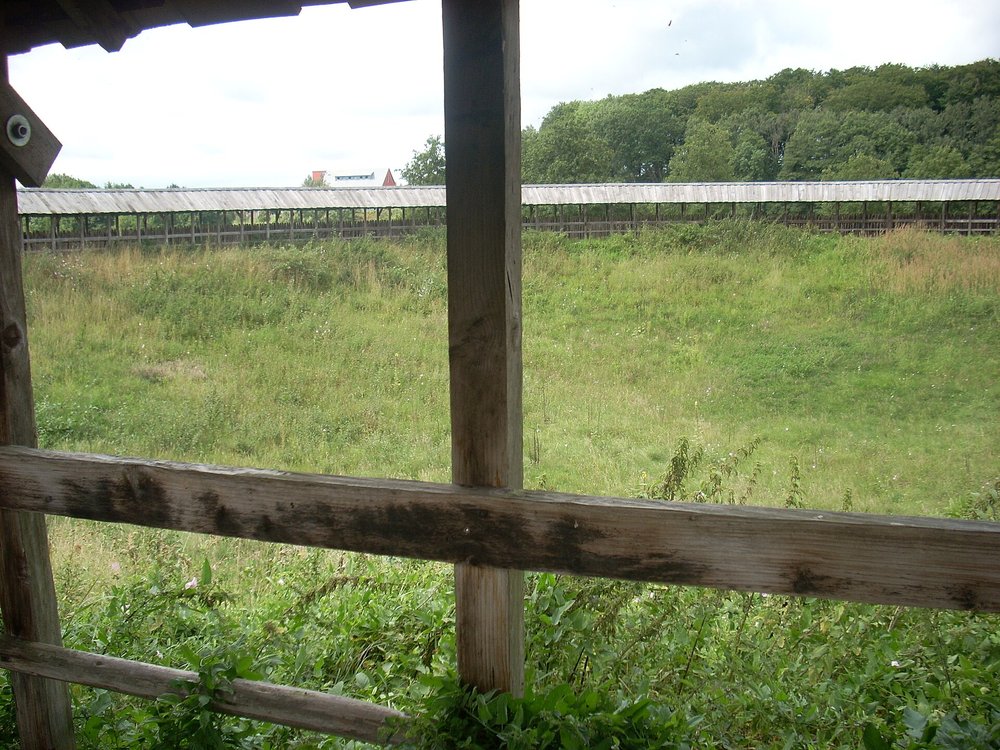
The Warnabi (German: Warnower) are a subject for patient readers. They appear in a single sentence in Adam of Bremen, a century later Helmold of Bosau copies that sentence, and after that things go quiet. Yet a landscape hangs on them: one of the best-studied Slavic settlements in northern Germany, a stronghold where a prince died in 1160, and a river whose name probably predates the Slavs themselves. This article separates what the sources say, what archaeology adds and what is merely interpretation.
Anyone who searches for "Warnabi" soon lands on the Warni, Latin Varini, whom Tacitus lists in the first century among the worshippers of Nerthus. The names sound related, and a link is occasionally suggested. It is not established. The Warni are a Germanic people of late antiquity and the migration period; they have their own place in our article on the Warni. The Warnabi, by contrast, are Slavs. They appear in the sources only in the eleventh century, about a thousand years after Tacitus, and belong to the Obotrite confederation. In between lie the migration period, the departure of many Germanic groups to the west and south, and the arrival of Slavic settlers in the land between Elbe and Oder. Whether the two names have anything to do with each other is an open question for name research. One people did not grow out of the other, in any case.
How the Warnabi called themselves, we do not know. We know only the forms in which outsiders wrote them down: Warnabi in Adam of Bremen, Warnavi or Warnawi in Helmold, plus spelling variants in the manuscripts. The ending -abi or -avi matches a pattern found several times among the Elbe Slavs; the Warnabi would then be "those on the Warnow". That is the usual and obvious reading, but a reading it remains.
The Warnow is about 155 kilometres long. It rises near Grebbin north of Parchim at the western edge of the Mecklenburg Lake District, flows north past Sternberg, Bützow and Schwaan and enters the Baltic at Warnemünde, a district of Rostock. Its catchment covers a good 3,300 square kilometres. For early history it matters that this river did not draw a single tribal border but belonged to at least three landscapes. In the south and west lies the land that Adam of Bremen assigns to the Warnabi. Further downstream, from the coast at Rostock to the area of Bützow and Güstrow, lived the Kessini, named after the stronghold of Kessin near the Warnow mouth. To the west lay the Obotrite heartland around Mecklenburg on the Bay of Wismar.
That corrects a widespread notion. Rostock, Bützow and the lower Warnow are often lumped together as "Warnabi land" because the river carries the name. The evidence points elsewhere: this area is regarded in the scholarship as Kessini land. If the Warnabi are to be given a territory at all, they are better sought in the middle and upper Warnow region, around Sternberg and the lakes further south. That is a plausible assumption drawn from find spots, not a statement of the sources. That tribal lands did not match river courses exactly goes without saying for an age without maps, yet scholars have argued over exactly this on the Warnow. Friedrich Wigger saw the river in 1860 as a border between the Obotrites and the Kessini, whom he counted among the Wilzi. Wolfgang Brüske in 1983 read the Warnow instead as a connecting element and the Kessini as a core tribe of the Lutici (both after the Wikipedia article on the Kessini; originals not consulted).
Adam, a canon in Bremen, wrote his history of the Hamburg church, the Gesta Hammaburgensis ecclesiae pontificum, in the 1070s. It also describes the land beyond the Elbe in which his church sought mission and influence. In the second book he lists the Slavic peoples in a row. The Warnabi stand in this list. The passage reads as follows, in the form we take over from a Danish study of the Obotrites:
Likewise, towards us, the Polabians, whose stronghold is Ratzeburg. Beyond them are the Linones and the Warnabi.Adam of Bremen, Gesta Hammaburgensis ecclesiae pontificum II, 21 (numbering after a Danish study; older numberings differ); Latin: "Item versus nos Polabingi, quorum civitas Razispurg. Ultra illos sunt Lingones et Warnabi." Own translation; the Latin wording comes from a quotation in secondary literature and was not checked against an edition, so the rendering is approximate.
That is all there is. No stronghold, no prince, no god, no battle, no number. Adam gives no map but an enumeration that moves from station to station. "Beyond" means a direction in a series, not a distance in kilometres. Anyone who draws a tribal territory with borders from this sentence reads more into it than Adam wrote. That the Warnabi stand beside the Linones, the neighbours on the lower Elbe around Lenzen, points at most to a position south or southeast of the Polabians; the sentence carries little more.
A Russian-language study of the Baltic Slavs notes that Adam's manuscripts offer spelling variants such as Warnalii, Warnahi or Varnahi, and that the Saxon Annalist of the mid-twelfth century also lists the Warnabi under the years 952 and 983. According to the same study this is a verbatim borrowing from Adam and not an independent source; we have not checked it against the Annalist himself. Notably, Adam's predecessors know Obotrites but no Warnabi. According to the same study, Widukind of Corvey in the tenth century and Thietmar of Merseburg at the start of the eleventh speak of Obotrites and, alongside them, a second group called "Varen". Whether these Varen have anything to do with the later Warnabi is considered in the literature, but it is an interpretation.
Helmold of Bosau, a priest at Bosau on Lake Plön, wrote the Chronica Slavorum, the Chronicle of the Slavs, in the second half of the twelfth century. He knew the country from his own experience and, according to the Russian-language study, corrects Adam in several places. With the Warnabi he does not. In the second chapter of the first book, in an old French translation we could consult, it reads: "Beyond these are the Lingones and the Warnawi." As far as we can judge, that is Adam's sentence in Helmold's words. In Helmold's later enumerations and in the events of the twelfth century the Warnabi, according to the Russian-language study, no longer appear as actors. We have not worked through a complete Helmold edition; so this is not a secure finding.
Where Helmold needs the Warnow, he needs it as a location. When Duke Henry the Lion marched against the Obotrites in 1160, Niklot had, according to Helmold, kept only a single stronghold for himself. The passage stands in chapter 87 of the first book, as quoted in the Danish study: "Unum solum castrum sibi retinuit Wurle, situm iuxta flumen Warnou, prope terram Kicine." In rough translation: He kept one stronghold for himself, Werle, situated by the river Warnow, near the land of the Kessini. Here too the river stands for the location. No people named after it is mentioned. The Warnow as a landscape then appears in charters of the late twelfth century as Warnowe, so in 1171 and 1186 (after German Wikipedia; charter texts not consulted).
German Wikipedia assigns the district of Warnabi to the area of the Warnow and names Groß Raden near Sternberg and the hillfort at Friedrichsruhe in the district of Ludwigslust-Parchim as centres; for the Friedrichsruhe hillfort as a tribal centre it says explicitly that it is not attested in writing and is only assumed. That is honestly put and reflects the state of research well. There is no tribal stronghold that a source calls "main fortress of the Warnabi". Anyone who reads in books or on signboards that Groß Raden was the Warnabi's capital reads an attribution based on the position within the presumed territory and not on a text.
Two terms help here. A Gau (district) is a tract of land, an administrative and settlement unit so designated by a chronicler or a charter; a tribe is a group of people that sees itself as one. The two do not coincide. For the Warnabi only the first level is reasonably secure: there was a landscape of that name. That it was inhabited by a unified tribe with its own princes, its own cult and its own self-awareness is claimed by no source. German Wikipedia states that the Warnabi played no leading role within the Obotrites and, unlike the Wagri or the Polabians, developed no sub-principality of their own. That is a classification by modern scholarship; the sources are silent on it.
Almost everything tangible about the Warnabi landscape comes from archaeology, above all from Groß Raden, a few kilometres north of Sternberg. Ewald Schuldt excavated about 7,000 square metres there from 1973 to 1980, nearly half the settled area (after German Wikipedia). The soil was waterlogged, wood survived, and the area had remained pasture for centuries. So house plans, paths and fortifications could be read better than at almost any other site in the region.
The settlement lay on a peninsula in a lake; the lake later silted up, so the peninsula no longer looks as it did a thousand years ago. A ditch about four and a half metres wide and a palisade with a walkway protected it, and the only access ran through a tunnel gate over a bridge. Schuldt distinguished two building phases. An older fortified settlement arose, according to him, in the second half of the ninth century with about forty closely set wattle-walled houses of roughly four by five metres. Around 900 it burned down but was quickly rebuilt, now in log construction. At the end of the tenth century the site was abandoned, possibly after another destruction; German Wikipedia mentions Otto III's campaign of 995 only as a conceivable explanation. The causes of the destructions are regarded as unresolved.
The best-known feature of Groß Raden is a building of broad oak planks, about seven by eleven metres, at the southeast edge of the peninsula. Offering traces, the position apart from the houses and posts with carved face-like heads lead scholars to read it as a cult building, a so-called Umgangstempel, that is, a building one could walk around. Wikipedia words this with "dürfte" (is likely to), and that is the right caution: whether the building was roofed or open at the top is unclear. A travel guide that speaks of "the temple of the Warnabi" joins three interpretations into one statement. The find names no god. The sanctuary later built on an island within a circular rampart about ten metres high and 25 metres across inside is likewise a find with interpretation. A reconstruction of the tunnel gate was built in 2009. Today the Archaeological Open-Air Museum Groß Raden shows parts of the site.
What "Warnow" means is uncertain. English Wikipedia mentions a proposal of a pre-Indo-European root meaning "spring, stream", possibly from Hattic; the Slavic form would have arisen from it by an added initial v-. The same page mentions an older ancient trace: Ptolemy (around AD 150) describes a river that probably corresponds to the Warnow. That identification rests on weak ground. Other explanations start from a West Slavic word for the raven (varna), said to have been argued by the linguist Reinhold Trautmann in 1949 (so the Russian-language study; original not consulted). A third line leads to a personal name or to a root var- and thinks of the "Varen" of Widukind and Thietmar as the oldest self-designation of the Obotrites as a whole, from which Warnabi could have arisen by analogy with Weletabi. None of these explanations is proven, and some exclude each other. English Wikipedia also considers an influence of the Germanic Warni, which remains part of the unresolved name question mentioned at the start.
For the reading of the sources, the direction matters. Either the river carries the tribe's name or the tribe carries the river's. The latter is more likely, since -abi names are landscape and resident names. That the river already had a name before the Slavs, which they adopted and altered, is plausible and fits many river names in northern Germany. How far that holds for the Warnow is for linguistics to decide, not the historian.
The starting hint that the Warnabi had a special connection to the fighting of 1147 to 1160 cannot be sustained after our research. The events are well known, but they name the Obotrites as a whole and their prince Niklot, not the Warnabi. In 1147, during the so-called Wendish Crusade, a part of the Second Crusade directed against the pagan Slavs, Niklot struck first at Lübeck and Wagria and the siege of the stronghold of Dobin on Lake Schwerin was abandoned without result. In 1150 the Kessini and Circipani refused the tribute Niklot demanded; Helmold reports this in chapter 71 of the first book (after the English rendering on jassa.org). Niklot fell in 1160 at Werle. Henry the Lion then placed his retainers in the captured strongholds and did not grant the land as a fief, which ended the Obotrite land as an independent principality until Niklot's son Pribislav recovered it in 1167 as a Saxon vassal (after Wikipedia on Niklot; details of the source situation not checked here).
The link of the Warnabi with these years is therefore a spatial one: Werle lies, as Wikipedia gives it, in the Werle district of the municipality of Kassow northwest of Güstrow, near the Warnow, and Helmold explicitly places it on the border of the Kessini land. Whether the place belongs to the territory of the Warnabi, the Kessini or the Obotrites in the wider sense is not decided by the sources but by the shape one gives the tribes. Wikipedia records name forms for the stronghold such as Wurle and Orle and mentions a statement that the stronghold was built by Slavs around 600; the dating is marked there with "soll" (is said to), we have not checked it and do not carry it further.
All this yields a sober picture. In the written sources the Warnabi are traceable through two attestations that are really one, namely Adam and Helmold, who follows Adam. To this is added a landscape name Warnowe in the twelfth century. Everything else is inference: where did they live, who led them, whom did they worship? A Russian-language study concludes that the Warnabi were probably not independent but either a local designation of the Obotrites or a name form that arose in Adam's compilation. That is the most cautious reading possible, and it is not absurd. One can disagree, but then one needs more than a sentence of Adam's.
The word "tribe" itself is modern. The early medieval groupings on the southern Baltic coast were changeable. Groups split, joined and were named by foreign scribes after the nearest stronghold, the nearest river or the nearest tribute obligation. The Kessini are even considered by scholars a "new tribe", formed only around the turn of the millennium, probably as a split from the Circipani, and that too is conjecture. Anyone who wants to learn from the Warnabi something about the Obotrites, about their make-up from sub-tribes such as the Wagri and Polabians, should take away precisely this blurriness.
Whoever follows the Warnow from the lake landscape around Sternberg, where Groß Raden lies, through the valleys near Bützow and Schwaan to the Hanseatic city of Rostock and the river's mouth in the Baltic passes in turn through everything discussed in this article. Slavic hillforts and settlement sites are scattered through it, some with a signboard, many without. That a single river links these places may have tempted the scribes to make a people out of a region, a water and a name; that is a possibility, not a finding. Whether there was a people whose name they wrote down this article cannot decide.
For the castle world of the region our article on castle studies is helpful; for the wider context with the Wilzi and Lutici, the neighbours to the east and south, see the Wilzi and the Lutici.
Who were the Warnabi? A Slavic group that Adam of Bremen names in the eleventh century as Warnabi in a list. They are counted in the Obotrite confederation and assumed to have lived on the upper and middle Warnow in Mecklenburg.
Are the Warnabi the same as the Warni? No. The Warni are a Germanic people of antiquity, covered in a separate article. A kinship of names is considered in research, but not proven.
Where did the Warnabi live? Probably in the area around Sternberg and Groß Raden on the Warnow; Rostock and the lower Warnow belonged to the Kessini land. No exact border is transmitted.
Why is so little known about them? At the core there is only one mention in Adam of Bremen and a dependent one in Helmold, plus a landscape name and the excavations at Groß Raden. Slavic sources of their own that could show their view are missing.
Can Groß Raden be visited? Yes, the Archaeological Open-Air Museum Groß Raden near Sternberg shows the reconstructed site with parts of the fortification, houses and the cult building. Please check opening times with the museum beforehand.

The Abodrites · The Kessini · The Warni · The Circipani · The Polabians.
All History & Finds articles →
Two early medieval peoples called themselves Croats — one on the Adriatic coast, one deep inland between the Vistula …
Read more →A name that outlasted three decades of war: Widukind was the most famous leader of Saxon resistance against …
Read more →Yes, the Vikings really did reach Aachen: in late autumn 881 a Danish army under the kings Godfrid and Sigfrid raided …
Read more →The axe is the most honest tool of the Viking Age. It split firewood, built ships, cut paths through the forest - and …
Read more →