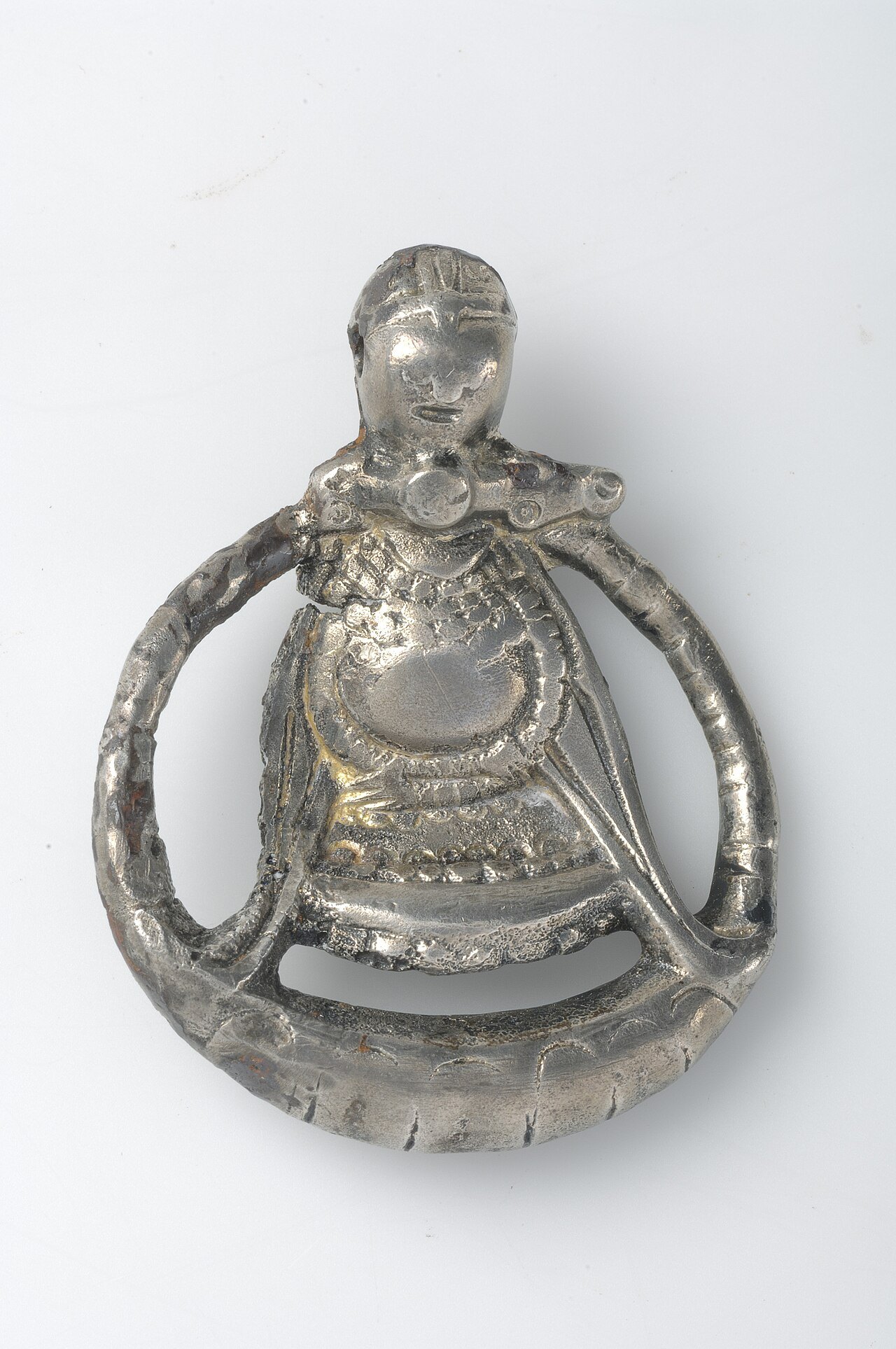
Just under four centimetres of gilded silver, a woman inside a ring, her hands folded beneath a rounded belly: the Aska pendant is among the most reproduced images of the Viking Age. Books, museum shops and replicas simply call her “Freyja”. She was found in 1920 in a woman's cremation grave in Östergötland, together with eight other pendants, an iron rod and vessels from distant countries. Some three hundred metres away stood a hall almost fifty metres long. This article first describes what can be seen and what lay in the grave, then tests how far the name Freyja will carry.
Aska is a village in Hagebyhöga parish, a few kilometres from Vadstena in the Swedish province of Östergötland. The Rök stone stands in the same province. In the early 1920s a small burial mound at Aska was removed during farm work. So the Swedish archaeologist Elisabeth Arwill-Nordbladh writes in a 2012 paper based on the excavation report. Most other accounts, including the Antiquity article on the hall, give 1920. Live Science says Arne found the pendant in 1920 while excavating several mounds and does not mention the earlier damage.
The archaeologist T. J. Arne examined the spot only some months after the damage was done. It was a rescue excavation, and according to Arwill-Nordbladh information was lost. Arne published the find in German in 1932, in the journal Acta Archaeologica, under the title “Ein bemerkenswerter Fund in Östergötland”. I could not consult that report; everything said here about the grave comes from later studies that draw on it.
How the objects lay in relation to each other, or whether the pendant hung at the neck, can no longer be said.
The grave was a cremation. According to Arwill-Nordbladh it held many burnt bones, which a modern analysis identified as those of a woman aged roughly 20 to 40. With them were bones of horse, dog and sheep or goat, presumably animals placed on the pyre. Live Science also reports rivets and nails from a decayed wooden casket.
Arwill-Nordbladh lists the furnishings in two groups. The usual dress of a high-ranking woman accounts for three brooches, one trefoil and two oval, and beads. Oval brooches held the strap dress at the shoulders (see Viking Age jewellery). These pieces date the grave to the middle of the tenth century.
The second group is less ordinary: a bronze vessel of oriental origin, a bronze kettle from the British Isles, riding equipment, a charred loaf of bread, an iron rod about half a metre long, and nine small pendants of gilded silver. Live Science adds four silver rings, a bone game board and an Islamic silver coin, and calls the rod “wolf-headed”. The two lists do not fully match, and without Arne's text I cannot say which is closer to the report.
The best known of the nine pendants measures 3.8 centimetres according to the figure caption in Arwill-Nordbladh; Live Science rounds this to about four. It is gilded silver; Swedish television (SVT), citing the museum, speaks of traces of gilding, so the surface is worn.
It shows a woman seen from the front. She stands or sits inside a circular frame, with her head rising above it. She wears a long skirt and over it a shawl or cloak. Her hands are folded beneath a clearly rounded belly. At her neck and on her chest sits large jewellery: Live Science describes a cloak buttoned at the neck and a bead-like ornament in rows, Arwill-Nordbladh a large brooch and further jewellery.
Even the posture is described differently. Live Science sees the woman standing with her legs apart. Other accounts call her “seated”. Arwill-Nordbladh does not commit herself.
The top of the pendant is worn. Live Science makes out lines suggesting a crown or headdress. Arwill-Nordbladh names three options: a hairstyle, a band, or headgear, perhaps even a helmet with a clover-shaped nose guard. She cites Ing-Marie Back Danielsson for a possible veil. The face is rubbed down, the mouth looks wry, and the eyes can hardly be seen.
The ring around the figure is ambiguous too. It can be read as a plain frame, as a snake biting its own tail, or in such a way that the snake's head doubles as the large brooch on the woman's chest.
Grave and pendant are not the same age. The grave belongs to the middle or second half of the tenth century; the excavation team around Martin Rundkvist places it at about 975, roughly the time of the last burials in the Aska cemeteries. The pendant, by contrast, was dated to around 800 by the Swedish archaeologist Birgit Arrhenius in 1962. So Arwill-Nordbladh reports; SVT gives the ninth century, Live Science a wide span from about 800 to 975.
If the early date holds, the piece was some 150 years old when the woman was cremated. The worn surface fits: such abrasion, Arwill-Nordbladh remarks, does not appear overnight.
Arrhenius noticed something else. In her judgement, the brooch and jewellery worn by the figure correspond to types that were common one or two centuries before the pendant itself was made. The woman therefore wears old-fashioned jewellery, not the fashion of the maker's own day. This observation is the starting point of the Freyja reading.
Nine small gilded silver pendants belong to the grave. Arwill-Nordbladh sorts them by their imagery into four time layers: some match the time of the burial, others the years around 800, others again the middle and late Vendel period of the seventh and eighth centuries, and one group takes up forms of the early to middle Roman Iron Age, about AD 150 to 200. Roughly 700 years separate the oldest models from the funeral.
The author suggests understanding the pendants as heirlooms, things that are neither sold nor given away because they carry a family's memory. According to Live Science, Rundkvist likewise sees them as heirlooms.
A piece cast around 800 and burnt around 975 had at least two lives. What its maker meant and what its last wearer saw in it need not have been the same.
In Sweden the pendant is called Frejasmycket, “the Freja jewel”; Anders Carlsson and Kenneth Jonsson use the term in the journal Myntstudier in 2012, and so does SVT. The Swedish History Museum in Stockholm considers the reading possible, according to Live Science.
The argument has two steps. First, Freyja owns a famous neck ornament in Old Norse poetry, the Brísingamen. Second, the Aska figure wears strikingly large and, following Arrhenius, old-fashioned jewellery at neck and chest. Arrhenius concluded that the brooch might represent the Brísingamen of the Edda. According to Live Science the museum further points to the button clasp and the rows of beads, and to Freyja's association with pregnancy and childbirth.
How the poetry introduces the ornament can be seen in Þrymskviða. The giant Þrymr demands Freyja as his wife, and this is her reaction:
Reið varð þá Freyja ok fnasaði,
allr ása salr undir bifðisk,
stökk þat it mikla men Brísinga.
Angry then was Freyja, and she snorted,
the whole hall of the Æsir trembled beneath her,
and the great neck-ring of the Brísings burst.Þrymskviða, st. 13, Old Norse in normalised spelling; our own translation
Of the ornament itself we learn only that it is large and can burst.
Four objections keep the Freyja reading from being more than a possibility.
The first concerns the Brísingamen itself. No Old Norse source describes what it looked like. The word men means a neck ornament, often a neck-ring of precious metal; whether a string of beads, a ring or a brooch is intended remains open. The familiar tale of the four dwarfs who forge it stands only in Sörla þáttr in Flateyjarbók, a manuscript written between about 1387 and 1394.
The second concerns distance. The Eddic poems and Snorri's works were written down in thirteenth-century Iceland. The pendant was made some 400 years earlier, on the far side of Scandinavia. That Östergötland around 800 told the same stories about the same goddess is conceivable but not attested.
The third concerns the jewellery. Every wealthy woman of the period wore brooches and beads; the dead woman of Aska herself had three brooches and beads with her. Large neck jewellery alone does not tell a goddess from a noblewoman. Arrhenius's point about the old-fashioned types is the stronger argument, because it implies a deliberate look backwards. But a look backwards may be directed at an ancestress as easily as at a goddess.
The fourth concerns the belly. The surviving myths know Freyja's husband Óðr and her daughter Hnoss, but no passage known to me describes Freyja as pregnant. The link with birth and fertility is not a pictorial motif taken from the texts.
The Lejre figurine poses the same problem: Viking Age images of gods carry no labels. A name only ever arises from comparison with texts centuries younger.
The hands beneath the swelling belly are the pendant's most striking feature. Arwill-Nordbladh reads the gesture as a sign of pregnancy, with overtones of fertility and sexuality. In December 2025 Live Science presented the piece as the only known depiction of a pregnant woman from the Viking Age.
It remains a reading. On a worn figure less than four centimetres high, a bulky cloak or a stout body cannot be ruled out.
Whether the dead woman herself was pregnant or died in childbirth, nobody knows. Live Science says so explicitly, and burnt bones from a disturbed grave cannot answer the question.
The iron rod is about half a metre long. Arwill-Nordbladh names three interpretations found in the literature: a roasting spit, a measuring rod, or the staff of office of a seeress, a völva. For the third reading she cites, among others, the archaeologist Neil Price and his book of 2002, and Ingrid Gustin.
The word völva is explained as “staff-bearer”, and Eiríks saga rauða describes a seeress with a staff. Such iron rods lay in several rich women's graves, for example at Fyrkat in Denmark, at Birka and at Klinta on Öland. Price has connected them with seiðr, a form of ritual magic.
Live Science quotes Price's view that, judging by the contents of her grave, the Aska woman may have been a practitioner of magic or ritual. The same report cites a study by a researcher named Gustafsson: later graves at Aska no longer contain comparable ritual objects, so the woman may have been the last pagan ritual specialist of her kind at the site. I was unable to check that study.
For the Freyja question the rod has a twist of its own. In Snorri's Ynglinga saga it is Freyja who teaches seiðr to the Æsir. Anyone who reads the dead woman as a seeress and the figure as Freyja gets a coherent picture: a ritual specialist carrying the image of the goddess of her craft. That proves nothing; one uncertain reading props up another.
For a long time the large, flat-topped mound at Aska, Askahögen, was taken for a mighty burial mound. Carlsson and Jonsson point out that the finds from the women's graves, the Frejasmycket among them, are often confused with this mound. In fact, by their account, the cemetery lies about 300 metres to the south-west.
What stood on the mound was first shown by ground-penetrating radar. After trial trenching in 1985 and 1986 the platform was surveyed geophysically; Andreas Viberg directed the radar work. SVT gives the year as 2013, and the results were published by Martin Rundkvist and Viberg in the journal Archaeological Prospection. The radar revealed the postholes of a hall measuring 48 by 14 metres; the abstract of the Antiquity article rounds this to 50 metres.
So the hall was not discovered in 2020 or 2021; those were the years of excavation. Rundkvist, Axel Löfving, Rudolf Gustavsson, Jens Heimdahl and Viberg published the results in Antiquity in December 2023.
The platform measures 65 by 40 metres at its base and stands 3 to 4 metres high. A horse was sacrificed and butchered during construction. From its radiocarbon date and the oldest grain from the hall the authors calculate a building date between 650 and 680. The latest dated grain falls between 880 and 990. The hall thus stood for about three centuries and was dismantled by around 990 at the latest. A cobblestone pavement then sealed its footprint. After 1000, according to Rundkvist, the mound probably served as the assembly site of the hundred, the local judicial district.
In the hall the excavators found 30 gold-foil figures, Swedish guldgubbar: tiny, paper-thin pieces of gold stamped with human shapes. SVT still gives 23 for the 2020 season. All show the same motif, an embracing, fully clothed couple. They lay within an area less than six metres across in the north-western part of the building. According to the authors this was, at the time of writing, the largest assemblage of such figures within the borders of the medieval Swedish kingdom. Comparable finds are known from Uppåkra in Scania, among other places.
There were also three whale-bone gaming pieces and fragments of a shield mount of the Vendel, Valsgärde or Sutton Hoo kind.
The strangest find lay in the stone pavement over the dismantled house: 20 fragments of human skulls from at least two adults and one child. One fragment dates, according to the article text, to the first century AD. The authors conclude that the skulls were deliberately taken from Roman Iron Age inhumation graves, from people dead for some 800 years when the hall came to an end.
A consideration of this article, not a published scholarly view: the dead woman wore pendants whose imagery reaches back to the Roman Iron Age, and skull fragments from that same period went into the pavement when the hall came down. Whether the two are connected has not been studied.
Rundkvist and his co-authors interpret Aska as the principal seat of a petty royal lineage. They set the site beside Old Uppsala, Borre in Norway, Old Lejre and Tissø in Denmark. This lineage, they argue, did not give up power until the Kingdom of Sweden was established around 995.
That is an interpretation built on construction effort, finds and comparison. No text names a king of Aska. The dates nevertheless fit together strikingly: the hall is dismantled by about 990, the last burials in the cemeteries fall around 975, and among those late graves is that of the woman with the nine pendants. She was buried in the final decades of the old order at Aska.
Small human images in silver and bronze are known from the Viking Age in growing numbers, and almost all bear a divine name that scholarship gave them.
The enthroned silver figure from Lejre, found in 2009, was first presented as Odin; that reading is disputed. The gilded silver figure from Hårby on Funen, discovered at the end of 2012, shows a woman with sword and shield and is therefore called a valkyrie. In the same paper Arwill-Nordbladh discusses two bronze figures from Scania, one from Uppåkra and one from Lindby, which are one-eyed and regarded as Odin. For women offering a drinking horn on pendants and picture stones, see our article on the valkyries.
Aska belongs to this group and stands apart from it. The figure carries neither weapon nor horn; her marks are the jewellery and the belly. She is also one of the few pieces with a secure grave context: Lejre and Hårby are settlement and detector finds, whereas the Aska pendant lay with a particular dead woman.
Arwill-Nordbladh herself asks about bodies that depart from the norm in myth and image, and places the pendant beside the one-eyed male figures. The barely visible eyes of the Aska woman may be intentional, a hint at a different kind of sight, or simply wear.
Whom does the figure represent? Freyja, another goddess, an ancestress of the house, a seeress, or a character from a story that was never written down? Each is compatible with the evidence.
Where the pendant was made is open as well. The date around 800 rests on stylistic comparison; no workshop is known, and I have seen no material analysis. Nor do the studies used here describe every motif on the other eight pendants. Whether the dead woman played a part in the hall, at feasts or rituals for instance, cannot be deduced from the finds either.
The pendant belongs to the Swedish History Museum (Historiska museet) in Stockholm. The World-Tree Project database lists it under inventory number 16429 and notes silver replicas in the Viking museum at Ribe; the museum's own object page could not be retrieved. Reproductions are widely sold as a “Freyja amulet”. The motif is an attested image of the Viking Age; the name that goes with it is a twentieth-century scholarly proposal.
Does the Aska pendant really show Freyja? That cannot be established with certainty. The reading rests on the figure's large, old-fashioned neck jewellery, which Birgit Arrhenius linked with the Brísingamen in 1962. There is no inscription, and the texts about Freyja are some 400 years younger than the piece.
How large and how old is the pendant? It measures 3.8 centimetres and is made of gilded silver. On the usual dating it was made around 800; it went into the grave in the middle or second half of the tenth century.
Was the woman in the grave a seeress? Possibly, but it is not proven. The iron rod supports the idea, and researchers such as Neil Price connect such rods with seeresses. It has also been explained as a roasting spit or a measuring rod.
Why is the piece sometimes called the “Ash Pendant” in English? Live Science apparently translated the place-name Aska literally in 2025; aska is the Swedish word for ash. In Sweden the pendant is called Frejasmycket, and the scholarly literature also uses “Aska Lady”.
What has the Aska hall to do with the pendant? Both belong to the same centre of power. The hall stood on a platform mound from about 650 until 990 at the latest, some 300 metres from the cemetery. The woman was buried in the last decades of that complex.
Freyja: goddess of the Vanir · Brísingamen: the necklace in the sources · The völva: seeress with the staff · Seiðr: magic and scholarly dispute · The Lejre figurine · The Hårby figurine · Old Uppsala: the royal mounds · Tissø: hall and cult site · Uppåkra: cult house and gold-foil figures · Women of the Viking Age
Freyja · Brisingamen – Freyja's Necklace in Edda, Skaldic Verse and Viking Graves · The Voelva · The silver figurine from Lejre · The Hårby figurine.
All History & Finds articles →
The Atrebates were a Belgic Celtic people in what is now Artois, and their name lives on in the city of Arras. They owe …
Read more →Aud the Deep-Minded (Old Norse Auðr djúpúðga, called Unnr in Laxdæla saga) was one of the four greatest settlers of …
Read more →Nearly 1,500 years before the first Germanic peoples entered Roman history books, a culture of the Early Bronze Age …
Read more →Drive through the French département of Gers today and you pass a town called Auch. The name sounds like nothing at …
Read more →