The stave church at Borgund in Lærdal is treated as the textbook example of its type. Dendrochronology says its timber was felled in the winter of 1180/81, and that is a hard number. Almost everything else, from the building date to the dragon heads to the "1868 restoration", is less certain than guidebooks make it sound. This article separates evidence, tradition and interpretation.
Borgund stands in Lærdal in western Norway, on the route between the fjord country and the interior. Visitors meet dragon heads, serpent ornament and runes, and think of Vikings. The chronology does not quite fit. By common convention the Viking Age ends around 1066; the Borgund timber was felled roughly a century later. For why such boundaries are drawn where they are, see the end of the Viking Age. Borgund belongs to a Christian kingdom that built its churches in wood and carried on motifs that also appear on Viking Age objects. That is a finding about forms, not about belief, and the distinction runs through this whole article.
A word on sources first. For this article I read the Borgund entry in the Store norske leksikon (by Leif Anker), the Norwegian, English and German Wikipedia articles, a 2019 report by Norwegian SciTech News and the page on stavechurch.com. I did not open the major handbooks – Hauglid, Bugge, Anker, Hohler – myself. Where I pass on what they say, it comes through the articles named.
A stave church (Norwegian stavkirke) is a timber building whose frame rests on vertical posts, the staves or masts. The walls are made of vertical boards; according to the English Wikipedia each board is tongued and grooved so that it interlocks with its neighbour. Borgund has a raised central space. The English and German Wikipedia say twelve free-standing masts carry the roof of the raised nave, while the Store norske leksikon counts fourteen masts in the central frame. These do not contradict each other, since the counting differs; the German Wikipedia speaks of a "14-mast stave church" in which twelve masts support the nave roof, and adds that the third mast on each long side is "floating", ending on the lowest tie beam.
A lower aisle runs around the nave; to the east a chancel and apse follow. Outside, an ambulatory (Norwegian svalgang) surrounds the building and the chancel. The roofscape is stepped: the Store norske leksikon counts seven roof levels one above the other, the German Wikipedia describes a "six-tier structure". Again this is a matter of counting, not a dispute about the building. A roof turret with a two-stage spire completes it.
The roof is covered with wooden shingles. The German Wikipedia says they were originally fixed with wooden pegs and that metal appears only in the doors. This recalls the timber craft known from shipbuilding (Viking shipbuilding), but it is a comparison of technique, not evidence that knowledge was passed on. That shipbuilders raised the stave churches is something I did not find in the sources I read.
Dendrochronology dates timber by its annual rings. It can give the year a tree was felled when the outer rings or the bark edge survive. For Borgund the Store norske leksikon and the Norwegian and German Wikipedia agree on the winter of 1180/81. The Store norske leksikon specifies that this concerns the timber of one central-frame stave. Number of samples, method and further timbers are not given. Who carried out the measurement is also not stated in the articles I read; the Norwegian Wikipedia explicitly does not say.
That secures a terminus post quem: the church cannot be earlier than that winter. The Store norske leksikon concludes that it was built "shortly after", "probably well before 1200". That is an inference, not a measurement. Freshly felled timber was often used quickly in the Middle Ages, but how long it lay in this particular case is not recorded. The "around 1180–1200" of the working title is defensible if understood as a span above a hard lower limit. The date 1180/81 is a felling date, not the year of completion and not of consecration.
A 2019 report by Norwegian SciTech News gives context. Its fact box reads "Borgund Stave Church 1180–1181. Previous estimate 1150–1250." The report names researchers but does not tie them explicitly to Borgund; it is about new dates for Norwegian stave churches in general. The older estimate of 1150 to 1250 shows how widely stylistic dating scattered before dendrochronology. The usual dating before the measurements the Store norske leksikon gives as 1150–1200.
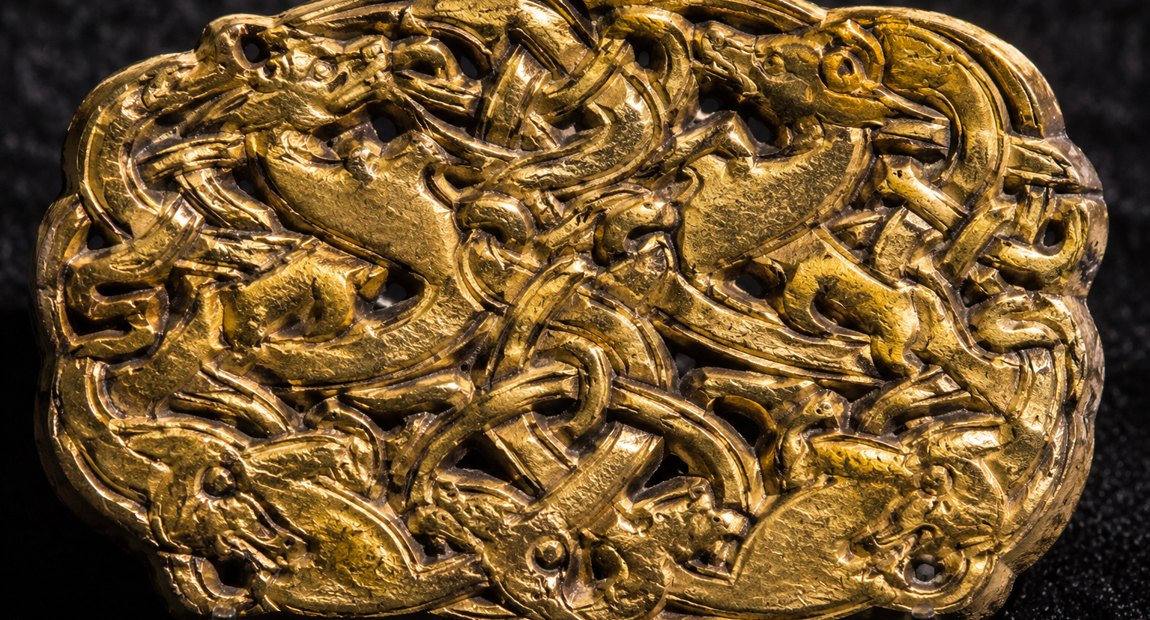
The carvings at the portals draw the most attention. The west portal has archivolts, that is, stepped arch rings, plus half-columns and animal ornament of interlaced dragon-like beasts and leaf tendrils (Norwegian and German Wikipedia). The English Wikipedia mentions dragons biting each other at neck and tail, and animal heads at the foot of the half-columns from whose mouths tendrils grow. According to the same source the portal was originally painted in green, red, black and white. The south nave portal is more modest; lions stand on the capitals and simple masks sit at the base of the columns. The chancel portal is undecorated according to the Norwegian Wikipedia, while the German Wikipedia calls it heavily damaged. The two statements conflict, and I could not settle them.
The German Wikipedia also mentions a high "ghost threshold" at the west portal with a narrow entrance. The term comes from folklore interpretation: a high threshold forces a person to stoop and keeps evil out. The threshold is documented; that it served this purpose cannot be clearly established from the sources I read.
For stylistic placement, the Store norske leksikon points to the church of Høre in Valdres, whose portals are similar and whose dating to the 1180s supports that of Borgund. The article also sees links to the Urnes style. This site has its own piece on the Urnes style and the portal it is named after: the Urnes portal. A motif comparison does not prove a workshop connection, but it does show a shared vocabulary of forms.
The dragon heads on the gables are what visitors recognise in photographs. The German Wikipedia places them at the gable corners of the nave roof, facing east and west; like gargoyles, they were meant to keep evil forces away. That function is stated there without a source. The Norwegian Wikipedia counts four dragon heads on the ridge combs of nave and tower, and the English one four on the gables.
The question of authenticity matters more. "Anno 1738" is carved into the ridge comb of the nave, which was partly replaced that year. The Store norske leksikon says the dragon heads were renewed then, probably as copies of older pieces. The German Wikipedia adds that one original medieval dragon head was kept. The Norwegian Wikipedia does not explicitly link 1738 to the heads; the English one speaks of "possible 18th-century replacements" and names Lom and Urnes as places where originals survive. Taken together: the heads seen today very probably date from the 18th century, and whether they faithfully copy older forms is not documented. Anyone who speaks of "thousand-year-old Viking dragons" is wrong three times over: not a thousand years, probably not original, and not from the Viking Age. More on the dragon as image in the north is in the dragon in the north.
The church has rune inscriptions and incised figures, according to the English Wikipedia on the inner chancel walls and at the west portal. The German Wikipedia speaks of runes on the building timber and in the chancel and says they are now protected by plastic covers. The Norwegian Wikipedia mentions figures and runes on the inner chancel walls and considers them probably medieval, without giving wording.
The content concerns inscription N 351. In the Rundata rune database the transliteration begins "þorir ræist runar þessar þan olausmessoæpþan", normalised "Þórir reist rúnar þessar þann Ólausmessaptan": Þórir carved these runes on the eve of Olaus-mass, with the database adding "when he travelled past here". The entry has a gap at that point, and I saw only this partial rendering, not the full text. The Norns line ("they shaped for me") I know only from the English Wikipedia, which reads the text as Þórir blaming fate; the English and German Wikipedia render the passage differently. Rundata dates it only to the "Middle Ages"; I give no narrower date. English Wikipedia places the find at the north portal, other Wikipedia versions speak of the chancel and west portal; I could not resolve that. Another inscription is said to read "Ave Maria" (English Wikipedia).
This find is instructive without being over-read: in one building stand a Christian greeting to Mary, a mention of St Olav's mass (see Olaf the Saint) and the Norns, women of fate from older tradition (see Norns). How seriously Þórir meant the Norns cannot be told from the inscription alone; English Wikipedia reads it as a remnant of older belief, but it is no evidence of cult. How runes stayed in use in the Middle Ages is covered in Runes and Runes and Science.
"… næsten af ny reparered"Wording on the 1665 repair of the Borgund bell tower, quoted from the Store norske leksikon (entry "Borgund stavkirke"); roughly "almost repaired anew". I have not read the original text myself; the spelling follows the quoted wording, the translation is my own.
South of the church stands the bell tower (Norwegian støpul). It is a free-standing stave structure and, according to the Store norske leksikon and the English and Norwegian Wikipedia, the only surviving one in Norway. On its date the sources differ: the English and Norwegian Wikipedia say the mid-13th century, the German one considers it probably contemporary with the church. The Store norske leksikon gives no construction date but mentions a repair in 1665, seen in the quotation above. Nine staves carry roof and bell frame according to that article. I found no dendrochronological dates for the tower, so the question stays open.
On the cladding: the Store norske leksikon dates the weather boarding to the early 20th century; the Norwegian Wikipedia says a new door around 1700 is recorded in an account and that the cladding was probably removed after the 1890s; the English one mentions new cladding in the 1990s. These are different statements about different moments, presumably several interventions. No closed building history of the tower can be read from the sources.
The working title spoke of a "restoration in 1868 by Dietrichson". That cannot be maintained. 1868 is the year the new parish church was finished and the stave church lost its function; the Store norske leksikon says the old church had been regarded as too small since 1860. Afterwards the Fortidsminneforeningen was allowed to buy the stave church with a grant from the Storting. The Store norske leksikon gives no purchase date; the English and German Wikipedia say 1877.
The restoration itself falls, according to the Norwegian Wikipedia, in the early 1870s under the architect Christian Christie and was finished in 1872. Removed were galleries, pews, windows, the chancel ceiling and post-Reformation paint, among other things; the Store norske leksikon adds a wooden barrel vault in the nave (removed around 1870), the 17th-century galleries, a sacristy annex on the south side and oriels, and says the stone altar was rebuilt around 1870. The aim, according to the Norwegian Wikipedia, was the state before the Reformation.
Lorentz Dietrichson appears in another context. The Norwegian Wikipedia says he dated the church to 1150 or earlier on the basis of a rune inscription, while arguing that because of the ornament at the west portal it could not be older than 1150. That is a 19th-century dating debate, not a restoration. A participation by an architect named Blix, which I had been given to check, I found in no source I read. Whether Dietrichson was otherwise involved with the church in 1868 I do not know; the Store norske leksikon does not mention him.
What in the interior is "original" thus remains a matter of delimitation. Some of the furnishings are known from later times: the pulpit of 1550 to 1570, the altarpiece of 1654 with a frame of 1620, a soapstone font and a medieval stone altar (English and German Wikipedia). In 1973, according to the German Wikipedia, a wooden floor was laid to protect the original floor, and the ambulatory has been closed to visitors since. The Store norske leksikon reports that parts of an older ambulatory were found under the floor in 1969; the German Wikipedia mentions excavations in 1969 and 1985 that found traces of an older building. A predecessor is thus hinted at, no more than that. The stavechurch.com page speaks of an old wooden church whose timbers were rotting – a reason for the new building that I found confirmed nowhere else.
The church is run as a museum by the society according to the English Wikipedia; no services are held (German Wikipedia). The Store norske leksikon gives visitor numbers for 2019 as over 50,000 a year. Opening times change from season to season: the German Wikipedia says early May to end of September, stavechurch.com gave 16 April to 30 September for 2018. I deliberately did not take over prices or current hours; they belong on the operator's page. An exhibition centre with a café opened on 2 May 2005 according to the German Wikipedia. Location: on the E16 between Fagernes and Sogndal, about 30 kilometres east of Lærdalsøyri (German Wikipedia).
The Gustav Adolf stave church in Hahnenklee in the Harz was built in 1907/08 to plans by Karl Mohrmann as a copy of Borgund and consecrated on 28 June 1908 (English Wikipedia; not checked against a second source). Fantoft near Bergen, by contrast, is not a Borgund replica: a stave church built around 1150 at Fortun was moved there in 1883 and rebuilt after an arson attack in 1992 (English Wikipedia). It shows how strongly Borgund shaped the picture of the "typical" stave church in the 19th and 20th centuries. Viking Age woodcarving and its successors are covered in Viking woodcarving.
That dragons, tendrils and Christian invocations stand side by side at Borgund is no contradiction. Norway's turn to Christianity was a long process; how it can be grasped in the sources is told in Christianisation of the Germanic peoples. On how much Christian material the Norse tradition holds, see How Christian is the Edda?. On glass in this period there is a piece of its own: Viking Age glass windows.
How old is Borgund stave church? The timber of one central-frame stave was felled in the winter of 1180/81. The church is therefore younger than that date, but probably not by much.
Is Borgund really the best-preserved stave church? The label appears in guidebooks. The sources I read compare it with other churches such as Hopperstad, Høre, Lom and Urnes, but none sets out a yardstick for "best preserved". I can only say that Borgund counts as the type church of the "Borgund type" (German Wikipedia).
Do the dragon heads belong to the Viking Age? No. The heads seen today very probably date from the 18th century; 1738 is carved into the ridge comb.
What do the runes say? Inscription N 351 says that Þórir carved runes on the eve of Olaus-mass (Rundata); according to English Wikipedia he also complains about the Norns. Another inscription is said to read "Ave Maria". I have seen the full text only in part.
Can the church be visited today? Yes, as a museum, in season. Current times are with the operator, because they change.
The Urnes portal · The dragon in the north · Norns · Olaf the Saint · Runes · Runes and Science · Viking woodcarving · The end of the Viking Age · Christianisation of the Germanic peoples

The Urnes portal – the last animal style · Dragons of the North · The Norns · Runes & their meaning · Viking Woodcarving.
All History & Finds articles →
In the first century AD the Brigantes held much of northern England. Tacitus calls their civitas the most populous in …
Read more →The Britons were not one nation but a web of Celtic peoples that Rome conquered step by step from AD 43. The greatest …
Read more →The Brizani are said to be the Slavic tribe of the Prignitz and the area around Havelberg. Anyone looking for them …
Read more →Yes, Scandinavia really had horned helmets – but in the Bronze Age, not the Viking Age. The two bronze helmets from …
Read more →