Around 1222 Snorri Sturluson wrote a poem of 102 stanzas in which almost every one shows a different form or variant, and between the stanzas he explained what he was doing. This article takes the rules of that Háttatal at their word and counts them out: on Snorri's own model stanza, on poems of the Edda, on a half-stanza by the oldest skald known by name, and on eight lines cut into a stone on Öland in the late tenth century.
Háttatal, the “tally of verse-forms”, closes Snorri's Edda. It opens as a catechism. The rule of the verse-forms, it says, rests on three numbers: how many forms there are, how many lines a stanza has, and how many syllables a line has. The line is called vísuorð, the stanza erendi, the syllable samstafa. The commentary on the first stanza describes the main skaldic metre in three sentences:
“There are twelve staves in the stanza, and three are set in each quarter. In each quarter there are two lines. Six syllables belong to each line.”Snorri Sturluson, Háttatal, commentary on stanza 1; my own translation from the Old Norse (text after Guðni Jónsson)
In the original: Þat eru tólf stafir í erendi, ok eru þrír settir í hvern fjórðung. Í hverjum fjórðungi eru tvau vísuorð. Hverju vísuorði fylgja sex samstöfur. Four quarters of two lines make eight lines. Two kinds of echo are added: alliteration, in the first sound of stressed syllables, and the hendingar, rhymes inside the line. Snorri calls the metre dróttkvæðr háttr, says that most carefully made verse is in it, and calls it the beginning of all verse-forms, “as speech-runes stand before other runes”.
The Old Norse text is in the source archive of this site. Every count below is my own.
Alliteration means that stressed syllables begin with the same sound. Snorri distinguishes two roles. The höfuðstafr, the head-stave, stands at the start of the second line of a pair and “governs the sound”. The first line carries two staves with the same initial, the stuðlar, literally “props”. If the head-stave is a consonant, the props must be the same consonant. If it is a vowel, the props must be vowels too, preferably each a different one. Staves occurring more or less often than three times in the quarter Snorri calls wrong.
Metrics knows two further points: the clusters sk, sp and st alliterate only with themselves, and j counts among the vowels. Neither is in Snorri; I take them from Wikipedia's articles on alliterative verse and dróttkvætt and test them on stanzas below.
The principle is old. The shorter golden horn of Gallehus, dated to about 400, read ek hlewagastiz holtijaz horna tawido: three stressed words in h, the fourth without a stave. That is Snorri's scheme, some eight hundred years before him. How alliteration steers the word choice of a whole poem is shown in our article on Alvíssmál.
The poems of the Edda manage without internal rhyme and without a fixed syllable count. Their commonest metre is called fornyrðislag, roughly “the way of old words”. Völuspá begins:
Hljóðs bið ek allar / helgar kindir, / meiri ok minni / mögu Heimdallar; / viltu at ek, Valföðr, / vel fyr telja / forn spjöll fira, / þau er fremst of man.
Bellows renders the first four short lines: “Hearing I ask from the holy races, / From Heimdall's sons, both high and low”. Two short lines form a pair. In the first, Hljóðs alliterates with helgar; in the second, meiri and minni with mögu; in the third, viltu and Valföðr with vel; in the fourth, forn and fira with fremst. The syllables vary: as written, the eight lines count 5, 4, 5, 5, 6, 4, 4 and 5. The first pair has one prop only, the others two. One prop in the first and third lines is what Snorri prescribes for his own specimen of fornyrðislag (Háttatal 96).
Each short line has two lifts; helgar kindir falls twice from stressed to unstressed. Eduard Sievers sorted such patterns into five basic types, A to E, and set them out in his “Altgermanische Metrik” (1893). Type A is the falling pattern of helgar kindir, type B the rising one. I have not tested the types on the stanzas myself.
Málaháttr, roughly “speech metre”, fills the short line more fully. It is the metre of Atlamál, the longer of the two lays on the fall of the Gjúkungs at Atli's court (text in the source archive):
Frétt hefir öld óvu, / þá er endr of gerðu / seggir samkundu, / sú var nýt fæstum, / æxtu einmæli, / yggr var þeim síðan / ok it sama sonum Gjúka, / er váru sannráðnir.
Bellows renders the first half: “There are many who know how of old did men / In counsel gather; little good did they get”. The staves: öld, óvu and endr, three different vowels; seggir, samkundu and sú; æxtu, einmæli and yggr; sama, sonum and sannráðnir. The syllable counts are 6, 6, 5, 5, 5, 5, 8 and 6. No line has fewer than five; the Völuspá stanza gets by with four three times. The difference from fornyrðislag is one of weight, not of design.
The second great Eddic metre is built differently. Two short lines alliterate with each other; then comes a third line that has no partner and alliterates within itself. That happens twice. The best-known stanza of Hávamál (76 in the archive's numbering; bilingual reading edition):
Deyr fé, / deyja frændr, / deyr sjalfr it sama, / en orðstírr / deyr aldregi, / hveim er sér góðan getr.
Bellows: “Cattle die, and kinsmen die, / And so one dies one's self; / But a noble name will never die, / If good renown one gets.” Fé alliterates with frændr; the third line binds sjalfr and sama. In the second half orðstírr and aldregi alliterate, and the closing line carries góðan and getr. The short, self-contained halves suit maxims and dialogue; Hávamál, Vafþrúðnismál, Skírnismál, Lokasenna and Alvíssmál are mostly in this metre.
Add to ljóðaháttr one more self-alliterating line that repeats the previous one almost word for word, and the result is galdralag, “spell metre” (galdr is the chanted charm). In Hávamál Odin lists eighteen spell-songs. The tenth, stanza 155, is aimed at túnriður, “fence-riders”:
Þat kann ek it tíunda: / ef ek sé túnriður / leika lofti á, / ek svá vinnk, / at þær villar fara / sinna heimhama, / sinna heimhuga.
Literally, more or less: “That I know as the tenth: if I see fence-riders sporting in the air, I work it so that they go astray, away from their home-shapes, away from their home-minds.” Seven lines instead of six, and the last two differ in part of one word. Snorri's specimen (Háttatal 101) pushes the principle further: sóttak opens three lines, þá er ek two, and the close runs kaldan straum kili, / kaldan sjá kili, “the cold stream with the keel, the cold sea with the keel”.
Drótt is a ruler's retinue; the name is usually given as “court metre”. The first stanza of Háttatal praises King Hákon of Norway:
Lætr sá, er Hákun heitir, / hann rekkir lið, bannat, / jörð kann frelsa, fyrðum / friðrofs, konungr, ofsa. / Sjalfr ræðr allt ok Elfar / ungr stillir sá milli, / gramr á gift at fremri, / Gandvíkr jöfurr landi.
First the syllables. The nominative ending -r does not form a syllable of its own; lætr, ungr and gramr are monosyllables, konungr and Gandvíkr have two. Counted that way, lines 2 to 8 have exactly six. Line 1 has seven as written; more below.
Then the staves. Hákun and heitir are the props, hann the head-stave. The second quarter has frelsa, fyrðum and friðrofs, the third allt, Elfar and ungr with three different vowels, the fourth gramr, gift and Gandvíkr.
Finally the line end. All eight lines close on a two-syllable word with a stressed, heavy first syllable: heitir, bannat, fyrðum, ofsa, Elfar, milli, fremri, landi. That is the falling, trochaic close by which the metre is recognised. Three lifts a line are usual; the last sits on that penultimate syllable.
Every line contains two syllables that chime internally. Snorri explains it on his third and fourth lines. In jörð kann frelsa, fyrðum, jörð and fyrð- have different vowels but the same consonants after them. That is skothending, half-rhyme. In friðrofs, konungr, ofsa, rofs and ofs- agree in the vowel and in everything that follows. That is aðalhending, full rhyme. The second rhyming syllable, the viðrhending, always stands, Snorri says, in the syllable that has one more after it, the penultimate. The first, the frumhending, may stand at the start of a word or in its middle.
The test on the remaining lines: line 1 læt- and heit- (half-rhyme on t), line 2 hann and bann- (full), line 5 sjalf- and Elf- (half), line 6 still- and mill- (full), line 7 gram- and frem- (half), line 8 Gand- and land- (full). Odd lines half-rhyme, even lines rhyme fully, without exception.
Lætr sá, er Hákun heitir has seven written syllables. Snorri supplies the explanation a few pages later. As the fourth “licence” (leyfi) he names making two syllables into one by taking the vowel from one of them; this is called bragarmál. His example is þars for þar es. In the same way sá er was spoken as sás, and the line has six syllables.
The rule of six describes the normal case, then, not a mechanical count. Snorri says so openly: syllables may be taken “slow or quick”. With slow ones, five are enough in the second and fourth lines. Stanza 8 shows the other extreme, nine syllables in the odd lines and seven in the even, with the remark that eight or seven are quite acceptable in the first and third. Full rhyme in an odd line is also listed among the licences.
With so many bonds, little room is left for ordinary word order. So the skalds push clauses into one another. Hákon's first half-stanza holds three. In order, the main clause runs: Sá konungr, er Hákun heitir, lætr bannat fyrðum ofsa friðrofs, “The king who is called Hákon has the arrogance of peace-breaking forbidden to men”. Its words stand in lines 1, 2, 3 and 4. Between them sit two independent clauses: hann rekkir lið, “he emboldens the troop”, and jörð kann frelsa, “he knows how to make the land safe”.
In the second half-stanza one phrase is scattered over four lines: milli Gandvíkr ok Elfar, “between Gandvík and the Elf”. Ok Elfar stands in line 5, milli in line 6, Gandvíkr in line 8. The source archive equates the Elf with the Göta älv and Gandvík with the White Sea. In order: “This young ruler himself governs all the land between Gandvík and the Elf; the prince has the greater fortune for it.” For “ruler” four lines use three words: stillir, gramr, jöfurr. Such substitute words are called heiti; they supply whatever initial or rhyme syllable is needed.
On top of the interlacing comes the kenning, the periphrasis in several parts. In Skáldskaparmál Snorri quotes a half-stanza by Bragi Boddason, the oldest skald known by name, from the poem long called Ragnarsdrápa:
Vilið, Hrafnketill, heyra, / hvé hreingróit steini / Þrúðar skal ek ok þengil / þjófs ilja blað leyfa?
Word by word: vilið “will you”, heyra “hear”, hvé “how”, hreingróit “cleanly overgrown”, steini “with colour”, Þrúðar “of Þrúðr”, skal ek “I shall”, ok þengil “and the prince”, þjófs “of the thief”, ilja “of the foot-soles”, blað “leaf”, leyfa “praise”. In order: Vilið heyra, Hrafnketill, hvé ek skal leyfa blað ilja þjófs Þrúðar, hreingróit steini, ok þengil?
The kenning is read from the end. The “thief of Þrúðr” is a giant; Snorri puts Hrungnir in his place and introduces the lines with the words Ilja blað Hrungnis, sem Bragi kvað, “leaf of Hrungnir's soles, as Bragi said”. The reason stands just before: the shield is named after Hrungnir's feet because the giant stood on his shield. Þrúðar stands in line 3, the three words it belongs to in line 4, and half of another clause lies between.
Counted like Snorri's, Bragi's four lines fit less well. The staves are in place: Hrafnketill, heyra and hvé; Þrúðar, þengil and þjófs. Line 2 has a full rhyme, hrein- and stein-. In line 4 I find only a half-rhyme, þjófs and leyf-, and in lines 1 and 3 none at all. As written, lines 1 and 3 have seven syllables. In line 3 the contraction of skal ek helps. For line 1 the handbooks let two short syllables, as in vilið, stand for one long one; I have not looked that rule up.
Snorri knew the facts. In Háttatal he composes stanzas in the manner of the old poets: one after Ragnarr loðbrók, then Torf-Einars háttr, Egils háttr, Fleins háttr and Braga háttr. Of the first he says that the first and third lines are háttlausa, without rhyme, while the second and fourth have full rhyme. Then comes a sentence that shows how he understood his rule-book: the old skalds often have several forms or metrical faults in one stanza, and one must not compose after that pattern, though it is not held to spoil the old poems. The rule is a norm of the thirteenth century. Whether Bragi's verses really date from the ninth century cannot be proved. The loose rhymes fit a great age but prove nothing.
The number 102 can be checked against the text. The source archive has 102 stanzas, and in the hundredth Snorri himself says that tírætt hundrað has now been counted, a hundred of ten tens. Two more follow. Its heading names King Hákon and Duke Skúli. The commentary divides it into three poems: the second begins after stanza 30, the third after stanza 67. According to the introduction to Anthony Faulkes's edition, stanzas 1 to 30 are about Hákon and 31 to 67 about Skúli; the third poem too is mainly about Skúli, and only the closing stanzas concern both. On the date: Snorri was in Norway from 1218 to 1220, and the poem knows events that could not have been known in Iceland before the summer of 1222, but none of 1223. The accepted date of 1222–3 goes back, Faulkes says, to Konráð Gíslason.
The first two poems vary dróttkvætt. Sometimes the syntax changes (two complete clauses in every line in stanza 9), sometimes the placing of the rhymes, sometimes the length. In hrynhent the line mostly has eight syllables. By stanza 67, in Snorri's words, sixty verse-forms have been assembled. The third poem brings the “lesser” metres, among them runhent with end-rhyme: in stanza 80 the lines end in -örum. End-rhyme was known, then, but remained the exception (see the article on Egill). At the close stand the Eddic metres, each with its heading: málaháttr (95), fornyrðislag (96), ljóðaháttr (100), galdralag (101).
As a witness Háttatal has a limit. It is the work of one scholar who describes and prescribes at once. What tenth-century poets called their forms, no source of their own time known to me tells us.
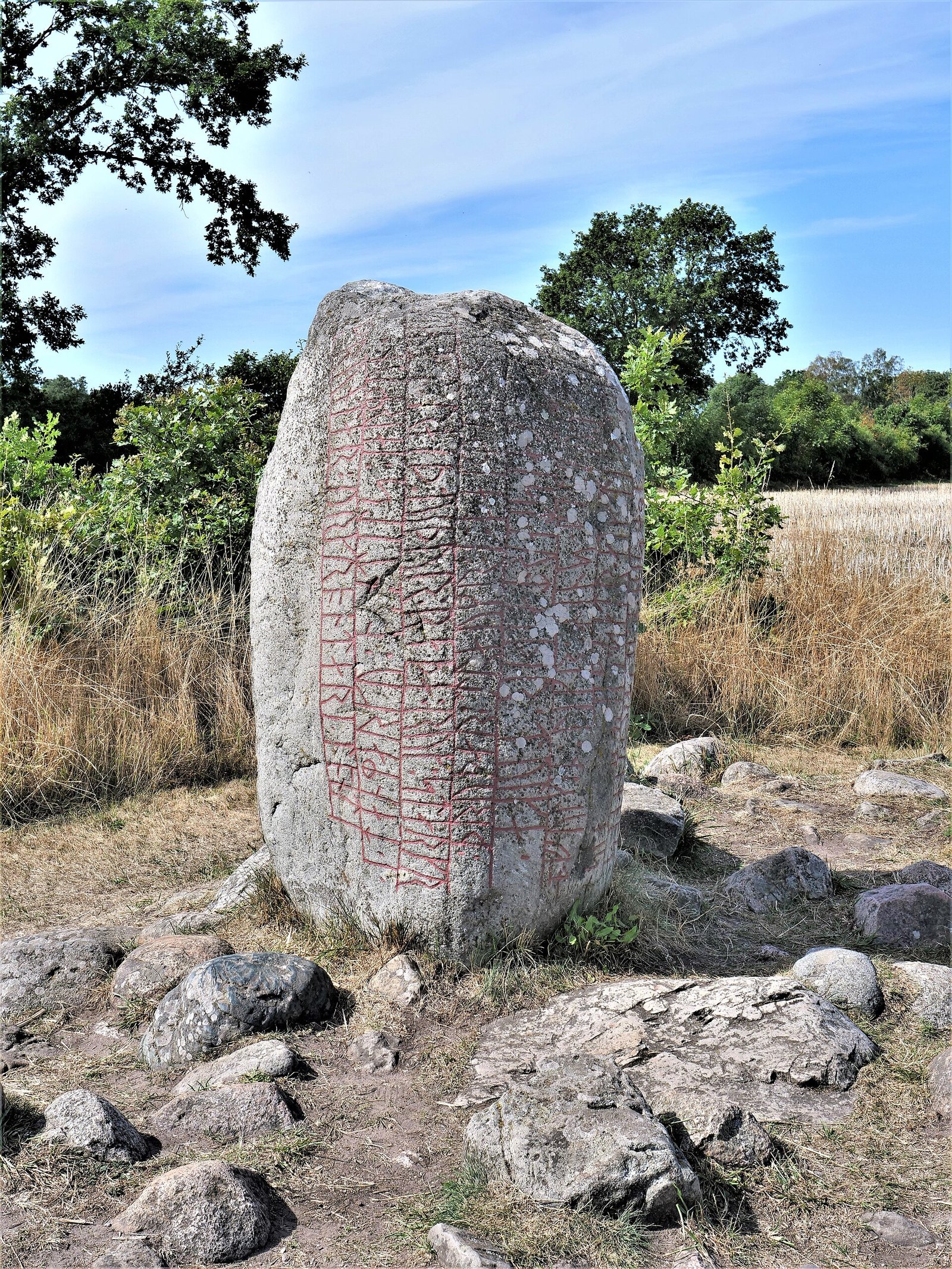
Skaldic stanzas reach us almost entirely through manuscripts centuries younger than their poets. Hence the weight of the Karlevi stone on Öland (Öl 1). The runic database Rundata dates it to the late tenth century. The inscription commemorates one Sibbi, son of Foldarr, and contains a complete stanza. According to English Wikipedia it is the only complete skaldic stanza on a runestone. In the database's normalised form:
Folginn liggr hinns fylgðu, / flestr vissi þat, mestar / dæðir dolga Þrúðar / draugr í þessu haugi; / munat Reið-Viðurr ráða / rógstarkr í Danmǫrku / Endils jǫrmungrundar / ørgrandari landi.
Rundata translates, in substance: hidden in this mound lies the one whom the greatest deeds followed, as most men knew, “Þrúðr's warrior of battles”; never will a more honest “wagon-Viðurr” upon “Endill's expanses” rule land in Denmark. Several points are uncertain, and the name Endill has lost its beginning on the stone.
The form can be counted. Seven lines have six syllables; line 5 has seven if munat is counted in full. All eight close with a falling cadence: fylgðu, mestar, Þrúðar, haugi, ráða, -mǫrku, -grundar, landi. The staves: f in folginn, fylgðu, flestr; d in dæðir, dolga, draugr; r in Reið-, ráða, rógstarkr; in the last pair Endils, jǫrmun- and ørgrandari, two vowels and a j. The rhymes alternate by the book: folg- and fylg- half, flest- and mest- full, dæð- and Þrúð- half, draug- and haug- full, Reið- and ráð- half, End- and grund- half, grand- and land- full. Only in line 6 do stark- and mǫrk- have the same consonants but, in this spelling, unlike vowels. The poet commanded the rules Snorri wrote down a good two hundred years later.
The Rök stone, probably early ninth century according to English Wikipedia, has a stanza on Theodoric which that article calls fornyrðislag. Its pairs alliterate on þ (Þiaurikʀ, þurmōði), on st (stilliʀ, strąndu), on g (garwʀ, guta) and on sk (skialdi, skati). Two of the four fit the rule for st and sk.
What does dróttkvætt mean? Drótt is a ruler's retinue. Snorri calls the metre dróttkvæðr háttr; “court metre” is the usual English name. A stanza has eight six-syllable lines, three staves to each pair of lines and two rhyming syllables in each line.
What is the difference between skothending and aðalhending? In skothending only the consonants after the vowel agree (jörð and fyrð-); in aðalhending the vowel agrees as well (rofs and ofs-). The first belongs to the odd lines, the second to the even ones.
What metre is the Edda in? Several. Völuspá is in fornyrðislag, gnomic and dialogue poems such as Hávamál in ljóðaháttr, Atlamál in málaháttr. Galdralag occurs in single stanzas.
How many stanzas does Háttatal have? 102. In the hundredth Snorri says the hundred has now been counted; two more follow.
Is there dróttkvætt outside the manuscripts? Yes. The Karlevi runestone on Öland bears a complete stanza. Rundata dates it to the late tenth century.
Kennings: the periphrases of the skalds · Skáldskaparmál: Snorri's handbook of poetic diction · Ragnarsdrápa: Bragi's shield poem · Haustlöng · Húsdrápa · Bragi, god and poet · Egill Skallagrímsson · Alvíssmál: alliteration takes the lead · The Rök runestone · The golden horns of Gallehus
Kennings · Skáldskaparmál · Ragnarsdrápa · Húsdrápa · Bragi – god of poetry.
The Edda is not one book but the name shared by two medieval Icelandic works: the Prose Edda, a handbook for poets …
Read more →Egill Skallagrímsson is the best-known poet of medieval Iceland: a warrior who is said to have saved his head in York …
Read more →The einherjar (Old Norse, singular einheri) are the warriors who fell in battle and were chosen by the valkyries to …
Read more →The name stands in four passages of Old Norse literature, and each time it means something slightly different. In one …
Read more →