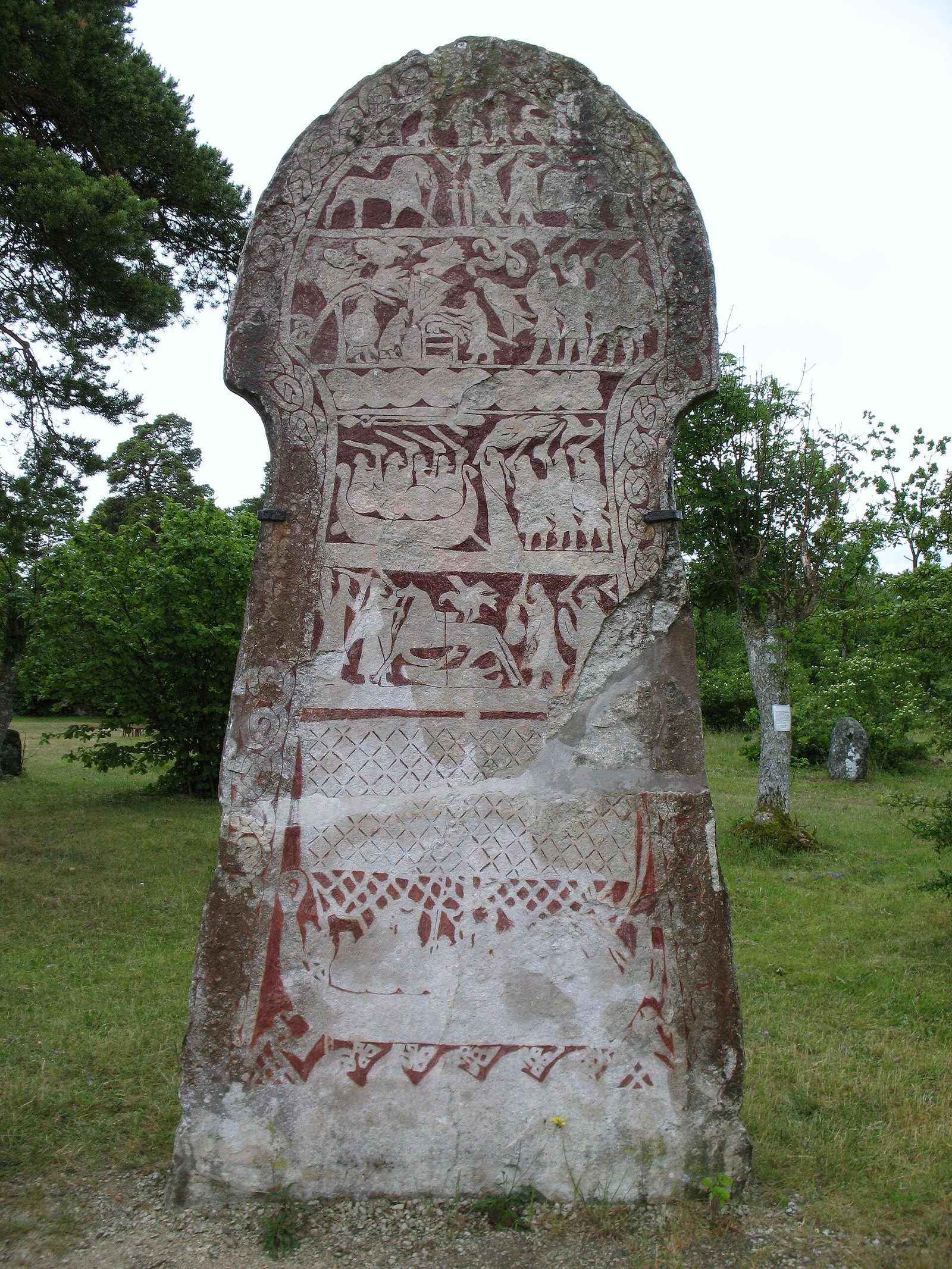
A prince called Ragnarr gives a poet a shield with stories pictured on it. The poet answers with a praise poem that puts those pictures into words. That is how the stanzas known as Ragnarsdrápa are read, and they count as the oldest skaldic verse we have. They survive only as quotations in Snorri's handbook of poetic diction, written a good three hundred years after their supposed date. This article goes through the verses scene by scene and keeps apart what the poem says, what Snorri adds, and what scholars have reconstructed.
The most important facts about Ragnarsdrápa are contained in four lines. In Snorri they close the stanzas on the death of two brothers in a Gothic king's hall, and the poet steps out of his story:
Þat sék fall á fögrum / flotna randar botni. / Ræs gafumk reiðar mána / Ragnarr ok fjölð sagna.
Bragi Boddason, Ragnarsdrápa, refrain, quoted in Skáldskaparmál (ch. 51 in our source archive's numbering); Old Norse text after Guðni Jónsson, own translation
“That fall I see on the fair base of the shield. Ragnarr gave me the moon of Rær's chariot, and a host of stories with it.”
“I see”: this is someone with a thing in front of him. Rær is the name of a sea-king, his chariot is the ship, and the moon of the ship is the round shield hung on its side. The “host of stories” are the subjects shown on the shield. I leave the word flotna (“of seafarers, of men”) open in my translation: it can be taken with the fall or with the shield.
The last two lines come back. In Finnur Jónsson's selection of 1929 they also close the stanzas about Hildr. Such a recurring close is a stef, a refrain, the mark of a drápa, the most ambitious form of skaldic praise poem. Our article on kennings uses this very refrain as an example.
The sources call the poet Bragi Boddason or Bragi inn gamli, “the Old”. Everything else about his life comes from texts written some four hundred years after his time. According to the summaries in the Store norske leksikon (Else Mundal) and the English Wikipedia, Skáldatal, an Icelandic catalogue of court poets, lists him as skald to Ragnar Lodbrok, Eysteinn Beli and Björn at Haugi. Landnámabók names his wife, Lopthœna, daughter of the skald Erpr lútandi.
He is usually placed in the first half of the ninth century, which would make him the earliest skald from whom any verse survives. Sharing a name with the god of poetry brought his existence into doubt; today, according to Mundal, he is generally regarded as historical. More on that in the article on Bragi.
No manuscript preserves Ragnarsdrápa as a continuous poem. What we have stands in Skáldskaparmál, the part of the Prose Edda in which Snorri Sturluson, in the thirteenth century, explains the language of poetry and cites older skalds as evidence. One further stanza stands at the beginning of Gylfaginning.
What matters is where Snorri names the poem himself. In the Old Norse text of our source archive he does so twice. After the story of Sigurd's descendants he writes that Bragi the Old composed on the fall of Sörli and Hamðir “in the drápa he composed about Ragnar Lodbrok”; four stanzas and the refrain follow. And the story of the battle of the Hjaðningar ends with the remark that Bragi composed on it “in the drápa on Ragnar Lodbrok”. Guðni Jónsson's edition prints no verses at that point; I read them in Finnur Jónsson's selection on heimskringla.no.
All other quotations from Bragi are introduced without a title, with formulas such as “Thus Bragi composed”. That applies to two half-stanzas about a shield, six about Thor's fishing trip, the Gefjon stanza and a few stray verses. Whether they belong to Ragnarsdrápa is an editorial decision, not a statement of the source.
The figures vary accordingly. Mundal speaks of 26 stanzas or parts of stanzas transmitted under Bragi's name, 20 of which are assigned to the same poem. The English Wikipedia likewise speaks of twenty stanzas surviving whole or in part. Finnur Jónsson's 1929 selection prints twelve items under the title Ragnarsdrápa: two opening half-stanzas, and four stanzas plus refrain for each of the two heroic scenes. His large edition of skaldic verse (vol. B I, as given on heimskringla.no) counts twenty: it adds Gefjon as no. 13, the fishing verses as nos. 14 to 19, and as no. 20 a half-stanza on the eyes of the giant Þjazi.
Two half-stanzas stand side by side in Snorri's list of kennings for weapons and armour. The first is a question: “Will you hear, Hrafnketill, how I shall praise the leaf of the foot-soles of Þrúðr's thief, cleanly covered with colour, and the prince?” Snorri cites the lines because the shield is here called “the leaf of Hrungnir's soles”.
Snorri tells the story elsewhere in Skáldskaparmál. The giant Hrungnir waits for Thor to come to their duel, holding his stone shield before him. When Thor's companion Þjálfi persuades him that the god will attack from below, he stands on the shield. That Bragi calls the giant “thief of Þrúðr” points to a second story that is told nowhere: Þrúðr is Thor's daughter according to Snorri's list of Thor kennings. An abduction of Þrúðr by Hrungnir is known only from this one kenning.
The word steini matters. Here it means “with paint”. The shield was painted, then, and “cleanly” or “brightly” so.
Snorri introduces the second half-stanza with the remark that Bragi composed it “about the ring on the shield”. It is a subordinate clause whose main clause is missing: “… unless the famous son of Sigurðr wanted good recompense for the ringing wheel, with a ring for its hub, of Högni's daughter.” Snorri resolves it: Bragi calls the shield “Hildr's wheel” and the ring the hub of the wheel. Hildr, Högni's daughter, is the woman fought over in the second part of the poem. The prince is a son of Sigurðr, which matters for the question of which Ragnarr is meant.
Four stanzas deal with a subject from heroic legend. My account follows the archive's Old Norse text; passages its working translation marks as uncertain I leave open.
The first stanza: Jörmunrekkr wakes with an evil dream, among blood-stained retainers, in the “torrent of swords”, the fight. There is tumult in the hall of “Randvér's chief kinsman”, that is, his father, when the “raven-black brothers of Erpr” avenge their injuries. The second stanza shows the floor of the hall. “Corpse-dew”, blood, runs over the benches; severed hands and feet can be made out; a man falls head first into a pool mixed with blood. Then the poet breaks off: that is painted on the “leaf of Leifi's lands”, the shield.
The first half of the third stanza is obscure, the second clear: “very soon” Hamðir and Sörli are struck with the “hard shoulder-lumps of Hergautr's lady-friend”. Hergautr is Odin, his lady-friend the earth, her lumps stones: the brothers are stoned. The fourth stanza calls them “descendants of Gjúki” and “sons of Jónakr” and speaks of repaying them for “forehead-blows and edges”, because they meant to take the life of the “beloved of Bird-Hildr”. Bird-Hildr stands for Svanhildr, whose name means “Swan-Hildr”.
Snorri tells it in prose just before. Svanhildr, Sigurd's daughter, is trampled to death by horses at Jörmunrekkr's command. Her mother Guðrún goads her sons Sörli, Hamðir and Erpr to revenge. On the way the two elder brothers kill the third. In the hall they cut off the sleeping king's hands and feet; the head stays on because Erpr is missing. Weapons cannot harm them, so Jörmunrekkr has them stoned.
Much of this is already in Bragi: the waking king, the severed hands and feet, the stoning, the names Hamðir, Sörli, Erpr, Jónakr, Gjúki and Randvér. Snorri writes that the three brothers were “black as a raven” in hair colour, like all the Niflungs. Bragi calls them hrafnbláir, raven-black. What the surviving stanzas lack is Guðrún, Bikki's counsel, the manner of Svanhildr's death and the killing of Erpr.
The Eddic poem Hamðismál has the same subject. Edward Pettit, in his edition of the Poetic Edda, takes Bragi's stanzas as evidence that key elements of the story were known in ninth-century Norway. Behind Jörmunrekkr stands the Gothic king Ermanaric; according to Pettit, Jordanes already attests a vengeance for Svanhildr in the sixth century. The wider legend is covered in our article on Völsunga saga.
The stanzas on the second heroic subject I know from Finnur Jónsson's editions. My account follows his Danish translation of 1912, which I have seen only in summary; more recent editions may resolve details differently. Högni, Heðinn and Hildr are named. The setting is a beach (á sandi) and an island (í hólmi).
Bragi refers to the woman three times with the name of a goddess as the base word: in a multi-part kenning with ósk-Rán, which Finnur Jónsson takes as “she who wishes for bloodshed”, as “ring-shaking Sif” and as “healing Þrúðr of bloody wounds”. Last, he calls her fordæða, a witch. The first stanza says she intended battle for her father, with hostile mind, when, “filled with malice”, she carried a neck-ring to the ships. The second: she did not offer the prince the necklace to move him to cowardice. She always seemed to argue against battle while urging it on. The princes, so the stanza ends, were to keep company with the wolf's sister. According to Finnur Jónsson that is Hel, sister of the Fenris wolf: they were to die.
The third stanza turns to the men. Its first half, which mentions a “landless” leader on the beach, is hard to construe, and I leave it open. The aside “then hatred swelled in Högni” and the close are clear: the warriors attack Heðinn instead of accepting the rings from Hildr's neck. The fourth says that on the island the witch among women got her way, and the whole host advanced in anger under its shields. The name Hjarrandi occurs there inside a kenning for the shields. Two lines and the refrain follow: this attack can be recognised on the “penny of Svölnir's hall”. Finnur Jónsson takes that as Odin's hall, and its “penny” as the shield.
Hildr incites under a show of reconciliation. Her name means “battle” and is also a valkyrie name.
Snorri's prose is fuller. King Heðinn, son of Hjarrandi, carries off Hildr while her father Högni is away at a meeting of kings. Högni pursues him to the Orkney island of Háey. Hildr offers her father a necklace in settlement on Heðinn's behalf and threatens battle in the same breath. Högni refuses; he has already drawn the dwarf-made sword Dáinsleif. They fight all day. At night Hildr wakes the dead by sorcery, and so it goes on: the fallen and their weapons turn to stone and rise again each morning. Poems say, Snorri writes, that the Hjaðningar will wait like this for Ragnarök.
The necklace, Hildr's double game, Högni's fury, the island and the sorcery agree with the verses: Bragi calls Hildr a witch, Snorri has her wake the dead. The kenning “healing Þrúðr of bloody wounds” can be read as an allusion to that. But the surviving stanzas say nothing of dead men raised, of petrifaction, or of a battle lasting to the end of the world. Orkney, Háey and the sword Dáinsleif are named by Snorri alone. Whether Bragi told this in lost stanzas cannot be established.
Six half-stanzas by Bragi tell how Thor gets the Midgard Serpent on his hook. Snorri quotes them under the names of Odin, under the kennings for Thor, in the chapter on the Völsungs and in the word list for the sea. Nowhere does he say which poem they come from.
Together they give a series of moments. It “is plain” to the poet that the son of the “Father of men” wished early on to test his strength against the water-washed ring of the earth. The line of Odin's heir lay by no means slack when Jörmungandr uncoiled on the sand. Thor grips the hammer in his right hand when he recognises the fish that girdles all lands. The ugly ring of the sea stares up, hard-minded, at “Hrungnir's skull-splitter”. The writhing serpent, described as the eel of the “Völsungs' drink”, poison, hangs on the hook. And finally Thor's companion, whom the verse does not name, cuts the thin line “before Thor”.
So in Bragi the companion cuts the line, as in Snorri's prose in Gylfaginning, where Hymir reaches for the bait-knife and hacks through Thor's line at the gunwale. In Húsdrápa by Úlfr Uggason, a good hundred years younger, Thor strikes off the serpent's head. Hymir's name does not occur in Bragi's surviving verses, nor does the ox-head used as bait. For the Eddic version see the article on Hymiskviða.
One detail of wording speaks for Ragnarsdrápa: “it is plain to me” (þat erumk sýnt) suits someone looking at a picture, like the “I see” of the refrain. It is not proof.
The best-known stanza by Bragi is not in Skáldskaparmál but in the first chapter of Gylfaginning. King Gylfi of Sweden promises a wandering woman as much land as four oxen can plough in a day and a night. The woman is the goddess Gefjon. She yokes her four sons by a giant to the plough as oxen and tears out a piece of land, which the beasts drag westward into the sea: Zealand. Then comes: “Thus says Bragi the Old.”
Gefjon, glad, drew “Denmark's increase” away from Gylfi, so that the draught-beasts steamed. The oxen bore eight “forehead-moons”, eyes, and four heads as they went before the wide plundered land of the meadow-isle. The giant sons, and the lake left behind in Sweden, are supplied by the prose. The source archive for Gylfaginning gives the stanza in Old Norse with R. B. Anderson's translation.
Snorri names no poem here either, and nothing in the stanza points to a shield or a picture. That it belongs to Ragnarsdrápa is an unprovable assumption resting on the idea of a shield with four fields. Snorri tells the story a second time in Ynglinga saga.
Many accounts present the idea as fact. It comes from scholarship. According to the English Wikipedia, Lee M. Hollander assumed that the complete poem described four quarters of the shield, each in four stanzas and presumably with a refrain. Mundal describes the version printed in editions as largely a reconstruction built on that idea.
It is supported by the refrain, which twice closes a section, and by the four stanzas in each heroic scene. Against it, Snorri assigns only two scenes to the poem, that the fishing verses amount to six half-stanzas without a refrain, and that a single stanza survives on Gefjon.
Actual finds of shields and their paint are summarised in the article on the Viking shield.
Snorri has no doubts: both times he calls the poem a drápa on Ragnar Lodbrok. The byname does not occur in the poem itself. There the giver is Ragnarr, and the prince who expects recompense is a son of Sigurðr.
That fits the legendary tradition in which Ragnar Lodbrok is the son of Sigurðr hringr. Mundal notes that the half-stanza agrees with Snorri's attribution, though not with certainty. According to the English Wikipedia, Vésteinn Ólason thinks the poem was more probably addressed to a later Ragnarr; the same article says earlier scholars even proposed the Swedish king Björn at Haugi.
Ragnar Lodbrok is himself a figure of legend; Mundal considers a leader active in the Seine region in the 840s as a possible model. Anyone who reads Ragnarsdrápa as evidence for the Ragnar of the sagas is relying on an identification made in the thirteenth century.
The figures differ. The usual dating to the first half of the ninth century rests on the rulers named in Skáldatal. Guðbrandur Vigfússon, according to the English Wikipedia, preferred the span 835 to 900. Pettit writes that Bragi is thought to have been active in Norway around 850 to 870. The note on heimskringla.no says language, style and metre suggest great age, but authenticity cannot be proved.
One argument for age is visible in the text. The metre is dróttkvætt, the “court metre”: lines of six syllables, linked in pairs by alliteration, with internal rhymes called hendingar. In skalds of the tenth and eleventh centuries these rhymes follow strict rules. In Bragi they do not yet; the English Wikipedia refers to a study by Klaus Johan Myrvoll. In the line Ragnarr ok fjölð sagna, Ragn- and sagn- rhyme. In the line before it, Ræs gafumk reiðar mána, I find no internal rhyme, only the alliteration on r that binds the two lines.
That does not make Bragi the inventor of the form. His multi-part kennings presuppose practised listeners. That speaks for older poetry now lost, though it cannot be demonstrated.
Three early poems describe pictures with mythological content. Haustlöng by Þjóðólfr of Hvinir also concerns a shield and tells of the abduction of Iðunn and of Thor's fight with Hrungnir. Húsdrápa describes depictions in an Icelandic hall.
Ragnarsdrápa differs in its subjects. Where Þjóðólfr and Úlfr, as far as they survive, deal only with gods, Bragi puts two heroic legends at the centre, and only for those is membership of the poem secure. In both there is a woman whose name contains the word hildr, “battle”: Svanhildr, whose death is avenged, and Hildr, who kindles the fight. “Hildr's wheel” is also what the opening calls the shield. Whether the poet is playing on the echo cannot be proved.
What does “Ragnarsdrápa” mean? “Praise poem on Ragnarr”. A drápa is a skaldic praise poem with a refrain.
How much of Ragnarsdrápa survives? The stanzas on Hamðir and Sörli with the refrain, and those on Hildr, are securely assigned. Add the opening, Thor's fishing trip and the Gefjon stanza and the total is around twenty stanzas and half-stanzas.
Is Ragnarsdrápa really the oldest skaldic poem? It is regarded as the oldest of which verses survive. The ninth-century date rests on late sources, language and metre.
Did the shield really exist? The poem says so; the shield has not survived. The pictures cannot be reconstructed from the verses.
Where can I read the stanzas in the original? The source archive for Skáldskaparmál gives Bragi's verses in Old Norse at the points where Snorri quotes them, with a working translation. The Hildr stanzas are missing there.
Bragi – god of poetry · Haustlǫng: the shield poem · Húsdrápa · Skáldskaparmál · Kennings.
A traveller stops at three houses, shares the meal, sleeps three nights between husband and wife and moves on. Nine …
Read more →Almost everything we think we know about the Norse world of gods and heroes comes from Iceland. But there is a second …
Read more →A man surprises women bathing, takes one woman's feather dress and so forces her into marriage; years later she finds …
Read more →Sigurd is the greatest hero of the North: the Volsung who kills the dragon Fáfnir with the sword Gram, wakes Brynhild …
Read more →