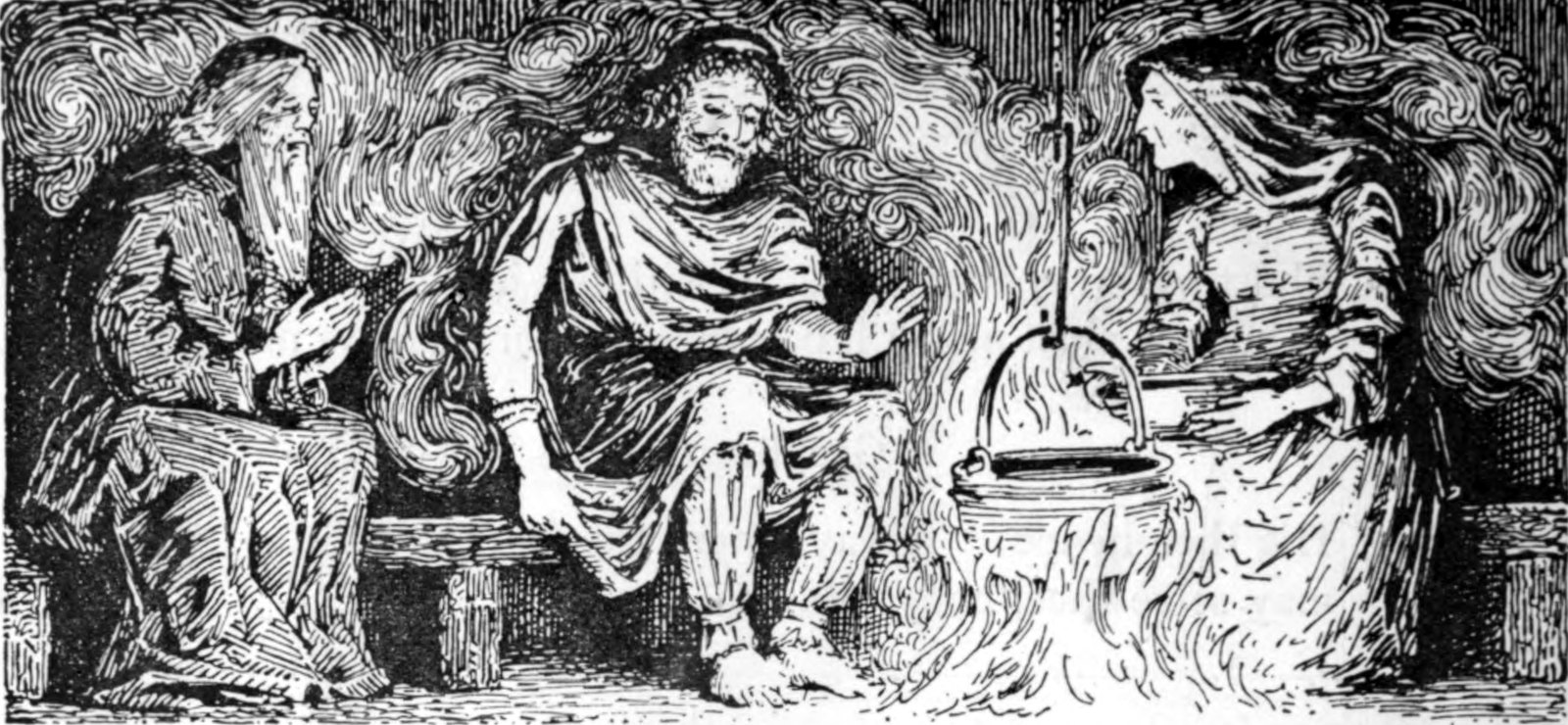
A traveller stops at three houses, shares the meal, sleeps three nights between husband and wife and moves on. Nine months later each house has a son: Þræll, Karl and Jarl – the thrall, the free farmer, the nobleman. This is how Rígsþula explains why people are unequal. The poem survives in a single manuscript, its ending is lost, and the claim that the traveller is Heimdall rests on a prose preface alone. This article walks through the text stanza by stanza and separates what is there from what was read into it later.
Rígsþula is printed in every modern edition of the Poetic Edda, yet it is absent from the Codex Regius, the main manuscript of that collection. It survives in one place only: the Codex Wormianus, shelfmark AM 242 fol., an Icelandic vellum manuscript of Snorri's Edda. The Arnamagnæan Institute in Copenhagen, which keeps the book, dates it to about 1350. Edward Pettit, in his dual-language Edda of 2023, locates the poem on pages 155–156; English Wikipedia speaks of the last surviving leaf.
The codex is named after the Danish physician and antiquarian Ole Worm, who according to a note on its first page received it from the Icelander Arngrímur Jónsson; the Institute gives the year 1628. In 1706 it passed to Árni Magnússon. Besides Snorri's Edda it contains four grammatical treatises. Rígsþula thus stands in a handbook of poetics, not a book of poems. Why it was copied there is not recorded; its name lists would at least have given a skald a stock of words for servant, maid, man, woman and son.
There is no second copy against which corrupt passages could be checked, and the text breaks off in the middle of a speech. In Guðni Jónsson's edition, on which our source archive is based, the poem has 48 stanzas, several of them defective. A þula is a list in verse, a mnemonic catalogue; Pettit translates the title as “Rígr's List”.
Before the first stanza the manuscript has a short piece of prose. In the normalised Old Norse printed by Pettit it reads: “Svá segja menn í fornum sǫgum, at einnhverr af Ásum, sá er Heimdallr hét, fór ferðar sinnar ok fram með sjóvarstrǫndu nøkkurri, kom at einum húsabœ ok nefndisk Rígr. Eptir þeiri sǫgu er kvæði þetta.” In my own translation: People say in old stories that one of the Æsir, who was called Heimdallr, went on his way along a certain seashore, came to a farmstead and called himself Rígr. This poem follows that story.
This is the only place where Heimdall is named. The verse speaks only of Rígr. The first stanza calls him a wise and powerful god of the Æsir and has him walk “green ways” (grænar brautir), not a seashore as the preface says. The difference is small, but prose and verse do not match.
Rígr comes to a house with a fire on the floor. A grey-haired couple sits by the hearth, Ái and Edda. The names are usually read as “great-grandfather” and “great-grandmother”, as in our reading edition. Edda wears an old-fashioned headdress (aldinfalda).
The sequence that follows is repeated three times, almost word for word. Rígr “knew how to give them counsel” (Rígr kunni þeim ráð at segja) and sits down in the middle of the bench with the couple on either side. Edda brings a lumpy loaf, heavy and thick and full of husks, with broth in a bowl. Rígr lies down in the middle of the bed, again between the two, stays three nights and walks on. Nine months pass.
Edda bears a son. They sprinkle him with water and name him Þræll, the Old Norse word for an unfree servant. Stanza 8 describes him: wrinkled skin on his hands, knotted knuckles, thick fingers, an ugly face, a bent back, long heels. He ties loads with bast and hauls brushwood home all day. A woman joins him, with dirt on her soles, sunburnt arms and a flat nose; her name is Þír.
The two have twelve sons and nine daughters, if one counts the names in stanzas 12 and 13, among them Fjósnir, Drumbr, Digraldi, Kumba, Ambátt and Trönubeina. Ambátt is the ordinary word for a bondwoman and Trönubeina means “crane-legs”; Pettit translates “Handmaiden” and “Crane Legs”. I have not checked the other names one by one. They build fences, dung fields, tend pigs and goats and dig turf. “From them come the families of thralls” (þaðan eru komnar þræla ættir). For the historical evidence see slavery in the Viking Age.
The second couple, Afi and Amma (“grandfather” and “grandmother”), are at work. The man is shaping wood for a loom beam; his beard is trimmed and his shirt fits close. The woman is working the distaff. She wears a headcloth, a kerchief at her neck and “dwarfs on her shoulders” (dvergar á öxlum), which is what the text literally says. Bellows renders them as clasps, Simrock as laces at the shoulder; Pettit glosses them as fibulae. On such dress fittings see Viking Age clothing and weaving.
Here the text is damaged. Amma's meal is lost except for one line: “boiled calf was the best of the dainties.” The same line already stands in the first house in Guðni Jónsson's text, where Bellows puts it in brackets. Simrock omits Amma's meal altogether.
Amma's son is Karl, red and ruddy. He tames oxen, makes the ard (arðr), builds houses and barns, makes carts and drives the plough – the programme of a man who owns his farm (see Viking farming). His bride Snör arrives with keys hanging at her belt and in a goatskin kirtle. Their twelve sons bear names that are also words for free men: Drengr, Þegn, Bóndi, Smiðr – farmer and smith are literally in the list. Ten daughters follow. “From them come the families of free farmers.”
The third building is called a hall. Its door faces south, a ring hangs on the post, the floor is strewn. Faðir and Móðir, “father” and “mother”, look into each other's eyes and play with their fingers. The master of the house twists a bowstring and shafts arrows. The lady smooths her linen and straightens her sleeves. She wears a headdress, an ornament on her breast, a long trailing gown and a blue-dyed shift; her neck is “whiter than pure new snow”.
The food rises in rank too. Móðir covers the table with patterned white linen and lays thin loaves of white wheat on it. She brings dishes mounted with silver, pork and roasted birds. There is wine in the jug. From husk bread to boiled calf to wheat bread with wine: the three meals form a scale. What finds confirm is covered under Viking food.
Móðir bears a boy and wraps him in silk; he is sprinkled with water and named Jarl. His hair is fair, his cheeks bright, his eyes sharp “as a young serpent's” (sem yrmlingi).
Jarl grows up in the hall and learns what the poem regards as noble: swinging the linden shield, bending the bow, shafting arrows, hurling spears, riding horses, loosing hounds, drawing swords and swimming.
Then comes something the first two houses lack. Rígr returns “out of the grove” (ór runni) and teaches Jarl the runes. He gives him his own name, declares him his son and tells him to take possession of ancestral land (óðalvöllu). The poem tells of no second visit to Þræll or Karl.
Jarl then rides through dark forest and over frosty hills to a hall, “wakes war”, reddens the field and wins land. Afterwards he rules eighteen farms, shares out treasures and slender horses and “hewed the arm-ring apart” (hjó sundr baug). This is the generous lord who pays out precious metal in pieces; for cut rings from hoards see hacksilver. Messengers ask on Jarl's behalf for Erna, the slender-fingered daughter of a Hersir.
Jarl and Erna have twelve sons, from Burr and Barn to Kundr and the youngest, Konr. Almost all the names mean “son”, “child” or “heir”. In passing the poem mentions swimming and the board game tafl (see hnefatafl).
The youngest stands out. “En Konr ungr kunni rúnar” – but Konr the Young knew runes. Read Konr ungr together and you hear konungr, “king”. That is the poet's pun, as Pettit also notes, not word history: konungr is cognate with English “king” and German “König” and did not arise from Konr ungr. Two stanzas list what Konr can do.
But Kon the Young learned runes to use,
Runes everlasting, the runes of life;
Soon could he well the warriors shield,
Dull the swordblade, and still the seas.
Bird-chatter learned he, flames could he lessen,
Minds could quiet, and sorrows calm;
The might and strength of twice four men.Rígsþula, stanzas 43–44 (numbering of Guðni Jónsson's text; Bellows's own numbering differs, which I have not checked), translated by Henry Adams Bellows, The Poetic Edda (1923)
The original has two words for the runes, ævinrúnar and aldrrúnar. Bellows makes them everlasting runes and runes of life, Simrock runes of time and of the future. According to Pettit both literally mean “life-runes”, and the distinction is obscure. On practice versus poetry see rune magic.
Stanza 45 tells of a contest: Konr matches himself against “Rígr Jarl” in runes and knows more. With that he earns the right to be called Rígr himself. The name is thus a title handed on. Then Konr rides through thicket and wood, hunting birds. A crow on a branch addresses him: he would do better to ride horses and fell an army. Danr and Danpr own costly halls and a nobler inheritance “than you have”; they know how to ride the keel, test the blade and tear wounds.
Here the text ends. Konr's answer is lost.
The two names in the crow's speech turn up in two other traditions, and both concern the origin of kingship. In Ynglinga saga, the first part of Snorri's Heimskringla, we read of King Dyggvi: “Móðir Dyggva var Drótt, dóttir Danps konungs, sonar Rígs, er fyrstr var konungr kallaðr á danska tungu.” Dyggvi's mother was Drótt, daughter of King Danpr, the son of Rígr, who was the first to be called king in the Danish tongue. His kinsmen, the next sentence adds, held the name of king as the highest rank ever after. Pettit assigns the passage to chapter 17, English Wikipedia to chapter 20; chapter numbering depends on the edition and translation. Grammatically the relative clause can refer to Rígr or Danpr; the summaries I saw differ.
The second trace is the Latin epitome that Arngrímur Jónsson made in the late sixteenth century of the now lost Skjöldunga saga – the same Arngrímur who later gave away the Codex Wormianus. In the summaries I saw, Rígr there marries Dana, daughter of a certain Danp, and wins the royal title; his son is called Dan. I have not read the Latin wording.
The three genealogies do not agree. In Snorri, Danpr is Rígr's son; in Arngrímur, his father-in-law; in Rígsþula, Danr and Danpr are foreign lords against whom Konr is to measure himself. All three share the link between Rígr, Danpr and the title “king”. Hence the inference that the poem was heading for a union of Konr with that house and the beginning of kingship. It is an inference, no more. On the legendary Danish kings see the Danes.
Apart from the preface, one line above all supports the identification with Heimdall. Völuspá opens with the seeress asking for a hearing: “Hljóðs bið ek allar helgar kindir, meiri ok minni mögu Heimdallar” – all holy kindreds, the greater and lesser sons of Heimdall. If humans high and low are Heimdall's sons, a story in which he fathers them lies close at hand. Pettit also points to stanza 43 (in his numbering) of Hyndluljóð.
Against this stands the picture the poem itself draws. A god who wanders unrecognised, stops at farms, teaches runes and sides with kings is otherwise Odin. Pettit writes that without the preface one would sooner think of him. According to English Wikipedia, Finnur Jónsson and Rudolf Simek held that the name Rígr was transferred from Odin to Heimdall only later; I report this from that summary, not from their works.
Karl G. Johansson goes furthest, in an article of 1998. As Pettit and German Wikipedia report him, he regards the preface as the work of the fourteenth-century compiler of the Codex Wormianus, perhaps prompted by the first stanza of Völuspá. If so, Rígsþula would preserve no old tradition about Heimdall. The question is open. Pettit mentions a possible counter-trace: an obscure runic inscription of the eleventh or twelfth century on a spindle-whorl from Saltfleetby St Clement in England, which seems to name Heimdall, possibly beside Odin and one other figure, as helpers of a certain Úlfljót, probably the woman who used the whorl – much as Rígr “knows counsel” for Amma at her distaff. The reading is uncertain, and if Odin stands beside him it settles nothing.
Rígr is not a Norse word. The name is almost universally derived from Old Irish rí, “king”, more precisely from an inflected form (ríg). A god who is called “king”, and whose name finally passes to the future king: that fits the design of the poem.
What the loanword says about the origin of the poem remains open. Pettit considers composition in a Norse-Irish settlement in the British Isles, but notes that Irish influence was also felt in Iceland and Norway. English Wikipedia sums up that Celtic authorship was once considered and that the majority today assumes an Icelandic poet. On Norse-Irish contact see the Vikings in Ireland.
Proposals range from the tenth to the thirteenth century, the suggested places of origin from the British Isles to Norway. Older scholarship thought the poem very old, later the thirteenth century was argued, and part of recent research again favours the Viking Age. So English Wikipedia sums it up.
German Wikipedia reports one late dating in more detail, though without names: the poem is said to be not much older than its manuscript and to reflect Norwegian conditions of the first half of the thirteenth century. Who holds this date I could not check.
Pettit thinks Iceland less likely as a place of origin than is usual for eddic poems, because the rigid hierarchy does not match medieval Iceland, which had no aristocracy and no king until 1262. Yet an Icelander could also compose a poem about an order he knew from Norway.
Only the upper limit is firm: by about 1350 the text existed. Oral transmission can change a poem, so dating from vocabulary or material culture is uncertain. Wine, silver tableware and silk in the third house prove neither an early nor a late date on their own.
Rígsþula is a model, not a report. It sorts people into three hereditary groups and ties the difference to the body: the thrall is dark and bent, the farmer red and ruddy, the earl fair and sharp-eyed. Pettit speaks in his introduction of “unashamed classism, ageism, sexism and racism”. In his view the poem affirms the poet's or the patron's idea of the proper stratification of society, with the king at the top.
The sequence great-grandparents – grandparents – parents can be read as an ascent. According to English Wikipedia, Thomas D. Hill notes that most scholars find a benevolent reading of the poem too kind; I have not read his article of 1986. Þræll, Karl and Jarl are half-brothers, yet the poem draws no conclusion from that.
Georges Dumézil compared the three classes with the tripartite order he saw in many Indo-European cultures. According to the Wikipedia summary he pointed out that Konr alone, with his knowledge of runes, represents the supernatural function. The poem knows no separate priestly class.
As a source for social history the poem is therefore of limited use. It gives no numbers, knows no freedmen and no traders, and women appear only as wives and mothers. The thing of the free men is absent too. Its value lies elsewhere: it shows what a poet thought typical of each rank: husk bread or wheat, goatskin or silk, digging turf or shooting the bow. Such details can be compared with finds; the find tests the poem, not the reverse.
Anyone quoting a stanza number should name the edition. Guðni Jónsson and Pettit count 48 stanzas. Bellows divides some stanzas differently, and Simrock runs stanzas together and arrives at 45.
The wording differs too. Stanza 7 says of the newborn Þræll “hörvi svartan”. Simrock translates “black of skin”, Bellows reads a cloth over black hair; the stanza survives only as a fragment. In the last stanza the crow says in the original that Danr and Danpr have a nobler inheritance “than you have” (æðra óðal en ér hafið). Simrock (his stanza 45) turns this into the opposite: halls “not finer”, an estate “not richer” than Konr's. In the source archive Old Norse, Simrock and Bellows stand side by side.
Who is Rígr? In the poem, a god of the Æsir who wanders unrecognised and fathers a son in each of three houses. The prose preface of the manuscript identifies him with Heimdall. Some scholars think Odin was originally meant. The name itself goes back to the Old Irish word for “king”.
Where does Rígsþula survive? Only in the Codex Wormianus (AM 242 fol.), an Icelandic manuscript of Snorri's Edda from the mid-fourteenth century, kept in Copenhagen. It is not in the Codex Regius of the Poetic Edda.
How old is the poem? That cannot be established with certainty. Dates from the tenth to the thirteenth century have been proposed. The only firm point is that it was written down by about 1350.
Why does Rígsþula end so abruptly? The only manuscript breaks off after the crow's stanza about Danr and Danpr. The ending is lost. Snorri's Ynglinga saga and a Latin epitome of the lost Skjöldunga saga suggest that it dealt with the origin of kingship.
Can the poem tell us how many slaves, farmers and nobles there were? No. It gives no figures and knows only three groups. It is evidence of how an upper class justified inequality, not a social statistic.
Heimdall – the White God, Watchman of Bifröst and Keeper of the Gjallarhorn · Völuspá – the Seeress's Prophecy · The Codex Regius · Hyndluljóð · The Edda.
Almost everything we think we know about the Norse world of gods and heroes comes from Iceland. But there is a second …
Read more →A man surprises women bathing, takes one woman's feather dress and so forces her into marriage; years later she finds …
Read more →Sigurd is the greatest hero of the North: the Volsung who kills the dragon Fáfnir with the sword Gram, wakes Brynhild …
Read more →Sindri (called Eitri in some editions) and Brokkr are the dwarf brothers who, according to Snorri Sturluson's …
Read more →