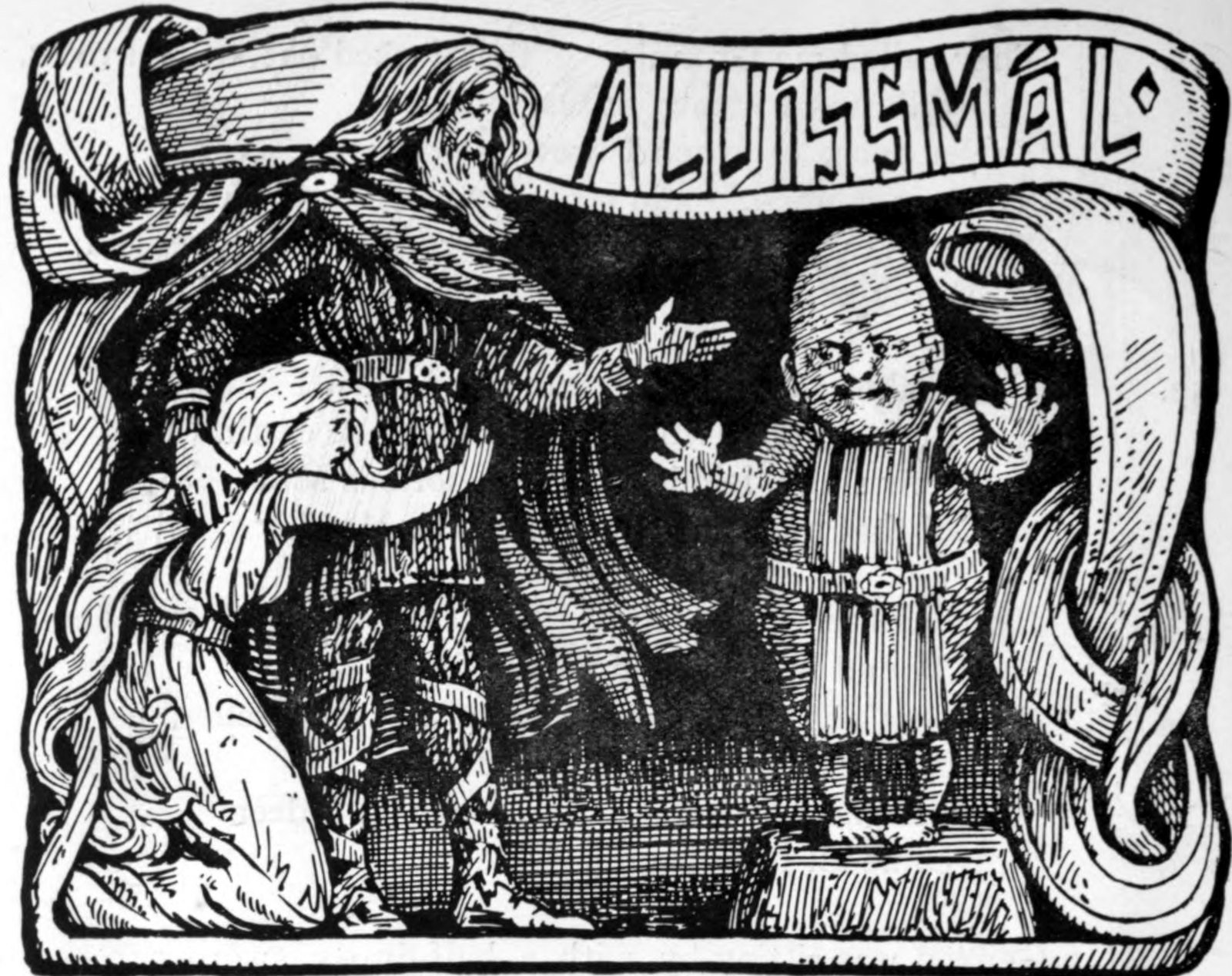
Thirty-five stanzas, thirteen questions, seventy-eight names: Alvíssmál is the eddic poem in which Thor defeats a dwarf with patience instead of a hammer. This article reads the poem stanza by stanza as a text. It counts which beings speak and how often, shows how alliteration steers the word lists, compares Snorri's quotations with the Codex Regius, and separates what the final stanza says from what readers have long supplied.
The story takes three sentences. A dwarf called Alvíss (“All-Wise”) arrives to fetch a bride who has been promised to him. Thor, who speaks of himself as her father, will not let her go and attaches a condition to his consent: the dwarf must tell him what things are called in all the worlds. Alvíss answers thirteen times without a slip, and then the sun shines into the hall.
Who the daughter is, and what can be said about her name, is the subject of our article on Þrúðr; the dwarf as a figure appears in our survey of the dwarfs. This article is about the poem itself. Of its 35 stanzas, 26 belong to the questions and answers, and that catalogue is more carefully built than a first reading suggests.
The text used is the Old Norse of Guðni Jónsson's edition as printed in our source archive, alongside Karl Simrock's German translation (1851) and Henry Adams Bellows's English one (1923). All stanza numbers follow that count. Simrock is one stanza ahead from stanza 9 onwards because he inserts a stanza the Codex Regius lacks. See also our reading edition.
There is no prose introduction. The poem opens in the middle of the dwarf's speech: the bride shall now come home with him (st. 1). The other speaker mocks him. Why so pale about the nose, has he spent the night with a corpse? He looks rather like a þurs, a giant (st. 2).
The dwarf gives his name and address: he lives beneath the earth, his place is under a stone (st. 3). He then appeals to a firm pledge that nobody should break. The stanza names the person he has come to see as vagna vers. Simrock and Bellows translate “wagon-guider” and take it to mean Thor. Edward Pettit, who published a dual-language Poetic Edda in 2023, prints a question mark and thinks rather of Odin. The poem does not say who gave the pledge. Thor says only that he was not at home when it was given, and that he, “as father”, has most say over the bride (st. 4).
Alvíss does not recognise him and calls him a wanderer whom few will know (st. 5). The reply: Vingþórr ek heiti, “Vingþórr is my name”, son of Síðgrani (st. 6). The name Vingþórr also stands in the first line of Þrymskviða; Síðgrani is taken to be a byname of Odin. Nobody in the poem uses the plain name Thor. The dwarf gives way (st. 7), and Thor states his terms: the maid's love shall not be denied the “wise guest” if he can tell, out of every world, all that Thor wishes to know (st. 8).
The daughter remains nameless. There is no deadline and no wager.
From stanza 9 to stanza 34, question and answer alternate thirteen times. Thor's question always opens with the same three lines: Segðu mér þat, Alvíss, öll of rök fira vörumk, dvergr, at vitir, roughly “Tell me this, Alvíss – I expect, dwarf, that you know the whole fate of beings”. It always closes with heimi hverjum í, “in every world”.
The clause that describes each thing speaks from a human point of view. The earth is that which “lies before the sons of men”, the moon that “which men see”, the sea that “on which men row”, the ale that “which the sons of men drink”. Night gets a mythological tag: she is in Nörvi kennda, in Bellows “the daughter of Nor”. Vafþrúðnismál gives the same parentage in stanza 25 (“Nótt var Nörvi borin”), and Snorri's Gylfaginning knows a giant “Nörfi or Narfi” as the father of Night.
The thirteen subjects, in the poem's order: earth, sky, moon, sun, clouds, wind, calm, sea, fire, wood, night, seed, ale. Twice the answer opens with a different word. Thor asks about the sea using marr; Alvíss begins with sær and brings in marr only at the end, as the dwarfs' word (“the deep sea”). Thor asks about seed, sáð, and Alvíss replies Bygg heitir með mönnum, “Barley it is called among men”.
Each answer gives exactly six names, each with the group that uses it. Thirteen answers make 78 names. The first is always the word used by men, and it is always the ordinary Old Norse word. The gods always come second, the giants always fourth. The other three places vary. Three examples, with the words in the form they have in the verse and renderings from Simrock and Bellows:
How far translators can diverge is shown by the moon in stanza 14: the gods' word, mylinn, is “Flame” in Bellows and “Scheibe” (disc) in Simrock. Many of these words hardly occur elsewhere, and their sense has to be worked out from their parts.
It is often said that Alvíss gives the names used by men, Æsir, Vanir, giants, elves, dwarfs and in Hel. As a total that is right, but no stanza names all seven: each has only six places. The count:
That makes twelve labels, and several overlap. The sun stanza has both “gods” and “sons of the Æsir”, the earth stanza “Æsir” and “powers above”, the ale stanza “giants” and “Suttung's sons”, whom Pettit explains as giants. The poem does not say who the ginnregin and uppregin are; Bellows renders both “the holy ones high”. The word halir in stanza 28 on its own means “men”. Bellows takes it as the dwellers “in hell”, and Pettit calls the difference from the men of the first line unclear.
Why do the groups change? The explanation lies in the verse. The poem is in ljóðaháttr, the stanza form of eddic dialogue poems: two short lines linked by alliteration, then a full line that alliterates within itself, and the same again. Alliteration means that stressed words begin with the same sound; all vowels alliterate with one another, and in eddic verse j counts with them. What follows is my own count of the Old Norse text.
Lines one and two: the gods' word alliterates with the human word. Himinn – hlýrnir, máni – mylinn, sól – sunna, vindr – váfuðr, nótt – njól, bygg – barr, and so on in ten stanzas. In exactly three stanzas the gods are called æsir instead of goð: with jörð, eldr and öl. Those are the three human words that begin with a vowel. Here the word ásum itself carries the alliteration, and the gods' word (fold, funi, bjórr) is free.
The full lines: here the name alliterates with the group. Eight times the third line pairs a word in v with vanir: vega, vindófni, vindflot, vindlot, vág, vág again, vöxt, veig. The dwarfs say drjúpansal, Dvalins leika, dags veru, djúpan mar, draumnjörun. In Hel things are called hverfanda hvél, hjalm huliðs, hviðuð, hröðuð, hnipin. The rare groups occur only in such lines: gneggjuð ginnregin, aur uppregin, alskír ása synir, hlíðþang halir, sumbl Suttungs synir. They evidently stand where the initial sound of the name called for them.
Lines four and five: in ten of the thirteen answers the giants' word begins with a vowel, for instance ígræn, uppheim, eygló or óljós. In exactly those ten, the next line has alfar, whose initial vowel supplies the second stave. Where the giants' word begins with a consonant, a different group follows: skyndi jötnar – skin dvergar for the moon, frekan jötnar – forbrenni dvergar for fire, hreinalög jötnar – í helju mjöð for ale.
Pettit puts the weight elsewhere: the poet chose words to suit each kind of being, as far as alliteration and his formulaic method allowed; the giants' words are grim and utilitarian, the elves' cheerful. Before reading a people's “character” out of a single name, it is worth checking whether any other initial sound was possible there.
Bellows judged in 1923 that the text appears to be in excellent condition. In a few places it is not. In stanza 11, the question about the sky, the descriptive line in our archive text contains the string erakendi. Pettit calls the manuscript reading corrupt. According to my retrieval of his edition he prints an emendation that introduces the giant name Hymir, supported by the parallel line in the night stanza, and himself describes it as conjectural. Bellows writes “beheld of the high one”.
Two words occur twice. Lagastafr is the elves' word for the sea in stanza 24 and their word for seed in stanza 32. Pettit finds it meaningless for seed and suspects a copying error: a scribe repeated the word from the sea stanza, and the elves' real word for seed is lost. In the same way kalla vág vanir stands twice, word for word, in stanza 24 for the sea and in stanza 26 for fire. Bellows turns the second into “Wildfire”; Pettit glosses “surge” and refers back to stanza 24. Which explanation is right cannot be settled.
In stanza 16 Alvíss gives his own people's word for the sun: Dvalins leika. Dvalinn is a well-known dwarf name. It stands in the catalogue of dwarfs in Völuspá, and according to Hávamál 143 Dvalinn carved runes “for the dwarfs”. Bellows translates the phrase “The Deceiver of Dvalin”. Pettit understands leika as toy or playmate and sees in it a hint that dwarfs were thought to be endangered by daylight. No story explaining the name survives.
After the ale stanza Thor speaks one last time. The Old Norse of stanza 35: Í einu brjósti ek sák aldrigi fleiri forna stafi; miklum tálum kveð ek tældan þik: Uppi ertu, dvergr, of dagaðr, nú skínn sól í sali. Closely translated: “In one breast I never saw more ancient staves; with great wiles, I say, you have been beguiled: you are up, dwarf, overtaken by day; now the sun shines into the hall.” The stanza has seven lines instead of six; according to Pettit its second half is in galdralag, a variant of the metre.
There is not a word here about stone, or about death. Bellows has “The day has caught thee, dwarf!” That Alvíss is petrified is an inference from other texts. The most important is Helgakviða Hjörvarðssonar: in stanza 30 Atli tells the giantess Hrímgerðr that it is day, that he has delayed her, and that she now stands as a laughable harbour mark í steins líki, “in the likeness of stone”. Pettit is careful: it is merely a likelihood that Alvíss turns to stone at dawn, and he adds the dwarf name Sólblindi, “Sun-Blind”, as supporting evidence.
Snorri Sturluson knew the poem. In Skáldskaparmál, his handbook of poetic diction, he cites two stanzas as evidence, both with the reference í Alsvinnsmálum. They are the answers about wind and about night, stanzas 20 and 30 of the poem. According to Pettit the manuscripts of Skáldskaparmál call it variously Alvíssmál, Ǫlvíssmál and Alsvinnsmál.
The night stanza in Bellows's translation of the poem:
“‘Night’ men call it, ‘Darkness’ gods name it,
‘The Hood’ the holy ones high;
The giants ‘The Lightless,’ the elves ‘Sleep's joy’
The dwarfs ‘The Weaver of Dreams.’”Alvíssmál 30, translated by Henry Adams Bellows, The Poetic Edda (1923)
Snorri's versions differ from the Codex Regius. For wind the poem has váfuðr as the gods' word, Snorri's text vönsuðr; the elves say dynfara in the poem, gnýfara in Snorri; in Hel the wind is hviðuðr in the poem, hlömmuðr in Snorri. For night the poem has njól and, for the giants, óljós; Snorri has njóla and ósorg. The groups and their order are the same in both versions, and the substitutes keep the alliteration: vönsuðr with vindr, hlömmuðr with helju. How the differences arose cannot be established.
A third passage does not name the poem. In the section on names for sky, sun and moon Snorri lists among the sun words sunna, eyglóa, alskír, fagrahvél and Dvalins leika – all five substitutes from stanza 16, eygló in a slightly different form – and among the moon words ártali, mulinn and skyndir. Just before, he remarks that not all of these written names have been found in poems. Whether he took the sun words from Alvíssmál or from a list behind both, he does not say.
The complete poem survives only in the Codex Regius of the Poetic Edda (GKS 2365 4to), on fols 19v–20r according to Pettit, and in later paper copies that depend on it. In the manuscript it stands at the seam between the poems about gods and those about heroes: after Völundarkviða and before the first Helgi lay. The compiler gives no reason for his order.
For a corrupt line such as the one in stanza 11 there is therefore no second manuscript to turn to. Only stanzas 20 and 30 have an independent witness in Snorri, and there the wording is not uniform.
Accounts differ, and none is proven. Only the upper limit is firm: the poem must have existed in some form when Snorri quoted it. Pettit writes, with matching caution, that it may have existed in some form before about 1220–41.
Bellows (1923) reports two older positions. Eugen Mogk placed the poem in the twelfth century, the period when skaldic poetry was being revived in Iceland as a learned pursuit; Finnur Jónsson thought of the tenth century and of Norway, which Bellows rejects. The English Wikipedia article cites Jan de Vries (1967) and Rudolf Simek and Hermann Pálsson (1987) for a twelfth-century date, the argument being words otherwise found only in late skaldic verse. I have not consulted any of these works myself.
The unusual thing is the role of Thor. Elsewhere he mostly acts by strength, and in Hárbarðsljóð he has to put up with a ferryman's mockery. Here he wins by stalling. Pettit observes that in this poem Thor resembles Odin, using trickery rather than brute force. As a reason for the restraint Pettit suggests that Thor does not want to act openly against a promise made by Odin. The poem says nothing of the kind.
A comparison with Vafþrúðnismál brings out the differences. There Odin and the giant expressly wager their heads (st. 19), each questions the other, and the giant loses because he cannot answer a question. In Alvíssmál only one party asks. Nothing is staked, and the one questioned fails at no question. The subject matter differs too: Vafþrúðnir knows how the world began and how it ends; Alvíss knows what things are called.
Old Norse poetic language has two kinds of substitute expression: the kenning, a paraphrase of two or more elements, and the heiti, a single poetic word used in place of the everyday one. Alvíssmál mostly supplies heiti, with a few paraphrases such as Dvalins leika. Pettit sets the poem beside the þulur, versified name-lists, and thinks it may have served poets as an aide-mémoire. He quotes the linguist Calvert Watkins, who called it a quite artificial literary showpiece.
Gods and men having different words for the same thing is not peculiar to the North: Pettit compares, among others, Homer's Iliad and an Irish treatise on poetic language.
As evidence for lived religion the catalogue is of little use. The “languages” consist of words that exist in Old Norse itself: bjórr, mjöðr and sumbl are common words for beer, mead and a drinking feast, and Snorri lists fold among the names for earth with a skaldic verse to back it. The poem's value lies in its inventory of a poetic vocabulary and in showing how one poet grouped the beings of mythology – elves and dwarfs, for instance, are kept apart throughout.
What is Alvíssmál about? The dwarf Alvíss wants to take home a bride promised to him, Thor's daughter. Thor first makes him say what thirteen things, from earth to ale, are called among the various beings. While the dwarf answers, day breaks.
Does Alvíss turn to stone at the end? The poem says only that he has been overtaken by day and that the sun is shining into the hall. Petrification is inferred from the giantess Hrímgerðr, who in Helgakviða Hjörvarðssonar stands “in the likeness of stone” at daybreak.
How many languages or worlds does the poem name? Each answer names six groups. Across the poem there are twelve labels, most often men, gods, giants, elves, Vanir, dwarfs and “in Hel”. The text gives no number of worlds.
Where is the poem preserved? Complete only in the thirteenth-century Codex Regius of the Poetic Edda (GKS 2365 4to) and in paper copies derived from it. Snorri quotes two stanzas in Skáldskaparmál with different wording.
When was the poem composed? That cannot be established. It must have existed before Snorri quoted it in the first half of the thirteenth century. The twelfth century is often named, occasionally the tenth.
Thor · Þrúðr and Alvíssmál – how Thor saved his daughter with questions instead of a hammer · Vafþrúðnismál – Odin's Head-Wager with the Wisest Giant · Kennings · The Codex Regius.
A thrown stone, a dead otter, a skin stuffed with gold and a dwarf who curses his treasure: the story of Andvari is …
Read more →She comes neither clothed nor naked, neither fed nor hungry, neither alone nor accompanied – and so wins a king …
Read more →Baldr dies when his blind brother Höðr throws a sprig of mistletoe at him – the one plant Frigg never made swear an …
Read more →A god saddles his horse, rides into the world of the dead and sings a dead woman out of her grave, because he wants to …
Read more →