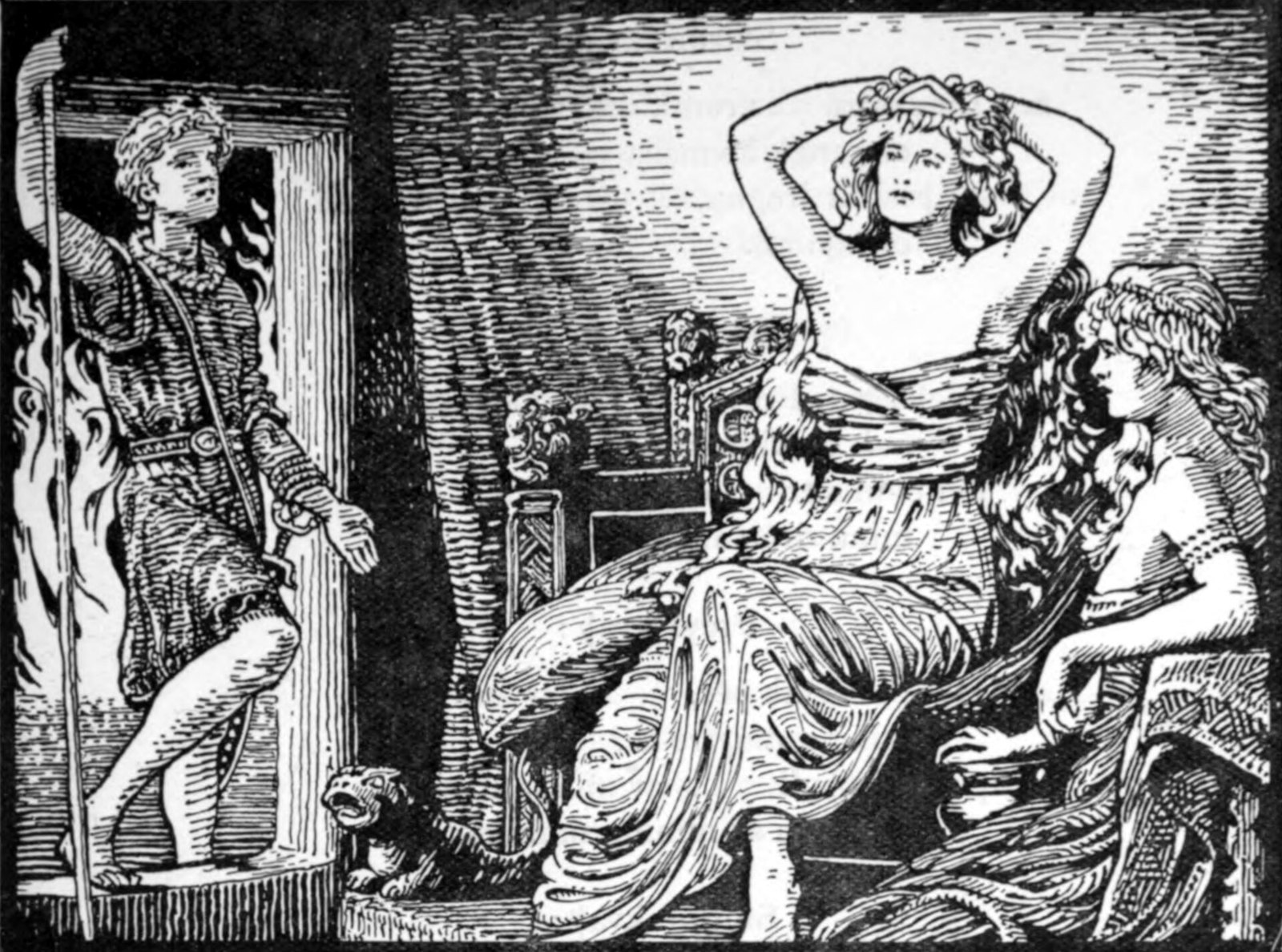
Forty-two stanzas, almost all of them direct speech, with a few lines of prose in between: the eddic poem Skírnismál tells how the god Freyr sends his servant to a giant's daughter, and how that servant woos her first with gold, then with a sword and finally with a curse. This article reads the poem as a text. It asks what the two manuscripts actually contain, what Snorri made of the story, and what was read into it only by twentieth-century scholarship.
Skírnismál belongs to the mythological poems of the Poetic Edda. In Guðni Jónsson's edition, which underlies our reading edition, it has 42 stanzas. Henry Adams Bellows arrives at 43 in his translation of 1923 because he splits one long stanza of the curse.
Nothing in the poem is narrated. Everything is said by the characters themselves: Skaði, Skírnir, Freyr, a herdsman, a serving maid, Gerðr. Narrative prose steps in only three times: before the first stanza, at the arrival at the giant Gymir's home, and at the return. Beyond that there are speaker tags such as “Skírnir kvað” (Skírnir said). According to Edward Pettit's edition of 2023 they are abbreviated in both manuscripts and often sit in the outer margin; in the Codex Regius some were trimmed away with the page edge.
The plot is retold in our article on Skírnir and Freyr's sword. What follows concerns the wording, the transmission and the interpretations.
The poem survives complete only in the Codex Regius (GKS 2365 4to), on folios 11r to 12r according to Pettit. Its heading there is “För Skírnis”, Skírnir's journey, written in red and now faded. The second witness is the fragment AM 748 I a 4to. It has the opening prose and most of stanzas 1 to 27, then breaks off at the word “firum”, the last of stanza 27, according to Pettit. In this fragment the poem is called “Skírnismál”. The name in common use today therefore comes from the incomplete manuscript.
The text is not free of gaps. In stanza 12 a line is missing; Simrock supplied one in brackets. Stanza 15, the maid's answer, has only three lines. According to Bellows' notes the fragment also omits stanza 18 and two lines each of stanzas 21 and 22. The whole curse from stanza 28 onward rests on a single manuscript.
A third, indirect witness is Snorri Sturluson. In Gylfaginning (chapter 37) he tells the story in prose and ends by quoting a stanza that corresponds to the last stanza of the poem. He knew a version, or at least its ending, before the Codex Regius was written.
The preface is short. In my own translation from the Old Norse at heimskringla.no: Freyr, son of Njörðr, had one day seated himself in Hliðskjálf and looked over all the worlds. He looked into Jötunheimr and saw there a fair maiden as she walked from her father's hall to her bower. From this he took great sickness of mind (“hugsóttir miklar”). Skírnir was the name of Freyr's servant; Njörðr asked him to get Freyr to speak. Then: “Þá mælti Skaði” – then Skaði said.
The prose has Njörðr make the request, yet the first stanza belongs to Skaði, and she speaks of “our son”. According to Bellows, both manuscripts read “Skaði said”; the editor Sophus Bugge emended to “he said”, meaning Njörðr, and Bellows thinks him right. Guðni Jónsson keeps Skaði. In Snorri she does not appear in this story at all.
That Freyr had no business on Odin's high seat, and that his grief punished his presumption, is found only in Snorri.
Skírnir goes reluctantly. He expects “ill words” (stanza 2) and still asks Freyr why he sits alone in the long halls, day after day. Freyr's answer opens with an image. The sun, which he calls “álfröðull”, shines every day, but not to his liking (stanza 4).
Only when Skírnir recalls their shared youth does Freyr come out with it: in Gymir's courts he saw a maiden walking, her arms shone, and from them all the air and sea (stanza 6). Then the obstacle: of the Æsir and elves, no one wishes the two to be together (stanza 7). The poem does not say why. Freyr belongs to the Vanir, Gerðr to the giants; the text offers no other reason.
Skírnir sets conditions. He asks for the horse that will carry him through the dark, flickering flame and for the sword that fights of itself against giants (stanza 8). Freyr gives both. His answer contains a qualification: the sword fights of itself “ef sá er horskr er hefir” – if he who holds it is wise (stanza 9). In Snorri, Skírnir asks only for the sword.
Skírnir speaks stanza 10 to his horse, then the prose reports his arrival. Fierce dogs are chained before the fence around Gerðr's hall, and a herdsman sits on a mound. Asked how to get past the dogs, he answers with a question of his own: is he doomed to die, or already dead (stanza 12)? Skírnir replies with something like a proverb: his life was measured out to a single day (stanza 13).
Inside, Gerðr hears the din; the earth shakes (stanza 14). She has the stranger invited in and offered mead, although she fears that “minn bróðurbani”, her brother's slayer, is standing outside (stanza 16). No text says who this brother is. Bellows considers the giant Beli, whom Freyr killed according to Völuspá (stanza 53: “bani Belja”) and Snorri, but concedes that Skírnir never kills anyone. Pettit thinks the phrase may simply mean “mortal enemy”. Neither can be proved.
Gerðr asks her guest whether he is of the elves, the sons of the Æsir or the wise Vanir, and how he came alone across the fire (stanza 17). Skírnir denies all three (stanza 18). Snorri calls him Freyr's “skósveinn” (servant) and elsewhere in Gylfaginning has him go as a messenger to the dwarfs to have the fetter Gleipnir made. Pettit translates the name as “Cleansing One” or “Shining One” and considers the figure a possible hypostasis of Freyr himself. That is interpretation.
The wooing begins with an offer to buy, and the poem says so. Skírnir will give eleven apples, all of gold, “frið at kaupa” (stanza 19); Bellows renders this “to buy thy troth”. Gerðr refuses, in a phrase that recurs: never will she do anything “at mannzkis munom”, at any man's wish (stanza 20, similarly 24).
Pettit mentions the proposal to read “epli ellilyfs”, apples of old-age-healing, instead of “epli ellifu”. They would then be the apples of Iðunn. In the manuscripts there are eleven.
The second offer is a ring. It was “burned with Odin's young son”, and eight of equal weight drip from it every ninth night (stanza 21). The ring has no name in the poem. That Draupnir is meant follows from Snorri, who relates in Gylfaginning that Odin laid the gold ring Draupnir on Baldr's pyre and describes its property in almost the same words. How the ring came into Skírnir's hands, neither text says.
Gerðr needs no gold; in Gymir's courts she lacks none (stanza 22). Now the tone changes. Skírnir shows the slender blade and threatens to strike Gerðr's head from her neck (stanza 23). She answers that she will never suffer compulsion (stanza 24). Skírnir then threatens her father's death (stanza 25).
For eleven stanzas only Skírnir speaks. He begins with a staff: “Tamsvendi ek þik drep”, with a taming wand I strike you (stanza 26).
First comes the place. Gerðr will sit on the eagle's mound, turned away from the world, gazing toward Hel; food will be more loathsome to her than the snake is to men (stanza 27). Then the gaze of others: the giant Hrímnir and every creature will stare at her, and she will be better known than the watchman of the gods (stanza 28) – Bellows takes this to be Heimdall. The four words of stanza 29, “tópi ok ópi, tiösull ok óþoli”, Simrock renders as loneliness, loathing, compulsion and impatience, Bellows as “rage and longing, fetters and wrath”. Their meaning is uncertain.
Next comes the marriage in store for her: with a three-headed thurs, or with no man at all (stanza 31). She is to become like a thistle – in Simrock one pressed “into the opening of the oven”, in Bellows one cast into the loft and crushed.
In stanza 32 Skírnir says he went to the wood to get a “gambanteinn”, and got one. The word occurs once more in the Poetic Edda: in Hárbarðsljóð (stanza 20) Hárbarðr boasts that the giant Hlébarðr gave him a gambanteinn and that he used it to rob him of his wits. What “gamban-” means is uncertain; Bellows writes “magic wand”, Pettit adds a question mark. The same element stands in stanza 33 in “gambanreiði goða”, the wrath of the gods that Gerðr has brought on herself. Whether tamsvöndr and gambanteinn are the same staff, the text does not say.
Then the proclamation. Giants, frost-thurses, the sons of Suttungr and the Æsir themselves are to hear how Skírnir bans the woman from “men's joy” and “men's use” (stanza 34). The thurs Hrímgrímnir shall have her below the corpse-gates, and at the roots of the tree she will be given goat's urine to drink (stanza 35).
The poem is in ljóðaháttr, the metre of eddic dialogue poems. In the curse, Pettit notes, its extended variant galdralag, “spell metre”, appears in several places. Lines are repeated with a single word exchanged. “Kranga kosta laus, kranga kosta vön” (stanza 30). “Gambantein at geta, gambantein ek gat” (32). “Mær, at þínom munom, mær, at mínom munom” (35) – maid, at your wish, maid, at my wish.
Last comes the most quoted stanza.
“I write thee a charm and three runes therewith,
Longing and madness and lust;
But what I have writ I may yet unwrite
If I find a need therefor.”Skírnismál, stanza 36 (Bellows' stanza 37), translated by Henry Adams Bellows (1923), as given in our source archive
Bellows' “a charm” conceals a rune name. The original begins “Þurs ríst ek þér”: a thurs I carve for you. “Þurs” means giant and is also the name of the rune ᚦ. No other rune is named. The three “staves” are called “ergi ok œði ok óþola” and bear the names of conditions, not of characters of the futhark; Pettit gives perversion, frenzy and unbearable lust as the usual renderings. According to Pettit the Old Norse rune poems associate the Þurs rune with the torment of women; see our article on rune magic.
The second half of the stanza turns the curse into leverage. What has been carved can be scraped off again, “ef göraz þarfar þess”, if need arises.
That such formulas were not confined to poems is shown by a find from the Bryggen wharf in Bergen. The rune stick B 257 is four-sided and broken off at one end. In the reading of McKinnell, Simek and Düwel (2004) it begins “I cut runes of help, I cut runes of protection”, against elves, trolls and thurses. The third side has the words “ylgjar ergi ok úþola” and wishes that the person addressed may never sit and never sleep. The fourth demands that she love the carver as herself; the grammatical form shows a woman is meant.
Ergi and óþoli are two of the three “staves” of stanza 36. The dating varies. “About 1335” is widely repeated, though I have seen no evidence for it; McKinnell, Simek and Düwel give 1380 to 1390, and Pettit speaks simply of the fourteenth century. Either way the stick is younger than the Codex Regius. It proves no Viking Age rite, but it shows these words in use as love compulsion in late medieval Norway – whether learned from the poem or drawn from a common stock of formulas cannot be decided.
Gerðr gives way in a single stanza. She bids the messenger welcome and hands him the “hrímkálkr”, the frost-cup full of old mead. She never thought she would love a “vaningi” (stanza 37). The word means a scion of the Vanir. According to Pettit, Snorri also has it as a poetic term for the boar, Freyr's animal; he thinks a veiled insult possible. Whether Gerðr yields out of fear or the curse is thought of as already working is left open.
Skírnir wants a date, and Gerðr names it: Barri is the grove they both know, “lundr lognfara”, and after nine nights she will there grant Njörðr's son delight (stanza 39). Bellows translates the name as “the Leafy”; Pettit derives it from “barr”, which can mean pine needle or barley. Snorri writes “Barrey” instead of Barri, that is, an island.
Then the return: Freyr asks before Skírnir has unsaddled, and Skírnir repeats Gerðr's stanza word for word. The poem ends with Freyr's lament: long is one night, long are two, how shall he endure three; often a month has seemed shorter to him than this half “hýnótt” (stanza 42). Nine nights were agreed, Freyr speaks of three; Simrock's Gylfaginning accordingly has “nine (three)”.
The meeting itself does not occur. The poem describes no wedding.
Snorri's chapter can be read alongside the poem in our source archive. Gerðr's hands shine, not her arms, as she raises them to open the door. Freyr's grief is retribution for his pride. Njörðr sends Skírnir; Skaði is absent. Freyr demands that Skírnir bring the woman home whether her father is willing or not. Then one sentence suffices: Skírnir went, wooed and received her promise. No apples, no ring, no sword at her neck, no curse. Snorri speaks expressly of a wedding (“brullaup”).
Snorri also appends something the poem lacks. The loss of the sword is the reason Freyr was unarmed when he fought Beli and killed him with a hart's antler. In the account of the end of the world Freyr then falls against Surtr because he lacks the good sword he gave to Skírnir. Lokasenna draws the same line to Ragnarök. There Loki taunts Freyr with having had Gymir's daughter “bought with gold” and so given away his sword (stanza 42). That fits neither Skírnismál, where the gold is refused, nor Snorri, who knows of no gold.
Further evidence for the couple is sparse. Hyndluljóð says in stanza 30 that Freyr had Gerðr to wife, Gymir's daughter of giant kin, and Aurboða's. In Skáldskaparmál Gerðr sits among the goddesses at the feast for Ægir. According to Pettit, Ynglinga saga names Gerðr, Gymir's daughter, in its tenth chapter as Freyr's wife and Fjölnir as their son. Other editions count differently (Linder and Haggson: chapter 12); I have not seen the wording myself.
Statements differ. Bellows wrote in 1923 that most critics placed the poem in the first half of the tenth century; Finnur Jónsson had argued for about 900 and for Norway. Pettit sums up in 2023 that the poem was once thought to be of the tenth century or earlier, whereas some recent commentators favour the twelfth or thirteenth century. A late form, he adds, does not rule out older material.
Only the upper limit is fixed: the Codex Regius was written around 1270, and Snorri quotes the final stanza before that.
The most influential reading comes from the Norwegian Magnus Olsen. In his essay “Fra gammelnorsk myte og kultus” (1909) he read the poem as the ritual marriage of a fertility cult. According to Rick McGregor, who surveyed the scholarship in 1995, Olsen relied chiefly on the names. Skírnir is “the shining one” and an aspect of Freyr, Gymir “the earth man”, Gerðr the force of vegetation, Barri the corn, Freyr the god of heavenly light.
The objection came from the Swede Jöran Sahlgren (from 1928). According to McGregor he denied that Gerðr is a goddess, connected Gymir with the sea and read Barri as a pine grove. The link with the sea has support in Snorri, who remarks in Skáldskaparmál that Ægir, Hlér and Gymir are one and the same. Sahlgren saw in the poem a folk tale with no cultic connection. McGregor's verdict is that Sahlgren dealt Olsen's thesis “some fatal blows” on philological grounds, even if parts of his own reading found no acceptance.
The idea survived. As early as 1920 Bertha Phillpotts had suspected the remains of ritual drama in the eddic dialogue poems. Ursula Dronke saw in the poem in 1962 the ancient pattern of the hieros gamos, the sacred marriage of Sky and Earth. Lars Lönnroth read the poem in 1977 as mediating between the official norm of marriage and suppressed passion. Stephen Mitchell treated it in 1983 as a mythological model. Gro Steinsland read it from the ideology of kingship: the union of god and giantess founds the ruling line. Mitchell, Steinsland and the two names that follow I know only from summaries.
Since the 1990s attention has centred on what is done to Gerðr. Carolyne Larrington set out the components of the curse in 1992: display and invisibility, intolerable sexual frustration, a repulsive husband, social descent, the disapproval of the male gods. Helga Kress in 1993 called the proceedings plain sexual coercion. Skírnir himself says he means to “tame” Gerðr (stanza 26).
The gold-foil figures, tiny stamped foils showing a couple, are often mentioned here. The identification with Freyr and Gerðr is a hypothesis; no foil bears a name, and according to our article on the guldgubber the pieces date from the sixth to eighth centuries, long before the poem was written down.
Is the poem called Skírnismál or För Skírnis? Both are transmitted. “För Skírnis” stands in the Codex Regius, “Skírnismál” in the fragment AM 748 I a 4to. The second title has prevailed.
How many stanzas does the poem have? Forty-two in Guðni Jónsson's edition and in Simrock. Bellows counts 43 because the matter of stanza 35 is spread over two stanzas in his version.
Who speaks the first stanza? Skaði, according to both manuscripts. The prose before it has Njörðr make the request, as does Snorri, and some editors have emended.
Does Gerðr consent freely? The text has her agree only after the curse, once she has rejected gold and the threat of the sword. Recent studies mostly read the scene as coercion.
Where can I read the poem in the original? The Old Norse text with Simrock's German translation is in our reading edition, Bellows' English version in the source archive.
Skírnir and Freyr's sword · Freyr · Draupnir · Rune magic · Guldgubber · Lokasenna · Codex Regius · Svipdagsmál · Alvíssmál · Sigrdrífumál
Skírnismál – how Freyr lost his sword · Freyr – god of fertility · Guldgubber – the tiny gold gods · Draupnir – Odin's Dripping Ring between the Dwarves' Forge, a Funeral Pyre and the Oath Ring · Lokasenna – the flyting of the gods.
Almost everything we think we know about Odin, Thor and the end of the world runs through a single figure: an Icelandic …
Read more →A son wakes his dead mother, receives nine protective charms from her, and then stands before a hall ringed with fire …
Read more →Thjálfi and Röskva (Old Norse Þjálfi and Rǫskva) are a brother and sister from a poor farmhouse who become servants of …
Read more →A giant in eagle shape, a god blackmailed into treachery, a goddess turned into a nut, and immortals going grey for the …
Read more →