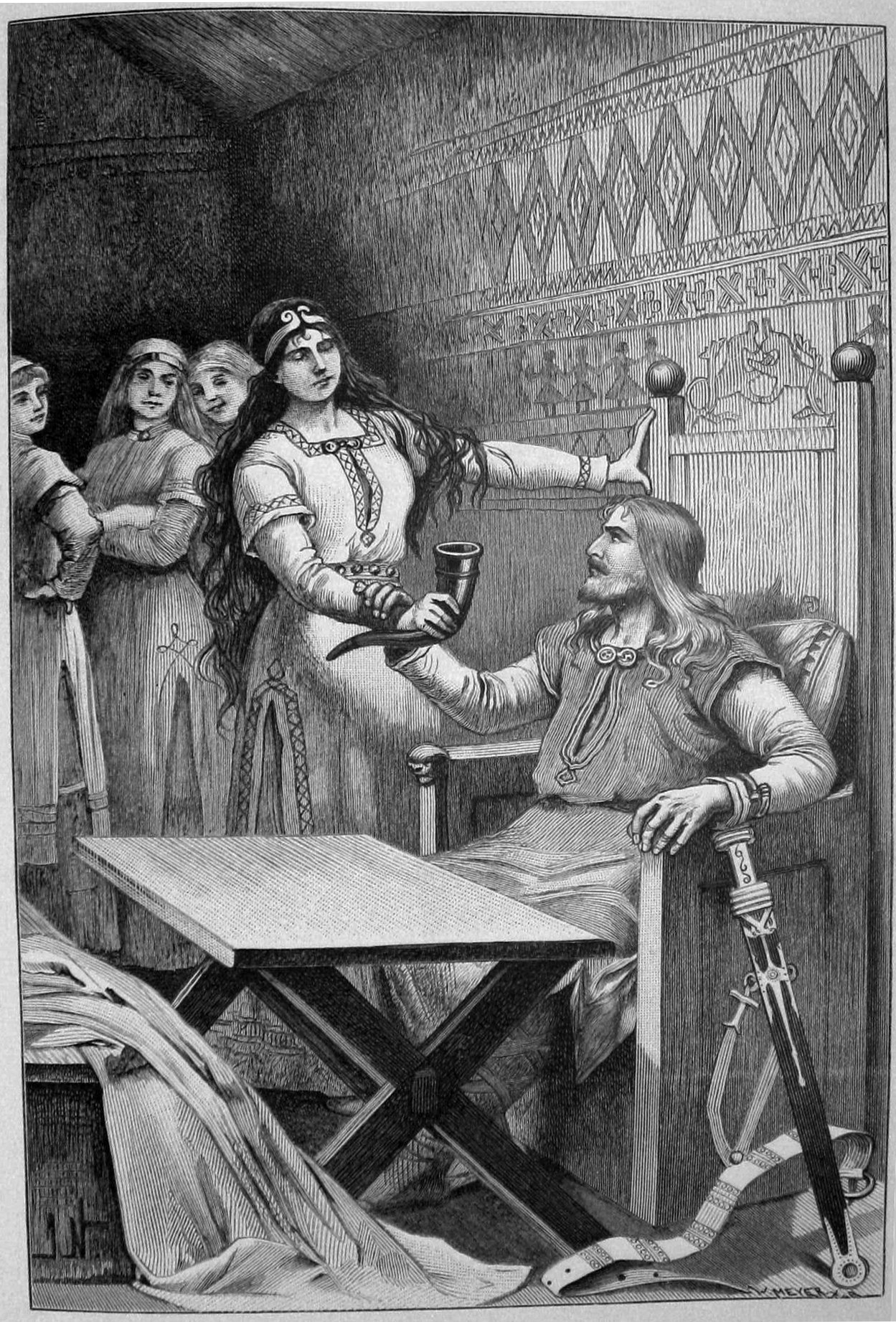
A hero cuts the armour off a sleeping figure, and the woman who wakes does not reproach him. She lectures him: on runes, on beer, on oaths, on how to treat the dead. Sigrdrífumál is the last poem before the great lacuna of the Codex Regius and breaks off there in the middle of a stanza. This article walks through the text in order, keeps verse apart from prose and poem apart from saga, and marks where the wording ends and interpretation begins – with the “pagan prayer”, with the kinds of runes, and with the question whether the valkyrie on the mountain is Brynhild.
“Sigrdrífumál” means “the sayings of Sigrdrífa”. In the Codex Regius, the late 13th-century manuscript of the Poetic Edda, that title does not appear. The text follows straight on from Fáfnismál, Sigurd's conversation with the dying dragon. According to Edward Pettit, editor of a 2023 dual-language edition, the division between the two poems is an editorial decision; it rests on later paper manuscripts, some of which call the piece “Brynhildarkviða Buðladóttur in fyrsta”, the first poem of Brynhild, Buðli's daughter. The title “Sigrdrífumál” too is, according to Pettit, supplied by editors, following modern convention.
Verse alternates with prose sentences that supply the action; scholars call this mixed form a prosimetrum. The metre changes too. Most stanzas are in ljóðaháttr, the metre of wisdom and teaching poetry, some in narrative fornyrðislag, a few in galdralag, the “spell metre” with repeated lines. The translator Henry Adams Bellows (1923) regarded the text as a patchwork assembled by the compiler from fragments and his own prose.
The complete wording is available on this site stanza by stanza in the bilingual reading edition and in three languages in the source archive. Stanza numbers here follow that count (after Guðni Jónsson, 37 stanzas); Bellows and others number differently in places.
At the end of Fáfnismál Sigurd, having tasted the dragon's blood, understands the speech of birds. They advise him to take the hoard and ride to Gjúki's court, then speak of another woman. Stanza 42 names a hall on high Hindarfjall, wrapped in fire on the outside. Stanza 43 says that a “battle-wise” woman sleeps on the mountain and that Yggr – a name of Odin – pricked her with the thorn because she felled other men than he wished. Stanza 44 adds that the hero may see the maid under the helmet who rode from the fight on the horse Vingskornir; no prince's son can break the sleep “of Sigrdrífa” against the decree of the norns.
According to Pettit this is the only place where the word occurs in verse: the stanzas of Sigrdrífumál itself never use the name, which stands only in a prose sentence.
Sigurd rides up onto Hindarfjall, heading south towards the land of the Franks. On the mountain he sees a great light, “as if fire were burning”, shining up to the sky. When he comes near, there is a skjaldborg, a stronghold of shields, with a banner above it. Inside someone lies asleep in full war-gear. Sigurd takes the helmet off and sees that it is a woman. The mail-coat sits as if grown into the flesh. With the sword Gram he cuts it open from the neck down and out through both sleeves. At that she wakes.
The poem's prose speaks of a light like fire and a fort of shields, not of a ride through flames. The vafrlogi, the flickering flame that Sigurd later rides through in Gunnar's shape, belongs in Snorri to a different episode. Fáfnismál already surrounds the sleeper's hall with fire, and in Helreið Brynhildar Brynhild says that Odin enclosed her with red and white shields and set fire burning round her hall. The texts distribute shields and flames differently (see Brynhild).
The woman asks what bit through the mail-coat. Sigurd answers that Sigmund's son did it, with Sigurd's sword. In stanza 2 she says she slept long; Odin so ordained it that she could not shake off the blundstafir, the “sleep-staves”. A prose sentence adds that Sigurd sits down and asks her name, and that she takes a horn full of mead and gives him a minnisveig, a memory-drink.
Then come the two stanzas that made the poem famous. In the first she hails the day and the sons of day, the night and her nipt, her kinswoman, and asks them to look on the two of them “with unangry eyes” and to grant victory to those sitting there. Bellows translates “daughter”, Simrock simply writes “nourishing earth”; Pettit thinks Jörð, Earth, possible, because Snorri makes her night's daughter, but does not call it certain. The second stanza reads in Bellows's version:
“Hail to the gods! Ye goddesses, hail,
And all the generous earth!
Give to us wisdom and goodly speech,
And healing hands, life-long.”Sigrdrífumál, st. 4, translated by Henry Adams Bellows (1923); Old Norse text and Simrock's German version in the source archive
In Old Norse she asks for mál ok mannvit, speech and good sense, and for læknishendr, meðan lifum, healing hands while we live. Victory is asked for once; after that it is language, understanding and healing. Valhalla and death in battle are not mentioned.
These two stanzas are often called the only surviving pagan prayer of the North; our article on the so-called Viking prayer explains why that goes too far. The more careful wording I can document is in English Wikipedia, citing Gro Steinsland and Preben Meulengracht Sørensen (1998): the passage is one of the few direct invocations of the Norse gods that have been preserved and is sometimes dubbed a “pagan prayer”. “One of the few” is not “the only”. Pettit speaks of a greeting to personified powers and a request for their favour.
The stanzas stand in a manuscript written in Christian Iceland, and they are a character's speech in a heroic poem. They do not prove that anyone prayed like this in the 10th century, and how old the words are cannot be established with certainty. Bellows counted stanzas 2 to 4 among the finest things in Old Norse poetry and says much of Act III of Wagner's “Siegfried” rests on those three.
Only now, in a prose passage after stanza 4, does the name fall: she called herself Sigrdrífa and was a valkyrie. She tells of two kings who fought. One was Hjálmgunnarr, old and the greatest of warriors, and Odin had promised him victory. The other was Agnarr, brother of one Auða (manuscript, per Pettit: “Hauðu”). Sigrdrífa struck down Hjálmgunnarr in the battle. In revenge Odin pricked her with the svefnþorn, the sleep-thorn, and decreed that she should never again win victory in battle and should be married. She set a vow against it: to marry no man who could know fear.
Almost nothing more is known of the two kings; Helreið Brynhildar calls Hjálmgunnarr an old man “among the Gothic people”. No text explains what a sleep-thorn is; stanza 2 speaks of sleep-staves, the birds in Fáfnismál of a thorn. A valkyrie, who chooses the slain on Odin's behalf, decides against him and loses her office for it. The punishment is marriage; her vow admits only a man without fear.
Sigurd asks her to teach him wisdom, if she has tidings from all the worlds.
The teaching begins with a drink. She brings him beer, “mixed with strength and great fame”, full of songs and líknstafir, healing staves, of good spells and gamanrúnar, runes of gladness.
Then she lists kinds of runes, each on the same pattern: name, purpose, place of carving. Sigrúnar, victory-runes, belong on the sword-hilt and on two further parts of the weapon called véttrim and valböst; Pettit calls both words obscure. One is also to name Týr twice. Ölrúnar, ale-runes, guard against another man's wife betraying one's trust; they are cut on the horn and the back of the hand, and Nauð is marked on the nail. The full cup is to be blessed and leek thrown in, so that the mead is never mixed with harm. Bjargrúnar, helping-runes, release the child from the mother; they go on the palms and round the joints, and the dísir are asked for aid. Brimrúnar, surf-runes, save the “sail-steeds” at sea; they are cut on stem and rudder-blade and burnt into the oar. Limrúnar, branch- or limb-runes, are for the healer; they belong on the bark and wood of a tree whose branches lean east. Málrúnar, speech-runes, are to prevent anyone repaying harm with hatred; they are wound, woven and set together at the assembly. Hugrúnar, mind-runes, make one wiser than others.
That makes seven kinds, and only twice does the list become specific. Nauð, “need”, is presumably the n-rune (Pettit). And Týr is both a god and the name of the t-rune. Whether stanza 6 means invoking the god or cutting the sign twice, the wording leaves open; Pettit comments only on Týr as a god of victory, while the Wikipedia article, following Lars Magnar Enoksen, assumes the t-rune. Our article on Týr sets inscriptions with clustered t-runes beside the passage. For the other kinds the poem names no sign at all.
On the ale-runes Pettit notes that they may carry a secondary sense of “good-luck runes”, since alu was an early Norse word for good fortune. That word stands on Migration-Period bracteates and amulets, as does laukaz, “leek”; see our article on rune magic. Many centuries separate those inscriptions from the poem; a continuous tradition cannot be demonstrated.
With the mind-runes the tone changes. Hroptr read them, cut them and devised them, says stanza 13, from the liquid that had dripped from the skull of Heiðdraupnir and the horn of Hoddrofnir. Hroptr is a name of Odin; Pettit calls the other two names obscure. Stanza 14 shows someone standing on a mountain with sword and helmet, and then Mímir's head speaks “the first word” and tells “true staves”.
A list follows of places where runes were cut (st. 15–17): on the shield before the shining deity, on Árvakr's ear and Alsvinnr's hoof, that is on the horses of the sun, on Sleipnir's teeth, on the bear's paw and Bragi's tongue, on the wolf's claws and the eagle's beak, on glass and gold, on the point of Gungnir and on Grani's breast, on the norn's nail and the owl's beak.
Stanza 18 tells what became of all these runes: they were scraped off, mixed with the “holy mead” and sent out on wide ways. Now they are with the Æsir, with the elves, some with the wise Vanir, and some are held by humankind. This is a separate origin myth beside Odin's self-sacrifice on the tree in Hávamál. Stanza 19 sums up: these are bókrúnar, helping-runes, all ale-runes and the glorious runes of might, useful to anyone who keeps them unconfused and unspoilt – “until the gods perish”. Whether bókrúnar means “book-runes” or “beech-runes” is open.
Völsunga saga transmits these stanzas with different wording. Where the poem in our archive text has “Grani's breast”, the saga has “the giantess's breast”; for “the luck of men” it has “good silver”, and the victory-runes are for one who wants “to be wise”, not “to have victory”.
The Wikipedia article calls Sigrdrífumál the most prolific surviving source on historical runic magic. The poem attests an idea: runes are cut in particular places and then take effect; names are spoken, help is asked for, leek and beer are used. Egils saga has a related scene in which Egill cuts runes into a horn of poisoned drink.
The poem is not a manual. It says where to carve, almost never what. Every stanza follows the same formula, and the sequence tracks a warrior's life: fighting, feasting, childbirth, seafaring, wounds, lawsuits, wits. Whether practice lies behind it is open. What actually stands on weapons is shown in our article on runic inscriptions on weapons; the basics are in the introduction to runes.
After the rune lore Sigrdrífa puts a choice before Sigurd: speech or silence he must weigh himself; all harms are measured out. Sigurd answers that he will not flee even if doomed; he was not born a coward and wants all her loving counsel as long as he lives (st. 21).
Eleven counsels follow. He should stay blameless towards kinsmen and be slow to avenge their wrongs. He should swear no false oath. He should not argue with fools at the assembly – but if he keeps silent under an insult he will be thought a coward, so he should kill the slanderer the next day. He should not lodge with a witch by the road, nor let fair women rob him of sleep, nor wrangle with drunken men. He should fight rather than be burnt in the house, and seduce neither maiden nor wife. He should care for the dead, whether they died of sickness, at sea or by weapons. He should not trust the son of a man whose father or brother he has killed: “a wolf is in the young son, though he be gladdened with gold.” And he should beware of harm that comes from friends.
Between the numbered counsels stand stanzas that expand them. The one after the ninth is the most unusual: a bath is to be made for the dead, hands and head washed, the body combed and dried before it goes into the kista, the coffin, and one should pray that they sleep in bliss (st. 34). Simrock's German has “let a mound be raised” here; the Old Norse word is laug, “bath”.
The tone of this series recalls Hávamál, especially the counsels to Loddfáfnir with their fixed opening formula. Pettit refers to John McKinnell, who observed correspondences of structure and wording with the second half of Hávamál; if Hávamál was an influence here, the poem would be comparatively late.
The last stanza changes key: not long, it seems to me, will the prince's life be; strong strife has arisen.
In the Codex Regius the text does not reach stanza 37. After the words “This I counsel you sixth, though among men …”, in the middle of stanza 29, the page ends, and the following gathering of eight leaves is missing.
The rest of stanza 29 and stanzas 30 to 37 come from paper manuscripts of the 17th and 18th centuries. According to Pettit they seem to derive from the Codex Regius before the gathering was lost; Bellows in 1923 instead assumed an old parchment as their source, probably not the complete Codex Regius. If Pettit is right, the exemplar predates 1643, since the gap already existed when Bishop Brynjólfur Sveinsson obtained the book that year. That is my inference. Everything from stanza 29 onwards is more weakly attested than the beginning.
How the poem ended is unknown. Völsunga saga gives the counsels in prose, shortened and in a different order, and then has Sigurd swear that he will have her as his wife; she replies that she would choose him if she had the choice of all men, and both confirm it with oaths. Whether the poem contained such a betrothal is open.
The prose of Sigrdrífumál says the woman called herself Sigrdrífa. Völsunga saga tells the same scene with the same stanzas and calls her Brynhild. Snorri writes in Skáldskaparmál that the woman who woke called herself Hildr, “she is called Brynhildr and was a valkyrie”. In Helreið Brynhildar Brynhild tells the story of Hjálmgunnarr, Odin's anger and the sleep as her own and says she was called “Hildr under the helmet”. Grípisspá, by contrast, which summarises Sigurd's life in advance, first announces a nameless ruler's daughter who sleeps on the mountain in her mail-coat and will teach him runes (st. 15–17), and only ten stanzas later introduces Brynhild, Buðli's daughter, who grows up at Heimir's (st. 27) – as if this were a second meeting with another woman.
Then there is the word itself. Sigrdrífa can be understood as “victory-driver”; Pettit also mentions “victory-snowdrift”. In Fáfnismál 44, according to the Wikipedia article, it may be an ordinary word for a valkyrie, a description and not a name. For Bellows it was an epithet of Brynhild that the compiler misread as a proper name. Others reckon with two originally separate figures, a valkyrie on the mountain and a king's daughter, merged in transmission. Pettit states that the basis of the equation is uncertain. The text does not settle the question.
The accounts I consulted give no date of composition. Two latest limits are firm: the writing of the Codex Regius around 1270, and Völsunga saga, whose author knew a version with these stanzas. Anyone who assumes a patchwork, as Bellows did, has to date each piece separately. Bellows himself traced only stanzas 2 to 4 and 20 to 21 with confidence to a poem about Sigurd and Brynhild. Whoever cites the rune stanzas as evidence for the Viking Age should mention this uncertainty.
What is Sigrdrífumál about? Sigurd wakes a valkyrie on Hindarfjall whom Odin has put to sleep. She hails day, night and the gods, hands him a drink, teaches him seven kinds of runes, tells of their origin and gives him eleven counsels for his life.
What does the name Sigrdrífa mean? It is usually explained as “victory-driver” or “she who drives to victory”. Whether it is a proper name or a term for a valkyrie is disputed.
Which runes does the poem name? Victory-runes, ale-runes, helping-runes for childbirth, surf-runes, branch-runes, speech-runes and mind-runes, plus book- or beech-runes and runes of might in stanza 19. Apart from Nauð and Týr it does not say which signs are meant.
Why is the ending uncertain? Because eight leaves are missing in the Codex Regius after the beginning of stanza 29. The last stanzas are known only from much later paper copies.
Is Sigrdrífa the same as Brynhild? Völsunga saga, Snorri and Helreið Brynhildar equate the two or suggest it. The verses of the poem give no name. The question is not settled.
Brynhild · Sigurd the dragon-slayer · The Valkyries · The Völsunga saga · Fáfnismál: Sigurd's Talk with the Dying Dragon.
Sigurd is the greatest hero of the North: the Volsung who kills the dragon Fáfnir with the sword Gram, wakes Brynhild …
Read more →Sindri (called Eitri in some editions) and Brokkr are the dwarf brothers who, according to Snorri Sturluson's …
Read more →A boy kneads a venomous snake into the bread dough and does not flinch. A few years later he is stuck with his father …
Read more →A man skilled in magic, from the island of Hlésey, visits the gods, is given the seat next to Bragi and asks questions …
Read more →