In this poem the dragon fight takes six short sentences, and they are prose. What the verse holds is the conversation afterwards: a mortally wounded serpent asks his killer for his name, warns him off the gold, and answers questions about the Norns and the gods' last battlefield. This article reads Fáfnismál as a text – section by section, with an eye on the manuscript, the metres and the places where editors have stepped in.
Fáfnismál survives in one medieval manuscript: the Codex Regius of the Poetic Edda (GKS 2365 4to), dated on the evidence of its script to about 1270–1280. Edward Pettit, in his dual-language edition of the Edda (2023), gives the leaves as fol. 30r–31v. The name “Fáfnismál”, roughly “Fáfnir's sayings”, is not there. Pettit calls the title post-medieval; it comes from later paper copies.
In the manuscript the text simply runs on. Reginsmál ends with the remark that Reginn urged Sigurðr to kill Fáfnir, and the prose about the ride to Gnitaheiðr follows at once. Henry Adams Bellows wrote in 1923 that the poem follows “without any indication of a break”. According to Pettit there is, however, a red heading – a rubric – before the first stanza: Frá dauða Fáfnis, “Of Fáfnir's death”. Pettit's apparatus calls it rubricated but faded, and illegible in the photograph of the facsimile volume. So the scene has a sub-heading, but the poem has no title.
“Reginsmál”, “Fáfnismál” and “Sigrdrífumál” are therefore cuts that later copyists and editors made in one continuous block of narrative.
Scholars call this kind of mixture a prosimetrum: the action moves forward in terse prose, and the speaking is done in verse. The source archive on this site counts 44 stanzas, following Guðni Jónsson's edition. The prose passages are not reproduced there; I read them in the Old Norse text printed by Pettit.
The opening prose is followed by the exchange between Fáfnir and Sigurðr (stanzas 1–22), broken by one prose sentence after the first stanza. A second passage brings Reginn back, and the two of them trade words (23–31). Another tells of the roasted heart; then the birds speak (32–38) and Sigurðr answers (39). One sentence reports Reginn's death, the birds speak again (40–44), and the closing prose deals with the hoard.
Pettit accordingly reads the piece as a record of verse conversations, not as a narrative lay. Who Fáfnir was and how the legend of Sigurd runs as a whole is told elsewhere on this site.
In Pettit's text the opening prose has six sentences. Sigurðr and Reginn go up onto Gnitaheiðr and find the track Fáfnir makes when he crawls to the water. Sigurðr digs a large pit in the path and gets into it. When Fáfnir crawls off the gold he blows venom, and it passes over Sigurðr's head. When he crawls across the pit, Sigurðr thrusts the sword into his heart. Fáfnir lashes about with head and tail. Then the sentence that makes the conversation possible: Sigurðr leaps out of the pit, ok sá þá hvárr annan – “and then each saw the other”.
The serpent blows venom, not fire; in stanza 18 Fáfnir says so himself: Eitri ek fnæsta, “venom I snorted”. The hero strikes from hiding, and only Fáfnir's scorn comments on it.
The first stanza belongs to the dying one. He asks about parentage, and the same word falls three times: Sveinn ok sveinn, hverjum ertu svein of borinn? – lad, lad, to what lad were you born? Sigurðr dodges. In stanza 2 he calls himself göfugt dýr. Bellows translates “the Noble Hart”, Simrock's German has “wonder-beast”. He is motherless, he says, has no father as other men have, and always goes alone.
The reason is given by the only prose sentence set inside this dialogue. In Bellows's version: “Sigurth concealed his name because it was believed in olden times that the word of a dying man might have great power if he cursed his foe by his name.” With í forneskju, “in ancient days”, the compiler marks the custom as one he regards as past.
Fáfnir sees through it: if you had no father as others have, by what wonder were you born? Stanza 3 has only three lines in the manuscript. Bellows prints two more, in which the dragon accuses the boy of lying, and his note admits they are “conjecturally reconstructed” from the prose of Völsunga saga. In stanza 4 the name comes out after all: Sigurðr ek heiti, Sigmundr hét minn faðir.
Stanzas 5 to 8 are a quarrel. Fáfnir wants to know who put the boy up to it. Sigurðr answers: my heart drove me, my hands helped me, and my sharp sword. He adds a proverb: few are bold in age who were cowards in childhood. Pettit leaves the last line of stanza 5 untranslated as probably corrupt.
Then Fáfnir turns personal. He calls Sigurðr haftr ok hernuminn, bound and taken in war. According to Bellows and Pettit the gibe refers to Sigurðr's mother Hjördís, who was carried off, pregnant, to a foreign king's court after Sigmundr's death. Sigurðr rejects it: bound I am not – you have found that I live free.
Stanza 9 brings the sentence on which the whole legend turns: It gjalla gull ok it glóðrauða fé, þér verða þeir baugar at bana – the ringing gold and the glow-red wealth, those rings will be your death. Sigurðr's reply is sober: every man wants to rule his wealth until the one day, and each must go to Hel once. Fáfnir threatens him with the judgment of the Norns; everything is a peril to the doomed (allt er feigs forað). Where the curse comes from is told in the article on Andvari.
Then Sigurðr changes his tone. Twice he opens a question with the same formula: Segðu mér, Fáfnir, alls þik fróðan kveða ok vel margt vita – tell me, Fáfnir, since they call you wise and you know a great deal. The first question concerns the Norns who help mothers in childbirth. Fáfnir answers that the Norns are of very different descent: some of the kin of the Æsir, some of the elves, some daughters of Dvalinn. The second: what is the name of the island where Surtr and the Æsir will mix “sword-liquid”, that is, blood? Answer: it is called Óskópnir, and there all the gods shall play with spears; Bilröst breaks as they cross the bridge, and the horses swim in the river.
Snorri Sturluson quotes stanza 13 in Gylfaginning, where he treats the Norns; the wording can be compared in the source archive, and Pettit records a small difference in the verb. Vafþrúðnismál names the field where Surtr and the gods meet as Vígríðr (stanza 18). Bellows therefore took Óskópnir to be “apparently another name for Vigrith”; Pettit translates “Unshapen” and wonders whether the place would be created only shortly before the battle. Which reading is right cannot be settled.
The bridge is called Bilröst here, as in Grímnismál 44, not Bifröst as in Snorri; Bellows keeps “Bilrost”, while Simrock silently writes “Bifröst”. More in the articles on Bifröst and Surtr.
Bellows thought stanzas 11–15 “probably interpolated”, taken from a poem similar to Vafþrúðnismál. Pettit, by contrast, stresses how close the whole poem stands to Eddic wisdom poetry. Neither judgment can be proved from the text. What is certain is the form: question formula and answer follow the pattern of the wisdom contest.
In stanza 16 Fáfnir looks back. Ægishjalm bar ek of alda sonum, meðan ek of menjum lák – the helm of terror I bore over the sons of men while I lay on the treasures. Sigurðr answers with a maxim: the helm of terror protects no one where angry men fight; whoever comes among many finds that no one alone is the boldest. The closing line, at engi er einna hvatastr, stands word for word in Hávamál 64, as Pettit notes.
What the ægishjálmr is, the poem leaves open. Pettit allows two readings: an object Fáfnir wore, or an image for the fear he inspired. The prose decides for the object: in Reginsmál Fáfnir owns a helm of terror that every living creature dreads, and at the end Sigurðr takes it from the lair. Nowhere is a drawn symbol mentioned; how the name was later attached to an Icelandic magical stave is explained in the article on Vegvísir and Ægishjálmur.
Stanza 18 again has only three lines; here too Bellows fills the gap from Völsunga saga and says so. After Sigurðr's retort in stanza 19 comes the second piece of advice, its second half word for word as in stanza 9, and Sigurðr's refusal.
“I counsel thee, Sigurth, heed my speech,
And ride thou homeward hence,
The sounding gold, the glow-red wealth,
And the rings thy bane shall be.”
“Thy counsel is given, but go I shall
To the gold in the heather hidden;
And, Fafnir, thou with death dost fight,
Lying where Hel shall have thee.”Fáfnismál 20–21, translated by Henry Adams Bellows (1923)
With stanza 22 the serpent dies. His last word is for his brother: Reginn mik réð, hann þik ráða mun. By Pettit's note Fáfnir is playing on two senses of ráða, “to advise” and “to betray”.
Reginn had gone away during the killing and came back as Sigurðr was wiping the blood from the sword. He calls Sigurðr the most fearless of all men. Sigurðr declines the praise: many a man is bold who never reddens his sword in another's breast.
Then Reginn's tone shifts: you have wounded my brother, ok vald ek þó sjalfr sumu – and yet I myself had a share in it. Sigurðr hands it back: it was your advice that I ride here. In the prose Reginn cuts the heart out of the serpent with a sword called Riðill and drinks the blood from the wound. In stanza 27 he asks Sigurðr to hold the heart to the fire while he sleeps. There follow Sigurðr's reproach that Reginn lay in the heather, Reginn's reminder of the sword he forged, and two gnomic stanzas on courage counting for more than a sharp blade.
The order is an old problem. Bellows writes that the four stanzas from the reproach to the maxims (28–31 in Guðni Jónsson's count) stand in the manuscript after the request to roast the heart, “which fails to make clear sense”; he moves them in front of it, following Völsunga saga. The source archive keeps the manuscript order.
In stanza 29 Reginn calls his dead brother inn aldna jötun, the old giant, and in stanza 38 a bird calls Reginn the frost-cold giant. The prose of Reginsmál, on the other hand, calls Reginn “a dwarf in stature”.
The third prose passage is the most famous. Sigurðr took Fáfnir's heart and roasted it on a spit. When he thought it was done and the juice foamed out of the heart, he touched it with his finger to test it. He burned himself and put the finger in his mouth, and when Fáfnir's heart-blood came on his tongue he understood the speech of birds. The wording does not mention a thumb; it says fingr, as do Snorri and Völsunga saga.
What he hears are igður chattering in the brushwood. Bellows and Pettit write “nuthatches”; Pettit adds: “Or perhaps titmice or tits.” Simrock, in his German Prose Edda, has female eagles, and William Morris and Eiríkr Magnússon, in their Völsunga saga, “wood-peckers”.
How many birds speak is equally unclear. According to Bellows the manuscript has the numerals II, III and IV in the margin; Völsunga saga distributes the speeches among six birds, and Pettit assigns stanzas 32–38 accordingly.
The first voice says Sigurðr would be wise to eat the shining life-muscle himself. The second: there lies Reginn, plotting to betray the one who trusts him. The third advises sending the grey-haired þulr – Bellows has “chatterer” – to Hel shorter by a head. In stanza 39 Sigurðr replies that fate will not let Reginn be his death. Then the prose: he struck off Reginn's head, ate Fáfnir's heart and drank the blood of both, Reginn and Fáfnir.
The last five stanzas look beyond the poem. Bind the red rings together, Sigurðr. Green paths lead to Gjúki, where a king has raised a daughter whom Sigurðr will win with a bride-price. Pettit identifies the unnamed daughter as Guðrún. Then the other road: a hall stands on high Hindarfjall, wrapped in fire on the outside. On the mountain a battle-wise woman sleeps. Yggr, that is Odin, pricked her with the thorn because she felled other men than he wished.
The final stanza contains the word that gave the next poem its name: the prince's son cannot break the sleep of Sigrdrífa against the decree of the Norns. Whether this is a personal name here or a term for the valkyrie, something like “victory-driver”, Pettit leaves open; Bellows translates “the victory-bringer”. Völsunga saga puts Brynhildr in her place. More in the articles on Sigrdrífumál and Brynhildr.
Sigurðr rode along Fáfnir's track to his lair and found it open. The doors and door-frames were of iron, and so were all the beams in the house, and it was dug down into the earth. There he found a great deal of gold and filled two chests. He took the helm of terror, a golden mail-coat, the sword Hrotti and many treasures, and loaded Grani with them. The horse would not go forward until Sigurðr mounted. The prose imagines the serpent as master of a house, not as a beast in a cave.
Most of Fáfnismál is in ljóðaháttr, the “song metre” of Eddic gnomic and dialogue poetry. In the source archive it shows in the layout: the stanzas normally have six short lines – a pair of linked lines and a single full line, twice over. Nine stanzas differ. Bellows lists stanzas 32, 33, 35, 36 and 40–44; they are in fornyrðislag, the narrative “old story metre” with eight short lines. All nine belong to the birds.
Bellows concluded that the fornyrðislag stanzas came from another poem in which several birds speak, and pointed to “we sisters” in stanza 35. That cannot be proved; the metre is an indication, no more.
Völsunga saga retells the material in chapters 18 and 19 (as counted in Guðni Jónsson's edition; Pettit cites the bird scene as chapter 20) and turns the dialogue into prose sentence by sentence, down to “noble beast”. An old man with a long beard advises digging several pits so that the blood can drain away; the saga gives him no name at this point. The thrust goes in “under the left shoulder”. The island is called Óskaptr, and Bilröst is missing. Sigurðr himself cuts out the heart with Riðill; in the poem Reginn does it. Six igður speak. Sigurðr eats only part of the heart and keeps the rest; the saga says nothing of drinking the blood of both brothers. And the sleeper is called Brynhildr straight away.
Snorri tells the episode in Skáldskaparmál in order to explain the skalds' expressions for gold. With him Reginn demands the roasting of the heart as compensation for his brother. The igður sit in the wood, and stanzas 32 and 33 of the poem are quoted. Sigurðr ties the gold into packs; chests, helm and mail-coat are absent. The purpose comes at the end: hence gold is called Fáfnir's lair, metal of Gnitaheiðr or Grani's burden.
Pettit also names Norna-Gests þáttr and Þiðreks saga, the latter with a divergent version.
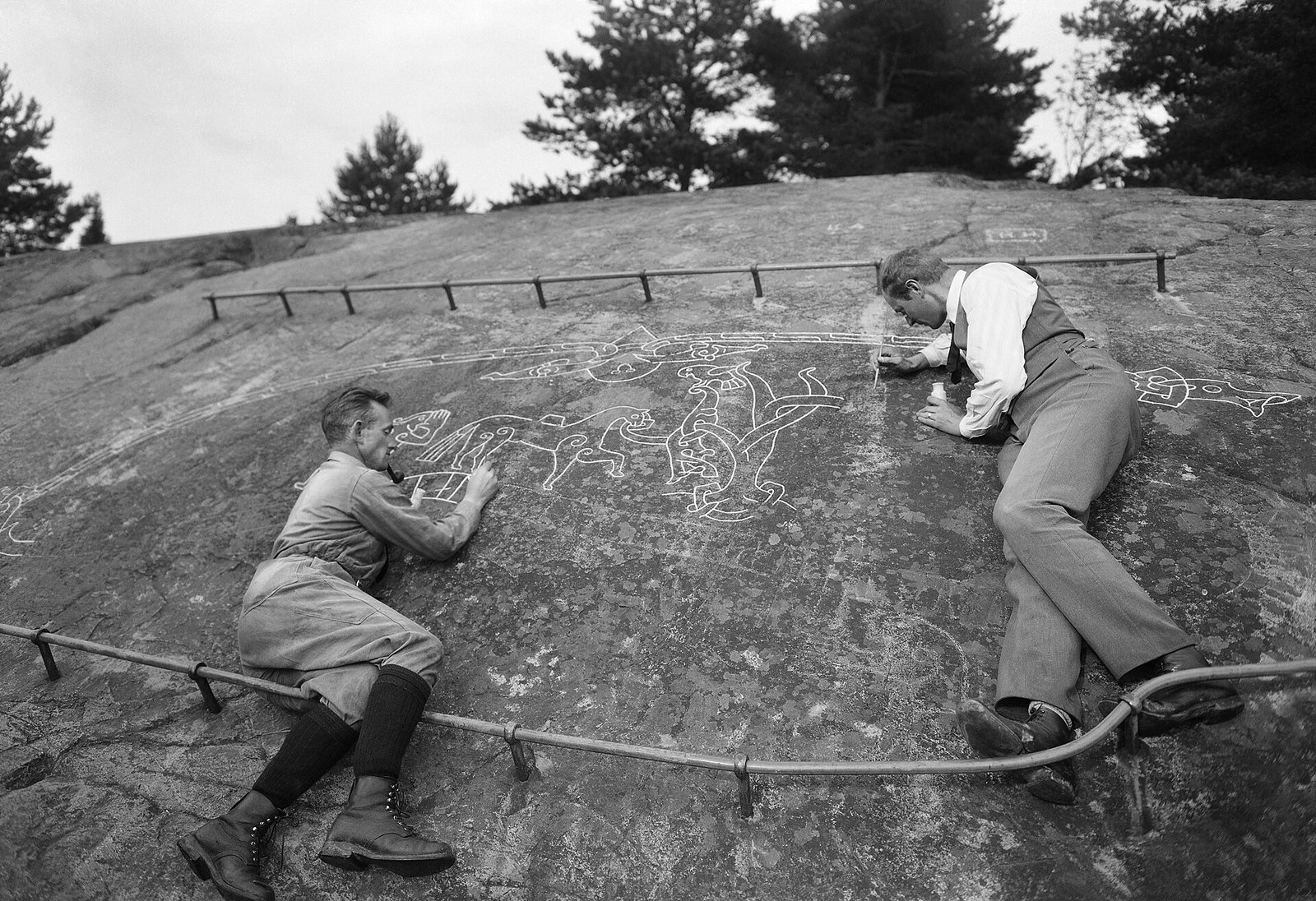
Pettit names two pictorial witnesses: the rock carving at Ramsund in Södermanland, which he dates to about 1030, and the wood-carvings from Hylestad stave church in Norway, of the late twelfth or early thirteenth century. On the usual reading both show the thrust, the roasting of the heart and the finger in the mouth; they are described in the Fáfnir article.
For the burnt finger Pettit points to the Irish tale of Finn mac Cumhaill, who burns his thumb on a salmon and gains knowledge by it. Whether one story depends on the other the comparison does not show. The wider setting is covered in The Dragon in the North.
The serpent turns out to be right: he foretells the curse of the gold twice in the same words and announces Reginn's treachery, which the birds confirm at once. Sigurðr is no silent strongman; he hides his name, parries with proverbs, asks questions of lore and declines the praise. And the deed has no glory in it: it is done from a pit, in prose, and the victim calls the killer a captive.
How old the poem is I cannot say on evidence. The manuscript supplies only a latest date, the 1270s. I found no dating in Bellows's or Pettit's introductions and will not supply one from memory. The Ramsund carving shows similar scenes roughly two and a half centuries before the manuscript; but it attests the story, not this wording.
Whether a single poet shaped the whole also remains open. Only the text of the Codex Regius can be quoted, and that is an edited text of the thirteenth century with a compiler's prose.
What does “Fáfnismál” mean? Literally “Fáfnir's sayings” or “the speech of Fáfnir”; mál means speech. The title is post-medieval; according to Pettit the Codex Regius has only the rubric “Of Fáfnir's death”.
Where is the poem preserved? Complete only in the Codex Regius of the Poetic Edda (GKS 2365 4to). Snorri quotes three stanzas in his Edda, and Völsunga saga gives the content in prose.
Why does Sigurðr hide his name at first? The prose explains it: in ancient days people believed that the word of a dying man had great power if he cursed his enemy by name. In stanza 4 Sigurðr gives his name all the same.
Which birds warn Sigurðr? The Old Norse word is igður. Bellows and Pettit translate nuthatches, and Pettit allows titmice as well; older translations have eagles or woodpeckers.
How old is Fáfnismál? That cannot be established with certainty. The only manuscript dates from the late thirteenth century; the poem must be older than that, but by how much is open. Pictures of the story exist from the eleventh century.
Read Fáfnismál in two languages (Old Norse and Bellows) · Fáfnismál in the source archive · Fáfnir: from son to serpent · Sigurd the dragon-slayer · Völsunga saga · Sigrdrífumál: the awakened valkyrie · The Codex Regius · Andvari and the curse of the gold · Vegvísir and Ægishjálmur · Vafþrúðnismál
Fafnir – the Dragon · Sigurd the dragon-slayer · The Völsunga saga · Vegvísir & Ægishjálmr · Sigrdrífumál: what the awakened valkyrie teaches Sigurd.
There is not a single story about Loki's parents. No poem tells how they met, no scene shows them with their son, no …
Read more →Fenrir (also Fenrisúlfr, the "Fenris wolf") is the monstrous wolf of Norse mythology: a son of Loki and the giantess …
Read more →Before the gods fall, the cold comes. That is how Snorri Sturluson tells it around 1220: three winters in a row, snow …
Read more →A single n separates two figures of Norse mythology. Fjörgyn, feminine, is a name of the Earth and so of Thor's mother …
Read more →