The Mørstad hoard is the largest Viking-Age coin hoard ever found in Norway. On 10 April 2026 two metal detectorists picked up the first silver coins in a field by the river Glomma near Rena in Østerdalen – and their detectors simply would not stop beeping. By early October 2026 archaeologists had counted around 5,200 coins, and the dig is not over yet. Here is what was found, what the coins reveal and which questions remain open.
The find spot lies on the farm of Mørstad in Åmot municipality, Innlandet county, in a field near the river Glomma. Nobody had searched it with metal detectors before. Rune Sætre and Vegard Sørlie asked the landowner for permission first, and the landowner turned out to be Ole Erik Hørstad, the mayor of Åmot. On 10 April 2026 the two detectorists came across the first coins. After nineteen of them they stopped and called the county archaeologists. Exactly as it should be done.
The next day a team was in the field, and after the first day of excavation some seventy coins lay on the table. "The detectors never stopped beeping," said May-Tove Smiseth, the Innlandet County Municipality archaeologist responsible for metal-detector finds. Her first guess had been that the total would not exceed 500. She praised the finders for reporting straight away and following the rules to the letter. The find was only announced at the end of April, once the site was secured.
The figures over the following months read like a serial. On a good day around 200 coins came out of the ground. At the end of April the count stood at 2,970, on the morning of 1 May at 3,274, a week later at over 4,000. Coin number 4,000 was a Danish penny of Harthacnut, son of Cnut the Great, probably struck in Lund around 1030–1035. By mid-May the tally was 4,772, and by early summer 4,886.
When excavation and radar turned up nothing more, the landowner sowed his grain. After the harvest the detectorists returned, this time with an excavator, because the remaining signals were coming from deeper down. At the end of September the archaeologists held coin number 5,000 in their hands – an Otto-Adelheid penny, one of the most common types in the whole hoard. On 1 October 2026 the count stood at around 5,200. According to a report from 5 October, Smiseth even thinks more than 6,000 is possible.
For comparison: Norway had known Viking-Age coin hoards of around 2,000 coins, but none with more than 3,000. Mørstad is larger than the next four Norwegian finds combined. Svein Harald Gullbekk, professor of numismatics at the Museum of Cultural History in Oslo, called it "truly exceptional". It is not the largest Viking-Age silver hoard of all: on Gotland the Spillings hoard came to light in 1999 with more than 14,000 coins, mostly Arabic dirhams. For Norway, however, Mørstad is a record.
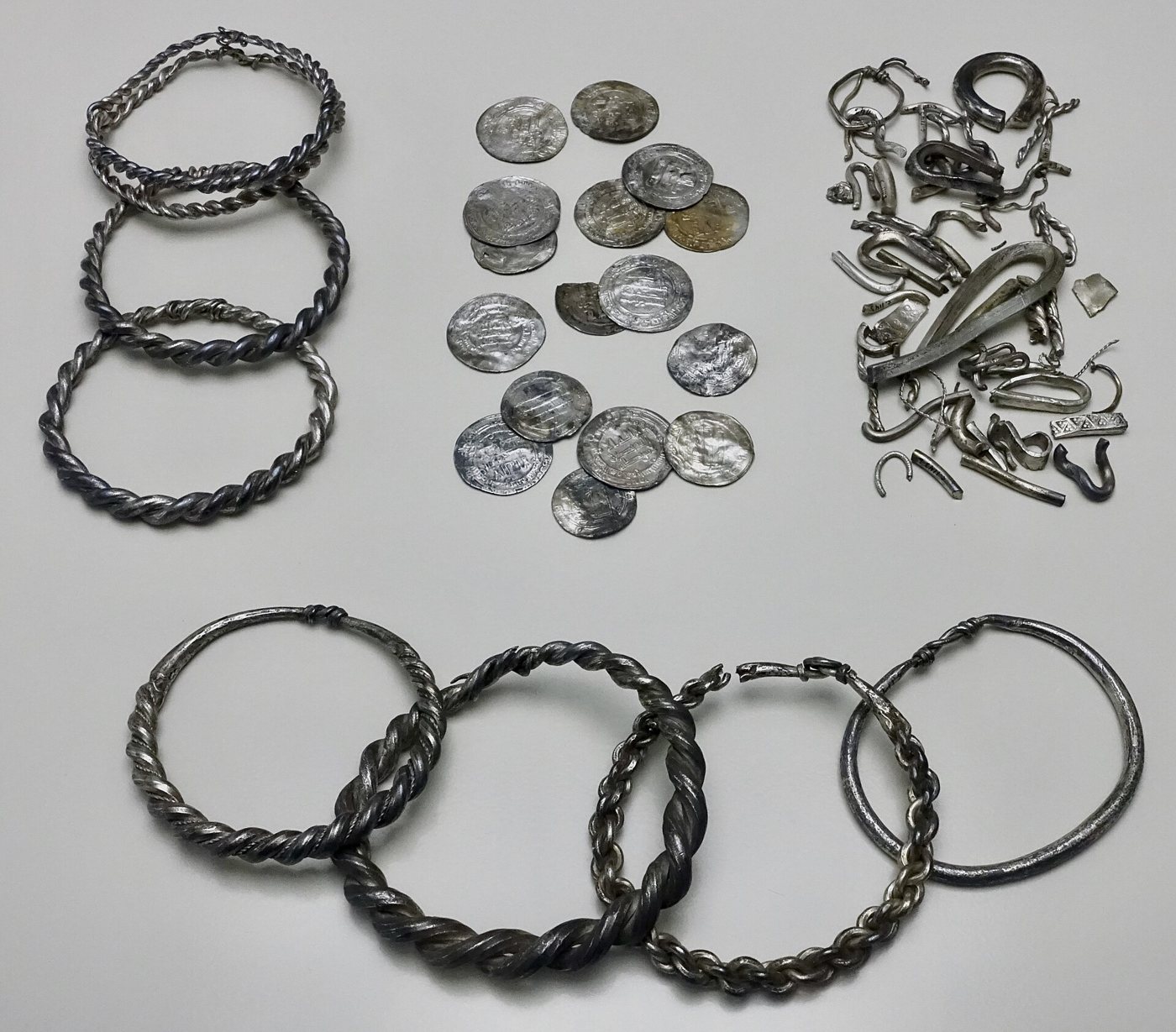
Alongside the coins, a few small pieces of hacksilver were found. The coins did not lie in a pot. They were probably kept in a leather pouch or another container of organic material that has rotted away. The plough then spread the contents across the field – though in Smiseth's estimate only for about a decade, not for centuries.
A hoard in the ploughsoil has lost its original context, but every coin still carries one piece of information: where it lay. Each was rinsed with water, put into its own bag and labelled with exact coordinates. The points soon showed a clear concentration, which told the team where to dig.
There the topsoil was removed carefully in grids – surveyed squares – and both the loose soil and the sandy subsoil beneath were examined. No container and no wooden structure turned up. The Norwegian Institute for Cultural Heritage Research (NIKU) surveyed the field with ground-penetrating radar, which maps disturbances below the surface without digging. The result: no buildings, no pits, no other structures from the period.
The soil itself was a stroke of luck. It contains very few stones, which probably explains why the coins survived so well. Many are shiny, only a few are blackened by oxidation, and Smiseth said some "almost look newly minted". The coins are also whole, not clipped or hacked, which suggests they circulated as money rather than as raw silver.
The hoard is a cross-section of northern Europe's money in the first half of the 11th century. More than 95 per cent of the coins come from kingdoms in what is now England and Germany. The rest are Danish, Swedish, Bohemian, Irish and Norwegian issues, plus, according to the Norwegian encyclopedia Store norske leksikon, a few Islamic dirhams.
A typical member of the German group is the Otto-Adelheid penny. It carries the names of Emperor Otto III and his grandmother Adelaide, was struck in the Harz region from the 980s onwards and kept almost the same design until around the middle of the 11th century: a cross on one side, a stylised church building on the other.
Familiar names appear: Æthelred II, from whom the Danes extorted vast sums of Danegeld – one coin shows him in profile with the legend "Ethelred". Cnut the Great, who for a time held England, Denmark and Norway together. And some English coins carry the names of their moneyers, which sound suspiciously Norse: Beorn, Aslac, Cetil. Numismatist Anne Skogsfjord, who is cataloguing the hoard, identified them. Men of Scandinavian origin evidently worked in England's mints.
Exactly how many coins come from which mint and which type has not yet been published. English coins of the period changed their design roughly every six years, which is why specialists can often date them quite closely; that fine-grained analysis will come with the catalogue. One coin shows traces of a suspension loop: someone wore it as jewellery for a while before it went back to being money.
The oldest coins were struck around 975 to 980, the youngest around 1050. But it is the youngest pieces, not the oldest, that reveal when the hoard went into the ground.
Among the thousands of coins are four rather unassuming ones. They are early issues of Harald Hardrada, the king who fell at Stamford Bridge in 1066. Harald became co-king of Norway in 1046 and ruled alone from 1047, so his coins cannot be older than that. This settles it: the hoard was buried after 1046/47, probably not long afterwards.
How do you recognise an early Harald coin? By its inscription, style and silver content – the first issues contained noticeably more silver than later ones. Before Mørstad, only about 15 to 20 specimens of this earliest group were known, along with some 250 of the later variants. These are also the first coins of Harald Hardrada ever found in Østerdalen; earlier finds come from Western Norway and the Oslofjord area.
Most of his coins were probably struck in Trondheim, some in Hamar, and a few name their mint. They show a triquetra and a cross – a fine example of how naturally old signs and Christian symbolism sat side by side at the time; on these coins the triquetra is read as a sign of the Trinity. The triquetra has its own article.
"Here we see the beginning of a radical change in the means of payment in Norway."Jon Anders Risvaag, NTNU, on the Mørstad coins (translated)
Before he became king, Harald had spent many years in the service of the Byzantine emperor. Gullbekk and Risvaag see this as an inspiration for what he built in Norway: a coinage controlled by the king. Before Harald, every coin in the country was foreign. The first silver penny struck in Norway does belong to Olaf Tryggvason, minted at Nidaros between 995 and 998 – but not a single example has been found in Norway itself, only in Sweden, Denmark and Germany.
Harald's penny weighed about 0.90 grams, one 240th of the old Norwegian mark of roughly 214 grams. It was struck at Nidarnes, today's Trondheim, and at Hamar. The truly radical part was the silver content. According to the University of Oslo coin cabinet, it started at the international standard of about 90 per cent and fell, deliberately and steadily, to an average of just over 30 per cent over his reign. The rest was copper.
That only worked if people accepted that a coin was worth what the king said, not what its silver weighed. Risvaag describes exactly this leap: from silver value to face value. The later Trondheim coins were no longer tested for their silver. Apart from Byzantium, Norway was the first land in northern Europe to use low-silver coins; the rest of the continent followed around 1100.
In Morkinskinna, an Icelandic kings' saga of the 13th century, the Icelander Halldór Snorrason, one of Harald's own retinue, refuses to accept payment in these coins and throws them away. Late tradition, but telling. The coin finds show that Harald's money was used and hoarded across the country all the same. By his death in 1066, about two-thirds of the coins in circulation were Norwegian. His sons Magnus Haraldsson and Olaf Kyrre finished the job, and Olaf Kyrre withdrew almost all foreign coins – and his father's – from circulation.
To see why numismatists are so excited, you need to know how Vikings paid. For much of the Viking Age, silver in the North was a commodity that was weighed. Coins, arm rings and ingots were hacked up and weighed on small folding scales with standardised weights. Whether a coin came from Baghdad or London made no difference; weight was what counted. More in our article on Viking silver hoards.
In the 11th century that began to change. The Mørstad hoard stands right on the threshold: little hacksilver, a great many whole coins, among them the first of the Norwegian king. Gullbekk put it this way: this is the birth of the monetary system we have today.
How fast the change happened shows in another Norwegian hoard, from Gresli in Tydal, Trøndelag. According to the coin cabinet's find list, it holds 2,209 Norwegian pennies, 38 German ones, two Danish pennies, two imitations of Anglo-Saxon coins and two unidentified pieces. Its youngest coins belong to the decades around 1080 to 1095. Within a few decades of Mørstad the picture had flipped completely: there, almost all foreign money; at Gresli, almost all home-grown.
The ranking of Norway's largest Viking-Age coin hoards tells the same story. After Mørstad come Årstad near Egersund (found around 1836–1843, 1,849 coins, buried after 1029), Dronningens gate in Trondheim (1950, about 964 coins, after 1035), Foldøy near Jelsa (1907, 776 coins, after 1051) and Slethei in Sola (1866, 587 coins, after 1018). The Trondheim hoard was left unguarded overnight, passers-by helped themselves, and only 69 coins came back under an amnesty. So much for reporting finds properly.
On Gotland, by contrast, the older hoards are full of Arabic dirhams that travelled along the rivers of eastern Europe. The Spillings hoard was buried after 870, almost two centuries before Mørstad. Read more in our piece on the Gotlanders. Mørstad belongs to a later world, one shaped by English and German silver.
That leaves the question of why so much silver lay in Østerdalen, far from the coast and the big trading towns. The most convincing answer is iron. Kjetil Loftsgarden, archaeologist at the Museum of Cultural History and project leader of the excavation, says the hoard gives a striking picture of the wealth that iron production created. The farmer at Mørstad, he thinks, probably made iron himself.
The evidence lies more or less next door. Also in Åmot municipality, the Museum of Cultural History investigated a whole landscape of ironmaking between 2003 and 2007 in the Gråfjell area, now the Regionfelt Østlandet military training ground. The project registered 109 iron production sites and excavated 39 of them, along with hundreds of charcoal pits and ore-roasting places. Most excavated sites date from about 950 to 1300. The raw material was bog iron, ore that had formed in bogs and wetlands. Some sites of this Hedmark tradition left more than 80 tonnes of slag behind.
Loftsgarden reckons on about two to four tonnes of iron per site and thousands of such sites, run by specialised farmers across the inland valleys. The mid-11th century was a time of growth in Europe: more people, new towns, rising church and royal power. Iron was in demand. Denmark, for one, had no iron production of its own and imported iron, partly from Norway.
In that case the silver was not looted on raids but earned with iron. That fits a picture we see elsewhere too: most Scandinavians of the Viking Age were farmers, craftspeople and traders, not raiders. More on that in how the Vikings really lived.
Gullbekk calls the hoard evidence of payment on a large scale, linking Østerdalen to an international trading network. The route can at least be sketched: rivers like the Glomma were key transport arteries in the Viking Age, and iron travelled down them towards the coast and on to iron-poor Denmark. Silver came back.
Where that silver originally came from is written on the coins. The English pieces recall that in the first half of the 11th century enormous sums flowed from England to Scandinavia – as Danegeld, as pay for Cnut's warriors and as trading profit. Swedish rune stones remember such men: see the England-farers. German silver reached the North through the trading places of the North Sea and the Baltic.
Whether the coins accumulated in small sums over years or arrived in a few large payments will only become clear once types and minting dates are analysed. For the bigger picture, see our article on Viking trade.
That is the big open question, and Norway's Director-General of Cultural Heritage, Hanna Geiran, asked it publicly: why was the hoard deposited right here at Rena, and who buried it? She even wondered whether Harald Hardrada himself might be connected. There is no certain answer. Here are the interpretations so far.
A family's savings. Gullbekk thinks this may have been the wealth of a farm – a sort of safe deposit in the ground. No written prices survive from the North for this period, so he compared the sum with property deals from the 13th and 14th centuries and concluded it might perhaps have bought a whole farm. A comparison across two centuries, so only a rough guide.
A hiding place by the river. Knut Paasche of NIKU suspects the hoard was hidden deliberately away from any house, since a home is the first place thieves look. His colleague Lars Gustavsen studied how the river's course has shifted over time, and Paasche thinks the spot may then have lain on an island or a rise in the river.
Hiding place or offering? Whether someone hid their money in uncertain times and never came back, or laid the hoard down deliberately as a gift, cannot be decided at present. Store norske leksikon considers a deposit meant to be retrieved the more likely option. Loftsgarden put it drily: you don't forget where you buried almost 5,000 silver coins. Something dramatic must have intervened. What, we do not know.
The coins belong to the Norwegian state under section 12 of the Cultural Heritage Act of 1978. Section 13 provides for a finder's reward. The amount is set by the Directorate for Cultural Heritage (Riksantikvaren) on the recommendation of the responsible museum, and the decision is final.
For gold and silver there is a clear floor: at least the metal value by weight plus at least ten per cent. Rarity, condition and the finders' conduct can push it higher. Reporting immediately, stopping digging and leaving the site untouched can raise the reward; carrying on digging risks reductions or losing it entirely. If archaeologists find more pieces during the follow-up investigation, the whole find is assessed and the reward goes to the first finder. Finder and landowner normally split it fifty-fifty, and the reward counts as taxable income. How much will be paid for Mørstad has not been made public.
Gullbekk expects the site to be investigated for a couple more seasons. Identifying and cataloguing the coins alone will take at least a year: every coin is identified, conserved, photographed and entered into the museum database. Norway's Ministry of Climate and Environment, which is responsible for cultural heritage, has provided 1.2 million kroner for excavation and radar surveys. The coins are held in the coin cabinet of the Museum of Cultural History in Oslo, which has promised a public exhibition.
How many coins will there be in the end? Which mints and types are in the hoard? Will further Norwegian issues shift the 1046/47 date? Can the river course around 1050 be reconstructed well enough to test the island idea? Only the catalogue will tell. We will update this article when it appears.
For us, the Mørstad hoard shows what one responsible phone call is worth, and how closely Norway around 1050 was tied to England and the Empire. It also reminds us that behind every hoard stands a person who put it in the ground and never came back.
How many coins are in the Mørstad hoard? On 1 October 2026 the count stood at around 5,200 silver coins, plus a few pieces of hacksilver. Excavation continues, and the county archaeologist thinks more than 6,000 is possible.
Where was the Mørstad hoard found? In a field on the Mørstad farm near Rena in Åmot municipality, Innlandet county, close to the river Glomma in Østerdalen, eastern Norway.
How old is the Mørstad Viking hoard? The coins were struck between about 975 and 1050. Four early coins of Harald Hardrada show that it was buried after 1046/47.
Is the Mørstad hoard the largest Viking hoard ever found? No. It is the largest Viking-Age coin hoard in Norway. The Spillings hoard on Gotland contains more than 14,000 coins.
Do metal detectorists get paid for finds in Norway? A finder's reward is possible. For silver it is at least the metal value plus ten per cent, normally split between finder and landowner.
Can I see the Mørstad hoard? Not yet. The coins are being studied at the Museum of Cultural History in Oslo, which has announced an exhibition.
For courage. For remembrance. For legends that live on.

Harald Hardrada · The silver hoards · Hacksilver – silver as currency · The Spillings Hoard · Cnut the Great · Viking Trade.
All History & Finds articles →
Whoever won did not always keep the spoils. In the Roman Iron Age, Germanic victors sank the entire equipment of …
Read more →The Morini were a Belgic-Celtic coastal people on the English Channel, in the area of today's French-Belgian border …
Read more →Hold a well-preserved blade from the Migration or Viking age in the right light and you notice something strange: a …
Read more →The Nahanarvali were a sub-tribe of the Lugian league in eastern Germania. They are famous for an ancient sacred grove.
Read more →
_Museum_Oslo._VIKINGR_Norwegian_Viking-Age_Exhibition_01_Silver_hoard_(s%C3%B8lvskatt)_found_at_Teisen,_Oslo,_deposited_after_919._Armrings,_Arabian_and_Persian_coins,_hacked-up_ingots,_jewelry,_coins,_etc._4896.jpg)