A Norwegian book of the thirteenth century claims that its stories come from German men, and it names three towns they came from: Soest, Bremen and Münster. Þiðreks saga af Bern gathers almost everything medieval continental Europe told about Dietrich von Bern, Wayland the smith, Sigurd and the Niflungs, and arranges it as a single biography. This article sets out what the saga says about its own origin, how it has come down to us, where it differs from the Nibelungenlied and the Edda, and why Dietrich's "Bern" is not on the Rhine.
Most Old Norse sagas deal with Iceland, Norway or the Nordic past. Þiðreks saga af Bern does not. Its hero is Þiðrekr, the Dietrich von Bern of German heroic legend, and its settings lie between Italy and the Baltic. The prologue maps the ground: the story begins in Apulia and runs north through Lombardy, by way of Venice, Swabia, Hungary, Poland, Russia and the land of the Wends to Denmark and Sweden, through all of Saxony and Francia, and west as far as Spain.
The language is Old Norse; the matter is German. Dietrich's youth, his companions, his exile at the court of the king of the Huns and his return form the frame. Set into it are tales that elsewhere stand alone: the story of the smith Velent, that is Wayland, the youth of Sigurd, the flight of Walter and Hildegund, the fall of the Niflungs. Nearly all continental heroic legend is bundled into one narrative.
The text opens with a preface that speaks unusually openly about the author's work. Its best-known sentence runs: "Þessi saga er ein af þeim stærstum sögum, er gervar hafa verit í þýðverskri tungu" – this saga is one of the largest that have been made in the German tongue. It tells of King Þiðrekr and his champions, of Sigurðr Fáfnisbani and the Niflungs, of the Vilkinamenn and many other kings.
The author knows that the same matter circulates in the North. Danes and Swedes can tell many stories about it and have put some of it into songs. "Norrænir menn", people of Norse speech, have also gathered part of it, some of it in verse. As examples he names Sigurðr Fáfnisbani, the Niflungs and the smith Velent.
Of his own source he says that the saga is put together from the account of German men and partly from their songs. Take one man from every town in Saxony, and each will tell the story alike; their old songs are the reason. He compares the exaggerations of these songs with skaldic praise and cites a stanza by the skald Hallfreðr on Olaf Tryggvason – he writes for an audience that knows skaldic verse.
The prologue places the action after the death of the emperor Constantine the Great. It explains the heroes' strength by the idea that people after the Flood were as large as giants and have weakened since. It closes with praise of storytelling, which costs no money and puts no one in danger.
A second statement about sources stands in the middle of the text, at the end of the Niflung narrative, in chapter 394 by the numbering that Guðni Jónsson's edition also uses. There the narrator appeals to people who know the scene.
"Hér má nú heyra frásögn þýðerskra manna, hversu farit hafa þessi tíðendi … Þeir menn hafa oss ok sagt í frá þessu, er fæddir hafa verit í Brimum eða Mynstrborg." – Here one may now hear the account of German men of how these events came about … Those men too have told us of this who were born in Bremen or Münster.Þiðreks saga af Bern, ch. 394 (excerpt from two sentences), Old Norse text after Guðni Jónsson, heimskringla.no; my own translation
The real point lies between the two sentence openings quoted here. Some of these men, the text says, were born in Susat, where it all happened, and have seen the places: the spot where Högni fell, the one where Írungr was killed, the snake tower in which King Gunnarr met his death, the garden still called the garden of the Niflungs, and the western gate, called Högnahlið. The people from Bremen and Münster knew nothing of one another and yet all told it alike.
Susat is Soest in Westphalia; the edition spells the name Susa, Susam or Susat depending on the construction. What the passage proves is limited: in the thirteenth century people in Soest evidently pointed out places where the fall of the Niflungs was supposed to have happened. Whether the Norwegian author heard such men himself, or found the appeal in a source, cannot be established. That question is exactly where the theories of origin part ways.
According to the English Wikipedia, most scholars date the saga to about 1250 and place it in Bergen, at the court of King Hákon Hákonarson (Hákon IV). German merchants in Bergen could bring Low German stories with them, and the courtly vocabulary of the saga matches the translations produced at Hákon's court.
Direct evidence is lacking. Neither the prologue nor any other passage names Hákon, Bergen or a patron. The author is unknown; whether he was Norwegian or Icelandic is disputed. He was educated, probably a cleric.
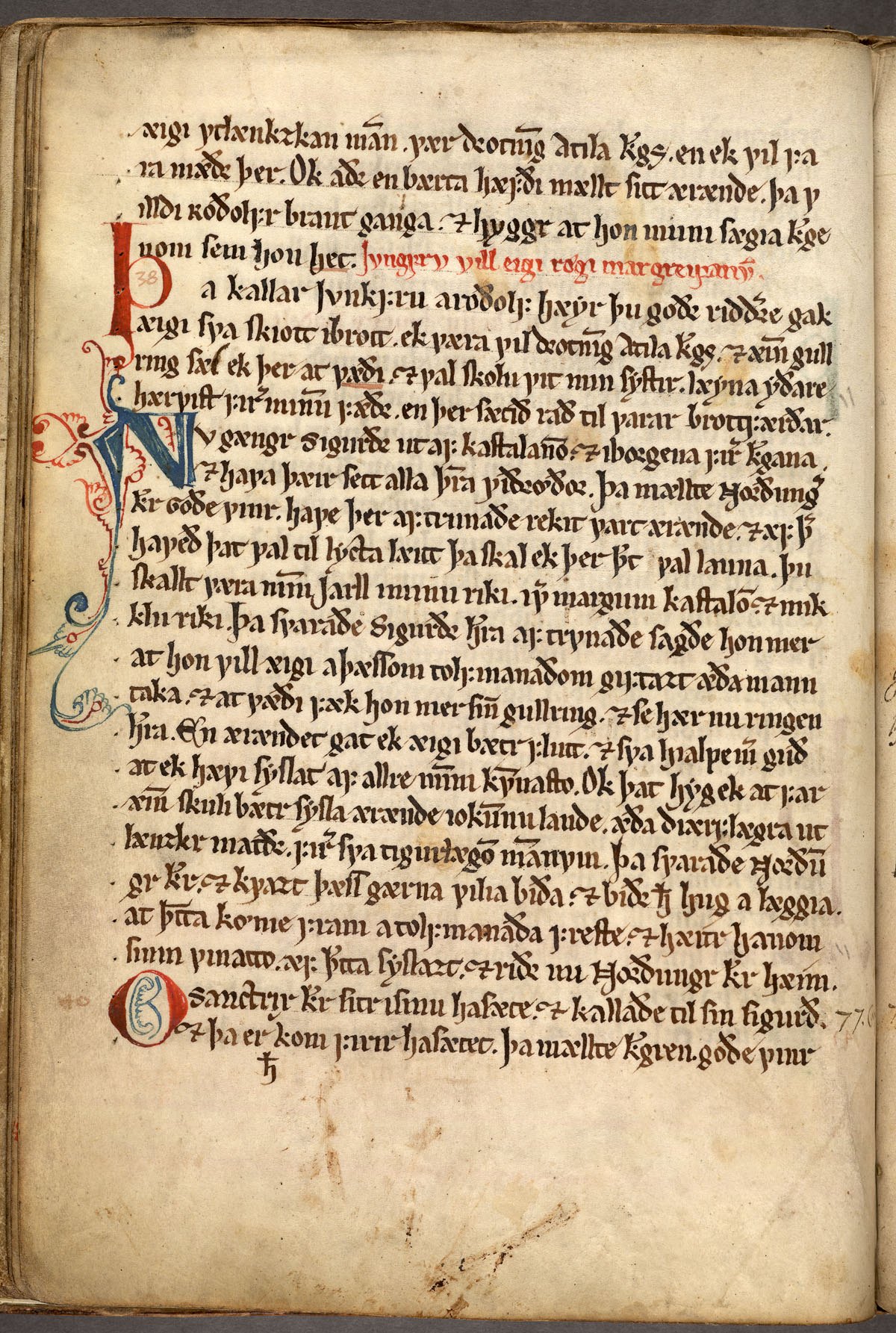
The most important manuscript is kept in the Royal Library in Stockholm under the shelfmark Perg. fol. nr. 4. Scholars call it the Stockholm membrane, Mb for short. It is a Norwegian parchment. The manuscript catalogue of the National Library of Sweden lists it as "Isl. perg. fol. 4", of Norwegian origin, from the second half of the thirteenth century; the English Wikipedia narrows this to about 1275–1300. Bergen as the place of writing is a conjecture. According to the German Wikipedia, a book list of Árni Sigurðarson, bishop of Bergen in the early fourteenth century, records a Þiðreks saga that may be this manuscript.
Mb now has 129 leaves, according to the German Wikipedia out of an original 162, with losses mainly at the beginning and end. Five scribes worked on it; the two main ones, Mb2 and Mb3, followed two different versions of the text. As a result the section on the kings of the Wilzi, the so-called Vilkina saga, appears twice in the manuscript.
Where the membrane is silent, seventeenth-century Icelandic paper manuscripts help, copied from lost parchment exemplars: A (AM 178 fol.) and B (AM 177 fol., dated 1690–1691), both from the collection of Árni Magnússon. Since the membrane lacks its beginning, the prologue can only come from this younger Icelandic tradition.
There is also an Old Swedish adaptation, Didrikskrönikan (also Didriks Krönika or "Sagan om Didrik af Bern"). Made around the middle of the fifteenth century, it survives in two manuscripts from around 1500, Skokloster E 9013 and Stockholm K 45 4to. It abridges heavily and smooths out contradictions. The prevailing view is that it rests mainly on the membrane.
The material hangs on Dietrich's life. Grandfather and father come first; in Guðni Jónsson's edition the opening section is called "Samsons þáttr". Then follow Þiðrekr's youth, the gathering of his companions, campaigns and bridal quests. Later his uncle Erminrekr drives him out. Þiðrekr flees to Attila's court, tries in vain to win back his realm and loses his brother and Attila's sons. He is drawn into the fall of the Niflungs, at last regains Bern and in the end rules the land of the Huns as well.
Thomas Klein proposed a division into three parts, which Susanne Kramarz-Bein adopts: youth and the gathering of heroes, marriages, old age and death. The section titles of the normalised edition show the modular design: Velents þáttr smiðs, the þáttr of Þéttleifr the Dane, of Herburt and Hildr, of Valtari and Hildigunnr. A þáttr is a short, self-contained tale.
Behind Dietrich von Bern stands, on the majority view, the Ostrogothic king Theoderic the Great, who ruled Italy until his death in 526. "Bern" is the old German name for Verona, where Theoderic defeated Odoacer in 489. In the saga Þiðrekr's father is called Þéttmarr, in German legend Dietmar; Theoderic's father was Thiudimir. See the article on the Ostrogoths for the historical side.
The similarities largely end there. The historical Theoderic conquered Italy and was never driven out. Attila died in 453, roughly around the time of Theoderic's birth, and the Gothic king Ermanaric, the model for Erminrekr, had then been dead for some eight decades. Legend makes all three contemporaries and kinsmen.
The saga describes its hero closely: tall, broad-shouldered, with fair, curling hair, and beardless even as a grown man. His foster-father is Hildibrandr, son of Duke Reginbaldr of Venice (Fenidi), who brings up the five-year-old prince; the saga compares their friendship to that of David and Jonathan. The dwarf Álfrekr procures the sword Naglhringr for him. He finds his helmet in the hoard of the couple Grímr and Hildr, whom he and Hildibrandr kill – and because each of the two wanted the helmet named after themselves, it is called Hildigrímr.
Þiðrekr has a circle of companions, and each brings his own story. The first is Heimir, son of the horse-breeder Studas: he challenges Þiðrekr to single combat, breaks his sword Blóðgangr on Þiðrekr's helmet and then becomes his man.
The most famous insertion is Velents þáttr. The North also knows the captive smith who takes revenge on King Niðungr from the eddic Völundarkviða; the saga tells the story at greater length. Velent learns his craft from the smith Mímir and from dwarfs, he escapes in a feather garment of his own making, and his son is Viðga, the Wittich of the German Dietrich epics. Our article on Völund compares the versions; the Old English Deor shows how widely the story travelled.
Readers of Völsunga saga will hardly recognise Sigurd here. His father is called Sigmundr, but rules a land named Tarlungaland; his mother is Sisibe, daughter of King Niðungr of Spain. While Sigmundr is away on campaign, two counts slander the queen, who has rejected them. In the forest she gives birth to a boy; the child ends up in a glass vessel in the river, and the mother dies.
The vessel breaks on a sandbank. A hind carries the infant in her mouth to her lair and suckles him for twelve months with her own young. Then the smith Mímir finds him and brings him up. The boy grows so strong that he smashes anvil, hammer and tongs. Mímir wants rid of him and sends him into the forest to a dragon – the dragon is Mímir's own brother Reginn, transformed by sorcery.
The roles are reversed. In the eddic lays and in Völsunga saga Reginn is the smith and foster-father and Fáfnir the dragon. In Þiðreks saga the smith is Mímir and the dragon Reginn. Sigurd kills the beast, boils the meat, burns himself on the broth and tastes it. Two birds tell him that the dragon was Mímir's brother and that Mímir wanted him dead. He smears himself with the blood, and wherever it reaches, his skin becomes like horn: "allt þar, sem á kom, er eftir sem horn sé". Only between the shoulders he cannot reach. There is no linden leaf here, as in the Nibelungenlied; the vulnerable spot is simply beyond the reach of his arms.
Mímir promises the returning youth armour, the sword Gramr and the stallion Grani. Sigurd takes the sword and kills him with it. He fetches the horse from Brynhildr, in whose stud it stands. The chapter describing Sigurd passed almost word for word into Völsunga saga – a fixed point for the order of the two works.
In the saga the Niflungs live in the city of Vernisa in Niflungaland. Gunnarr is king; Högni, Gernoz and Gíslher appear as his brothers. Sigurd is married to their sister Grímhildr. Quarrelling over rank, Grímhildr tells Brynhildr that Sigurd took her maidenhood, and shows a ring as proof. Brynhildr demands revenge.
Högni arranges a hunt. The hunters kill a boar and lie down to drink at a brook. Högni stands up and drives his spear between Sigurd's shoulders, through the heart. The men carry the dead man home and throw him into Grímhildr's bed. Högni claims a wild boar killed Sigurd; she answers: "Sá sami villigöltr hefir þú verit, Högni" – that boar was you, Högni, and no one else.
Later Grímhildr marries Attila, king of the Huns at Susat, and tells him of the Niflung treasure. Attila invites the brothers. At the Rhine Högni meets mermaids and kills the ferryman. Margrave Roðingeirr receives the Niflungs as guests. In Susat Grímhildr stirs up the fighting, first in the garden, then in the streets. Gunnarr ends in the snake tower. Gíslher kills Roðingeirr and falls to Hildibrandr. Þiðrekr intervenes late, overcomes Högni and in the end kills Grímhildr himself. The mortally wounded Högni begets a son in his last night and hands the woman the keys to "Sigisfreðkjallari", the cellar where the Niflung treasure lies.
This son, Aldrian, grows up at Attila's court and carries out the revenge that no one takes in the Nibelungenlied. Promising to show him the treasure, he lures the old king alone into the mountain, steps outside and bars the doors. Attila starves to death in the hoard. Aldrian becomes jarl in Niflungaland, with Gunnarr's widow Brynhildr, and because he alone knew the place and never went back, no one has ever learned where the treasure lies.
After Attila's death Þiðrekr takes over the land of the Huns. By then he has won back Bern. Later he kills a dragon that has slain King Hernit, and marries the widow. His last fight avenges Heimir, who had become a monk and then returned to him. Then one day, out hunting, he rides away on a huge black horse that is the devil in disguise. The Germans, says the saga, believe that God and Mary saved him.
The saga stands between two better-known versions and agrees fully with neither. With the Nibelungenlied it shares the murder on the hunt, the spear thrust between the shoulders, Hagen as the killer, the sister who takes revenge on her own brothers, Margrave Rüdiger and Dietrich's part in the final battle. With the Norse tradition it shares names and features that the Nibelungenlied lacks: Grani and Gramr, the warning birds, the snake tower in which Gunnarr dies, like the snake pit of the Atli lays. See Atli for the Norse side.
Peculiar to the saga are the childhood with the hind, the setting at Soest, Attila's starvation in the hoard, and Brynhildr's survival. The historical background, the fall of the Burgundian kingdom on the Rhine, is treated in our article on the Burgundians.
How the versions depend on one another is open. Some scholars hold that the Nibelungenlied itself was a source of the saga. Others assume an older, lost Nibelung epic from which both the saga and the second half of the Nibelungenlied drew. One direction is certain: the author of Völsunga saga knew Þiðreks saga. Klaus von See even read Völsunga saga as a response to it.
Two explanations have long stood opposed. The translation hypothesis assumes that the saga renders a lost Low German book. Its most important recent advocate is Theodore Andersson, who reckons with composition in northern Germany around 1200. The compilation hypothesis assumes that oral tales reached Norway, perhaps through Hanseatic merchants, and became a book only there.
Susanne Kramarz-Bein argues for a Norwegian origin and points to structural parallels with Karlamagnús saga, the Old Norse collection about Charlemagne, and with other translated chivalric sagas. She thinks the compiler used written and oral sources. Neither position can be proved, because no Low German text of this kind survives.
As testimony to events of the Migration Period it is of no use. As testimony to which legends were known in northern Germany between about 1200 and 1250 it is first-rate, because some were otherwise not written down there, or only later.
Outside academia the saga is known chiefly through an outsider thesis. The teacher and writer Heinz Ritter-Schaumburg (1902–1994) published "Die Nibelungen zogen nordwärts" in 1981 and "Dietrich von Bern – König zu Bonn" in 1982. He read the saga, above all its Old Swedish version, as a report of real events in the Rhineland and Westphalia. For him Bern is Bonn, the saga's "Roma" is Trier, the Niflungs came from the Neffelbach in the Eifel foothills, the "Duna" is the river Dhünn, and Attila was an otherwise unknown king at Soest.
Scholars in the field have mostly ignored or rejected the thesis. Gernot Müller published a detailed critique in "Studia Neophilologica" in 1985. Ritter-Schaumburg's chief witness, the Swedish version, is regarded as an abridged adaptation of the membrane, not an older source. And older witnesses to the legend do not fit: the Latin "Waltharius" places Attila in Pannonia, and the Hildebrandslied names Odoacer as Dietrich's opponent.
One point stands regardless. That medieval people attached the legend to places at home is attested for Soest by chapter 394 itself. But a thirteenth-century local tradition is not sixth-century history.
In Scandinavia the saga had a long afterlife. Around 1480 Albertus Pictor painted a scene from Didrikskrönikan in the church of Floda. Because the saga equated Vilkinaland with Sweden, its kings for a time even entered the Swedish royal line.
The Norwegian text was first printed in 1715 by Johan Peringskiöld in Stockholm, with a Latin translation, as "Wilkina saga" – its name in older literature. Henrik Bertelsen produced the critical edition in 1905–1911, Guðni Jónsson a normalised text in 1951. German translations were made in the nineteenth century by Friedrich Heinrich von der Hagen and August Raßmann and in 1924 by Fine Erichsen; an English translation by Edward R. Haymes appeared in 1988.
What is Þiðreks saga in one sentence? An Old Norse prose narrative, probably from Norway around 1250, that arranges German legend about Dietrich von Bern, Wayland, Sigurd and the Niflungs as Dietrich's biography.
Why is Dietrich called "von Bern"? Bern is the medieval German form of the name Verona in northern Italy. The identification with Bonn is an outsider thesis.
Does the saga really come from German storytellers? That is what it says itself, in the prologue and in chapter 394. What remains open is whether these sources were oral or whether a Low German book was translated.
How does its Sigurd differ from the Sigurd of the Edda? He grows up as a foundling with a hind and the smith Mímir, the dragon is called Reginn, its blood turns his skin to horn, and he dies on a hunt by Högni's spear.
Can the saga be read as a historical source for the Migration Period? No. It makes contemporaries of people who lived generations apart, and its geography mirrors the thirteenth century. Its value lies in the legends known in its own time.
The Nibelungenlied and the North · Völsunga saga · Sigurd the dragon-slayer · Völund the smith · Atli and Attila · Brynhildr · The Ostrogoths and Theoderic · The Burgundians · Deor · Hervarar saga
The Nibelungenlied and the North: one story, two traditions · Voelund the Smith · Sigurd the dragon-slayer · Atli – the Eddic King of the Huns Between History, Saga and Picture Stone · The Völsunga saga.
Thjálfi and Röskva (Old Norse Þjálfi and Rǫskva) are a brother and sister from a poor farmhouse who become servants of …
Read more →A giant in eagle shape, a god blackmailed into treachery, a goddess turned into a nut, and immortals going grey for the …
Read more →Þrúðr ("Strength") is, according to Snorri Sturluson, the daughter of Thor and Sif – and the bride at the heart of …
Read more →A god wakes up and reaches into empty air. The hammer that keeps the giants out of Asgard is gone, and the thief wants …
Read more →