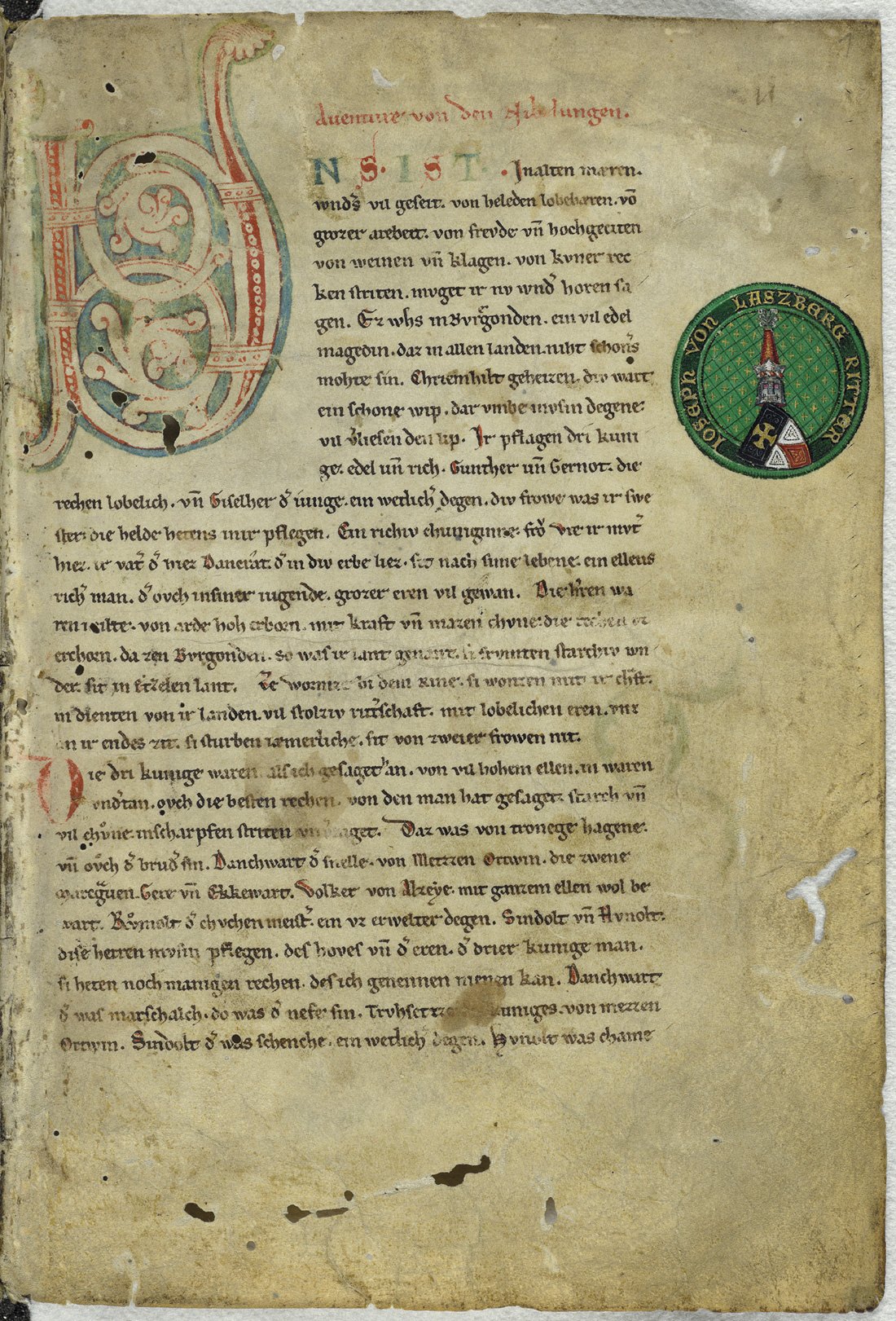
Around 1200 an unknown poet in the Danube region writes an epic of some 2,400 stanzas. At about the same time, and in the decades that follow, Icelanders and Norwegians set down the same material in lays and sagas. The names match; the plot does not. In the North, Guðrún avenges her brothers on her husband. In the Nibelungenlied, Kriemhild avenges her husband on her brothers. This article introduces the Nibelungenlied briefly and then lays it side by side with the Norse texts, to show what the two traditions knew of each other and what can be said about their age.
The Nibelungenlied is a Middle High German heroic epic in 39 sections, which the manuscripts call “âventiuren”. It is composed in four-line stanzas meant to be sung and runs to about 2,400 of them depending on the version. The poet does not name himself. Scholars place the composition between 1190 and 1204, partly because Wolfram von Eschenbach alludes to the epic in his “Parzival”. The area between Passau and Vienna is regarded as its home. The text knows that region best and gives a Bishop Pilgrim of Passau conspicuous room. From this it is inferred that Wolfger of Erla, bishop of Passau from 1191 to 1204, was the patron. There is no document to prove it.
About 37 German manuscripts survive, most of them only as fragments. Three count as the principal manuscripts and have carried the letters A, B and C since Karl Lachmann: A is in Munich (Bavarian State Library, Cgm 34), B in St Gall (Abbey Library, Cod. Sang. 857), C in Karlsruhe (Baden State Library, Cod. Donaueschingen 63). All three date from the 13th century. Lachmann’s ranking is considered obsolete; most scholars regard B as the best witness to the older version. Since 2009 the three manuscripts have been on UNESCO’s Memory of the World register.
The versions differ even in their final line. A and B end with the words “daz ist der Nibelunge nôt”, C with “daz ist der Nibelunge liet”. In the manuscripts the epic is followed by the “Klage” (“Lament”), a separate poem claiming that a “Master Konrad” wrote the story down in Latin for Bishop Pilgrim. That account is regarded as fiction.
Siegfried, a king’s son from Xanten on the Lower Rhine, comes to Worms to woo Kriemhild, sister of the kings Gunther, Gernot and Giselher. To win her he helps Gunther in his own wooing of Brünhild, a queen beyond the sea who tests every suitor in martial games. Siegfried defeats her, invisible under his cloak of concealment. Years later the two queens quarrel over precedence before Worms cathedral. Kriemhild produces the belt and ring that Siegfried took from Brünhild. Hagen, the kings’ most powerful vassal, then kills Siegfried with a spear at a spring during a hunt. The hoard that Kriemhild has inherited is sunk in the Rhine by Hagen.
Some thirteen years later Kriemhild marries Etzel, king of the Huns, and after further years invites her brothers to his court. Fighting breaks out there and almost everyone perishes. In the end Dietrich of Bern hands the captive Gunther and Hagen over to Kriemhild. She has Gunther beheaded, strikes Hagen down with Siegfried’s sword when he will not give up the hoard, and is herself killed by Hildebrand, Dietrich’s master-at-arms.
The Norse side consists of several texts of very different age. The oldest are individual heroic lays of the Poetic Edda, which were written down in the Codex Regius around 1270 but in part composed much earlier. Atlakviða, the “Lay of Atli”, is usually placed in the 9th century or around 900. Then there are Atlamál, the lays and fragments about Sigurðr (Grípisspá, Reginsmál, Fáfnismál, Sigrdrífumál, Brot af Sigurðarkviðu, Sigurðarkviða in skamma) and the Guðrún lays. Around 1220 Snorri Sturluson summarises the story in Skáldskaparmál in order to explain why gold is called “the Niflungs’ inheritance”. In the second half of the 13th century comes Völsunga saga, which retells the lays in prose.
Þiðreks saga, probably written in Bergen around 1250, is a special case. Its language is Old Norse, but by its own account it rests on the tales of German men and belongs in content to the German side. “The North” is therefore not one book but a bundle of lays, a summary and two sagas that contradict one another.
The Nibelungenlied is thus older than every surviving Norse manuscript, but younger than some of the lays those manuscripts contain.
The names are related but not identical. Both begin with the Germanic word for “victory”. The second element in Siegfried means “peace”; in Sigurðr, a contraction of older Sigvǫrðr, it means “protection, guardian”. Which form is the original is disputed.
The hero’s background differs as well. In the Nibelungenlied Siegfried grows up as a sheltered prince with his parents Siegmund and Sieglind in Xanten. In the North, Sigurðr is a posthumous son of Sigmundr, raised by the smith Reginn. In Þiðreks saga the boy is born in the forest and brought up by the smith Mimir. The smith already appears on the Swedish Ramsund carving of the 11th century, and late German texts such as the “Lied vom Hürnen Seyfrid” know him too. The motif is therefore regarded as old common property, dropped by the Nibelungenlied poet in favour of a courtly childhood.
The dragon fight, the centrepiece of the Sigurd lays in the North, does not take place in the Nibelungenlied. It is reported. When Siegfried rides into Worms, Hagen tells the kings who he is: a man who has won the hoard of the Nibelungs, taken the sword Balmung and wrested the cloak of concealment from the dwarf Alberich. Then comes a single stanza:
“noch weiz ich an im mere daz mir ist bechant
einen lintrachen den slvoch des heldes hant
er badet sich in dem blvote sin hvt wart hvrnin
des snidet in chein wafen daz ist diche worden scin”
I know yet more about him, this much is known to me: the hero’s hand slew a dragon. He bathed in the blood, and his skin turned to horn. That is why no weapon cuts him; it has often been shown.Nibelungenlied, 3rd âventiure, Hagen’s report, stanza 100 (stanza 101 in Karl Simrock’s edition of 1892); manuscript-style wording after the Bibliotheca Augustana (v stands for u); translation our own
Four lines, no name for the dragon, no place, no smith. In the North the same deed fills a whole lay: Sigurðr digs a pit, stabs Fáfnir from below, talks with the dying creature, roasts the heart, tastes the blood and afterwards understands the birds. The effect of the blood differs too. In the South it makes the skin impenetrable; in the North it confers knowledge.
The explanations of the hoard lie just as far apart. Hagen’s report makes it the property of a dynasty called Nibelungs, which Siegfried wins in combat. In the Edda, Odin, Hœnir and Loki must pay compensation for a slain otter; Loki takes the gold from the dwarf Andvari, and the dwarf curses it. Recent scholarship tends to see this as a Scandinavian elaboration.
No figure shows a wider gap. The Norse Brynhildr is, according to Snorri, a valkyrie who sleeps on a mountain in helmet and mail; her hall is ringed by a wall of flame, and she has sworn to take only the man who rides through it. Sigurðr does so in Gunnarr’s shape, lays his sword between himself and the bride at night and exchanges rings with her. The Brünhild of the Nibelungenlied is a queen of superhuman bodily strength who defeats her suitors in contests. The contest replaces the ride through the flames, the cloak the exchange of shapes.
The framework is the same: one man wins the woman for another, a ring brings the deceit to light, and a quarrel between two women over rank sets off the murder. In Völsunga saga and in Snorri the women wade into the river, and Brynhildr refuses to have in her hair the water that runs from Guðrún’s; Völsunga saga expressly calls the river the Rhine. In the Nibelungenlied the issue is who steps through the church door first. Which scene is older cannot be established. In the North Brynhildr kills herself and is burned with Sigurðr; in the Nibelungenlied Brünhild recedes into the background.
At one point the Norse tradition itself says that it knows the German version. In the Codex Regius, Brot af Sigurðarkviðu is followed by a short prose piece headed “Frá dauða Sigurðar”, “Of Sigurd’s death”. The lay, it says, tells it as if Sigurðr were killed out of doors; but some say he was slain asleep in his bed. And then: German men, þýðverskir menn in the Old Norse, say that he was killed outside in the forest. The old lay of Guðrún, for its part, has him die on the ride to the assembly. All agree only that he was treacherously done to death.
Here a 13th-century Icelandic redactor practises source criticism: he knows three manners of death and expressly assigns one to the Germans. It matches the Nibelungenlied, where Siegfried falls at the spring in the forest, and Þiðreks saga, where Högni spears him beside a brook during a hunt. The bed belongs to the Norse version: in Sigurðarkviða in skamma, in Snorri and in Völsunga saga it is Guttormr, a younger brother or stepbrother of the kings, who stabs the sleeping man, because he alone has sworn no oath.
The Brot itself says, in stanza 9 of the Old Norse numbering, that Sigurðr died “south of the Rhine”, and a raven calls down from a tree to the murderers that Atli will be their end. Scholars read the outdoor death in this lay as influence from the continental tradition.
The hero’s wife has two names. In the North she is Guðrún, and Grímhildr is the name of her mother, a woman skilled in magic; in the South she herself is Kriemhild, in Þiðreks saga Grimhild. Which name is the older is judged differently.
The real contrast lies in the revenge. In Atlakviða Atli invites his brothers-in-law Gunnarr and Högni in order to get at their gold, and has them killed. Guðrún, their sister and Atli’s wife, had warned them. After their death she slaughters the two sons she has with Atli, serves him their hearts, kills him and sets the hall on fire. Her loyalty belongs to her own kin, against her husband.
In the Nibelungenlied it is the other way round. Kriemhild marries Etzel to get her first husband’s murderers into her power: her brothers and their vassal. Her loyalty belongs to her husband, against her kin. According to the English Wikipedia’s survey, most specialists agree that the Norse role is the original one and that the reversal took place on the continent, when the story of the Burgundians’ fall grew together with the story of Siegfried’s murder. Jan-Dirk Müller objects that neither version can be shown to be original, since neither matches the historical events.
How early the German version was known in the North is shown by a report in Saxo Grammaticus, who wrote around 1200. He relates that a Saxon singer, wanting to warn the Danish duke Knud Lavard of an ambush, sang him the song of “Grimhild’s notorious treachery against her brothers”. Treachery against the brothers: that is the Kriemhild of the South, not the Guðrún of the Edda.
In the North Högni is a brother of Gunnarr and Guðrún. He does not kill Sigurðr himself, and in Atlakviða he dies steadfast: his heart is cut out, and he laughs. In the Nibelungenlied Hagen is no brother but a vassal and kinsman of the kings, at once counsellor, murderer and the man who sinks the hoard. In Þiðreks saga Högni is a half-brother of the kings, fathered on the queen by an elf.
Atli and Etzel go back to the same historical name, that of Attila, king of the Huns. The Norse Atli is greedy and cruel; he is the adversary. Etzel is a mild, almost passive ruler who watches the killing at his court helplessly. Müller considers that a more favourable continental image of Attila may lie behind the reversed revenge. That is conjecture.
On one point North and South agree: the gold ends in the Rhine, and the last person who knows takes the secret to the grave. In Atlakviða the captive Gunnarr first demands to see his brother’s heart. Only then, in stanza 27, does he refuse Atli the treasure: the Rhine shall rule over the “strife-metal of men”, the Niflungs’ inheritance; the rings shall gleam in the rolling water sooner than on the hands of the sons of the Huns. Snorri reports more soberly that Gunnarr and Högni hid the gold in the Rhine before they set out, “and that gold has never since been found”.
The Nibelungenlied distributes the same scene among different people. Hagen has sunk the hoard and will not speak as long as one of his lords is alive. Kriemhild has her brother Gunther beheaded, and Hagen keeps silent until she kills him. In the North Gunnarr sacrifices his brother so as to be the only one who knows; in the South Hagen’s condition costs his lord his life. A common earlier form seems likely; it has not survived.
The name travels too. In Snorri, Gunnarr and Högni are called “Niflungar and Gjúkungar”. In the Nibelungenlied the name first belongs to the earlier owners of the hoard and passes in the second part to the Burgundians.
Þiðreks saga tells the life of Dietrich of Bern and weaves the story of the Niflungs into it. Its version stands close to the Nibelungenlied: Sigurd has a skin of horn and dies while hunting, Grimhild avenges him on her brothers, and Þiðrekr himself cuts her down. Yet it also keeps features that recall the North, such as the youth spent with the smith and the snake tower for Gunnar. Attila’s court is located here in Susat, Soest in Westphalia. Whether the author knew the Nibelungenlied itself or an older, lost poem that also underlies its second part is an open question.
That German tales had reached Iceland before this saga is shown also by the prose introduction to the second lay of Guðrún in the Codex Regius. There King Þjóðrekr, that is Dietrich, sits at Atli’s court and laments together with Guðrún. Dietrich comes from the German legend, not the old Norse one. Conversely, the author of Völsunga saga took the description of Sigurd’s appearance from Þiðreks saga. By the 13th century, then, the two traditions were exchanging material.
Long the Norse version counted as the original and the Nibelungenlied as a late, courtly smoothing. In the accounts I consulted that picture no longer holds. Some Norse features are still considered old, above all Guðrún’s revenge for her brothers. Others, such as the hoard cursed by gods and the close tie to mythology, are now seen as Scandinavian developments. For the death in the forest, the German version is held to be the older.
There is broad agreement that two originally separate stories have grown together: Sigurd’s death and the fall of the Burgundians. Atlakviða, in which Sigurðr does not appear at all, supports this. The Nibelungenlied is the earliest securely dated text that joins both parts. Andreas Heusler assumed older oral stanzas that the poet expanded; Jan-Dirk Müller objects that no stanza can be proved to have been taken over.
For the second part there is a historical foothold. The Roman general Aëtius defeated the Burgundian king Gundahar on the Rhine around 435; soon afterwards (the chronicles give 436 or 437) Huns, according to Prosper Tiro, wiped out the king with his people and kin. The Burgundian law code names Gibica, Gundahar and Gislahar among the earlier kings: Gjúki, Gunnarr or Gunther, and Giselher. Attila died in 453 on the night after his wedding to a woman whom Jordanes calls Ildico; as early as the 9th century a Saxon poet claims that Attila’s wife killed him to avenge her father. Theoderic the Great, the model for Dietrich, was born only after Gundahar’s death. For Siegfried no historical predecessor is secure; the Frankish king Sigibert I is a hypothesis. See the articles on the Burgundians and on Atli.
The Nibelungenlied circulated widely in the Middle Ages but was never printed. The last known copy is in the Ambraser Heldenbuch of the early 16th century, where the text bears the title “Ditz Puech heysset Chrimhilt”. After the mid-16th century it is forgotten for some two hundred years.
In 1755 Jacob Hermann Obereit found manuscript C in the library of the counts of Hohenems. Johann Jacob Bodmer made the find known, printed extracts and compared the poem with the Iliad. In 1782 Christoph Heinrich Myller produced the first complete edition. Frederick II of Prussia answered the editor in 1784 that the work was not worth a shot of powder.
The label “national epic” belongs to the decades that followed. Friedrich Heinrich von der Hagen published a modernised rendering of the whole text in 1807 with a national-minded preface, followed in 1810 by an edition in the original language; according to the “Encyclopedia of Romantic Nationalism in Europe”, this book launched the epic as Germany’s national epic. Who first used the word I could not find. Karl Simrock’s modern German rendering of 1827 made it accessible to a wide public.
The best-known adaptation of the 19th century leads back to the North. Friedrich Hebbel dramatised the Nibelungenlied between 1855 and 1860. Richard Wagner, by contrast, based his “Ring of the Nibelung” almost entirely on the Old Norse versions, which were then held to be the more original. Valkyrie, ring of fire and potion of forgetfulness come from the Edda and Völsunga saga, not from the epic of 1200.
Is the Nibelungenlied a Viking legend? No. It is a Middle High German epic from the Danube region, composed around 1200, after the Viking Age. The material was known in the North by the 11th century, as carvings of the dragon-slayer show.
Which is older, the Edda or the Nibelungenlied? The manuscript of the Poetic Edda (around 1270) is younger than the Nibelungenlied (around 1200). Individual lays in it, above all Atlakviða, are thought to be centuries older.
Does Odin appear in the Nibelungenlied? No. The poet pushed the mythical features back; there are no gods, no valkyrie and no dwarf’s curse.
Why is Kriemhild called Guðrún in the North? That cannot be established. In the North the mother bears the name Grímhildr, which corresponds to Kriemhild. Some scholars consider Guðrún the older name, others Kriemhild.
Where is the Nibelung hoard? In the Rhine, according to the Nibelungenlied, Atlakviða and Snorri. Snorri adds that the gold has never been found. I know of no find that could be connected with the hoard.
Sigurd and the Völsung legend
Völsunga saga
Þiðreks saga
Atli and Attila
The Burgundians
Brynhildr
Fáfnir
Grípisspá
Reginsmál
Codex Regius
Sigurd the dragon-slayer · Fafnir – the Dragon · Brynhild · Atli – the Eddic King of the Huns Between History, Saga and Picture Stone · The Völsunga saga.
It begins with petty theft and ends with eleven people dead under a burning roof. In between lie fifty years, two dozen …
Read more →Odin, Thor, Yggdrasil, Ragnarök: few ancient worldviews fascinate as many people today as that of the Norse. Yet …
Read more →Above the gods stands fate – and it has many shapes. This large overview reaches far beyond the three famous Norns: to …
Read more →Odin is one-eyed because, according to the sources, he gave one of his eyes as a pledge to Mímir in exchange for a …
Read more →