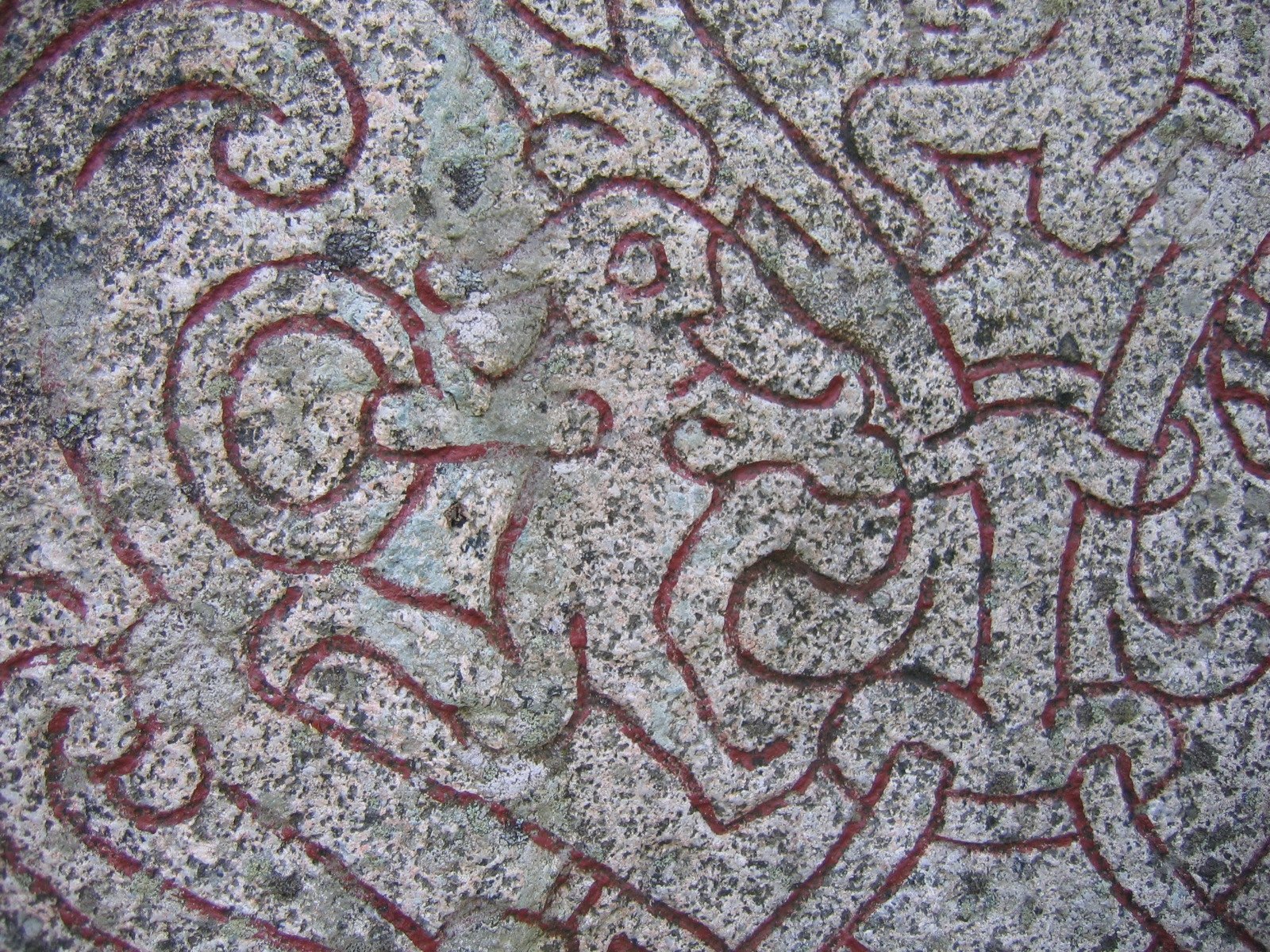
An otter eats a salmon with its eyes shut, a stone flies, and three gods have to fill a skin with gold. That is how the Poetic Edda begins the story of the hoard that will later destroy Sigurd, Brynhild and the Gjúkungs. Reginsmál tells it in a mixture of terse prose and 26 stanzas – and then breaks off to report a sea voyage, a man on a cliff and an act of revenge. This article reads the piece as a text: section by section, with an eye on the manuscript, the metres and the places where editions part company.
Reginsmál stands in the Codex Regius of the Poetic Edda (GKS 2365 4to), which the source archive on this site dates “c. 1270”. Edward Pettit, in his dual-language edition of the Edda (2023), gives the leaves as fol. 28v–30r. There is no heading “Reginsmál”; by Pettit's apparatus the title is supplied editorially. The text opens with an enlarged red S, now faded; an earlier edition that Pettit cites as NK claims to make out a faded line there, Frá Sigurði, “About Sigurðr”.
The last prose sentence says that Reginn urged Sigurðr to kill Fáfnir, and the ride to Gnitaheiðr with which Fáfnismál begins follows without a break. Pettit says outright that the two should be taken together. Henry Adams Bellows (1923) doubted that the compiler regarded Reginsmál, Fáfnismál and Sigrdrífumál as separate poems at all. “Reginsmál”, roughly “Reginn's sayings”, is thus a modern label for the first third of one continuous narrative about Sigurd's youth. In the manuscript it is preceded by Grípisspá.
The source archive prints the Old Norse text after Guðni Jónsson with the translations of Karl Simrock and Bellows, prose passages included. The prose carries the action; the stanzas are almost entirely speech. Four parts can be told apart.
First the earlier history of the gold (stanzas 1–12): Loki and the dwarf Andvari, Loki and Hreiðmarr, Hreiðmarr and his daughters. Then Sigurðr with Reginn (13–15), with the prose about the sword Gramr. Then the voyage, the stranger on the cliff and his advice (16–25). And at the end a single stanza on the victory (26).
For the later path of the hoard see Andvari, for the whole legend Sigurd.
The opening prose starts with a horse: Sigurðr goes to King Hjálprekr's stud and chooses a stallion that is called Grani from then on. Then Reginn is introduced, the son of Hreiðmarr. He was more skilful than any other man ok dvergr of vöxt – “and a dwarf in stature” – and also wise, fierce and versed in magic. He fosters and teaches Sigurðr “and loved him much”.
In the middle of the prose the voice changes. At first the narrator reports that Odin, Hœnir and Loki had come to Andvarafors, Andvari's waterfall. Then Reginn himself speaks: “Otr hét bróðir várr”, “Otr was the name of our brother”. From here on it is “we”: we seized them, we imposed the ransom. After stanza 12 the prose says so plainly: “All these happenings did Regin tell to Sigurth” (Bellows).
Otr often went into the waterfall in the shape of an otter. He had caught a salmon, sat on the bank and ate blundandi, with his eyes closed. Loki killed him with a stone. The gods thought themselves lucky and flayed the otter. That evening they sought lodging with Hreiðmarr and showed their catch.
The word for the demand is fjörlausn, “life-ransom”: the gods are to fill the otter-skin with gold and cover it on the outside with red gold. Only later, when the sons claim their share, does a word for kin-compensation appear (niðgjöld). The gods send Loki for the gold. He goes to Rán, gets her net and casts it at Andvarafors in front of the pike, for Andvari “had dwelt long in the waterfall in the shape of a pike”. The pike leaps into the net. On Rán see the article on Ægir and Rán.
Loki asks: what fish is this that runs in the flood and cannot guard itself against harm? Redeem your head from Hel, finn mér lindar loga – find me the “flame of the spring”. That is a circumlocution for gold. According to Pettit's apparatus the manuscript reads linar, which editors correct to lindar.
The fish answers with name and descent: Andvari ek heiti, Óinn hét minn faðir. A wretched Norn decreed in days of old that he should wade in water. So one of the Norns allots the dwarf his lot as well.
Loki's second question has nothing to do with gold: what requital awaits the sons of men who wound each other with words? Andvari replies that an over-heavy payment falls on those who must wade Vaðgelmir; whoever lies about another suffers the consequences far too long. Pettit takes Vaðgelmir to be a river; Bellows remarks that “certainly Loki's question does not fit the situation”. The pair sounds like wisdom poetry; whether it was inserted cannot be proved.
The prose sums up the robbery in three sentences. Loki saw all the gold that Andvari had. When the dwarf had brought it out he kept back one ring, and Loki took that too. The dwarf went into the rock and said:
“Now shall the gold that Gust once had
Bring their death to brothers twain,
And evil be for heroes eight;
Joy of my wealth shall no man win.”Reginsmál 5, translated by Henry Adams Bellows (1923; wording as in the source archive on this site)
Three things stand out. First, in this stanza the curse lies on the gold, not on the ring. The ring's name appears only in the following prose: Andvaranaut, “Andvari's Gift” in Pettit's gloss. Second, nobody knows who Gustr is. Bellows and Pettit offer the same two options: another name for Andvari, or an earlier owner. Third, the numbers. The two brothers, says Bellows, are Fáfnir and Reginn. For the eight nobles Pettit suggests, if the number is meant exactly, Sigurðr, Guthormr, Gunnarr, Högni, Atli, Erpr, Sörli and Hamðir.
The gods stuff the skin, stand it on its feet and heap the gold around it. Hreiðmarr steps up, sees a single whisker and demands that it be covered too. Then Odin draws out the ring Andvaranaut and hides the hair.
Stanzas 6 to 9 are a quarrel. Loki: the gold is paid to you, a great price for my head; no luck is shaped for your son, it will be the death of you both. The word reitt, “paid”, is missing in the manuscript according to Pettit and is supplied from Völsunga saga. Hreiðmarr answers with a triple repetition: gifts you gave, not gifts of love, not with a whole heart.
Stanza 8 is one of the hardest passages. Loki announces something worse, a strife among kinsmen; the princes for whom it is destined as a cause of hatred are not yet born. The manuscript, by Pettit's apparatus, has vm nept. Simrock translates “a fight over a woman”, Bellows “for a maid” – both read a woman into it. Yet Bellows's note calls the word “obscure” and allows that “gold” may be meant. Pettit emends to ónept and translates “the unceasing strife of kinsmen”, adding that this is one of many explanations. A forward reference to Brynhildr is therefore not secure.
Hreiðmarr is unmoved: he will rule the red gold as long as he lives – “get ye hence to your homes”.
Fáfnir and Reginn ask Hreiðmarr for kin-compensation for their brother Otr. He says no. Fáfnir runs his sleeping father through with a sword.
The dying man calls his daughters, who appear only here: “Lyngheiðr and Lofnheiðr, know that my life is gone.” Stanza 10 is incomplete in the source archive; its Old Norse text stops after the third line, and only Simrock and Bellows give Lyngheiðr's reply. In Pettit's text it closes the stanza: Fátt mun systir, þótt föður missi, hefna hlýra harms – scarcely will a sister, even if she loses her father, avenge that sorrow on her brother. According to his apparatus the manuscript has Far, corrected to Fátt.
Hreiðmarr answers with advice in the eight-line metre: then bring up a daughter, “wolf-hearted woman” (dís ulfhuguð), if you get no son by the prince; find the girl a husband, and their son will avenge your grief. Bellows thought the stanza an interpolation. No grandson of Lyngheiðr is ever heard of again. When Fáfnir refuses Reginn his inheritance, Reginn asks his sister's advice. She tells him to ask his brother in a friendly way; it is not fitting to demand it with the sword.
With stanza 13 the text jumps to the present. Reginn greets his guest: here the son of Sigmundr has come, the quick-resolved man; he has more courage than an old man, and from the greedy wolf I expect a fight. The second stanza calls him Yngva konr, Yngvi's descendant, and ends, in Bellows's version, “The threads of his fate all lands enfold”.
Reginn tells Sigurðr that Fáfnir lies on Gnitaheiðr in the shape of a serpent and owns an ægishjalmr that terrifies every living creature. Reginn makes Sigurðr a sword called Gramr. It was so sharp that he held it down in the Rhine – ofan í Rín, the river is named – and let a tuft of wool drift against it with the current; it cut the tuft as it cut the water. With this sword Sigurðr split Reginn's anvil. Of fragments of a father's sword the prose says nothing.
Reginn presses for the dragon fight, and Sigurðr refuses – for now. Loud would Hunding's sons laugh, who took Eylimi's life, if the prince cared more for red rings than for avenging his father. According to Snorri and Völsunga saga Eylimi is the father of Sigurd's mother Hjördís; Hunding himself is known from the Helgi lays, in which Sigmundr's son Helgi kills him (see the article on Helgi and Sigrún).
King Hjálprekr gives Sigurðr ships and men. They run into a great storm and beat about off a headland. A man stands there and calls out, almost wholly in circumlocutions: who rides there on Rævill's horses over the high waves? The sail-steeds are spattered with sweat, the wave-horses will not withstand the wind. Ships are meant; Rævill, says Pettit, is a sea-king.
The stranger replies with a stanza of names. Hnikarr they called him; now they may call the old man from the cliff Fengr or Fjölnir; “I want to receive passage” (Pettit). Pettit lists all three as names of Odin. Two of them stand in the name-list of Grímnismál, stanza 47, as the source archive shows; Fengr, says Bellows, does not occur elsewhere. The text itself never says “this was Odin”.
In Guðni Jónsson's text and in Völsunga saga the stranger says that he gladdened Huginn and addresses Sigurðr as “young Völsung”. In Pettit's text, for which he records no emendation, “young Völsungr” is the subject: Hnikarr was his name when Völsungr gladdened the raven. Bellows translates the same way. Then the prose: they put in to land, the old man came aboard, and the storm subsided.
Sigurðr asks a question of lore: tell me, Hnikarr, since you know the omens (heill) of gods and men – which are best when one must fight?
The answer is a list. Good is the company of the dark raven. Good, secondly, if on setting out you see two men eager for fame standing there. Thirdly, if you hear the wolf howl under ash boughs.
Stanza 23 is tactical: no man should fight facing the late-shining sister of the moon, that is, with the low sun in his eyes; victory goes to those who can see, and to those who hamalt fylkja – in Pettit's note a formation resembling a boar's snout, in Bellows a wedge. Stanza 24 names a bad sign: stumbling on the way to battle. Then deceitful dísir stand on both sides and want to see you wounded. The last stanza is everyday prudence: combed, washed and fed in the morning a man should be, for it is uncertain where he will be by evening. A similar thought stands in Hávamál 61, where one should ride to the assembly “washed and fed”.
Bellows found the series “strongly suggestive of the Hovamol”; stanza 23 he called “clearly an interpolation”, and stanza 25 originally unconnected. What is certain: seven stanzas of question and instruction stand in the middle of a revenge story, and none of the signs occurs in the battle that follows.
The battle itself gets two prose sentences. Sigurðr had a great fight with Lyngvi Hundingsson and his brothers; þar fell Lyngvi ok þeir þrír bræðr – there Lyngvi fell and those three brothers. After the battle Reginn speaks. In Bellows's version: “Now the bloody eagle with biting sword / Is carved on the back of Sigmund's killer;” The second half praises the prince's heir who reddened the earth and gladdened the ravens.
The stanza says nothing of ribs or lungs, nothing of a sacrifice to Odin, nothing of who held the sword. Pettit's note speaks of a “supposed” practice whose accounts grow “increasingly lurid”.
More detail comes only with Norna-Gests þáttr, which Pettit says “probably” dates from the early fourteenth century and which, by his account, contains versions of stanzas 13–26. Bellows says 11–26, but I did not find stanzas 11 and 12 in Nora Kershaw's translation of the þáttr (1921). There Reginn advises that the “blood eagle” be carved on Lyngvi's back, takes the sword himself, severs the ribs from the spine and draws out the lungs; only then comes the stanza. I know the passage only from Kershaw's translation, through a retrieval tool. Völsunga saga tells the revenge differently: in chapter 17 Sigurðr cleaves Lyngvi's helmet, head and mailed body.
Whether a ritual or a poetic image lies behind the phrase is disputed; the debate around Roberta Frank's article of 1984, which Pettit lists, is set out in the article on the blood eagle. The stanza itself is very slender evidence, and the prose of the same text reports the enemy's death without anything unusual.
Most stanzas have six short lines: twice a pair of lines and a single full line. That is ljóðaháttr, the metre of Eddic gnomic and dialogue poetry. Others have eight short lines; that is fornyrðislag, the narrative metre. By Bellows's notes and the line counts in the archive they fall thus: ljóðaháttr in stanzas 1–4, 6–10, 12, 19–22, 24 and 25; fornyrðislag in 5, 11, 13–18, 23 and 26.
The boundaries do not coincide with the scenes: Andvari's curse, Hreiðmarr's advice to his daughter and the tactical stanza are in a different metre from their surroundings. Bellows concluded that the piece is a compilation of whatever verse on the subject the compiler could find. Finnur Jónsson, he reports, divided it into two sets of fragments, which for Bellows did not go far enough. Pettit only describes the form: a prosimetrum, mostly in ljóðaháttr with some stanzas of fornyrðislag.
I found no dating in Bellows's introduction or Pettit's chapter. The manuscript supplies a latest date; how old the individual stanzas are I cannot say.
Snorri Sturluson tells the otter's ransom in Skáldskaparmál – chapter 46 in the source archive – to explain why gold is called otrgjöld. He quotes no stanza there, and much is different. Father and sons bind the gods, and the settlement is sworn. Odin sends Loki to Svartálfaheim. Andvari is “a fish in the water”, and Loki catches him with his hands – Rán's net is absent. The dwarf begs to keep the ring because with it he could make his wealth grow again, a property the Poetic Edda does not mention. In Snorri the curse is laid expressly on the ring: it shall cost every owner his head. Only Loki, on leaving, extends this to “that ring and that gold”. Odin thinks the ring beautiful and keeps it. In Snorri, in the next chapter (47), both brothers kill the father together. At the end stand three names for gold: otter's ransom, the gods' forced payment and rógmálmr, “strife-metal”. The voyage, Hnikarr and Hunding's sons Snorri leaves out altogether.
Völsunga saga follows the poem more closely. Pettit names chapters 13–15 and 17–18 as parallels; in the source archive four stanzas of the poem stand there: 1, 2, 6 and 18. The saga gives Andvari's curse in prose and extends it to “that gold ring and likewise all the gold”. It has a bearded old man help with the choice of Grani and adds that this was Odin. Gramr is made only at the third attempt, from the pieces of Sigmundr's sword. The daughters Lyngheiðr and Lofnheiðr are absent. Fjölnir vanishes at the landing and gives no omens; the seven stanzas that William Morris and Eiríkr Magnússon print here were, by their own note, inserted from Reginsmál.
The earlier history of the hoard is Reginn's report, in the first person plural, to the boy who is to kill Fáfnir; it ends with the sister's advice not to demand the inheritance with the sword. Sigurðr puts revenge for his father before the gold and gives the laughter of his enemies as the reason. And Odin appears twice: at the start as one of three gods who must pay, and the one who lays the ring on the last whisker; later, unrecognised, on the cliff as helper of the Völsung. The text does not connect the two.
What does “Reginsmál” mean? Literally “Reginn's sayings”; mál means speech or saying. The title comes from editors.
Where is Reginsmál preserved? In the Codex Regius of the Poetic Edda, between Grípisspá and Fáfnismál. Four stanzas also stand in Völsunga saga, and more, according to Pettit, in Norna-Gests þáttr. Snorri tells the otter's ransom in prose.
Who is Hnikarr? The name used by the man who stands on a headland in the storm and asks for passage; he also gives the names Fengr and Fjölnir. In Grímnismál, Hnikarr and Fjölnir are names of Odin.
What does stanza 26 say about the blood eagle? Only that a bloody eagle has been carved with a biting sword on the back of Sigmundr's killer. In Völsunga saga Lyngvi falls to a sword-stroke in battle.
Why does Sigurðr avenge his father first? Stanza 15 gives the reason: Hunding's sons would laugh aloud if red rings mattered more to him than avenging his father.
Reginsmál in the source archive (Old Norse, Simrock, Bellows) · Fáfnismál: the talk with the dying dragon · Grípisspá: Sigurd's fate foretold · Sigrdrífumál · Andvari and the curse of the gold · Fáfnir: from son to serpent · Sigurd the dragon-slayer · Völsunga saga · Skáldskaparmál · The blood eagle: ritual or misunderstanding?
Fáfnismál · Sigrdrífumál · Fafnir – the Dragon · Sigurd the dragon-slayer · The blood eagle.
A traveller stops at three houses, shares the meal, sleeps three nights between husband and wife and moves on. Nine …
Read more →Almost everything we think we know about the Norse world of gods and heroes comes from Iceland. But there is a second …
Read more →A man surprises women bathing, takes one woman's feather dress and so forces her into marriage; years later she finds …
Read more →A hero cuts the armour off a sleeping figure, and the woman who wakes does not reproach him. She lectures him: on …
Read more →