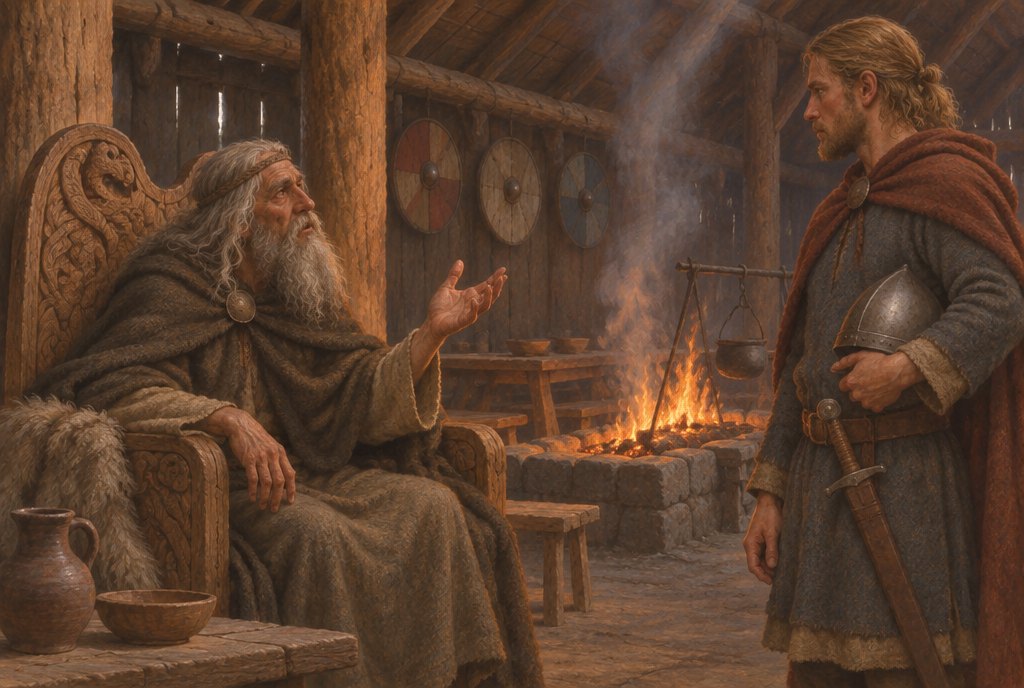
A young man rides to his uncle and asks how his life will turn out. The uncle knows, and a good third of the way through he refuses to go on. Grípisspá, “Grípir's prophecy”, opens the poems about Sigurd the dragon-slayer in the Codex Regius and tells everything in advance in 53 stanzas: vengeance for his father, Fáfnir, the sleeper on the mountain, Brynhild, the deception, his death. Scholars regard it as one of the youngest poems in the collection, and not a great one. That is what makes it instructive. It shows how a medieval Icelander arranged the Sigurd material, where the tradition failed to fit together, and how he spoke about fate.
Grípisspá survives in a single medieval manuscript, the Codex Regius of the Poetic Edda (GKS 2365 4to), written around 1270. Edward Pettit, in his dual-language edition of 2023, gives folios 27r to 28v. According to Henry Adams Bellows (1923), no other early manuscript contains the poem.
It has no title in the vellum. Pettit's apparatus states that the name “Grípisspá” comes from later paper manuscripts. The word joins the name Grípir with spá, “prophecy”, the same word found in Völuspá, the prophecy of the seeress. A second name circulates beside it: the text collection heimskringla.no and the site voluspa.org add “Sigurðarkviða Fáfnisbana I” in brackets, “first lay of Sigurd, Fáfnir's slayer”, and the English Wikipedia gives the same second title. I could not check who introduced that numbering.
The heroic part of the book begins with the poems about Helgi; a prose piece on the death of Sinfjötli then leads over to Sigurd's parents. Grípisspá follows at once, and only then come Reginsmál, Fáfnismál and Sigrdrífumál. Pettit therefore calls the poem a synoptic preface to the later Sigurd poems in the manuscript. The full text is in our reading edition and in the source archive, the latter with Bellows's translation. Stanza numbers here follow the archive's count after Guðni Jónsson.
A few prose sentences stand before the first stanza, given here in my own translation from the Old Norse: Grípir was the name of Eylimi's son, the brother of Hjördís. He ruled over lands and was the wisest of all men, and foreknowing. Sigurd rode alone and came to Grípir's hall. Sigurd was easy to recognise. Outside the hall he met a man who gave his name as Geitir, and spoke to him.
Since Hjördís is Sigurd's mother (stanza 3), Grípir is his mother's brother, and Sigurd addresses him in exactly those terms in stanzas 6 and 24, móðurbróðir. Pettit connects the name Grípir with grípa, “to grasp”. Bellows thought the uncle was probably a pure invention of the poet. That is a conjecture; in the texts consulted here he appears only in this poem and in one chapter of Völsunga saga.
The first five stanzas belong to the reception. Sigurd asks who lives here; Geitir announces the stranger, and Grípir comes out of the hall, greets his nephew and has the horse Grani seen to. From stanza 6 the poem has one form only: Sigurd asks, Grípir answers. Narrative verse occurs only in stanzas 4 to 6.
The first answer is praise. Sigurd will be the most renowned man under the sun, free with gold, slow to flee, noble to look at and wise in speech (stanza 7). The deeds follow in the order of the next poems. First he avenges his father and Eylimi and fells the sons of Hunding (9). Then he alone kills the gleaming serpent that lies greedy on Gnitaheiðr, and becomes the slayer of both Reginn and Fáfnir (11). He finds Fáfnir's lair, loads the gold on Grani's back and rides to Gjúki (13).
Stanza 15 leads up the mountain. A ruler's daughter sleeps there, bright in her mail-coat, “after Helgi's death”; Sigurd will cut the mail-coat with the sword that killed Fáfnir. Pettit calls this Helgi's identity uncertain and considers the slayer of Hunding as well as Hjálm-Gunnarr, whom the valkyrie felled against Odin's will according to the prose of Sigrdrífumál.
The woman, once awake, will teach Sigurd runes, all that men would wish to own, and how to speak in every human tongue, and healing (17). She is given no name, there is no word of fire, and none of a betrothal. Sigurd sums it up drily: that is done, the knowledge is learned, he is ready to ride on (18).
Stanza 19 names the next stop. Sigurd will come to Heimir's dwelling and be a glad guest there. Then, in the same stanza, Grípir breaks off: what he foresaw is at an end, and Sigurd should ask no more.
For eight stanzas nothing happens in the plot, and they are the liveliest in the poem. Sigurd sees at once that his uncle knows more than he says (20). Grípir evades: only the youth lay clear before him, and people are wrong to call him wise and foreknowing (21). Sigurd replies that nobody on earth sees further, and that his uncle should hide nothing, however ugly (22). Grípir assures him that no shame lies on this life and that his name will last as long as men live (23). Only when Sigurd says that they must then part like this, and asks once more, does Grípir give way and speak the sentence around which the poem is built: a day is appointed for your death (25).
The reluctant seer has relatives in the collection. In Baldrs draumar the dead seeress ends her answers with a refrain which says that she spoke under compulsion and will now be silent. Pettit sets Grípisspá, as a spá, beside Völuspá and stanzas 29 to 44 of Hyndluljóð. Those deal with gods and the course of the world, this one with a single man asking about his own end. No völva appears, no ritual, no magic. Grípir is a king who simply knows.
What follows tells the part of the legend whose poems are largely lost from the Codex Regius. At Heimir's there lives a girl, fair to see, whom men call Brynhild, Buðli's daughter; Heimir fosters the hard-minded maid (27). What is that to him, Sigurd asks. She will take most of his joy, Grípir answers: he will not sleep, will settle no lawsuits and will heed no one unless he sees her (29). Sigurd wants to know whether he can win her with the bride-price (30). The answer is the bitterest passage in the poem: you two will swear every oath, very firmly, and keep few. After a single night as Gjúki's guest you will not remember Heimir's foster-daughter (31).
Appalled, Sigurd asks whether his uncle sees fickleness in his nature (32). No, it will come through another's treachery: he will pay for Grímhild's counsels. She will offer him her bright-haired daughter and spin wiles against him (33). That daughter is Guðrún, whom Sigurd himself names in stanza 34. Grímhild then gets him to woo Brynhild on behalf of Gunnar, whom the poem calls “lord of the Goths”; Pettit notes that the word can also mean “men” in general (35). Gunnar, Högni and Sigurd swear oaths to one another, and on the way Gunnar and Sigurd exchange appearances (37). Sigurd will have Gunnar's looks and bearing but his own speech and thoughts, and so betroths himself to Heimir's foster-daughter (39).
Sigurd names what is coming for what it is: one falsehood will draw another after it (38), and men will call him base (40).
Grípir reassures him on one point. Sigurd will rest beside the maid as if she were his mother (41). Sigurd asks whether Gunnar will have a good wife if the bride has slept three nights at his side – such a thing is without precedent (42). Grípir foretells the double wedding: both feasts will be drunk together in Gjúki's halls, and once home the two men will change shapes back (43).
The editions differ here. According to Bellows and Pettit the manuscript has Grípir's statement about the wedding first and Sigurd's question after it; both editors reverse them for a smoother sequence.
Sigurd remembers the oaths and yet must keep silent; he grants Guðrún a good marriage. Brynhild, however, thinks herself badly married and looks for revenge (45). She will tell Gunnar that Sigurd did not keep his oaths when the king trusted him with all his heart (47). Is he guilty, then, or is the woman lying (48)? Grípir acquits him: in anger and grief she will not deal well with him; he never does the good woman any harm, though the king's wife was tricked with wiles (49). Will Gjúki's sons redden their blades on their kinsman (50)? Guðrún will be grim at heart, her brothers will plot Sigurd's death, and there will be no joy for the wise woman afterwards. “Grímhild is the cause of that” is the last line of the prediction (51).
Grípir adds a stanza of comfort: no nobler man will come upon the earth beneath the seat of the sun (52). Sigurd answers with four long lines that close the poem.
Now fare thee well! our fates we shun not;
And well has Gripir answered my wish;
More of joy to me wouldst tell
Of my life to come if so thou couldst.Grípisspá, st. 53 (st. 52 in Bellows's numbering), translated by Henry Adams Bellows (1923)
The most striking problem of the poem lies between stanza 15 and stanza 27. Sigurd wakes a nameless ruler's daughter on the mountain, learns from her and rides on. Twelve stanzas later Brynhild is introduced as if the listener had never heard of her, with name, father and foster-father, and Sigurd asks what this girl has to do with him.
The other texts proceed differently. In Völsunga saga the sleeper is Brynhild; she and Sigurd swear to marry each other on the mountain (chapter 21 in the archive's count) and renew the oaths when he sees her again at Heimir's in Hlymdalir (chapter 24). Helreið Brynhildar has Brynhild herself relate that in Hlymdalir she was called “Hildr under the helmet”, that after the death of Hjálm-Gunnarr Odin shut her in with shields and set fire round her hall, and that Sigurd rode on Grani to where her foster-father ruled (stanzas 6 to 12).
Bellows read Grípisspá as the counter-example. The poet does not identify the valkyrie of stanzas 15 to 17 with Buðli's daughter, and he combines two versions of the Brynhild story “rather clumsily” by sending Sigurd first to Gjúki, then to the valkyrie and then back to Gjúki. Pettit, by contrast, states in his note on stanza 15 that the ruler's daughter is Brynhild as in the saga, and refers for the name Sigrdrífa to Fáfnismál 44 and Sigrdrífumál. On the early visit to Gjúki in stanzas 13 and 14 he remarks that neither the rest of the manuscript nor the saga knows of it, and points to Fáfnismál 41.
That reference leads further. At the end of Fáfnismál the birds first advise Sigurd to take the road to Gjúki, whose daughter he may “buy with the bride-price”, and only then speak of the sleeper on Hindarfjall. Grípisspá has the same order, and the phrase about the bride-price, mundi kaupa, returns in stanza 30, there applied to Brynhild. That the poet drew on the bird stanzas is my own observation, not a finding I can cite.
Whether two originally separate figures lie behind this, a valkyrie and a king's daughter, or a late poet awkwardly spread one figure over two episodes, cannot be established. What is certain is the text: Grípisspá calls the sleeper neither Brynhild nor Sigrdrífa, and it makes no connection between the two women.
The poem names no potion of forgetfulness. Stanza 31 says only that after one night at Gjúki's Sigurd will no longer remember Brynhild, and stanza 33 puts that down to Grímhild's wiles. The horn the queen hands him is in Völsunga saga (chapter 26 in the archive's count). The wall of flame is missing as well: there is no mention of fire, either with the sleeper or in the wooing for Gunnar, whereas the saga gives the ride through the flames two stanzas (chapter 27). Missing too are the ring Andvaranaut, the sword laid between the two in bed, which Sigurðarkviða in skamma mentions in stanza 4, and the quarrel of the queens. Nothing is said about how or where Sigurd dies, and Odin does not appear.
On three points the poem differs from other versions. It counts three nights at Brynhild's side (42), like the saga; Helreið Brynhildar speaks of eight. It has both weddings held together (43), whereas in the saga Sigurd marries Guðrún first and only later woos for Gunnar; Bellows pointed out that the Nibelungenlied knows the double wedding. And it expressly declares Brynhild's charge against Sigurd unfounded (49), whereas the saga gives the two a daughter, Áslaug. Bellows saw two traditions here.
The poem speaks of what is predetermined strikingly often and in a matter-of-fact way, and the terms vary. In stanza 28 Sigurd says that Grípir sees “all örlög” ahead; the translations render it as “fate”. Stanza 24 says tersely lagt er allt fyrir, “everything is laid down beforehand”. Death is “intended” or “appointed”, ætlaðr (25). The comfort in stanza 52 uses gift, “fortune”. And the farewell names sköp, literally something like “what has been shaped”: mun-at sköpum vinna, one cannot overcome fate (53). The same word stands in Fáfnismál 44, which says that nobody may break the valkyrie's sleep “against the decree of the Norns”, fyr sköpum norna.
The Norns themselves do not appear in Grípisspá, nor does any god. Fate here is not a person but a fact known to a wise kinsman. Sigurd learns everything and changes nothing; he does not even try. At the same time the poem takes pains to exonerate him: the guilt lies with Grímhild (33, 51), no shame touches him (23), the charge is false (49). Foreknowledge and innocence stand side by side, and the poet does not resolve the contradiction.
A poem that Pettit places in the thirteenth century can serve as evidence for Viking Age belief in fate only with caution. On the dispute over Christian and pre-Christian elements in the Eddic poems see How Christian is the Edda?.
On its relative age the accounts consulted agree. Bellows called Grípisspá “unquestionably one of the latest” poems in the collection and dated it not much before the year 1200. Pettit writes that it was probably composed in the thirteenth century. The only fixed limit is the manuscript of about 1270. The late dating rests on the structure: the poem presupposes the other Sigurd poems and summarises them. Bellows thought the author seemed to have had written copies of them before him, and he reported, as “not without plausibility”, an existing suggestion that the poem was written by the man who compiled the collection. There is no external evidence for that.
Both editors judge its quality coolly. Bellows granted the poet skill in handling verse and denied him any inspiration; the characters lack life and the speeches are conventional. Pettit calls it “a pedestrian work in fornyrðislag” which nevertheless serves a useful purpose as an overview. Fornyrðislag is the narrative metre of the Eddic poems, long lines of two short verses linked by alliteration; see the article on dróttkvætt and the metres of the North.
The question “What more will my life be?” recurs almost word for word in stanzas 12, 14 and 18, the promise of lasting fame in 23 and 41.
A gathering of eight leaves is missing from the middle of the Sigurd section of the Codex Regius. The text breaks off in Sigrdrífumál and resumes with the end of a Sigurd poem, “Brot af Sigurðarkviðu”. The most important substitute is Völsunga saga, which retells the lost poems in prose; the articles on the Codex Regius and on Völsunga saga set this out.
Grípisspá is a second witness, and it covers the arc from Heimir to the murder plot in verse and in one sweep. In his introduction to the Brot, Pettit names it, beside the saga, which he rates higher, among the texts from which the events before the manuscript resumes can be determined in broad terms. Its stanzas 27 to 51 correspond to what the saga tells in chapters 23 to 30 of the archive's count: Heimir, Brynhild, Gjúki's court, Grímhild, the wooing in exchanged shapes, the weddings, Brynhild's accusation, the plot to kill.
The value of this witness has limits. First, the poem gives only headings. Whether a lost poem contained the potion or the ride through the flames, Grípisspá cannot say, because it is silent on both. Second, nobody knows which poems its author knew. Pettit mentions a hypothetical longer Sigurd poem, in his spelling “Sigurðarkviða in meira”, which some believe stood in the lacuna. Third, the poem goes its own way in details. Where it departs from the saga, as with the double wedding or Sigurd's innocence, it may preserve an older version or reflect a late poet's smoothing.
The saga tells the visit in one short chapter (chapter 16 in the archive's count). Grípir, it says, was Sigurd's mother's brother, foreknowing and aware of the fates of men. Sigurd asks how his life will go; Grípir hesitates for a long time and at last, when pressed, tells him his whole destiny, “just as it afterwards came to pass”. Then Sigurd rides home. What Grípir says the saga does not report.
The place in the sequence differs. In the saga Sigurd goes to Grípir shortly after Reginn has forged the sword. In the Codex Regius the prophecy stands before Reginsmál and so before the foster-father's first appearance. More on the hero and the pictorial evidence is in the article on Sigurd.
What does “Grípisspá” mean? “Grípir's prophecy”. Spá means prophecy; Grípir is Sigurd's mother's brother. According to Pettit the title comes from later paper manuscripts; in the Codex Regius the poem is untitled.
How many stanzas does the poem have? 53 in Guðni Jónsson's count, which our source archive follows, and likewise in Bellows.
Why does a summary stand at the beginning and not at the end? The manuscript gives no reason. Pettit calls the poem a synoptic preface to the Sigurd poems that follow.
Can Sigurd avert his fate? Not in the poem, and he does not try. His last sentence says that one cannot overcome fate (stanza 53).
Who is the woman asleep on the mountain? The poem calls her only a ruler's daughter in a mail-coat. Völsunga saga makes her Brynhild; the prose of Sigrdrífumál gives the name Sigrdrífa. Which view is the older cannot be established with certainty.
Sigurd the dragon-slayer · Brynhild · Sigrdrífumál · Fáfnismál · The Codex Regius.
A Danish king buys two giantesses, sets them to a magic mill and has them grind gold and peace without ever letting …
Read more →Gullinbursti ("Gold-Bristle") is the golden boar of Freyr, the Norse god of fertility: according to Snorri's Prose …
Read more →Gungnir is the spear of the god Odin: according to the Prose Edda it was forged by the dwarf sons of Ívaldi and handed …
Read more →The mead of poetry turns anyone who drinks it into a skald or a scholar. It lies in the mountain Hnitbjorg, guarded by …
Read more →