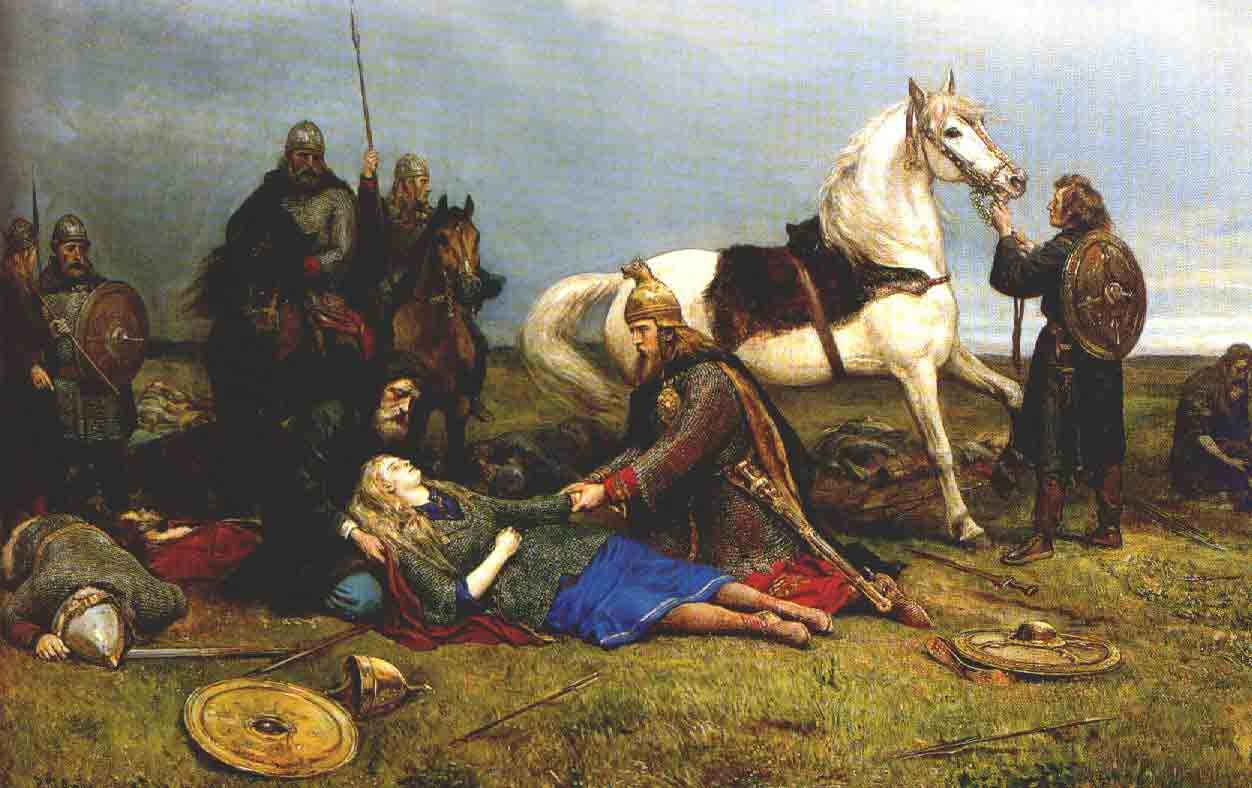
A sword that shines like a ray of the sun and brings no luck to anyone who carries it passes from hand to hand: from a king in Garðaríki to a berserk and his granddaughter, and on to two half-brothers who face each other in an eight-day battle between Goths and Huns. Hervarar saga ok Heiðreks binds together four very different stories, three old poems and a list of Swedish kings – and it survives in three versions that disagree from the first sentence on. This article reads the saga as a text: structure, manuscripts, poems, age and afterlife.
Hervarar saga ok Heiðreks, “the saga of Hervör and Heiðrekr”, is one of the fornaldarsögur. These Icelandic “sagas of ancient times” are set long before the settlement of Iceland and deal more freely in giants, dwarfs and the walking dead than the sagas of Icelanders do. Hervarar saga stands out among them for its many stanzas, some of which preserve names from the Migration Period.
The saga strings together four blocks held in place only by the sword Tyrfingr and one family. The first tells where the weapon came from, and of the berserk Arngrímr and his sons' fight on the island of Sámsey. The second belongs to Hervör, who wakes her dead father in his barrow, the third to her son Heiðrekr and his riddle contest with Odin. The fourth is the inheritance quarrel between his sons Angantýr and Hlöðr, which ends in the battle of the Goths and the Huns. Then, in one version only, comes a list of Danish and Swedish kings reaching into the twelfth century.
Hervör herself and the dialogue at the barrow have their own article: Hervör and the sword Tyrfing. This one looks at the saga as a whole.
The saga survives in three redactions, named by letters after their main manuscripts.
R is the vellum manuscript GKS 2845 4to, now in the Árni Magnússon Institute in Reykjavík. English Wikipedia dates it to the fifteenth century, the translator Peter Tunstall slightly earlier. R is held to be closest to the lost original, but breaks off in chapter 12, in the middle of the battle poem.
H is Hauksbók (AM 544 4to), from the early fourteenth century (English Wikipedia gives c. 1325) and so the oldest surviving manuscript of the saga. Its text ends after Gestumblindi's second riddle. According to English Wikipedia, H combines an R-like version with U material.
U is best represented by a seventeenth-century paper manuscript, Uppsala University Library R 715. AM 203 fol. is a copy of R that carries on with a U-type text where R stops. U adds a new opening chapter and is the only version to preserve the ending.
Readers today therefore almost always meet a composite. The widely used edition by Guðni Jónsson and Bjarni Vilhjálmsson (1943–44), reproduced on heimskringla.no, opens like R with King Sigrlami and continues past the point where R ends, down to the Swedish kings.
The origin of the sword shows the difference most clearly. In the R-based text King Sigrlami rules Garðaríki, the land of the Rus. He owns the sword Tyrfingr, made by unnamed dwarfs. The blade is described: it is the sharpest of weapons, and each time it is drawn it shines “svá sem af sólargeisla”, as if from a sunbeam. It cannot be bared without becoming a man's death (“at eigi yrði hann manns bani”) and may only be sheathed with warm blood on it; nothing it wounds lives to the next day, and no stroke misses. Here these are properties of the weapon. No dwarfs' curse is mentioned.
Hauksbók tells more. There the king rides out hunting, sees two dwarfs by a stone at sunset and forces them to forge him a sword. In the H text they are called Dvalinn and Dulinn (so Tunstall and Kershaw); English Wikipedia writes “Durin”. The king whom Dvalinn addresses in his curse is called Svafrlami in H. The curse has three parts: the sword will be a man's death every time it is drawn, three shameful deeds (Old Norse níðingsverk) will be done with it, and it will be the king's own bane.
So the familiar picture of the cursed sword that brings shame three times comes from H and U. R knows an uncanny sword but no smiths' curse at the start. Which three deeds are meant the text, as far as I have seen it, never says outright; the assignments in the literature are interpretations. For real blades of the period see the Viking sword.
The viking Arngrímr enters Sigrlami's service, marries his daughter Eyfura and receives Tyrfingr as a gift. So the R text; in the other tradition Arngrímr takes the sword from the king. He settles with Eyfura on his island of Bólm. They have twelve sons; the text names Angantýr, the eldest, Hjörvarðr, Hervarðr, Hrani and two Haddingjar. All are berserks who have never lost a battle.
At a Yule feast Hjörvarðr vows to marry the daughter of the Swedish king Ingjaldr at Uppsala or no one. There Hjálmarr inn hugumstóri, one of the king's men, objects, and the princess chooses the man she knows. Hjörvarðr challenges Hjálmarr to single combat on Sámsey, modern Samsø. On such duels see holmgang.
Before they sail, Arngrímr gives Tyrfingr to Angantýr, who has just married Sváfa, daughter of Earl Bjarmarr. In the bay of Munarvágr the brothers meet the ships of Hjálmarr and his companion Örvar-Oddr (“Arrow-Oddr”), the hero of a saga of his own. Oddr kills eleven of the brothers; Hjálmarr kills Angantýr and dies himself of sixteen wounds. The brothers are buried with their weapons in mounds on Sámsey.
After Angantýr's death Bjarmarr's daughter bears a girl, who is sprinkled with water and named Hervör. She prefers weapons to needlework, dresses as a man, calls herself Hervarðr and joins a band of vikings. On Sámsey she walks alone through the fire burning over the mounds and calls her father: “Vaki þú, Angantýr” – “Wake, Angantýr”.
The dialogue that follows is known as Hervararkviða, in English “The Waking of Angantýr”. The dead man refuses, warns, then gives way. His warning recurs in several stanzas:
“Sjá mun Tyrfingr, / ef þú trúa mættir, / ætt þinni, mær, / allri spilla.”
“This Tyrfingr will – if only you could believe it – destroy all your kin, maiden.”Hervarar saga ok Heiðreks, ch. 4 (Hervararkviða); Old Norse text after Guðni Jónsson and Bjarni Vilhjálmsson (heimskringla.no), own translation
Hervör takes the sword all the same. The threat stands in the poem, not only in the prose: even the R text, with no dwarfs' curse at the start, has Angantýr foretell the family's ruin. In every version the doom belongs to the sword; only the reason changes. On the dead man who guards his property in the mound, see draugr.
Still as Hervarðr, Hervör then spends a winter with King Guðmundr at Glasisvellir, later returns to Bjarmarr, gives up the man's role and marries Guðmundr's son Höfundr.
Hervör and Höfundr have two sons. Angantýr takes after his father; Heiðrekr makes trouble. At a feast he kills his brother – in the R-based text with a stone thrown in the dark. Other versions are said to have the deed done with Tyrfingr; I have not checked that against the text. Höfundr banishes his son and, at Hervör's request, sends him off with counsels: never to help a man who has killed his lord, never to free one who has murdered his companion, not to let his wife visit her kin too often. His mother gives him gold and the sword.
Heiðrekr breaks the counsels one after another. He buys the freedom of a traitor and of a murderer, comes to Reiðgotaland, defeats two rebellious earls for the old king Haraldr and receives Haraldr's daughter Helga and half the kingdom. When famine strikes, the lots demand the sacrifice of the noblest boy in the land. Höfundr rules that this is Heiðrekr's son. In return Heiðrekr claims every fourth man at the sacrificial assembly, uses them to kill Haraldr and dedicates the fallen to Odin in place of his son. Helga hangs herself. On what is known of such rites see human sacrifice among the Vikings.
On a campaign in Húnaland Heiðrekr defeats King Humli and carries off his daughter Sifka. Her son Hlöðr grows up with his grandfather among the Huns. In the end Heiðrekr counts as a powerful and wise king. He keeps a great boar and makes a vow: whoever has offended against him shall have the judgment of his twelve wise men – or go free if he can set the king riddles the king cannot solve.
A powerful man named Gestumblindi, an enemy of the king, is summoned. Trusting himself neither to the judgment nor to riddles, he sacrifices to Odin for help. At night a stranger arrives, the two exchange clothes, and the guest goes to the king in Gestumblindi's place. According to English Wikipedia the U version writes the name “Gestr inn blindi”, “Gestr the blind” or “the blind guest” – a fitting alias for the one-eyed god.
Riddle then follows riddle, all in verse. Most end with the same line, “Heiðrekr konungr, hyggðu at gátu” – “King Heiðrekr, think on the riddle” – and the king replies with a fixed formula beginning “Góð er gáta þín, Gestumblindi”: “Good is your riddle, Gestumblindi”. How many riddles there are depends on the manuscript. English Wikipedia speaks of around 37; the R-based reading text has fewer (I have not counted them against the printed edition).
The answers lead into the everyday life of a northern household: ale, dew, the hammer, the bellows, the spider, the leek, obsidian, angelica, the anchor, the cow, the shield, ptarmigans, the waves, a sow with her piglets.
The last question is no longer a riddle. The guest asks what Odin said into the ear of the dead Baldr before he was laid on the pyre. The same question ends Odin's contest with the giant in Vafþrúðnismál (stanza 54). Scholars call this a neck riddle: one only the asker can answer. Heiðrekr realises who his guest is and strikes with Tyrfingr. Odin escapes as a falcon, the blade shears off his tail feathers – which is why, the saga says, the falcon has a short tail. The god curses the king: thralls shall kill him.
The curse is fulfilled in the next chapter. Heiðrekr has brought home nine captives of noble birth from a raid in the west. One night they kill the guard, slay the king in his chamber and make off with Tyrfingr and the treasure. A stanza places the deed beneath the “Harvaða fjöll”.
Heiðrekr's son Angantýr is made king and swears not to sit in his father's high seat until he has avenged him. At the river Grafá he sees one of the killers cut the head off a fish – with Tyrfingr. That night he attacks their tent, kills all nine and recovers the sword. Then he holds his father's funeral feast “at Danparstöðum”, on the estate called Árheimar.
To this feast rides Hlöðr, the half-brother from Húnaland. With his arrival begins the poem scholars call Hlöðskviða, “The Battle of the Goths and the Huns”. According to English Wikipedia it consists of 29 stanzas or parts of stanzas scattered across the end of the saga; Christopher Tolkien argued in 1960 that it was originally an independent poem. This part is missing in H and breaks off in R.
Hlöðr demands half of his father's inheritance: land and treasure, the forest Myrkviðr, the holy grave and the stone that stands at the steads on the Danpr. Angantýr refuses, but offers wealth, men, horses and a third of the land of the Goths, Goðþjóð. Then Gizurr Grýtingaliði, Heiðrekr's old foster-father, calls Hlöðr a bondmaid's son and a bastard. Hlöðr rides back to Humli.
In spring the Huns call up every man of twelve years and every horse of two. The host passes through Myrkviðr, which divides Húnaland from Gotaland. Beyond the forest stands a fortress held by Angantýr's sister Hervör with her foster-father Ormarr – a second Hervör, granddaughter of the first. At sunrise she sees dust and glinting armour in the south, rides out and falls.
Gizurr rides to meet the Hunnish host and declares the battle: “Býð ek yðr at Dylgju ok á Dúnheiði” – he summons them to Dylgja, to Dúnheiðr and beneath the Jassarfjöll. The battle lasts eight days. On the last, Angantýr breaks the Hunnish shield-wall with Tyrfingr; Hlöðr and Humli fall. Angantýr finds his brother and laments: “Bölvat er okkr, bróðir, bani em ek þinn orðinn” – “We are cursed, brother; I have become your slayer.” His last words are “illr er dómr norna”: evil is the doom of the norns.
What sets this poem apart from other heroic verse of the North is its proper names. “Danpar-” is commonly taken to contain the name of the Dnieper; English Wikipedia places Árheimar on that river and reads Dúnheiðr as a field on the Danube. Christopher Tolkien, in his article “The Battle of the Goths and the Huns” (Saga-Book 14, 1953–57), linked the “Harvaða fjöll” with the name of the Carpathians by way of the Germanic consonant shift, in which an old k and p become h and f. If so, the name entered Germanic very early and was handed down orally.
Two further names point the same way. Gizurr's byname Grýtingaliði contains “Grýtingar”, which recalls the Greutungi, and the sword-name Tyrfingr recalls the Tervingi – the two great Gothic groupings of the fourth century. According to English Wikipedia such names indicate a Germanic tradition going back before about 390. For the background see the Goths and the Ostrogoths.
One witness outside Scandinavia supports the age of the material. The Old English poem Widsith, according to English Wikipedia, names counterparts of Heiðrekr, Sifka, Hlöðr and Angantýr; it is regarded as the oldest parallel. But names are all Widsith has to offer.
Since the nineteenth century scholars have looked for the event behind the poem. The proposals listed by English Wikipedia exclude one another: a fight between the Gothic king Ostrogotha and the Gepid king Fastida, reported by Jordanes (Carl Christian Rafn); the Battle of the Catalaunian Plains in 451 (Richard Heinzel); fighting between Langobards and Bulgars (Rudolf Much); a conflict after Attila's death in 453 (Gustav Neckel); an event on the Danube in 386 (Lukman). Reinhard Wenskus (1994) connected Árheimar with Arnhem and thought of a campaign of the Salian Franks – a lone voice.
There is no agreement. Most scholars, the same source says, place the material in the fourth or fifth century without fixing a date. Even the scribes disagreed: one manuscript equates Reiðgotaland and Húnaland with “Þýðskaland”, that is Germany, while other redactions equate Reiðgotaland with Jutland.
After the battle the saga changes genre once more. Angantýr rules long in Reiðgotaland; his son Heiðrekr úlfhamr (“wolf-skin”) follows him. Heiðrekr's daughter Hildr is the mother of Hálfdan snjalli, father of Ívarr inn víðfaðmi, who subdues Sweden, Denmark and many other lands. The line runs on through Haraldr hilditönn and Sigurðr hringr, opponents at Brávellir, to Ragnarr loðbrók.
Then the view narrows to Sweden: from Björn járnsíða by way of Eiríkr inn sigrsæli and Styrbjörn, who falls on Fýrisvellir, to Óláfr sænski, the first Christian king, then to Steinkell and his son Ingi, whom the Swedes make choose between the old law and the kingship. English Wikipedia has the list end with Philip Halstensson, a king of the early twelfth century.
This ending stands only in the U tradition. Scholars assume it was originally a separate text, attached later. It still counts as a source for eleventh-century Swedish history, though it survives only in seventeenth-century copies. Several of these kings are also known to Saxo Grammaticus.
The saga's layers lie far apart. The names in the battle poem point to the fourth or fifth century. How old the poems themselves are remains open. On Hervararkviða English Wikipedia reports two views: Christopher Tolkien held the poem to be older than the saga, while Hall thinks it was composed for a narrative already very like the saga. The prose is placed in the thirteenth century (Tunstall: “around 1250”); the manuscripts run from the early fourteenth century to the seventeenth.
The saga was first printed in Sweden. Olof Verelius published it with a translation; Jeffrey Scott Love counts the editions from 1672, English Wikipedia gives 1671. Seventeenth-century scholars still read it as fairly accurate history; Love's 2013 study deals with this early reception.
The English scholar George Hickes drew on Verelius's edition. His rendering of Hervararkviða appeared in 1705 and was, according to Hannah Burrows, the first Old Norse poem in English. In 1763 Thomas Percy included a revised version, “The Incantation of Hervor”, in his Five Pieces of Runic Poetry. Burrows puts its success down to the strong heroine and the uncanny setting. Leconte de Lisle wrote “L'Épée d'Angantyr” in 1862.
Jón Helgason edited the saga in 1924, Nora Kershaw translated it into English in 1921, and in 1960 Christopher Tolkien published The Saga of King Heidrek the Wise (London: Nelson), text and translation together. For his father's Norse sources see Tolkien. Hannah Burrows re-edited the stanzas in 2017; Reifegerste produced an annotated German translation in 1989.
What is Hervarar saga about? The sword Tyrfingr and its bearers: Arngrímr and his sons, Hervör, who fetches it from the barrow, King Heiðrekr, and his sons, who meet in the battle of Goths and Huns.
Who forged Tyrfingr? Dwarfs. Hauksbók names them Dvalinn and Dulinn (Durinn in some accounts) and has them curse the sword. Version R speaks only of dwarfs in general and has no curse at this point.
How many riddles does Gestumblindi ask? The figures differ because the manuscripts differ: up to around 37, depending on the version. At the end stands the question about Odin's words in Baldr's ear, which only Odin himself can answer.
Is the battle with the Huns historical? That cannot be established. Some names may reach back to the Goths on the Black Sea; which battle is meant remains open.
Which version should one read? Most editions and translations follow R and supply the ending from the U tradition. For the dwarfs' curse you need the opening of Hauksbók.
Hervoer · Hauksbók · Dwarves in Norse Mythology: Maggots in a Giant, Masters of the Gods' Treasures, Demons of Disease · Odin · The Shieldmaiden.
A young woman sails alone by night to an island, walks between burning grave mounds and wakes her dead father to claim …
Read more →No god in Norse mythology has a role so brief and so far-reaching as Höðr. He does essentially one thing: he shoots or …
Read more →Hringhorni is the ship of the god Baldr – in Snorri's words "the greatest of all ships" – and after his death it …
Read more →A Danish king scatters gold on a road so that his pursuers dismount to pick it up. A champion sits motionless in the …
Read more →