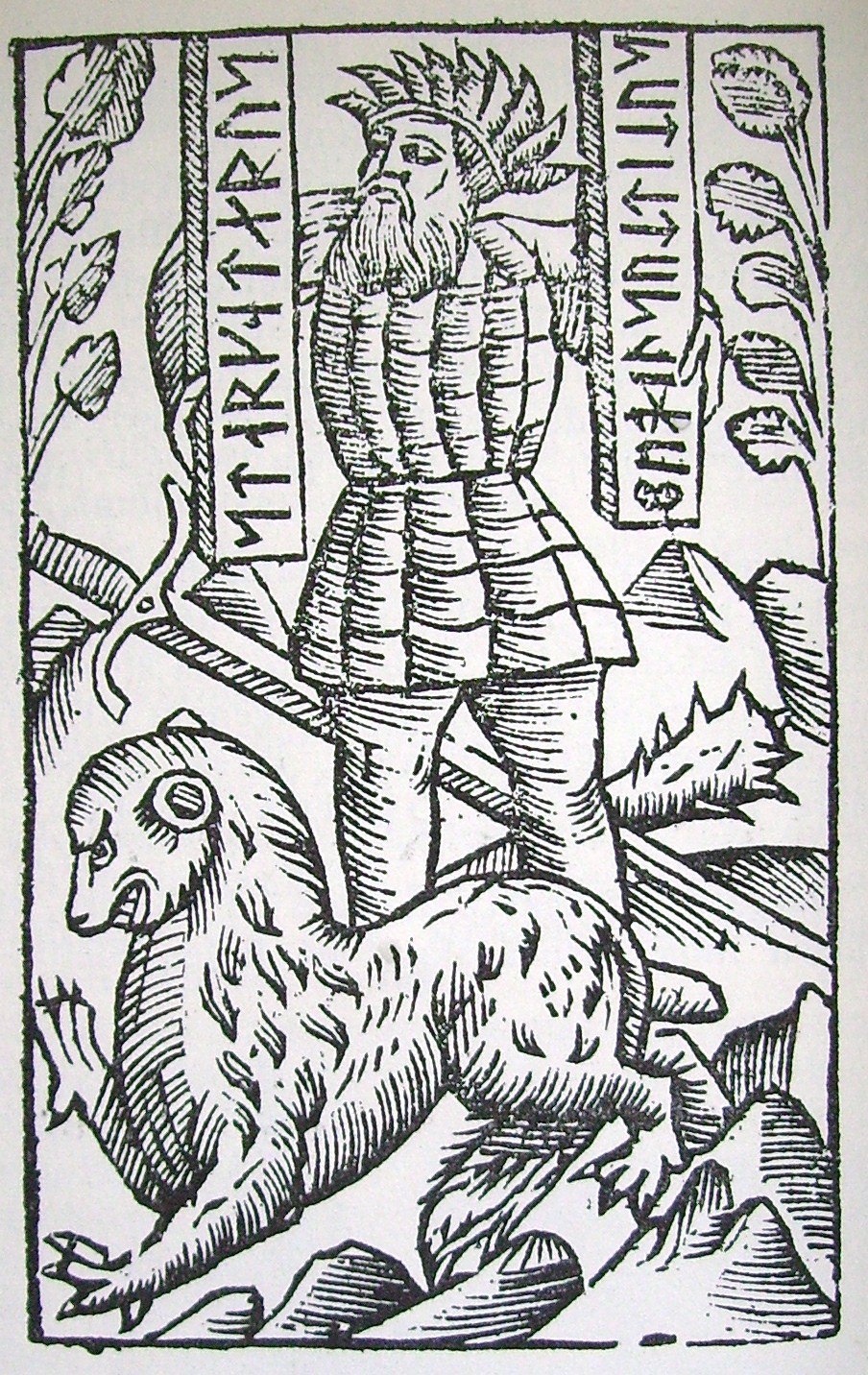
A king stands on a tree stump with a noose of calf-gut round his neck, too soft to strangle anyone. His best warrior taps him with a reed. It is meant to be a sacrifice in show only. Then the reed becomes a spear and the gut a rope. So begins the career of Starkad, the fighter to whom Odin grants three human lifetimes and who must commit a shameful deed in each of them. This article takes the sources one by one and shows where they agree and where they do not.
Starkad – Old Norse Starkaðr, Starcatherus in the Latin of Saxo Grammaticus – is one of the oddest figures of Norse heroic legend. Unlike the dragon-slayer Sigurd he is old, scarred and surly, a man without land or children who moves from one royal hall to the next. He wins every fight and is wounded in every fight. He composes poetry and forgets what he composed. The high-born respect him; ordinary people cannot stand him.
These contradictions are not accidental. One of the sources, Gautreks saga, traces them explicitly to a quarrel between two gods: Odin gives, and Thor spoils each gift with a counter-decree.
The fullest account stands in the Gesta Danorum, the Latin history of the Danes by Saxo Grammaticus, written around 1200. Starkad enters in Book Six and dies in Book Eight. For this article I worked through Books Six and Eight in extracts from Oliver Elton's English translation of 1894; of Book Seven I know only a single sentence.
The second main source is Gautreks saga, an Icelandic legendary saga (fornaldarsaga, a saga set in the time before Iceland was settled). Its seventh chapter describes the allotting of Starkad's fate and the sacrifice of King Víkarr. Embedded in the saga is a poem put into Starkad's own mouth, the Víkarsbálkr. Our article on Gungnir places the saga “probably in the 13th or 14th century”; nothing more precise can be shown here, and I give no figure for the age of the stanzas.
There are shorter mentions as well: in Ynglinga saga, in the fragment Sögubrot on the battle of Brávellir, in one version of Hervarar saga, and in Norna-Gests þáttr, a short tale about an age-old guest at the court of Olaf Tryggvason. For this article I know these passages only from the summary in the English Wikipedia, not from their wording.
Saxo introduces Starkad as the son of Storwerk. He alone escaped from a shipwreck in which his companions died, and King Frotho (Frode in Elton) took him in, gave him a ship and set him to guard the coast. He was born, Elton's text says, in “the country which borders Sweden on the east”. The English Wikipedia takes that to mean Estonia.
Saxo reports the tale that Starkad was sprung from giants and had an unusual number of hands, four of which “the god Thor tore off, shattering the framework of the sinews”, leaving only two. Saxo does not believe it himself. He calls the story “a fabulous yet common rumour” and “flatly incredible”.
Icelandic tradition solves the problem differently. It knows two men of the name. According to the English Wikipedia, the U and H versions of Hervarar saga tell of an elder Starkaðr Áludrengr, a giant who lives by a waterfall in northern Norway, wields four swords at once in a duel, and is finally killed by Thor because he has carried off Álfhildr, daughter of a king of Álfheimr. The hero of Gautreks saga would then be his grandson, the son of Stórvirkr. More on the giants of the North can be found in a separate article.
The seventh chapter of Gautreks saga contains one of the strangest divine scenes in Old Norse literature. A man called Hrosshársgrani – roughly “Horsehair-Grani” – turns out to be Odin. He and Thor pronounce in turn what Starkad is to receive in life. Thor begins, and he is hostile. The saga gives the reason: Álfhildr, the mother of Starkad's father, once preferred a “hundvísan jötun”, a very cunning giant, to Thor of the Æsir. The god holds the slight against the grandson.
In the text edited by Guðni Jónsson and Bjarni Vilhjálmsson there are thirteen:
Odin is the patron here and Thor the enemy. A níðingsverk is the act of a níðingr, a man without honour, the harshest verdict Old Norse society could pass on anyone. The article on insults and níð explains the term.
Odin's gifts have a price. King Víkarr's fleet is held up off Hörðaland – by contrary winds according to my extract from the saga text, becalmed according to the English Wikipedia. The lot deciding who is to be sacrificed to Odin falls on the king himself. A sacrifice in show only is agreed. The king climbs onto a tree stump (“stofn”), and calf-guts tied to a pine branch are laid round his neck. Starkad holds what looks like a reed stalk; in truth Hrosshársgrani has put a spear in his hand (“fekk Hrosshárs-Grani geir í hönd honum”).
“Nú gef ek þik Óðni.” […] “Reyrsprotinn varð at geir” […] “kálfsþarmarnir urðu at viðju sterkri” – “Now I give you to Odin.” […] “The reed stalk became a spear” […] “the calf-guts became a strong withy.”Gautreks saga, ch. 7; Old Norse text after Guðni Jónsson and Bjarni Vilhjálmsson (Fornaldarsögur Norðurlanda), heimskringla.no; my own translation, omissions marked
Starkad lets go of the branch. The stump falls from under the king's feet, the bough springs up and hoists him into the limbs of the tree. There he dies. The place, says the saga, has been called Víkarshólmar ever since.
Spear and rope together: this is exactly the double death that is linked with Odin elsewhere too, the god who says of himself in the Eddic poem Hávamál that he hung on the tree, wounded by a spear. A reed that turns into a spear in flight also occurs in Styrbjarnar þáttr; the article on Odin's spear Gungnir sets the two passages side by side. The scene is a medieval literary narrative about the pagan past, not an eyewitness report. For the actual evidence see the article on human sacrifice.
For Starkad the deed has consequences that fit Thor's decree. The saga says it made him deeply hated by the people and that he was first outlawed from Hörðaland. He flees east to the realm of the Swedes, to the kings Eiríkr and Alrekr at Uppsala. When Alrekr asks about his kin, he composes the Víkarsbálkr.
Saxo knows the story but tells it more briefly and with a different emphasis. He has no assembly of gods and no quarrel. Odin wants Wicarus (Wikar in Elton) to die a wretched death and therefore equips Starkad with a special accomplishment – Elton's translation speaks, in substance, of skill in spells. He also gives him, in Elton's words, “three spans of mortal life, that he might be able to commit in them as many abominable deeds”. In Saxo, then, gift and curse come from the same hand; Thor appears only in the story of the torn-off arms.
The mechanics of the sacrifice differ too. Saxo speaks of a noose of withies that is meant to hold the king only for show. But then “the tightness of the knot acted according to its nature, and cut off his last breath as he hung”. A reed turning into a spear is not mentioned in the extracts I worked from. Retellings state that in Saxo, too, Starkad finishes the hanging king with his blade; I have not seen the wording of that passage.
Three lives, three misdeeds: both main sources state the scheme. Which deeds are meant is less clear.
The first is certain. In both texts the death of Víkarr is the crime with which everything begins. The last is told clearly as well: in Book Eight the aged Starkad lets conspirators bribe him to murder the Danish king Olo (Ole in Elton). “One hundred and twenty marks of gold” are his reward. He stabs the king at the bath, is soon “smitten with remorse and shame”, and kills some of the instigators, among them Hlenne (Elton's form of the name).
The second deed is the problem. In Book Seven Saxo tells how, in a battle, “some strange terror stole upon him, and he chose to follow the flight of his friends”. Since Georges Dumézil, scholarship has taken this flight to be the second shameful deed. I did not find Saxo himself counting it so in the extracts I saw; the identification is interpretation. Gautreks saga is no help, since it tells only the first deed.
Book Six strings together episodes that take Starkad across the world as Saxo knew it. He joins one Bemon, whom Saxo calls the most courageous of the Danish rovers. In Russia the defenders scatter spiked nails; the Danes put on wooden clogs and walk across. There Starkad also defeats a sorcerer named Wisin, who blunts blades by magic – Starkad wraps his sword in a thin skin and the spell fails. At Byzantium he overcomes a giant called Tanne who was reputed invincible, in Poland a champion the Danes call Wasce. The Saxons put up their champion Hame against him; Starkad kills him in a duel.
He is said to have lived seven years with the “sons of Frey” in Sweden. Then he leaves Uppsala, and the reason is typical of the figure. During the sacrifices he is disgusted by the effeminate gestures, the clapping of the mimes and the unmanly clatter of bells. As a description of the cult at Old Uppsala the passage should be read with caution: it is the view of a Christian author around 1200, attributed to a legendary hero.
Starkad then enters the service of one Hakon and fights the men of a king Hugleik. From that fight comes a wound of which, according to Saxo, he said in a song that he had never suffered a worse one.
Two episodes show how Saxo uses the figure as a judge of morals. The first concerns Helga, sister of King Ingellus (Ingild in Elton). A goldsmith of low birth pays court to her. Starkad sits down by the door with his face muffled in a cap, watches the scene, and then goes for the man with his sword.
The second episode is the fight against nine brothers. A man named Helge, a suitor of Helga, has to face nine brothers and asks Starkad for help. The old man faces the nine alone. He kills six without being hit; the remaining three wound him badly before they fall as well – Saxo counts seventeen wounds.
The badly wounded man lies by the road and turns away anyone who offers help if their rank or way of life displeases him: a man driving a cart; a man married to another man's slave; a woman who grinds at the mill, whom he sends home to her child. Only a young peasant's son is allowed to bind his wounds. Better to bleed to death than be saved by the wrong people.
The climax of Book Six is Starkad's appearance at the court of Ingellus. The young king is Frotho's son, and his father is unavenged. Instead of taking revenge, Ingellus has married the sister of the sons of Swerting, on whom it ought to be taken, and lives in luxury. Starkad enters the hall. The queen insults him. He flings her head-band back in her face and hurls a bone at a piper.
Then he launches into a long poem. He reviles the rich cooking, the new manners, the king's sloth. One sentence of Elton's translation catches the tone: he had come to Denmark to find the son of Frode, “not a man who crammed his proud and gluttonous stomach with rich elaborate feasts”. The speech works. Ingellus leaps up and cuts down the sons of Swerting at his own table.
The scene has a famous relative. In the Old English Beowulf an unnamed old warrior goads the Heathobards into avenging their king, although his son Ingeld is married to the enemy's daughter. The English Wikipedia calls this old warrior a counterpart of Starkad; only the likeness of the motif is certain.
Outside Gautreks saga, Starkad appears in Icelandic texts only in minor parts, but always as the ancient, dreaded fighter. Ynglinga saga reports in its chapter on the Swedish king Aun that a Danish prince, Áli the Bold, drove Aun out until Starkad killed him; Aun then won back his throne. So the summary runs; in the edition used by our article on Ynglinga saga, Aun is the subject of chapter 29.
Sögubrot describes the legendary battle of Brávellir between Harald Wartooth and Sigurd Hring. According to the English Wikipedia, Starkad fights there on Sigurd Hring's side. Saxo tells the same battle in Book Eight. There Starkad overthrows Harald's nobles and cuts off the right hand of the shield-maiden Wisna, Harald's standard-bearer; he himself leaves the field with his neck cleft, one finger gone and his lung protruding from his chest. Our article on the warrior grave Bj 581 names the women Saxo brings on there. The battle cannot be grasped historically.
In Norna-Gests þáttr, finally, Starkad meets Sigurd the dragon-slayer. On learning whom he is facing he runs; Sigurd still knocks out two of his teeth.
Saxo tells Starkad's end in Book Eight. The hero is “worn out with extreme age”, can barely see and walks on two staves. He meets Hatherus (Hather in Elton), son of that Hlenne whom he himself struck down, and asks him to cut off his head.
He adds a promise: if Hatherus springs between head and trunk before the corpse falls, he will be “proof against arms”. Hatherus strikes but does not leap – he suspects that the promise hides some treachery. The severed head, Saxo says, “is said to have bitten the earth”. Hatherus has the body buried in the field that Elton calls Rolung.
What can be said about real ageing in the Viking Age is covered in a separate article. Starkad dies by the hand of a man whose father he killed.
Odin's fifth gift in Gautreks saga is poetry, and both main sources take it seriously. The saga puts the Víkarsbálkr into his mouth, a retrospect on his life in stanzas. Saxo has him speak in verse several times, at greatest length in the tirade. Saxo's Latin poems are generally regarded as reworkings of vernacular lays; which Old Norse models lie behind them in detail cannot be established with certainty, because those models are lost.
How the art of the skalds works technically is shown in the article on dróttkvætt.
The best-known modern interpretation comes from the French historian of religions Georges Dumézil. He developed it in “Aspects de la fonction guerrière chez les Indo-Européens” (1956), in “Heur et malheur du guerrier” (1969; English “The Destiny of the Warrior”, 1970) and in the second volume of “Mythe et épopée” (1971). I did not consult his books; I follow the summary by C. Scott Littleton in the Encyclopedia of Religion.
Dumézil assumed that the societies speaking Indo-European languages inherited a common pattern of thought: a threefold division into sovereignty and the sacred, into fighting, and into wealth and fertility. In this model the “three sins of the warrior” offend one against each sphere. For Starkad, Littleton lists them thus: he “sacrilegiously sacrifices his sovereign to the god Óðinn, abandons his cohorts in battle, and, for money, slays the Danish king Olo”. The distribution is plain enough – the sacred, fighting, wealth. As relatives Dumézil set beside him the Indian god Indra and the Greek Heracles, to whom he ascribed a similar triple scheme.
This is a hypothesis, not a finding. It rests on two premises, both of which are disputed: that the tripartite pattern existed as a common inheritance at all, and that the flight in Book Seven is really meant as the second of the three shameful deeds. The number three is popular in stories of every kind. The sources alone cannot settle the dispute.
Who was Starkad? A figure of Norse heroic legend: an ancient warrior and poet who is fated to live three human lifetimes and commit a shameful deed in each. His story is told chiefly by Saxo Grammaticus and in Gautreks saga. He is not historically attested.
Which three shameful deeds did he commit? The first is certain: he kills King Víkarr at a sacrifice that was meant to take place in show only. The third is held to be the paid murder of King Olo in Saxo's Book Eight. The second is usually said to be a flight from battle, told in Book Seven. That identification is interpretation.
Why is Thor his enemy? Gautreks saga gives a reason: Starkad's grandmother Álfhildr preferred a giant to the god. Thor takes it out on the grandson. In Saxo this quarrel is absent; there Thor only tears off the hero's surplus hands.
How did Starkad die? According to Saxo's Book Eight he has himself beheaded, as a nearly blind old man, by Hatherus, the son of a man he himself killed. The severed head is said to have bitten the earth.
What is the Víkarsbálkr? A poem that Gautreks saga puts into Starkad's mouth. He recites it at the court of Uppsala when King Alrekr asks about his kin, looking back on his life and on the death of Víkarr.
Saxo Grammaticus · Odin · Thor · Ynglinga saga · Hervarar saga ok Heiðreks – the saga of the sword Tyrfingr.
A son wakes his dead mother, receives nine protective charms from her, and then stands before a hall ringed with fire …
Read more →A Norwegian book of the thirteenth century claims that its stories come from German men, and it names three towns they …
Read more →Thjálfi and Röskva (Old Norse Þjálfi and Rǫskva) are a brother and sister from a poor farmhouse who become servants of …
Read more →A giant in eagle shape, a god blackmailed into treachery, a goddess turned into a nut, and immortals going grey for the …
Read more →