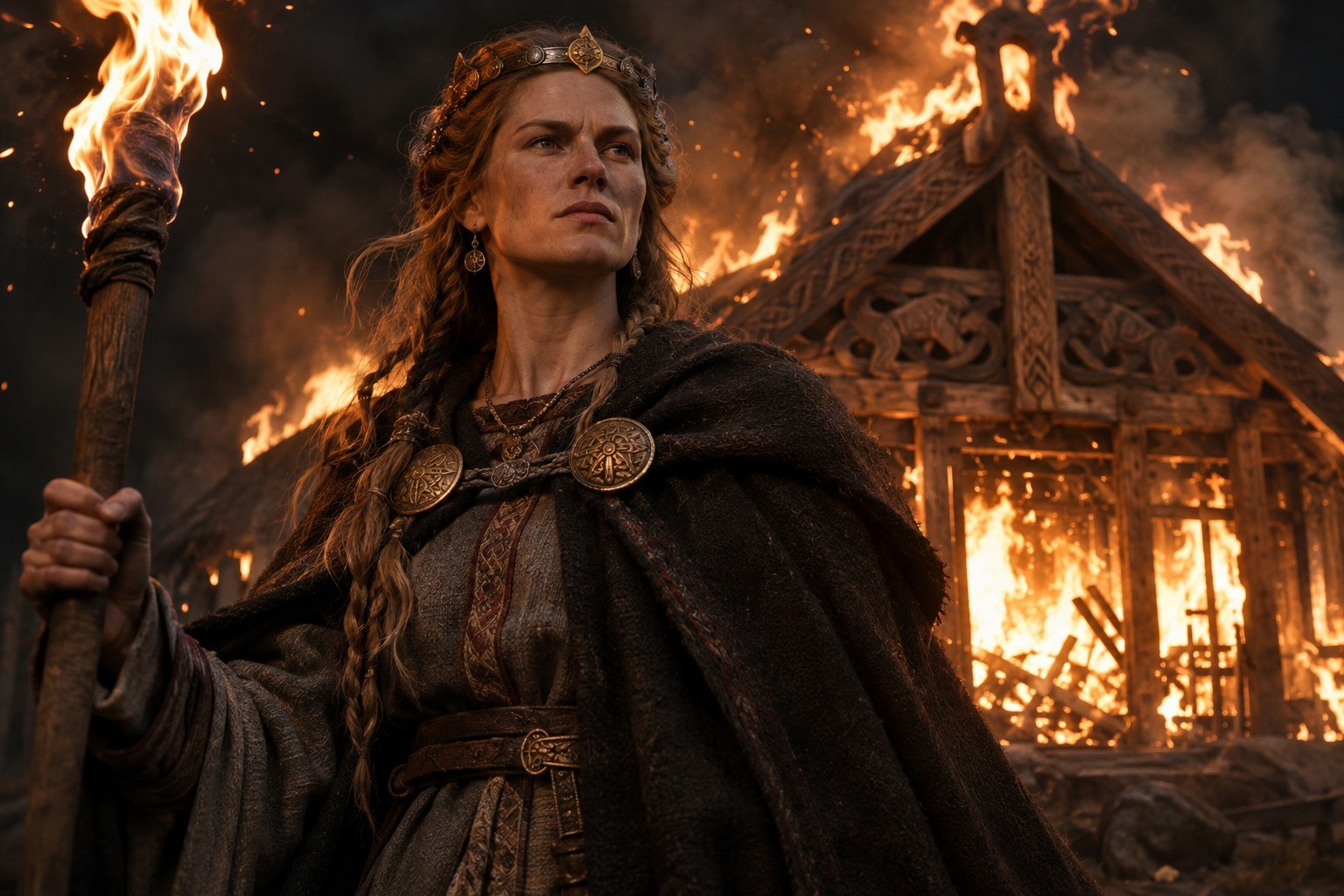
The same story told a second time, only longer, quieter and closer to the farmyard than the royal hall: Atli lures the brothers Gunnarr and Högni to his home, and by the end the brothers and Atli are dead. The Atlamál in grœnlenzku are the longest heroic poem of the Codex Regius. They tell of a runic message forged on the way, of two wives who dream of disaster in the night, and of a quarrel between Guðrún and the dying Atli. This article follows the text stanza by stanza, shows where it has gaps, and separates the heading "Greenlandic" from what can actually be concluded from it.
The Codex Regius, the Icelandic manuscript of the Poetic Edda written around 1270 (GKS 2365 4to), contains two poems on the same subject, one straight after the other. The first is the Atlakviða: terse, hard and full of dark images. The second is headed "Atlamál in grœnlenzku", "the Greenlandic sayings of Atli" or "the Greenlandic Lay of Atli". Both tell how Atli, the Norse descendant of Attila the Hun, invites his brothers-in-law to his court and has them killed, and how his wife Guðrún, their sister, kills him in return. The historical background is covered in our article on Atli and Attila.
The plot is almost the same; the telling is not. The poet adds new names, gives women a voice and lingers over scenes such as a farewell at the fjord or a marital quarrel about bride-gifts. In the introduction to his 1923 translation, Henry Adams Bellows called the Atlamál the longest of all the heroic poems in the collection. Edward Pettit, in his dual-language edition of 2023, describes it as the second-longest poem in the manuscript as a whole.
According to Pettit, the Atlamál occupy leaves 41r to 44r of the Codex Regius. In the order that our source archive reproduces from the manuscript, the Atlakviða is followed by the Atlamál and then by the Guðrúnarhvöt, which leads into the Hamðismál. How Guðrún came to be married to Atli after Sigurðr's death is told in the short prose piece "Dráp Niflunga" and in the Guðrúnarkviður; for the manuscript itself, see Codex Regius.
How many stanzas the poem has depends on whom you ask. The edition by Guðni Jónsson, which our source archive uses for the Old Norse text, counts 105 stanzas, including two places (st. 23 and 27) where the text is missing altogether. Karl Simrock's German translation arrives at 103, Bellows at 99, because both skip the gaps and merge or redivide several stanzas. All stanza numbers in this article follow the Old Norse numbering of our source archive.
The poem opens with a look back that already knows the ending: men once plotted in secret, and the sons of Gjúki were betrayed (st. 1). Atli took bad counsel although he was shrewd and sent messengers to summon his in-laws (st. 2).
Guðrún, called here only "the wise housewife", overhears what is planned in secret. She wants to help but cannot cross the sea herself (st. 3). So she carves runes. The messenger Vingi alters them before handing them over (st. 4). This is the first major difference from the Atlakviða, where Guðrún sends a ring with a wolf's hair wound round it (Atlakviða st. 8). The Atlamál replace that silent sign with writing, and writing can be forged.
Atli's envoys travel "um fjörð Lima" to the Gjúkungs. Simrock renders this as a sound with many arms, while Bellows reads a place name, "Limafjord", and suggests in his note that it is probably the Limfjord in northern Jutland. Whether the poet really placed the Gjúkungs in Denmark cannot be established.
The guests are warmly received (st. 5). Then two women appear who occur in the Poetic Edda only in this poem: Kostbera, Högni's wife, and Glaumvör, Gunnarr's wife (st. 6). Kostbera is "cunning in rune-craft" (st. 9, Bellows). She reads the message by firelight and can barely make sense of it. In the morning she tells Högni what she has read: his sister did not invite him this time (st. 11). It seems to her that death for both brothers lies beneath the words, "but one rune she missed, or else others have marred it" (st. 12, Bellows). Högni brushes this aside. Women are always fearful, he says, and the king will reward them with glowing red gold (st. 13).
First Kostbera, then Glaumvör tells her husband what she has dreamed, and each husband explains every dream away.
Kostbera sees Högni's bed-cover burning; Högni says it is only old linen (st. 15–16). She sees a bear break in, overturn the benches and seize many in its jaws; Högni explains that a storm is coming, she has seen a "hvítabjörn", a white bear, and that means a gale from the east (st. 17–18). She sees an eagle spatter everyone with blood and takes it for Atli's "hamr", his shape or spirit; Högni says it means oxen to be slaughtered, and assures her: "heill er hugr Atla", Atli's mind is true (st. 19–20).
Glaumvör dreams of a gallows on which Gunnarr hangs while serpents eat him alive (st. 22). Gunnarr's reply is lost; in place of stanza 23 the text has only a gap. Then she sees a bloody sword drawn from his mail-coat, a spear through his body and wolves howling at both ends; Gunnarr hears only barking dogs in it (st. 24–25). She dreams of a river rushing through the hall and breaking the brothers' legs (st. 26); again Gunnarr's interpretation is missing (st. 27). Finally she sees dead women coming in the night to invite Gunnarr to their benches, and fears that his "dísir", the protective female powers, have abandoned him (st. 28). Gunnarr's only answer is that it is too late: the journey is decided, and much suggests their lives will be short (st. 29).
The dreams anticipate what is later threatened, such as gallows and serpents (st. 59); the men's readings stay everyday: bedding, weather, cattle, dogs.
In the morning only five men set out: Gunnarr, Högni, Högni's sons Snævarr and Sólarr, and Orkning, Kostbera's brother. Their followers number twice as many, "their minds knew not wisdom" (st. 30, Bellows). The women go with them until the fjord parts them (st. 31). Vingi swears to Glaumvör that giants and the gallows may take him if he has lied (st. 32–33). Kostbera, here called simply "Bera", wishes them luck and victory (st. 34). Then comes the stanza that sums up the farewell:
They tenderly looked till each turned on his way,
Atlamál in grœnlenzku, st. 36 (Old Norse numbering; Bellows st. 33); Henry Adams Bellows, The Poetic Edda, 1923, public domain
Then with changing fate were their farings divided.
They row so hard that the keel splits; they do not even make the ship fast (st. 37). Then they see the farm that once belonged to Buðli, Atli's father, and Högni strikes the gate (st. 38). Only now does Vingi admit that he lured them with deceit (st. 39). The brothers cut him down with axes (st. 40–41).
Atli's men arm themselves, and after an exchange of words both sides shoot with bows across the courtyard (st. 42–44). Inside, Guðrún hears from a thrall what is happening in front of the hall. She tears off her necklaces and flings the silver so hard that the rings burst apart (st. 46). She goes out, greets her brothers for the last time and says she tried to keep them at home, but "none escapes his fate" (st. 47–48, Bellows).
What follows has no counterpart in the older poem. Guðrún throws off her cloak, grasps a naked sword and fights on her brothers' side. She kills two men, among them a brother of Atli, whose foot she strikes off, and her hands never tremble (st. 49–51). The fight lasts from morning until past midday (st. 53). The same stanza says eighteen fell before the enemy gained the upper hand, and names Bera's two sons and her brother. Bellows reads eighteen foes slain by Bera's sons and her brother; Simrock leaves open who the eighteen are. Atli draws up his own balance: they were thirty fighting men, eleven are left. Of five brothers alive at Buðli's death, Hel now has half and two lie slain (st. 54–55).
Atli accuses Guðrún of robbing him of his kin, cheating him of gold and sending his sister to her death (st. 56); the sister is Brynhildr, whose story is told in our article on Brynhildr. Guðrún retorts that he acted first: he took her mother's life for treasure and starved a kinswoman in a cave (st. 57). The poem does not say what these accusations refer to.
Atli orders Högni's heart to be cut out and Gunnarr to be bound to the gallows and thrown to the serpents (st. 59). Then Beiti, Atli's steward, suggests taking the thrall Hjalli instead of Högni, since he is good for nothing anyway (st. 61). Hjalli hides, wails about his swine and begs for his life (st. 62–63), and Högni pleads for him: he would rather face the knife-play himself than hear the howling (st. 64).
In the Atlakviða, Gunnarr demands to see Högni's heart; first they bring him Hjalli's trembling heart, and Gunnarr sees through the deception (Atlakviða st. 21–25). In the Atlamál, Hjalli serves no deception at all. Then they seize Högni, and he laughs so that everyone hears it (st. 65). Gunnarr takes up a harp and strikes it "ilkvistum", with his toes, so that the women weep and the rafters burst (st. 66). Both die early in the day (st. 67). The poem says nothing of a serpent that finally kills Gunnarr, and the treasure and its hiding place in the Rhine do not appear at all.
The toes are absent from the Atlakviða. There the Old Norse text says Gunnarr struck the harp with his hand ("hendi", Atlakviða st. 31). Simrock nevertheless translates "with his toes". Snorri and the Völsunga saga then tell the toe version, explaining that Gunnarr's hands were bound.
Atli stands over the dead and taunts Guðrún: "It is morning, Guthrun" (st. 68, Bellows). He offers her slave-women and silver as compensation (st. 69–70). Guðrún refuses, then seems to give in: the power of men breaks the will of women, so let Atli rule over all (st. 71–73). She plays, says the poet, "with two shields" (st. 74).
Both hold a funeral feast, Guðrún for her brothers, Atli for his fallen men (st. 75–76). Guðrún lures her two little sons to the chopping block. Then she cuts both their throats (st. 79). In the Atlakviða the sons have names, Erpr and Eitill (Atlakviða st. 37); in the Atlamál they remain nameless.
When Atli asks after the boys, Guðrún explains what he has eaten and drunk: their skulls served as beer-cups, their blood was in his drink, and she roasted their hearts on a spit and served them to him as calf's hearts (st. 82–83). Atli threatens to have her stoned and burned (st. 87). The revenge is completed by Guðrún and Hniflungr, Högni's son, who no longer hides his hatred of Atli (st. 88–89). Atli wakes, wounded, and asks who struck him (st. 90). Guðrún admits it, "and the son of Hogni" (st. 91, Bellows).
The dying Atli and his killer then reproach each other over their marriage. Atli lists the bride-gift, thirty slaves, seven handmaidens and even more silver, and complains that she often made his mother weep (st. 92–96).
Guðrún calls this a lie. Atli and his brothers quarrelled even as boys, and half his house went to Hel because of it (st. 97). Then she tells of her own youth: they were three siblings, they sailed east with Sigurðr, killed a king and took his land (st. 98–99). Then "inn húnski", "the Hunnish one", died, and here, as Bellows also notes, that means Sigurðr himself (st. 100). The last stanza of her speech breaks off in the text (st. 101).
Atli asks for an honourable burial (st. 102). Guðrún promises a ship, a painted coffin and a waxed shroud; she will care for everything "as if dear were we ever" (st. 103, Bellows). She keeps her word. Afterwards she wants to kill herself, but her death is long in coming (st. 104). The final stanza praises anyone who has children like Gjúki's (st. 105). Its key word, "þrámæli", is understood differently by the translators: Simrock reads "enmity", Bellows "valor heroic".
The Atlakviða is set in halls full of gold; the Atlamál come down to earth. Atli lives on a "bær", a farm (st. 38), he has thirty fighting men (st. 54), a steward and a thrall who would rather tend the pigs (st. 61–62). Pettit describes the setting as suggestive of the great farmsteads and farmers of the Icelandic prose sagas.
At first, only the heading names the origin. Greenland was settled from Iceland around 985/986; the story of the settlement is told in our articles on Erik the Red and the Greenlanders. For the Atlakviða, according to English Wikipedia, most scholars reject a Greenlandic origin because they consider the poem older than the colony. The Atlamál are a different case. In 1923 Bellows regarded the Greenland origin as "generally accepted", pointing to the polar bear in Kostbera's dream and the poem's general colour; English Wikipedia, citing Ursula Dronke's 1969 edition, also mentions the grim tone and the modest circumstances. Pettit speaks more cautiously of the poem's "apparent" status as Greenlandic literature and points to some indications of a Danish background; the Limfjord of stanza 4 would be one.
The date also remains open. Bellows reports that most critics placed the poem nearer 1100 than 1050. English Wikipedia gives the 12th century as most likely. Only one thing is certain: the poem is older than the manuscript of around 1270.
According to Bellows, English Wikipedia and Pettit, the Atlamál are the only Eddic poem composed entirely in málaháttr. This metre, roughly "speech manner", fills the short line more heavily than the usual narrative fornyrðislag; more on this in our article on dróttkvætt and the Eddic metres.
According to Bellows, the authors of the Völsunga saga knew the poem in very much its present form. The saga tells of Kostbera reading the runes, the dreams including the white bear and the eagle, and the revenge with Högni's son, who is called Niflungr there. But it combines this with the Atlakviða: the ring with the wolf's hair, the heart test with Hjalli and Gunnarr's refusal to give up the gold ("the Rhine shall now rule the gold") come from the older poem. At the end the saga has the hall burn. Snorri summarises the story briefly in the Skáldskaparmál; the gold in the Rhine and the burning hall, both absent from the Atlamál, he shares with the Atlakviða, and Högni's son as fellow avenger with the Atlamál. In the Þiðreks saga, according to Bellows, Högni's son is called Aldrian; he leaves Attila to starve in the treasure mountain. In the Nibelungenlied the revenge is reversed: Kriemhild avenges Siegfried on her own brothers.
The full text in Old Norse, German and English, stanza by stanza side by side, is in our source archive under Atlamál in grœnlenzku.
What does "Atlamál in grœnlenzku" mean? Roughly "the Greenlandic sayings of Atli" or "the Greenlandic Lay of Atli". Whether this manuscript heading gives the origin correctly is a research question.
How do the Atlamál differ from the Atlakviða? The plot is similar, but the Atlamál are longer, are set on a farm instead of in a royal hall and add new characters: Kostbera, Glaumvör, Högni's sons, Hniflungr. Guðrún fights with a sword, and the ending is a burial, not a burning hall.
Who is Hniflungr? Högni's son, who kills Atli together with Guðrún (st. 88–91). In the Völsunga saga he is called Niflungr.
How old is the poem? There is no secure date. Bellows reports a dating nearer 1100, English Wikipedia gives the 12th century. It was written down in the Codex Regius around 1270.
What do Kostbera and Glaumvör dream? Among other things fire, a bear, an eagle, a gallows and dead women. The men explain every dream away (st. 14–29).
Atlakviða: the old Lay of Atli · Atli and Attila · The Guðrúnarkviður · Hamðismál · The Völsunga saga · The Nibelungenlied · The Þiðreks saga · The Codex Regius · The Greenlanders
Atlakviða: the old Lay of Atli, the hoard in the Rhine and Guðrún's revenge · Atli – the Eddic King of the Huns Between History, Saga and Picture Stone · The Lays of Gudrun: three Eddic poems about the woman who outlives everyone · The Nibelungenlied and the North · Hamðismál: how Hamðir and Sörli avenge Svanhild and fail for want of a brother.
Baldr dies when his blind brother Höðr throws a sprig of mistletoe at him – the one plant Frigg never made swear an …
Read more →A god saddles his horse, rides into the world of the dead and sings a dead woman out of her grave, because he wants to …
Read more →Berserkers were warriors who went into a feared battle-frenzy, the berserksgangr – first attested in the late ninth …
Read more →There was no single Viking burial rite: people in the Viking-Age North either cremated their dead or laid them in the …
Read more →