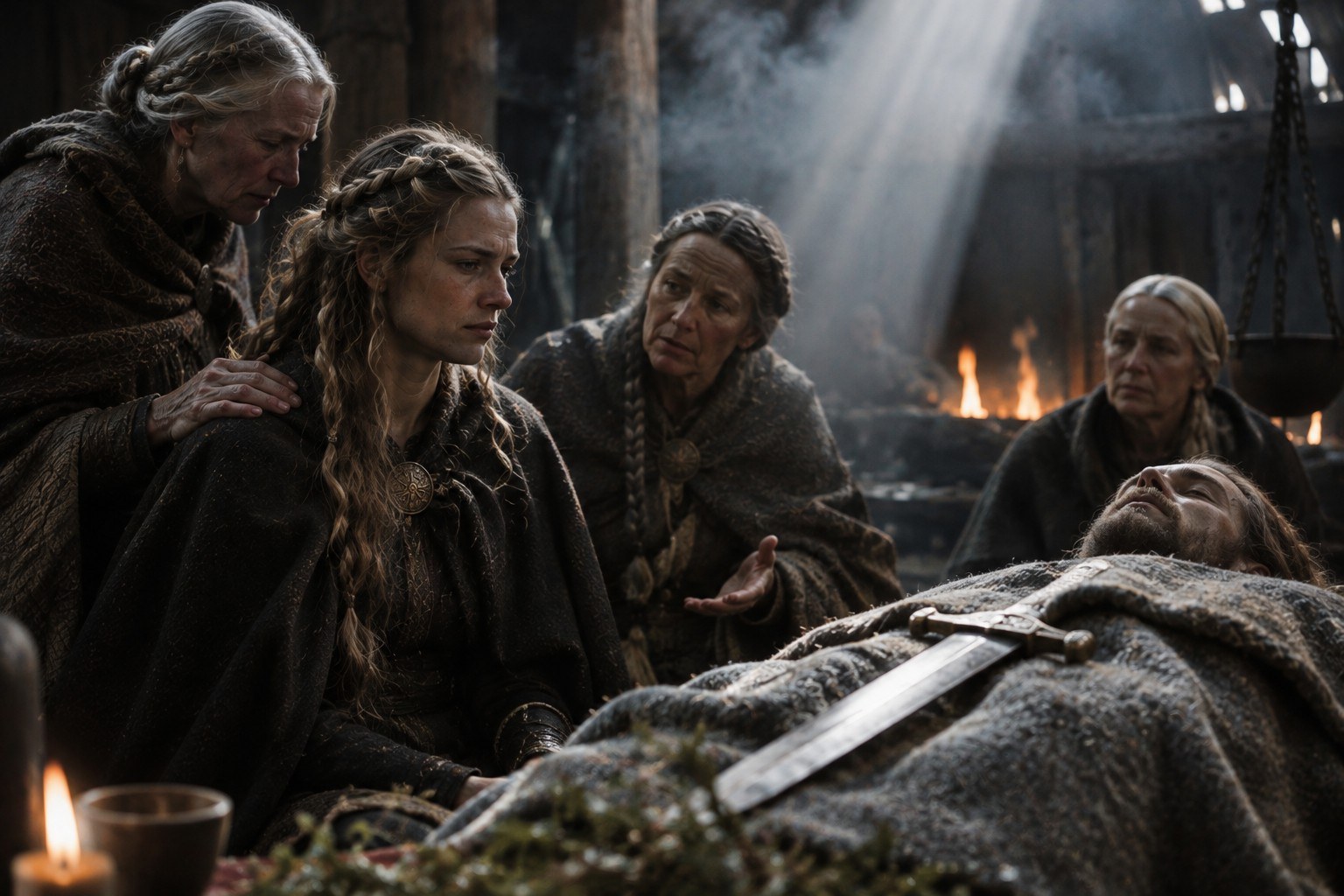
Gudrun is the character in the Völsung legend who lives longest. She loses her husband, then her brothers, and later her children. Three poems of the Edda carry her name, and in none of them does anyone swing a sword. The first shows a widow who cannot weep. In the second she tells a foreign king the story of her life. In the third she plunges her hand into a kettle of boiling water to save her honour. This article reads the three Guðrúnarkviður from the text, shows where they sit in the Codex Regius, and separates what the poems say from what later redactors and scholars made of them.
Guðrúnarkviða means "Lay of Gudrun". Editors distinguish three poems of that name. In the edition by Guðni Jónsson, which our source archive uses for the Old Norse text, the first has 27 stanzas, the second 44 and the third only 11. The second carries the epithet "in forna", "the old one".
What holds the three together is their central figure. Gudrun, daughter of King Gjúki and widow of Sigurd, stands at the heart of each poem. Little happens. The poems tell what comes after the great deeds: grief, a forced marriage, suspicion. In the German Nibelungenlied this woman is called Kriemhild, but the North tells her story differently: in the end Gudrun does not avenge her husband on her brothers, she avenges her brothers on her second husband, Atli. The Gudrun lays sit between these poles, after Sigurd's death and before or alongside the fall of the brothers told in Atlakviða and Atlamál.
All three survive in the Codex Regius, the manuscript GKS 2365 4to from around 1270, in the heroic section after the great lacuna. They are not grouped together. The fragment of a Sigurd lay (Brot af Sigurðarkviðu) is followed by the first Gudrun lay, then by Sigurðarkviða in skamma and Helreið Brynhildar. Only then comes a short prose piece, "Dráp Niflunga", "The Slaying of the Niflungs", followed by the second and third Gudrun lays.
That prose piece explains a great deal. It says Atli blamed the Gjúkungs for Brynhild's death; to make peace they gave him Gudrun, after giving her an "óminnisveig", a draught of forgetfulness. It then briefly relates the deaths of Gunnar and Högni. So when Gudrun speaks in the second and third lays, her brothers are already dead in the order of the manuscript. The compiler arranged the poems so that they become retrospectives.
The titles are also a product of transmission. According to Henry Adams Bellows, who translated the Edda into English in 1923, the second poem is headed simply "Guðrúnarkviða" in the manuscript; the numbers were added by editors. The epithet "in forna" comes from the prose at the end of Brot af Sigurðarkviðu. There the scribe sets the accounts of Sigurd's death side by side: some say he was slain in his bed, German men say in the forest, and in the "old Gudrun lay" he was killed when riding to the Thing. That is exactly what stanza 4 of the second poem says.
The first Gudrun lay opens in prose. Gudrun sits by the dead Sigurd; she does not weep like other women, yet she is close to bursting with grief. In passing the scribe notes that people say she had eaten of Fáfnir's heart and therefore understood the speech of birds.
The first stanza sets the theme: Gudrun wishes to die, but she does not sob, does not wring her hands and does not wail "as other women". How do you make someone weep who is frozen with pain? First wise earls try (st. 2), in vain. Then their wives sit down with her, adorned with gold, and each tells her bitterest sorrow (st. 3). Comfort by comparison is the core of the poem.
Gjaflaug, Gjúki's sister, has lost five husbands, two daughters, three sisters and eight brothers, and lives on alone (st. 4). Gudrun stays silent. The stanza that records this returns (st. 5 and 11) and structures the poem like a refrain.
Herborg, "queen of Hunland", outdoes her (st. 6–10). Seven sons and her husband fell in the south; the sea took her parents and four brothers. She buried them all herself within half a year, and in that same half-year she was taken captive. Every morning she had to bind the shoes of a hersir's wife (a hersir was a local chieftain), who beat her out of jealousy. It is a remarkably precise picture of a war captive's life. Bellows notes in his translation that neither Herborg nor her sorrows are mentioned anywhere else, and that it is not clear what a "queen of the Huns" is doing in Gunnar's home.
It is Gudrun's sister Gullrönd who finds the way. She tells the "foster-mother" that she does not know how to comfort a young wife (st. 12), pulls the shroud from Sigurd and lays his head in Gudrun's lap (st. 13). Gudrun looks once: the blood-clotted hair, the dimmed eyes, the pierced breast (st. 14). She sinks onto the pillow, and tears fall "like raindrops" (st. 15). In the yard her geese cry out (st. 16).
Now Gudrun speaks (st. 18–22). Sigurd rose above Gjúki's sons like the leek above the grass; she herself is now as slight as a leaf. Her brothers are to blame. Gunnar will have no joy of the gold, the rings will be his death, because he swore oaths to Sigurd (st. 21).
"So was my Sigurth o'er Gjuki's sons / As the spear-leek grown above the grass, / Or the jewel bright borne on the band, / The precious stone that princes wear."Guðrúnarkviða I, st. 18 (Bellows st. 17), translated by Henry Adams Bellows (1923)
At the close Brynhild herself appears. She curses whoever made Gudrun weep (st. 23) and lays all the blame on her brother Atli (st. 25–26): back then, in the hall of the Huns, they saw the "flame of the snake's bed" on the hero, a kenning for gold. The closing prose sends Gudrun to Denmark to stay with Þóra, Hákon's daughter, and reports that Brynhild had eight thralls and five serving women killed and then killed herself with a sword.
A prose introduction says that King Þjóðrekr was with Atli and had lost almost all his men there; he and Gudrun lamented their griefs to one another. Then Gudrun speaks, almost to the end. Behind Þjóðrekr stands Dietrich von Bern, who in the Þiðreks saga likewise lives as an exile at Attila's court.
Gudrun begins with her girlhood as "a maid of maids", until Gjúki dowered her with gold and gave her to Sigurd (st. 1). Sigurd rose above her brothers like green leek above grass, like the stag above other beasts (st. 2). Then her brothers begrudged her this husband (st. 3).
One of the most striking scenes in the Edda follows. Grani, Sigurd's horse, comes back from the Thing without his rider (st. 4). Weeping, Gudrun questions the animal; Grani bows his head to the grass, "the steed knew well his master was slain" (st. 5). Högni tells her Sigurd lies dead across the water, given to the wolves (st. 7–8). Gudrun wishes that ravens may tear his heart (st. 9), which points ahead to Högni's end in the Atli poems. She then gathers what the wolves have left, and here too she does not wail "as other women" (st. 11), almost word for word the formula of the first lay. She flees to the hall of Hálfr (st. 13) and spends seven half-years with Þóra in Denmark. The two women embroider scenes of battle, Sigmund's ships and the fight of Sigarr and Siggeirr on Fyn (st. 14–16).
Grimhild, Gudrun's mother, called a "Gothic woman" in the poem (st. 17), has her sons offer compensation. Gunnar and Högni offer gold, princes in red cloaks bring gifts, and Gudrun trusts none of them (st. 18–20). Then Grimhild hands her the cup (st. 21–23): cold and bitter, mixed with the "might of the earth", ice-cold sea and "sónum dreyra". Reddened signs she cannot read are carved into the horn; in the beer are burnt acorns, soot from the hearth, sacrificial entrails and boiled swine's liver. Then she forgets (st. 24).
This passage shows how uncertain single words can be. Simrock renders "sónum dreyra" as "atoning blood", Bellows as "blood of swine". The Völsunga saga, at the corresponding point in our Old Norse text, reads "dreyra sonar hennar", "the blood of her son". Which reading the poet meant cannot be settled from the poem alone.
Grimhild offers gold and Buðli's wealth if Gudrun becomes Atli's wife (st. 25–26). Gudrun refuses; she will not marry Brynhild's brother (st. 27). Then she predicts that Atli will kill Gunnar and cut out Högni's heart, and that she will not rest until she has taken Atli's life (st. 31). Grimhild weeps, adds lands to the offer, and Gudrun gives way, "against my will" (st. 34). The bridal party travels three times seven days (st. 35).
At the end Atli tells his dreams: Gudrun pierced him with a blade, he ate the hearts of his hawks with honey and the flesh of his whelps (st. 38–42). Gudrun interprets them harmlessly (st. 39, 43). Anyone who knows Atlakviða knows that there Gudrun serves Atli the hearts of their sons with honey. The poem breaks off with Atli's last speech (st. 44). Bellows described it as preserved "in rather bad shape", with omissions and some interpolations.
According to the prose, Herkja, a serving woman of Atli's and formerly his concubine, claimed she had seen Þjóðrekr and Gudrun together. Gudrun asks Atli why he no longer laughs (st. 1); he names the charge (st. 2). She offers an oath "by the white, holy stone" (st. 3). Her talks with Þjóðrekr, she says, concerned their shared grief (st. 4). He came with thirty men, and not one of them is alive (st. 5). Our two translators understand the following lines differently: Bellows reads a reproach, that Atli has robbed Gudrun of her brothers, Simrock a request that Atli should bring his brothers in mail.
Then Gudrun demands the ordeal. Saxi should be sent for, king of the southern men, who knows how to hallow the boiling kettle (st. 6). Seven hundred people enter the hall (st. 7). Gunnar will not come, Gudrun says, she cannot call on Högni, she must clear herself (st. 8). She reaches to the bottom and brings up precious stones: "Behold, ye warriors, well am I cleared" (st. 9). Atli's heart laughs, and now Herkja must reach in (st. 10). Her hands are scalded, and she is led into a foul bog (st. 11).
The stones are called "jarknasteinar", the same word Gudrun uses in the first lay when she calls Sigurd a jewel above princes. Whether this is a deliberate echo or a common poetic formula cannot be decided.
Poems like the first two Gudrun lays are often called elegies, laments in which a character looks back on her life. The text shows why: the action is over before the poem begins. These poems do not tell what happens but what it is like to have survived it. The recurring formulas fit this, such as not weeping "as other women" (Gðr I, st. 1; Gðr II, st. 11) or Sigurd as the leek above the grass (Gðr I, st. 18; Gðr II, st. 2). Whether one poet knew the other or both drew on a stock of set phrases remains open.
The lays are built from alliterating long lines whose halves are linked by stressed syllables with the same initial sound: "Ár var, þats Guðrún / gerðisk at deyja". They are usually assigned to the narrative Eddic metre fornyrðislag; how it differs from skaldic verse is explained in our article on dróttkvætt.
It is striking who speaks. In the first lay almost only women talk; the men stand at the edge. Read with their neighbours, the poems form a life in stages: widow, queen married against her will, accused wife, then the avenger of the Atli poems and, in Hamðismál, the mother who sends her last sons to their deaths. Because Gudrun announces her revenge before the wedding in the second lay, the killer of the Atli poems appears here as a woman married against her will who foretold what would happen.
None of the three poems can be dated securely. I report what Bellows wrote in the introductions to his translation, as reproduced on voluspa.org, mythopedia.com and sacred-texts.com. That is the state of research in 1923; I was not able to check more recent work for this article.
According to Bellows, most commentators dated the second lay to the first half of the tenth century; he called it the only Norse poem of the Sigurd cycle older than the year 1000, its core possibly a lament that reached the North from Germany in verse. In its present form the first lay is, for Bellows, "undoubtedly" younger than the second and "can scarcely have been composed much before the year 1000"; its poet seems to have known the older lament.
For the third lay Bellows argues concretely. The ordeal by boiling water, he says, was first introduced into Norway by St Olaf (died 1030), and the poem still treats it as foreign: a king from the south hallows the kettle. Þjóðrekr also points to a late date, since the legends of Theoderic hardly reached the North before 1000. Bellows arrives at the first half of the eleventh century and places the material in northern Germany. Arguments of this kind only give an earliest possible date, not a precise one.
The Völsunga saga follows the second lay closely in chapter 32: Grani bows his head, Gudrun hears the wolves in the forest, embroiders with Þóra, receives the draught and, after negotiations, travels to Atli. The Old Norse saga text in our archive, however, has nothing of Herkja and the kettle. One more point stands out: the English translation by William Morris and Eiríkr Magnússon inserts the full text of the first Gudrun lay after Sigurd's death, although the Old Norse saga text has no such passage there. Anyone reading the saga only in English might think the saga itself preserves the poem.
In the Nibelungenlied the widow is Kriemhild, and she takes revenge on her own brothers. Dietrich von Bern lives there, as in the Þiðreks saga, at the court of Etzel or Attila; his appearance as a guest at Atli's court in Gðr II and III fits this southern tradition. Historically he goes back to the Ostrogothic king Theoderic the Great, who died in 526, while Attila had died in 453, as our article on the Þiðreks saga explains. For Herkja, English Wikipedia reports that Bellows linked her to Kreka, a wife of Attila, and to Helche of the Nibelungenlied. Whether the poet knew this figure cannot be shown.
All three poems are available in full text in Old Norse, German and English in our source archive: the first, the second and the third lay of Gudrun, together with the prose Dráp Niflunga and the Völsunga saga. Our workshop in Alsdorf laser-engraves Norse motifs, but Gudrun herself is best met in her own words.
How many lays of Gudrun are there? The Poetic Edda contains three poems titled Guðrúnarkviða. Guðrúnarhvöt, "Gudrun's Inciting", in which she drives her sons to revenge, is not counted among them.
What is the first lay of Gudrun about? Gudrun sits silent over the dead Sigurd. Women tell of their own sorrows to make her weep. Only when her sister Gullrönd uncovers the body does her lament break out.
Who is Þjóðrekr in the Gudrun lays? He corresponds to Dietrich von Bern of German legend, behind whom stands the Ostrogothic king Theoderic. In the poems he is a guest at Atli's court who has lost his men.
What is the kettle ordeal? A trial by ordeal: whoever is innocent can pull stones out of boiling water without being scalded. Gudrun passes the test, while her accuser Herkja burns her hands.
Why is the second lay called "in forna"? The epithet comes from a prose note in the Codex Regius that cites an "old Gudrun lay". In the manuscript itself, according to Bellows, the poem is headed only Guðrúnarkviða.
Sigurd and the Völsung legend · Brynhild · Atli and Attila · Atlakviða · Atlamál · Hamðismál · Sigurðarkviða in skamma · Helreið Brynhildar · Þiðreks saga · Codex Regius
Sigurd the dragon-slayer · Brynhild · Atlakviða: the old Lay of Atli, the hoard in the Rhine and Guðrún's revenge · Sigurðarkviða in skamma: the "Short" Lay of Sigurd that is anything but short · Hamðismál: how Hamðir and Sörli avenge Svanhild and fail for want of a brother.
Gullinbursti ("Gold-Bristle") is the golden boar of Freyr, the Norse god of fertility: according to Snorri's Prose …
Read more →Gungnir is the spear of the god Odin: according to the Prose Edda it was forged by the dwarf sons of Ívaldi and handed …
Read more →The mead of poetry turns anyone who drinks it into a skald or a scholar. It lies in the mountain Hnitbjorg, guarded by …
Read more →Almost everything retold today as “Norse mythology” follows the thread of a single text: Gylfaginning, the first main …
Read more →