Seventy-one stanzas, a murder in the marriage bed, a single laugh and a funeral pyre on which a sword is to lie between two of the dead once more. Sigurðarkviða in skamma tells the end of Sigurd and Brynhild almost entirely from inside its characters. Its nickname, "the short one", comes from a prose sentence in the manuscript, and it is misleading: this is one of the longest poems in the Codex Regius.
In the Codex Regius, the Icelandic manuscript of Eddic poetry GKS 2365 4to from the late thirteenth century, this poem carries only a plain heading. Edward Pettit, in his dual-language edition of 2023, gives it as "Kviða Sigurðar", "Lay of Sigurd", and notes that the familiar modern title was supplied by editors. That title comes from a prose sentence at the end of Guðrúnarkviða I: Brynhild had eight thralls and five serving-women killed and then took her own life with a sword, "svá sem segir í Sigurðarkviðu inni skömmu" – "as is told in the short Lay of Sigurd".
Short it is not. In the numbering of Guðni Jónsson's edition, which our source archive follows, it has 71 stanzas. Pettit calls it the third-longest poem in the Codex Regius and identifies the metre as fornyrðislag: long lines of two half-lines bound together by alliteration, the matching initial sounds of stressed syllables. How this differs from the more elaborate verse of the skalds is explained in our article on dróttkvætt.
The nickname only makes sense as a comparison. Henry Adams Bellows argued in 1923 that the "long" Sigurd lay must simply have been a good deal longer still, and took the surviving Brot af Sigurðarkviðu to be part of it. Pettit speaks more cautiously of a hypothetical "longer" Lay of Sigurd. No such poem survives. It probably stood in the great lacuna of the manuscript, the lost gathering of eight leaves described in our article on the Codex Regius. Whether it really was a single long poem cannot be shown.
After the lacuna the manuscript resumes with the end of the Brot af Sigurðarkviðu. Then come a prose piece headed "Frá dauða Sigurðar" ("Of Sigurd's death"), Guðrúnarkviða I with Gudrun's lament over the body (see the Gudrun lays), then Sigurðarkviða in skamma, followed by Helreið Brynhildar. Pettit places the poem on leaves 34v to 36r.
As a story this is not seamless. Gudrun is already mourning the dead man before the next poem tells the murder again from the beginning. The compiler set several poems about the same events side by side and joined them with prose. As a result, a single manuscript holds Sigurd's death in at least two versions.
"Ár var, þats Sigurðr / sótti Gjúka" – it was long ago that Sigurd came to Gjúki. The young Völsung swears bond and oath with the two brothers Gunnar and Högni (st. 1) and is given the young Gudrun as his wife (st. 2). Then they all ride out to woo Brynhild for Gunnar (st. 3). How the wooing went, the poem does not say. The ride through the fire, the exchange of shapes and the ring Andvaranaut are all missing. One image remains: Sigurd "the southern" lays his naked sword between himself and Brynhild, does not kiss her, does not take her in his arms, and hands her over to Gunnar (st. 4).
The backstory is told in the Völsunga saga and in our articles on Sigurd and Brynhild; the Grípisspá foretells Sigurd's whole life. The poem takes all of this for granted. Bellows thought that this is why the poet concentrated almost entirely on character.
From stanza 6 on, the poem belongs to Brynhild. She sits alone outside at the end of the day: she will have Sigurd, "eða þó svelta", or else die. At once she regrets the word, for Gudrun is his wife and she is Gunnar's; "ljótar nornir", hateful Norns, have shaped long longing for them (st. 6–7).
Stanza 8 is the best known. Every evening, when Gudrun and Sigurd go to bed, Brynhild goes about "ills of fylld, / ísa ok jökla", full of harm, of ice and glaciers. Pettit reads this figuratively, as Brynhild filling up with ice-floes and glaciers; Bellows translated it literally, as her walking on the glacier's ice. The stanza also plays a part in the question of where the poem was composed.
Jealousy turns into a plan. Brynhild threatens to leave Gunnar and sleep her life away among her own kin unless he lets Sigurd die (st. 10–11). The son must go with the father, too; one should not raise the wolf-cub (st. 12). The poem gives the boy no name.
Gunnar broods all day (st. 13–14), then calls Högni. Brynhild is dearer to him than his life (st. 15), and then comes the second motive: "Gótt er at ráða / Rínar malmi" – it is good to rule the metal of the Rhine (st. 16). The gold Sigurd won from the dragon Fáfnir is already Rhine gold here, as the hoard will be later in Atlakviða.
Högni objects: it does not become them to break "sverði rofna / svarna eiða", sworn oaths with the sword (st. 17). He praises their power for as long as the "Hunnish army-Baldr" lives, and sees the real cause in Brynhild's excessive demands, "Brynhildar brek ofmikil" (st. 18–19). Sigurd is called "Hunnish" again and again in this poem. Pettit explains that húnskr came to be used for non-Nordic, foreign peoples; it has little to do with the historical Huns here.
Gunnar finds a way out that keeps the oath on paper: their younger brother Guthorm is to do the deed, for "hann var fyr útan / eiða svarna", he stood outside the oaths (st. 20). The lines "eiða svarna, / unnar tryggðir" repeat Högni's objection word for word. Gunnar answers in his brother's own words.
The murder takes half a stanza: the reckless one was easily roused, "stóð til hjarta / hjörr Sigurði", the sword stood in Sigurd's heart (st. 21). Pettit suggests the brevity of this half-stanza may be deliberate. Dying, Sigurd hurls the blade after his killer and cuts him in two (st. 22–23). Bellows read the word "Grams" there as the name of the sword Gram; Simrock took it as gramr, "prince".
Gudrun had slept without a care at Sigurd's side and wakes in his blood; the dead man is called "Freys vinar", friend of Freyr (st. 24). Sigurd raises himself once more: she should not weep, her brothers live. His heir is too young to flee from the house of his foes (st. 25–26). "Ein veldr Brynhildr / öllu bölvi", Brynhild alone is to blame for all the harm (st. 27); he himself kept his oaths and his kinship (st. 28). Then he dies, and Gudrun strikes her hands together so hard that the cups ring and the geese cry out in the yard (st. 29).
Brynhild hears Gudrun's cry from where she lies:
"Then Brynhild, daughter of Buthli, laughed,
Sigurðarkviða in skamma, stanza 30 (numbering of Guðni Jónsson, same in Bellows), translated by Henry Adams Bellows, The Poetic Edda, 1923
Only once, with all her heart,
When as she lay full loud she heard
The grievous wail of Gjuki's daughter."
"Einu sinni / af öllum hug", only once, with all her heart: the same formula appears in the Brot af Sigurðarkviðu, stanza 14. Both poems know Brynhild's laugh and describe it in almost the same words. Gunnar reads it correctly: she is not laughing for joy, she has gone pale, "hygg ek, at feig séir", I think you are doomed (st. 31–32).
In a long speech (st. 33–41) Brynhild tells her own story. She sat young and carefree in the house of her brother Atli until the three Gjúkungs rode in. She had pledged herself to the man who sat with gold on Grani's back. Atli refused her any share of her inheritance unless she married; she weighed fighting in her mail-coat, then gave in (st. 34–39). "Unnak einum", one alone she loved (st. 40). Pettit notes that the editors of the Neckel-Kuhn edition suspect a possible misordering of the "rather obscure" stanzas 36 to 39. Simrock and Bellows also number differently from Guðni Jónsson from stanza 39 on.
Gunnar puts his arms round her neck, and everyone tries to hold her back from "the long road"; she pushes them all away (st. 42–43). Högni refuses to help: let no one hold her back, and may she never be born again (st. 45). Brynhild shares out her treasure, looks over "soltnar þýjar / ok salkonur", puts on a golden mail-coat and runs herself through with the sword (st. 46–47). Bellows renders soltnar as slain bond-women, Simrock as "needy maids". The underlying verb svelta clearly means "to die" in stanzas 6 and 11 of the same poem, and the prose after Guðrúnarkviða I speaks of thralls and serving-women being killed. That supports Bellows, though it is not certain.
Wounded, she offers her women gold and clothes if they will go with her (st. 49). They answer: enough have died, we want to live (st. 50). Brynhild accepts this; no one should die unwillingly for her sake (st. 51). Whether such following in death reflects a Viking Age custom cannot be proved from a poem written down so late; the archaeological evidence is discussed in our article on burial.
"Sezktu niðr, Gunnarr", sit down, Gunnar (st. 53): what follows is the rest of the legend in outline. Gunnar will be reconciled with Gudrun; she will bear Svanhild, brighter than the sunbeam, and be married to Atli against her will (st. 54–56). Gunnar will desire Oddrún, Atli's sister, and love her in secret (st. 58), end in the snake pit (st. 59), and Gudrun will kill Atli in his bed (st. 60). The waves will carry her to King Jónakr (st. 62–63); Svanhild will die through Bikki's counsel at Jörmunrekkr's court, and Sigurd's line will be gone (st. 64).
These stanzas point to the other heroic poems: Gunnar's end is told in Atlakviða and Atlamál, the revenge for Svanhild in Hamðismál; Oddrún has a poem of her own, Oddrúnargrátr.
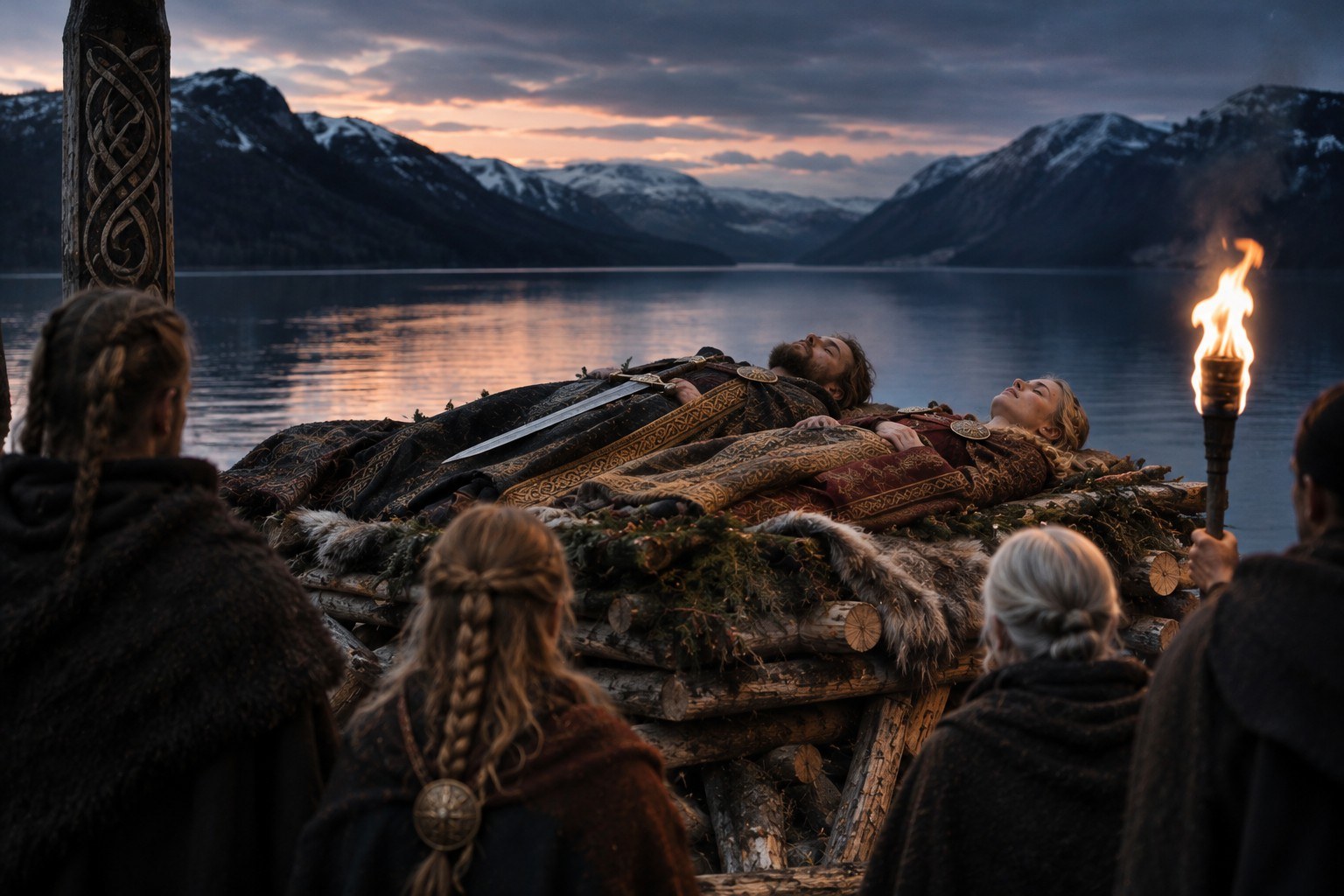
Her last request: a pyre so broad that all who died with Sigurd find room on it, hung with awnings and shields, Sigurd at her side (st. 65–66). Servants are to burn beside him, "tveir at höfðum / ok tveir haukar", two at the head and two hawks (st. 67). Simrock and Bellows add two at the feet and two hounds; these lines are not in the Old Norse text as edited by Guðni Jónsson. At the corresponding point the Völsunga saga has two at the head, two at the feet and two hawks, but no hounds.
Then the circle closes. Between them the keen blade is to lie again, "sem endr lagit", as it lay once, when they shared one bed and were called man and wife (st. 68). The sword of stanza 4 proved that Sigurd never touched Gunnar's bride. On the pyre it is both the proof of his loyalty to the oath and the sign of their separation. Five bond-women and eight thralls are to follow, so that the journey will "not be mean" (st. 69–70). Her last words: she would say more if "mjötuðr" gave her room; her voice fails, her wounds swell, "satt eitt sagðak", only truth she has spoken (st. 71). Simrock translated mjötuðr as "the god", Bellows as "fate". In our source archive stanzas 67 to 71 form a single unit under number 67, which is why the page header there gives 67 rather than 71 stanzas.
Right afterwards the manuscript contradicts itself. The prose before Helreið Brynhildar begins: "Eftir dauða Brynhildar váru gör bál tvau" – after Brynhild's death two pyres were built; Sigurd's burned first, and on the other Brynhild was burned, lying in a wagon hung with rich cloth. In this version her wish for a shared fire is not granted. Where she goes next is the subject of The road to Hel.
The Brot af Sigurðarkviðu tells Sigurd's death differently. There he falls "sunnan Rínar", south of the Rhine, a raven calls from a tree, the brothers ride home without him, and Gudrun stands outside asking where Sigurd is (Brot st. 9–11). He dies out of doors. In that poem Gunnar accuses him of breaking his oaths (Brot st. 6), while Brynhild testifies at the end that Sigurd kept them and laid a sword between them (Brot st. 22–23).
The compiler knew of the contradiction. In "Frá dauða Sigurðar" he writes that this poem makes it sound as if Sigurd was killed outside, but some say he was slain in his bed, asleep; "þýðverskir menn", German men, say outside in the forest; and the old Guðrúnarkviða says that Sigurd and Gjúki's sons had ridden to the assembly when he was killed. All agree that he was betrayed and struck down lying and unprepared. Sigurðarkviða in skamma represents the bed version. For the forest spring in the Nibelungenlied and the hunt in the Þiðreks saga, see the articles on those works.
The Völsunga saga follows the bed version closely. In our source archive (sections 30 and 31; Pettit counts chapters 32 and 33) Guttormr twice loses his nerve because Sigurd's gaze is too fierce, and strikes him asleep the third time. Gudrun wakes in his blood, Brynhild laughs, and Gunnar speaks almost the same sentences as in the poem. Brynhild asks for a shared pyre with the sword between them, and on the fire lie Sigurd, Guttormr and Sigurd's three-year-old son, whom Brynhild had killed. Pettit takes the saga to be paraphrasing a version of the poem here.
Snorri Sturluson, too, knows only the death in sleep in Skáldskaparmál: Gotthormr runs the sleeping Sigurd through, Sigurd throws Gram after him, and Sigurd's three-year-old son Sigmund dies with him. The queens' quarrel at the river, which Snorri tells just before, is not in Sigurðarkviða in skamma.
There is no date. Bellows placed the poem at the end of the eleventh century or in the first half of the twelfth, because it is probably later than Oddrúnargrátr, which he thought could hardly have been composed before 1050. Pettit reports the view that the poem borrows from numerous other Eddic poems and is therefore among the youngest. Both are inferences from the text. Bellows also saw German rather than Norse features in the narrative. On the place of composition he pointed to the glaciers of stanza 8: Greenland was possible, Iceland more likely, Norway practically ruled out. That too remains interpretation.
You can read the full text in Old Norse, German and English, stanza by stanza, in our source archive: Sigurðarkviða in skamma; for comparison, the Brot af Sigurðarkviðu.
Why is the poem called "short" when it is so long? The name comes from a prose sentence in the manuscript and sets it apart from a longer Lay of Sigurd. No such poem survives; Bellows, for one, took the Brot af Sigurðarkviðu to be part of it, but that is not certain.
Who kills Sigurd in Sigurðarkviða in skamma? Guthorm, the younger brother of Gunnar and Högni. He had sworn no oath. Gunnar sets him on; Högni had advised against it.
Why does a sword lie between Sigurd and Brynhild? It shows that Sigurd did not touch Gunnar's bride (st. 4). On the pyre it is to lie between them again (st. 68).
How old is the poem? There is no secure date. Bellows thought of the end of the eleventh or the first half of the twelfth century; Pettit reports that it is considered one of the youngest Eddic poems. It was written down in the late thirteenth century.
Where can I read the whole poem? In our source archive: the Old Norse text after Guðni Jónsson with the public-domain translations of Simrock and Bellows.
Sigurd · Brynhild · Helreið Brynhildar · The Gudrun lays · Grípisspá · The Codex Regius · Völsunga saga · Nibelungenlied · Atlakviða
Sigurd the dragon-slayer · Brynhild · Helreið Brynhildar: Brynhild's Hel-ride and her speech in her own defence · Grípisspá · The Lays of Gudrun: three Eddic poems about the woman who outlives everyone.
Sindri (called Eitri in some editions) and Brokkr are the dwarf brothers who, according to Snorri Sturluson's …
Read more →A boy kneads a venomous snake into the bread dough and does not flinch. A few years later he is stuck with his father …
Read more →A man skilled in magic, from the island of Hlésey, visits the gods, is given the seat next to Bragi and asks questions …
Read more →It is one of the strangest love stories of the North: a god falls for a single glance, grows sick with longing, and …
Read more →