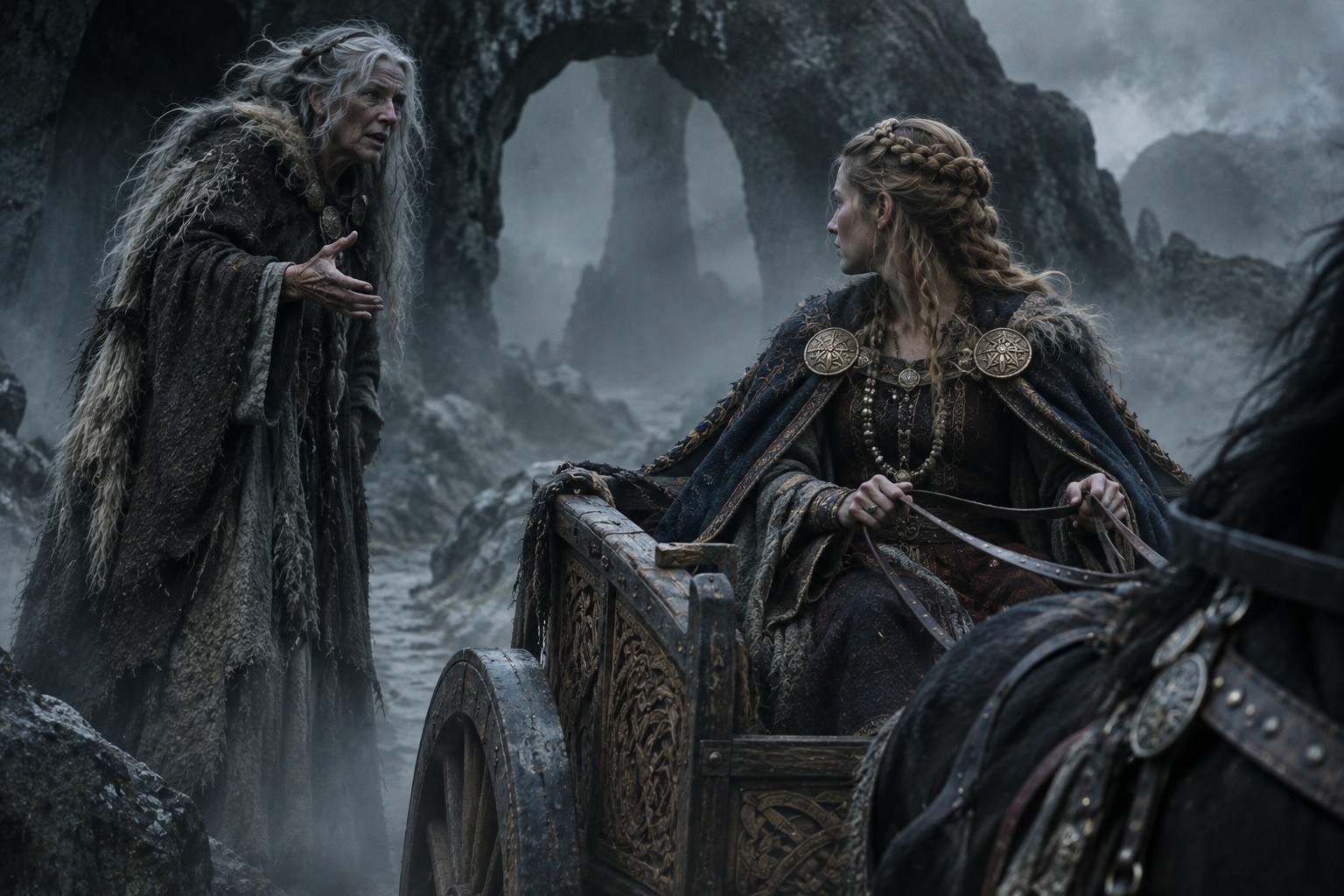
The pyre has burned down, and Brynhild still has things to say. In a short poem of the Poetic Edda she rides down the Hel-road on a richly hung wagon and meets a giantess who refuses to let her pass and accuses her of bloodshed and of chasing another woman's husband. Brynhild answers with the story of her life: a valkyrie youth, Odin's punishment, the ring of fire, eight chaste nights, a deception. This article walks through the stanzas in order, shows what the second witness in Norna-Gests þáttr does differently, and separates what the text says from what scholars suppose.
Helreið Brynhildar means "Brynhild's Hel-ride" or "Brynhild's ride to Hel". In Old Norse, Hel is both the name of the world of the dead and of its ruler; what the sources actually say about it is covered in our article on Hel. The poem is short. Guðni Jónsson's edition, which our source archive follows for numbering, has 15 stanzas; Pettit's dual-language edition (Open Book Publishers), which follows the manuscript, has 14. A prose passage in front sets the scene.
The poem is a single exchange. A giantess speaks three stanzas (1, 2 and 4), Brynhild speaks the rest. Brynhild says nothing about the underworld; she defends her life. These are the stations of the legend of Sigurd, told by the woman blamed for his death. For the figure herself see Brynhildr.
The introductory prose is brief. After Brynhild's death two pyres were built, one for Sigurd, which burned first, and on the second Brynhild was burned. She lay in a wagon hung with costly fabrics, Old Norse guðvefr. "Svá er sagt", "so it is said", Brynhild drove the wagon along the Hel-road and passed a farmstead where a giantess lived. The Old Norse word is tún, an enclosed yard or field. Simrock renders it freely as "cave", Bellows as "house".
This prose contradicts the poem that immediately precedes it in the manuscript. In Sigurðarkviða in skamma the dying Brynhild asks for a pyre built so broad on the field that there is room for all who die with Sigurd (st. 65), and to be burned beside "the Hunnish one" (st. 66). There is one fire there, two here. Henry Adams Bellows therefore considered the compiler unreliable at this point. It cannot be settled; the manuscript itself lets two funeral scenes stand side by side.
The title is not in the manuscript either. According to Pettit, the poem carries no heading of this wording in the Codex Regius; the rubricated opening words "Brynhildr reið Helveg" are illegible in the facsimile, and their reading depends on an older transcription. The name is therefore an editors' label.
The giantess, Old Norse gýgr, opens with a prohibition. Brynhild shall not pass through her "rock-propped" courts (st. 1). It would suit her better to weave braids than to seek out another woman's husband. The barb is aimed: Sigurd was Gudrun's husband.
In stanza 2 the giantess presses on. What does Brynhild want "from Valland", here in her house? Valland can mean France; Pettit thinks that unlikely here and suggests "Land of the Slain" or "Foreign Land", while Bellows doubted it was a proper name. Then come two hard lines: Brynhild has washed human blood from her hands. She is addressed as "Vár gulls", roughly "Vár of gold". Vár is a goddess name, and the phrase is a kenning-like circumlocution for a woman. Simrock simply writes "valkyrie": the sense, not the wording.
Brynhild rejects this in stanza 3. The "bride from the stone" should not reproach her for having gone raiding, Old Norse í víkingu. Anyone who knows the lineage of both will hold her the nobler. The giantess replies in stanza 4 with the heaviest charge: Brynhild, Buðli's daughter, was born to the greatest misfortune; she has destroyed the children of Gjúki and brought down their house. This means the Gjúkungs, Gunnar, Högni and Gudrun. Their final ruin comes later in the legend, at Atli's court, as told in Atlakviða. The giantess is speaking of more than Sigurd's death.
Who the giantess is, the poem does not say. She has no name and no stated office. She lives by the road, she stops the traveller, and she knows her story. Reading her as a guardian of the dead is interpretation; the text calls her only a giantess who lives there. The comparison with Snorri's bridge-keeper Móðguðr is drawn in our article on the road to Hel.
Brynhild's speech begins with stanza 5, and she announces it herself: from the wagon she will tell the "witless one" how the heirs of Gjúki made her loveless and oath-breaking. The word eiðrofi, "oath-breaker", is the core of her defence. She does not deny breaking oaths; she names those who caused it.
Then she goes far back. Everyone in Hlymdalir who knew her called her "Hild under the helmet" (st. 6). Hildr means "battle" and is a valkyrie name; the helmet fits. Hlymdalir, the "resounding dales", is according to Völsunga saga the home of Heimir, Brynhild's foster-father. This half-stanza does not stand here in the manuscript, according to Pettit and Bellows, but after the stanza about the swan-robes; Guðni Jónsson's edition moved it forward. Simrock follows the manuscript.
In stanza 8 of our numbering comes a scene familiar from other poems: a "bold king" had the feather-robes, Old Norse hamir, of eight sisters carried under an oak. She was twelve winters old when she swore oaths to the young prince. The poem leaves the king unnamed; Pettit names Agnarr and Sigurd as possibilities. Whoever takes a swan-maiden's robe gains power over her, the best-known example being Völundarkviða. Norna-Gests þáttr reads, according to Pettit and Bellows, not "átta systra" ("eight sisters") but "Atla systur" (Atli's sister or sisters). In the legend Atli is Brynhild's brother.
Between these two stanzas Guðni Jónsson's edition prints another half-stanza (st. 7): the other was named Agnarr, brother of Auða, whom no one wished to protect. It is missing from Simrock, Bellows and Pettit's manuscript text. According to Pettit, the prose after Sigrdrífumál st. 4 also names Agnarr; whether Guðni derived the half-stanza from there is unclear.
Now comes the deed that sets everything off. Brynhild sent old Hjálmgunnarr "among the Goths", á Goðþjóðu, to Hel and gave victory to Auða's young brother; at that Odin grew very angry (st. 9). Instead of "among the Goths", Norna-Gests þáttr has, according to Pettit, "brother of the giantess", gýgjar bróður. Then the encounter would have a personal motive. Whether that is the older reading or a later sharpening has not been decided.
Stanza 10 describes Odin's punishment: he shut her in at Skatalundr with shields, red and white, their rims touching. Her sleep was to be broken only by one who could feel fear nowhere. Skatalundr, roughly "warriors' grove" according to Pettit, was taken by Bellows as a mythical place. In Sigrdrífumál, in Fáfnismál and in Völsunga saga the sleeper's mountain is called Hindarfjall.
Völsunga saga tells the same backstory in prose in chapter 20: Odin had promised victory to old Hjálmgunnarr; his opponent was called Agnarr or Auðabróðir. Brynhild felled Hjálmgunnarr; in revenge Odin pricked her with the sleep-thorn, svefnþorn, and decreed that she should never again win victory and should be married. Against this she vowed to take no man who could know fear. Helreið does not mention the thorn; here it is Odin's shield-wall that holds her. The thorn appears in Fáfnismál (st. 43): Yggr, a name of Odin, pricked the sleeper with it.
Stanza 11 adds the image that became best known. Odin had "the destroyer of all wood" burn high around her hall, which faced south: a circumlocution for fire. Only one man was to ride across it, he who would bring her the gold that lay under Fáfnir. So shield-wall and ring of fire appear in the same poem one after the other. Fáfnismál 42 speaks of a hall on high Hindarfjall, ringed all round with fire. Völsunga saga knows both, in different places: in chapter 20 Sigurd sees on Hindarfjall a light as if fire were burning and then finds a shield-wall; in chapter 27 a fire surrounds Brynhild's hall, and Sigurd rides through it in Gunnar's shape.
In stanza 12 he does ride. The "gold-giver" rode on Grani to where her foster-father ruled, and there he seemed the best of all, "víkingr Dana", the "viking of the Danes", in the retinue. Simrock translates this as "the Hunnish prince", which is not in the text; Bellows has "prince of the Danes". Why Sigurd is Danish here is unclear. Bellows thought the whole stanza an interpolation from a different version of the story and suspected the "Danes" were a relic of the Helgi tradition.
The next stanza is among the most unusual in the legend. They slept happily in one bed, Brynhild says, as if he had been born her brother; for eight nights neither laid a hand on the other (st. 13). The number departs from the other texts. In Grípisspá Sigurd asks whether Gunnar will have a good wife although she slept "three nights" beside him (st. 42), and Völsunga saga also has three nights in chapter 27, with Sigurd laying the sword Gram bare between himself and Brynhild. Helreið mentions no sword. Pettit reads eight rather than nine as a sign of incompleteness: the union remains unconsummated.
Stanza 14 names the break. Gudrun, Gjúki's daughter, reproached her for having slept in Sigurd's arms. Then she learned what she had not wished to know: that they had deceived her "í verfangi", in the getting of a husband. The poem says no more about the quarrel of the queens. Its setting and the ring as proof come only in Völsunga saga and Snorri; Helreið takes the story for granted.
This is the character of the speech: a king took her feather-robe, Odin punished her and set the fire, the man who came did not touch her, then they lied to her. To the charge that she is pursuing another woman's husband, she answers: he was never another woman's.
The last stanza turns away from the past. All too long will men and women be born to grief; but she and Sigurd will spend their lives together. Then the command to the giantess to sink.
Ever with grief and all too long
Are men and women born in the world;
But yet we shall live our lives together,
Sigurth and I. Sink down, Giantess!Helreið Brynhildar, st. 15 (Bellows st. 14), translated by Henry Adams Bellows, The Poetic Edda (1923)
The line "við skulum okkrum aldri slíta, Sigurðr saman" means roughly "we shall spend our lives together, Sigurd and I", and Bellows keeps close to it. For Bellows the idea of reunion after death betrayed Christian influence, foreign to pagan Norse belief. Whether pre-Christian ideas of the afterlife really left no room for it cannot be decided with certainty from the few sources.
The command "Sökkstu, gýgjar kyn!" means, according to Pettit, "sink into the ground". Norna-Gests þáttr has instead "Sökztu nú, gýgr!" and adds in prose that the giantess screamed with a terrible voice and receded into the rock. Whether Brynhild reaches her goal, neither version tells.
The poem stands in the Codex Regius of the Poetic Edda (GKS 2365 4to, c. 1270), according to Pettit on fol. 36r–v, directly after Sigurðarkviða in skamma. It belongs to the poems on Sigurd's death that follow the manuscript's great lacuna.
A second witness is Norna-Gests þáttr, a short tale embedded in the "Longest Saga of Óláfr Tryggvason". According to the English Wikipedia article it survives in Flateyjarbók and other manuscripts, including AM 62 and GKS 2845, and is generally dated to the early fourteenth century. Its frame story, per the same article, tells of Gestr, who appears at King Óláfr's court and is said to be three hundred years old because a norn bound his life to a candle; after his baptism he dies when the candle burns down. See also Norns. The þáttr quotes Helreið in chapter 9.
The Norna-Gests version is no mere copy. According to Pettit it has "many variant readings": "Atla systur" for "átta systra", "brother of the giantess" for "among the Goths", "reyndar svæfði" for "randir snurtu" in the shield stanza, "í virðingu" ("in esteem") for "í verðungu" ("in the retinue"), and the different ending. The Hlymdalir half-stanza is missing there; Bellows and the Wikipedia article count it as st. 6, Pettit as st. 7. There is, according to Pettit, no critical edition of Norna-Gests þáttr; he points instead to the Edda commentary by von See and others (vol. 6).
Helreið shares its material with several texts but tells it differently. Closest is Sigrdrífumál. There Sigurd wakes a sleeping valkyrie on a mountain, and a prose passage tells of Hjálmgunnarr and Agnarr. The English Wikipedia article reports the argument that some parts of Helreið originally belonged to Sigrdrífumál; Bellows, by contrast, held Helreið to be a carefully built unit of, in his words, extraordinary dramatic unity, apart from stanza 12 in our numbering. Pettit thinks the Hjálmgunnarr episode was possibly influenced by the valkyrie of Sigrdrífumál.
The identification is the crux. Sigrdrífumál calls the woman Sigrdrífa, Völsunga saga calls the same woman Brynhild, and Snorri writes in Skáldskaparmál that Sigurd woke a sleeping woman in helmet and mail on the mountain; she named herself Hildr, "she is called Brynhildr and was a valkyrie". Helreið has Brynhild tell the sleeper's story as her own and gives her the name "Hild under the helmet". Whether two women were originally meant, a valkyrie and a king's daughter, is disputed.
Völsunga saga knows the backstory, the Hjálmgunnarr episode, Heimir in Hlymdalir and the fire round the hall. According to Pettit, however, it neither quotes nor paraphrases any stanza of Helreið. Whether its author did not know the poem or did not need it cannot be said.
With the German tradition, the Nibelungenlied, Helreið has little in common according to the Wikipedia article; its material is mostly Scandinavian. The valkyrie youth, the swan-robes and the Hel-ride are absent there.
There is no secure date. Only the latest limit is fixed: the writing of the Codex Regius around 1270. Pettit writes that the poem is thought to be one of the more recent poems in the manuscript relating to Sigurd's death. Bellows stated in 1923 that it was generally dated to the eleventh century and saw Christian influence in its ending. Both rest on style and content, not on external evidence; a year would be a guess.
The metre is fornyrðislag, "old-story metre": stanzas of eight short lines, linked in pairs by alliteration. It is not to be confused with the more elaborate dróttkvætt of the skalds. Pettit calls the poem short, though not certainly complete.
J. Quinn, cited by Pettit, notes that the giantess's words suggest that Brynhild is still alive on her journey and could still turn back.
The full text in Old Norse, German and English in our source archive is at Helreið Brynhildar, stanza by stanza side by side, with notes on the differing numbering in Simrock and Bellows.
Who is the giantess in Helreið Brynhildar? The poem gives no name. She is a gýgr who lives at a farmstead on the Hel-road, refuses Brynhild passage and accuses her of blood-guilt and of the ruin of the Gjúkungs. Norna-Gests þáttr makes Hjálmgunnarr, whom Brynhild killed, the "brother of the giantess"; the Codex Regius does not have this reading.
Why does Brynhild ride to Hel in a wagon? Only the prose before the poem explains it: she lay on the pyre in a wagon hung with costly fabrics and drove it along the Hel-road. In the poem itself Brynhild only says she speaks "from the wagon" (st. 5).
Are Brynhild and Sigrdrífa the same person? Helreið suggests so, since Brynhild tells the story of Hjálmgunnarr and Odin's punishment as her own. Völsunga saga and Snorri identify the two. Whether the tradition originally knew two figures is disputed among scholars.
How many stanzas does the poem have? Fourteen in the manuscript, fifteen in Guðni Jónsson's edition. The difference is a half-stanza on Agnarr, brother of Auða, which neither Simrock nor Bellows translates. Anyone citing stanzas should name the edition used.
How old is Helreið Brynhildar? Nobody knows exactly. The manuscript was written around 1270. Pettit calls the poem one of the more recent on Sigurd's death; Bellows in 1923 gave the eleventh century as the usual dating. Both are estimates based on style and content.
Brynhildr · Sigurðarkviða in skamma · Sigrdrífumál · The road to Hel · Codex Regius · Grípisspá · Völsunga saga · Valkyries
Brynhild · Sigurðarkviða in skamma: the "Short" Lay of Sigurd that is anything but short · Sigrdrífumál · Sigurd the dragon-slayer · The road to Hel.
Hermod (Old Norse Hermóðr) is the god who, after Baldr has been killed, rides Odin's eight-legged stallion Sleipnir for …
Read more →A sword that shines like a ray of the sun and brings no luck to anyone who carries it passes from hand to hand: from a …
Read more →A young woman sails alone by night to an island, walks between burning grave mounds and wakes her dead father to claim …
Read more →No god in Norse mythology has a role so brief and so far-reaching as Höðr. He does essentially one thing: he shoots or …
Read more →