Forty-three stanzas, a dark forest, a ring wound with a wolf's hair and two hearts on a platter: the Atlakviða tells the fall of the Niflungs in a few hard images. We walk through the text stanza by stanza, show where later versions read things into it that are not there, and keep the state of research apart from guesswork.
The Atlakviða, the "Lay of Atli", survives in the Codex Regius of the Poetic Edda, the Icelandic manuscript GKS 2365 4to from around 1270. It belongs to the heroic section: before it stands Oddrúnargrátr, Oddrún's lament, and directly after it come the Atlamál, a second and much longer telling of the same story. Henry Adams Bellows noted in 1923 that neither Atli poem is preserved or quoted anywhere else, although the compilers of the Völsunga saga used both extensively.
In Guðni Jónsson's edition, which our source archive follows, the poem has 43 stanzas; Simrock counts the same. Bellows divides some stanzas differently and arrives at 46. We use the Old Norse numbering throughout. A prose sentence by the compiler gives away the ending: Guðrún, Gjúki's daughter, avenged her brothers, killed first Atli's sons, then Atli himself, and burned the hall with all his household. The poem assumes that you already know Gunnarr, Högni and Guðrún; the backstory of Sigurd and Brynhildr has its own articles.
Atli sends a messenger called Knéfröðr to "Gjúki's courts" and "Gunnar's hall" (st. 1). The mood is poisoned from the start: the household drinks its wine "wary of the Huns' wrath", and then Knéfröðr speaks "with a cold voice", the man from the south on the high bench (st. 2).
His offer is extravagant. Gunnarr is to ride through Myrkviðr, the "Dark Wood", through which the road to Atli leads in the poem. Atli promises shields, ash spears, gold-red helmets, silver-gilt saddle-cloths, mail shirts and horses (st. 4), and with them the plain of wide Gnitaheiðr, "the steads of Danp" and the forest itself (st. 5). In the Sigurd story Gnitaheiðr is where the gold of Fáfnir lay. What "Danp" means is uncertain; Bellows considers a link to a place name that may point to the Dnieper.
Gunnarr asks Högni for advice (st. 6) and then answers with a boast that amounts to a refusal: no gold on Gnitaheiðr is so fine that the brothers lack its equal – seven halls full of swords with golden hilts, the best horse, golden mail, a helmet and shield "from Kíar's hall" (st. 7).
The best-known detail of the opening sits in a single stanza. A woman has sent the brothers a ring wound with "the garment of the heath-dweller", that is, a wolf's hair. "I think she meant to warn us," the speaker says, and: "wolfish is our road if we ride on this errand" (st. 8). The woman is only called "brúðr", bride or wife; she is generally understood to be Guðrún, Atli's wife and the kings' sister, which is why Simrock simply translates "the sister".
The speaker is not named in the verse either. Guðni Jónsson's edition places "Högni kvað" ("Högni said") before it; Bellows notes that the manuscript gives no speaker and that one editor assigns the first sentence to Gunnarr. What is certain is the image: a red ring with a wolf's hair in it, a message without words. Gunnar's later speech takes up the wolf again (st. 11); what the wolf can mean elsewhere in Norse imagery is the subject of our article on the wolf in the North.
The Völsunga saga combined this motif with its counterpart from the Atlamál. In chapter 33 Guðrún carves runes and also ties a wolf's hair into a gold ring; the messenger Vingi falsifies the runes. The Atlakviða has neither runes nor Vingi.
Nobody urges the journey, neither kinsmen nor counsellors (st. 9). Gunnarr decides anyway, "as a king should", has the golden cups passed round and speaks words that sound like a curse on himself: the wolf will rule the Niflungs' inheritance, old grey wolves, if Gunnarr is lost; black bears will bite if he does not come home (st. 11).
Weeping, the household sees the brothers off, and "the young guardian of Högni's heritage", probably Högni's son, wishes them a safe journey (st. 12). Then they ride over the mountains and through the "unknown" Myrkviðr, and all Hunland shakes (st. 13).
Stanza 14 shows Atli's realm: high watchtowers, a high fortress, the hall of the southern folk hung with shields and spears, Atli at his wine, guards outside. Here lies a textual problem. The manuscript reads "Bikka greppar", "Bikki's men". But Bikki belongs to the Svanhild story, a different poem. Some editors therefore moved the stanza into the Hamðismál. Bellows thinks it more likely that "Bikki" is a scribal error for Buðli, Atli's father, and translates "warriors of Buthli". That is an emendation, not a manuscript reading.
Guðrún is the first to see her brothers. The poet slips in a half-line that is easy to miss: she had drunk little beer (st. 15). Sober, she says it plainly: "You are betrayed, Gunnarr." Better to have come in mail, better to have put Atli himself in the snake pit; "now that snake pit is meant for you both" (st. 16). The word "ormgarðr", literally "snake yard", appears here for the first time.
Gunnarr replies that it is too late to gather the Niflungs; the road to the warriors "from the hills of the Rhine" is too long (st. 17). In stanza 18 he is "vin Borgunda", "friend of the Burgundians", in stanza 20 "gotna þjóðann", lord of the Goths. The background of the Burgundians and the Huns is covered in our article on Atli.
Gunnarr is put in chains (st. 18). Högni kills seven men with his sword and throws the eighth into the fire (st. 19). How he is overpowered, the poem does not say. Then Gunnarr is asked the question that matters to Atli: will he buy his life with gold (st. 20)?
Gunnar's answer is a cruel condition. First they must lay Högni's heart in his hand, cut bloody from his breast (st. 21). The Huns try a deception and bring the heart of a man called Hjalli. The Atlakviða does not say who Hjalli is; in the Atlamál he is a cowardly thrall, whom Bellows renders there as "Buthli's cook".
Gunnarr sees through it: "Here I have the heart of Hjalli the coward, unlike the heart of Högni the brave," for it trembles on the platter and trembled even more in the breast (st. 23). Then they cut the heart out of Högni himself, and the poem holds the moment in one image: Högni laughs as they cut the heart from his living body; he had no thought of wailing (st. 24). Stanza 25 mirrors stanza 23 almost word for word: this heart barely trembles.
Now it becomes clear why Gunnarr wanted to see the heart. As long as two men knew the hiding place, one of them might weaken. "There was always doubt in me while we two lived; now there is none, since I alone live" (st. 27). Gunnarr is the last who knows where the Niflungs' hoard lies.
"The swift Rhine shall hold the strife-gold of heroes,
Atlakviða, st. 27 (Bellows st. 29), translated by Henry Adams Bellows, The Poetic Edda, 1923, public domain
That once was the gods', the wealth of the Niflungs,
In the depths of the waters the death-rings shall glitter,
And not shine on the hands of the Hunnish men."
The Old Norse calls the gold "rógmalmr skatna", "the strife-metal of men". This kenning (poetic circumlocution) sums up the whole legend in two words. The adjective "áskunnr", Bellows' "that once was the gods'", links the hoard to the gods. Bellows explains that the poem blends the Rhine gold of German legend, the Nibelung hoard and the Norse tale of the gods' theft of Andvari's treasure.
What the poem does not say matters too. Nobody sinks the treasure before the journey; Gunnarr only declares that the Rhine shall rule the gold. Snorri tells it differently in the Skáldskaparmál: before setting out, the brothers hid Fáfnir's inheritance in the Rhine, "and that gold has never been found since". In the Nibelungenlied it is Hagen who sinks the hoard. All versions share the gold in the river; who puts it there, and when, they do not.
Atli has the wagon brought (st. 28) and rides his horse Glaumr. Guðrún holds back her tears and curses him: may it go with him as he kept the oaths he swore to Gunnarr, "by the sun in the south, by Sigtýr's mountain" and "by the ring of Ullr" (st. 30). Sigtýr, literally "victory god", is usually taken as a name of Odin; the ring of the god Ullr appears here as an object to swear by.
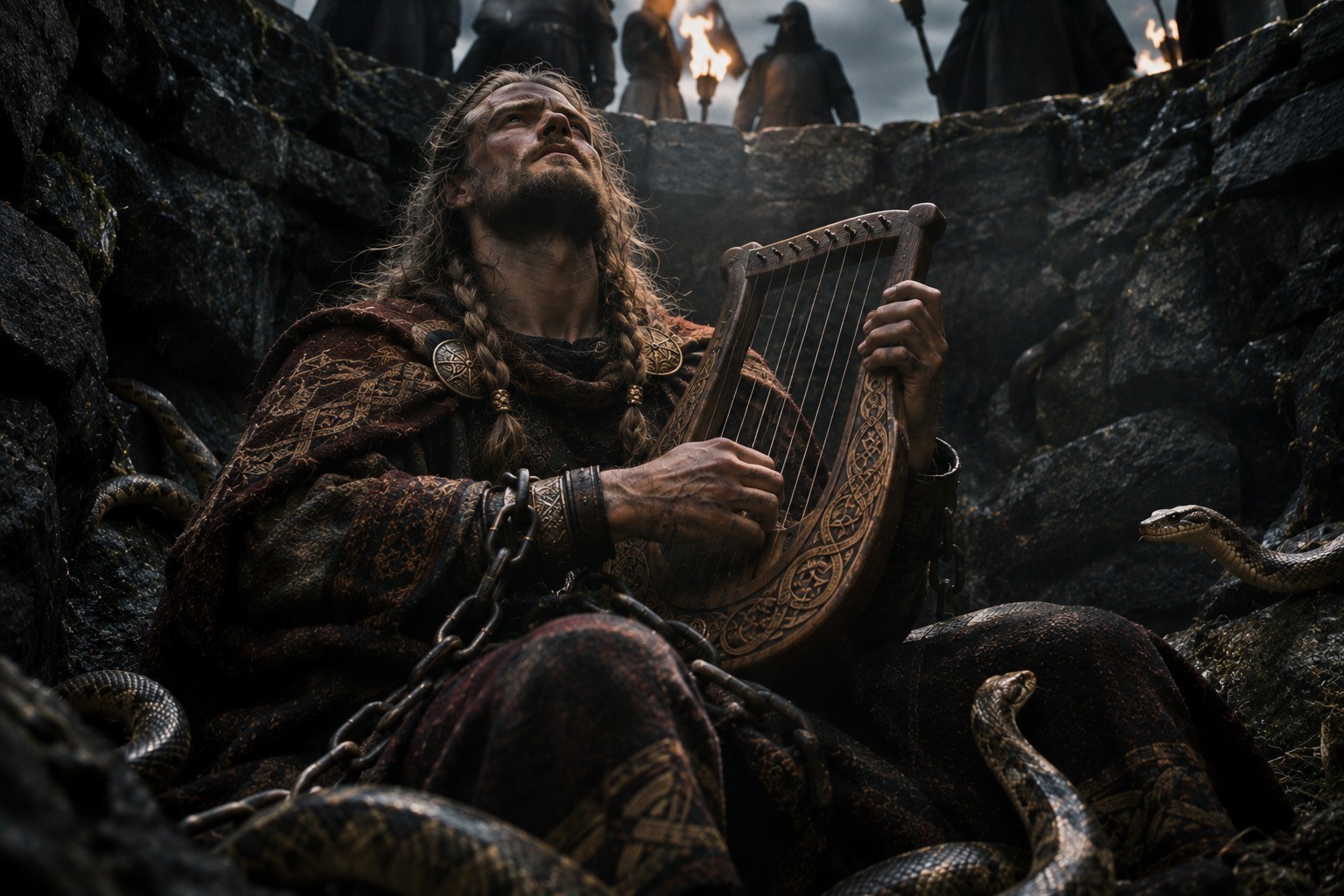
Then Gunnarr is laid alive in the yard that crawls with snakes. Here stands the line that retellings often render differently: "en einn Gunnarr / heiftmóðr hörpu / hendi kníði" – "Gunnarr alone, in wrath, struck the harp with his hand" (st. 31). The strings rang out; so, the stanza closes, should a ring-giver guard his gold from men.
Simrock translated "with his toes". That is not what the Atlakviða says; it matches the later versions, which he probably followed. In the Atlamál Gunnarr plays the harp "ilkvistum", with his toes (Atlamál st. 66 in our source archive). Snorri and the Völsunga saga (ch. 37) give the reason: his hands were bound. Bellows remarks that some editors changed "hand" to "foot" in the Atlakviða; he himself translates "with his hand".
Something else is missing too: the snake that kills Gunnarr. In Snorri all the snakes fall asleep at the harp's music except one adder, which bites in under his breastbone and hangs on his liver until he dies; in the Völsunga saga (ch. 37) it burrows in to his heart. The Atlakviða is silent about his end.
Atli rides home from the killing (st. 32). Guðrún meets him with a golden cup (st. 33), serves food at the feast unwillingly and then says it: Atli has eaten the bloody hearts of his own sons with honey (st. 36). Never again will he call Erpr and Eitill to his knees, never again see them shaft spears and ride horses (st. 37).
The hall breaks into uproar, the Huns weep, all but Guðrún: she never wept, not for her "bear-hard" brothers nor for her young sons (st. 38). How she killed the boys, the poem does not describe. She scatters gold and red rings among the household (st. 39). Atli is drunk and unarmed (st. 40).
Stanza 41 tells the killing briefly: with a blade Guðrún gives the bed blood to drink, lets the hounds loose, wakes the household and throws a firebrand at the hall door. Stanza 42 shows the fire: the old timbers fall, the house of the Buðlungs burns, and the shield-maids die in the flames too. Who these "skjaldmeyjar" were, the poem does not say; on the term itself see our article on the shield-maiden.
The last stanza steps outside the story: no woman will ever again avenge her brothers like this in a mail shirt; the bright one brought death to three kings of the people before she herself died. The text does not say who the three are. Bellows takes them as Atli, Erpr and Eitill and considers the stanza very likely a later addition. Ursula Dronke, according to the English Wikipedia, also considered it an addition. It cannot be proven. That Guðrún acted "before she died" assumes listeners who know her later fate, told in the Guðrún poems and the Hamðismál.
The heading in the Codex Regius calls the Atlakviða "Greenlandic", and the prose after the poem says: "This is told in more detail in the Greenlandic Atlamál." Bellows stresses that the scribe was not infallible; the label only shows that around 1300 both poems were associated with the Greenland settlement.
For the Atlakviða the label fits poorly. The English Wikipedia summarises: Greenland was settled only around 985, the poem is considered older, and most scholars explain the epithet as a confusion with the Atlamál; a Norwegian origin is thought more likely (citing R. G. Finch). For the Atlakviða the title remains a puzzle of the manuscript, not evidence of where it was composed.
The Atlakviða is counted among the oldest heroic poems of the Edda, but the estimates differ. In 1923 Bellows placed it in the first quarter of the 11th century, with the Atlamál some fifty or more years later. According to the English Wikipedia, it is now dated to around 900, possibly to the 9th century. Felix Genzmer, by the same summary, attributed it to the Norwegian skald Þorbjörn hornklofi and to the year 872; according to Finch it may at least have been inspired by the Hrafnsmál. There is no secure date.
One reason is the state of the text. Bellows calls the poem metrically chaotic, probably badly transmitted and full of words found nowhere else; his translation, he says, involves much guesswork. Our source text shows gaps as well: half-lines are missing in stanzas 20, 29 and 35, and one half-verse is split across stanzas 19 and 20.
Eddic poems are not composed in the elaborate court metre of the skalds, dróttkvætt, but in simpler alliterative verse. Two such metres concern the Atli poems: fornyrðislag and málaháttr. Bellows describes the Atlamál as consistently in málaháttr and the Atlakviða as a mixture with many fornyrðislag lines. The English Wikipedia offers two explanations: either older poems were joined together, or the differing line lengths were not yet felt as separate metres. The question is open.
The Atlamál tell the same story at greater length: runes instead of a ring, the wives Kostbera and Glaumvör interpreting dreams, a messenger called Vingi, Högni pleading for Hjalli, and Högni's son Hniflungr helping Guðrún kill Atli. Snorri summarises the story in the Skáldskaparmál to explain the kenning "Niflunga skattr" (treasure of the Niflungs); in his version Guðrún kills Atli together with Högni's son. The Völsunga saga combines both poems: wolf's hair and runes side by side (ch. 33), the heart test and the Rhine speech following the Atlakviða (ch. 37), Kostbera, Glaumvör and Vingi following the Atlamál (ch. 33–35).
In the Völsunga saga and in Snorri, Atli is also Brynhild's brother. In the Atlakviða Brynhildr does not appear at all; Atli wants gold, as the question in stanza 20 and Gunnar's refusal in stanzas 26–27 show. In the south, the Nibelungenlied has Kriemhild invite her brothers to Etzel's court to avenge Siegfried; the Norwegian Þiðreks saga stands between the two worlds. Put briefly: in the Atlakviða the wife avenges her brothers on her husband, in the Nibelungenlied she avenges her husband on her brothers.
Because better-known versions overlay the poem, many people know the story but not the text. For our laser-engraved designs at Glanz & Gravur we work from sources like this one, not from retellings. You will find the full text in Old Norse, German and English in our source archive under Atlakviða – The Lay of Atli, stanza by stanza side by side.
What does "Atlakviða" mean? "The Lay of Atli". Atli is the Norse form of the name Attila; the legendary figure shares little more than the name and the people with the historical king of the Huns.
How many stanzas does the Atlakviða have? 43 in Guðni Jónsson and Simrock, 46 in Bellows.
Why does Gunnarr demand Högni's heart? As long as Högni lives, two men know where the hoard is hidden. Only when his brother is surely dead can Gunnarr keep the secret alone (st. 26–27).
Is the Atlakviða older than the Atlamál? Bellows and, according to the English Wikipedia, most scholars assume so. Bellows put both in the 11th century, the Atlakviða first; today it is often placed around 900. There is no secure date.
Where can I read the text? In the source archive on this site: Old Norse after Guðni Jónsson, with Simrock's German and Bellows' English translation.
Atli – the Eddic King of the Huns Between History, Saga and Picture Stone · Atlamál in grœnlenzku: the Greenlandic Lay of Atli · The Nibelungenlied and the North · The Lays of Gudrun: three Eddic poems about the woman who outlives everyone · The Völsunga saga.
The same story told a second time, only longer, quieter and closer to the farmyard than the royal hall: Atli lures the …
Read more →Baldr dies when his blind brother Höðr throws a sprig of mistletoe at him – the one plant Frigg never made swear an …
Read more →A god saddles his horse, rides into the world of the dead and sings a dead woman out of her grave, because he wants to …
Read more →Berserkers were warriors who went into a feared battle-frenzy, the berserksgangr – first attested in the late ninth …
Read more →