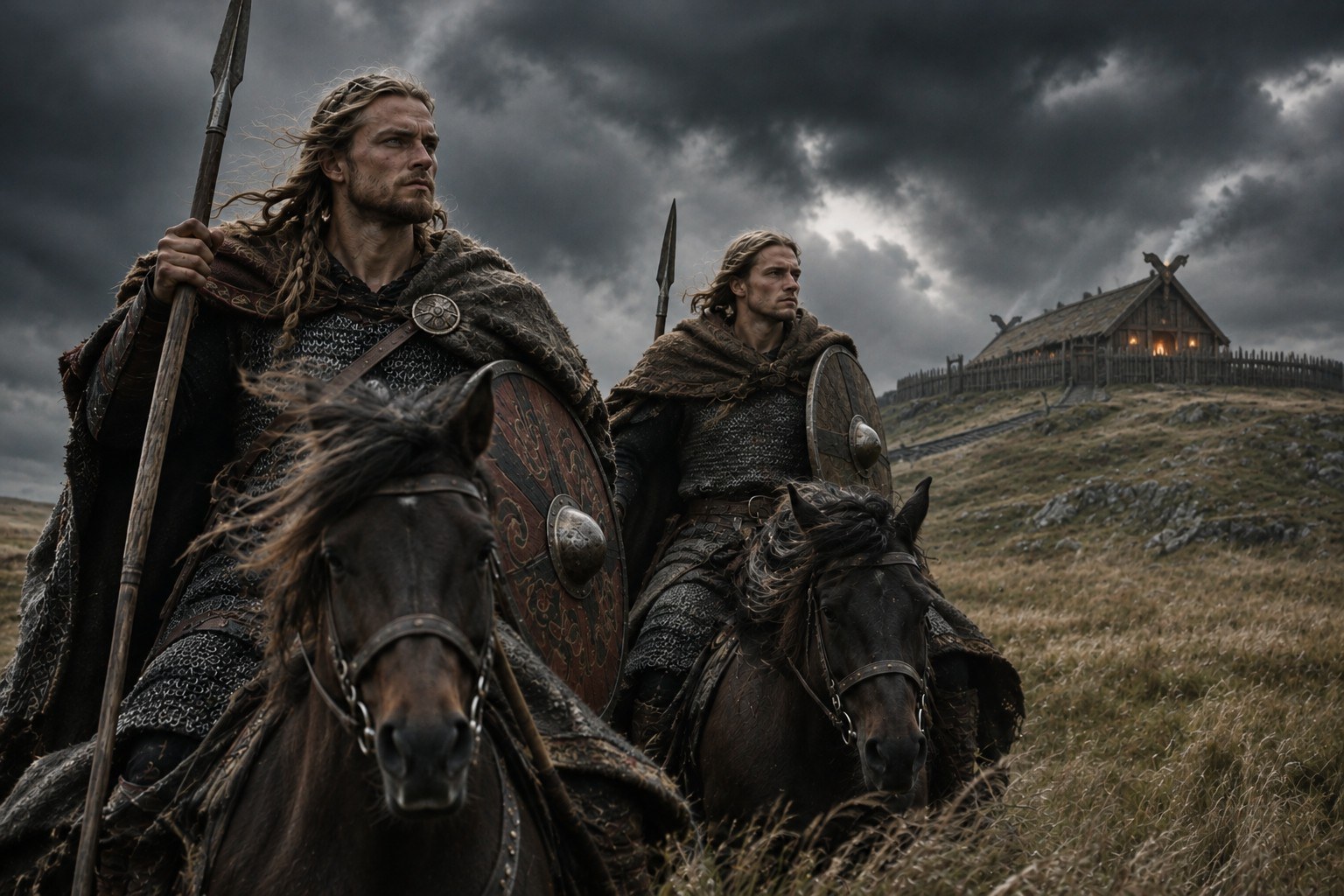
Two young men ride on Hunnish horses to a Gothic king to avenge their sister. On the way they kill the one man who could have helped them. In the hall they cut off the king's hands and feet, but his head stays on, and in the end the stones fly. Hamðismál is the last poem in the Codex Regius of the Poetic Edda and closes the whole cycle of Sigurd, the Gjúkungs and Gudrun. We read it stanza by stanza and compare it with Bragi, Snorri and the Völsunga saga.
Hamðismál does not open with its heroes but with time. "Not now, nor yet of yesterday was it, / Long the time that since hath lapsed," runs the second stanza in Henry Adams Bellows' translation of 1923. The Old Norse adds a half-line: er fátt fornara, "there is little that is older". And after the last stanza the manuscript notes in prose: Þetta eru kölluð Hamðismál in fornu, "this is called the old Hamðismál".
That proves no date. Behind King Jörmunrekkr stands the Gothic king Ermanaric of the 4th century; some nine hundred years separate him from the Icelandic manuscript.
In the edition of Guðni Jónsson, which our source archive follows, the poem has 31 stanzas: terse, abrupt and damaged in several places.
Read alone, Hamðismál says little about the cause. Stanza 3 only states that Jörmunrekkr had the brothers' sister Svanhild trampled on the open road by "white and black ... gray, road-wonted, the steeds of the Goths". It never says why.
The explanation is in the prose before the preceding poem, Guðrúnarhvöt ("Gudrun's Inciting"). After she had killed Atli, Gudrun walked into the sea to drown herself but could not sink. The waves carried her to the land of King Jónakr, who married her. Their sons were Sörli, Erpr and Hamðir. Svanhild, Gudrun's daughter by Sigurd, grew up there and was married to Jörmunrekkr the Mighty. With him was Bikki, who advised that Randvér, the king's son, should take her, and then told the king. The king had Randvér hanged and Svanhild trodden to death under horses' hooves.
Randvér's name never appears in Hamðismál. Stanza 17 only mentions a "sister's son" hanging wounded from a tree, "on the wind-cold wolf-tree west of the hall". Karl Simrock's German of 1851 has "the sister's stepson". That this is Randvér follows only from the prose and the later versions.
The action begins with Gudrun driving her sons to vengeance (st. 2–5). In her lament she is "lonely ... as the forest aspen", stripped of kin "as the fir of its boughs" (st. 5). Guðrúnarhvöt tells the same scene at greater length, and the lines about the white, black and gray horses of the Goths appear word for word in stanza 3 of Hamðismál and stanza 2 of Guðrúnarhvöt. More on Gudrun in our article on the Guðrúnarkviður.
Hamðir answers not with obedience but with reproach (st. 6–8). She gave small praise to Högni's deed when Sigurd was killed in his sleep and she sat on the bed while his slayers laughed. And to strike at Atli she killed Erpr and Eitill, her sons by Atli (as Atlakviða 37 also has it), and so struck above all at herself.
This Erpr is not the Erpr who dies later on the road; retellings often miss the shared name.
Sörli, "wise ... ever", refuses to quarrel with his mother (st. 9–10). His words sound like a farewell: Gudrun will weep for both of them too, for "we sit doomed on our steeds, and far hence shall we die". The Old Norse is er hér sitjum feigir á mörum, fjarri munum deyja. A man who is feigr is one whose death is already fixed.
The brothers ride out over wet mountains on "Hunnish steeds" (st. 11). On the way they meet Erpr (st. 12–14). Mockingly they ask what help "the weakling brown" could give. Erpr says he will help as one foot helps the other; the brothers scoff at the idea. Erpr retorts that it is ill to show the way to the timid. They call him hornungr, a bastard, draw their swords and kill him "to the giantess joy to give", as Bellows puts it (st. 15). By that, the poem says, they lessened their own strength by a third.
Here the tradition genuinely contradicts itself. Hamðismál calls Erpr inn sundrmæðri (st. 13), "the one of another mother", and in stanza 24 Hamðir stresses that he and Sörli are bræðra sammæðra, brothers of one mother. In the poem, then, Erpr is a half-brother, Jónakr's son by another woman, and the insult hornungr fits. The prose before Guðrúnarhvöt, however, lists Sörli, Erpr and Hamðir together as sons of Gudrun and Jónakr, and so do Snorri's Skáldskaparmál and the Völsunga saga. Snorri even adds a motive the poem lacks: angry with their mother, they killed Erpr because she loved him most.
The well-known scene in which the brothers stumble and catch themselves with a hand or the other foot is also missing from Hamðismál. In Snorri Sörli stumbles; in the Völsunga saga both do. The poem goes straight on: the brothers shake their cloaks, sheathe their swords and ride on (st. 16).
At their goal they first see the hanged man on the wolf-tree (st. 17). In the hall men are drinking until a watchman sounds his horn (st. 18).
The king laughs. He strokes his beard, is "warlike with wine" and turns the golden cup in his hand (st. 20). Happy he would be, he says, to see Hamðir and Sörli in his hall: he would bind them with bowstrings and hang Gjúki's good offspring on the gallows (st. 21).
Stanza 22 is the most puzzling in the poem. A figure named Hróðrglöð, "the fame-glad one", stands on the steps and speaks to her son. The Old Norse has a gap here, marked with dashes in the edition, and the poem does not say who she is. Bellows takes her as a woman addressing her son and moves the stanza forward in his translation. Simrock turns the speaker into a male "exalted one" warning his kin. The stanza asks whether two men alone can bind or strike down "ten hundred Goths". Bellows renders it "two hundred"; the Old Norse says tíu hundruð.
The fight takes a single stanza: clamour in the hall, shattered cups, men lying in the blood that came from the breasts of the Goths (st. 23). Then Hamðir addresses the king: he wished for their coming, and now he sees his feet and his hands flung into the hot fire (st. 24). Who cut off what, the poem does not say; in the Völsunga saga Hamðir takes the hands and Sörli the feet.
Stanza 25 brings the turn. "Like a bear" there roared inn reginkunngi baldr í hrynju, roughly "the god-descended lord in mail". He cries: stone the men, since spears and swords will not bite on the sons of Jónakr. Bellows renders the phrase "the king, of the race of the gods", Simrock "the high counsellor". The poem gives no name.
So who advises the stoning? Here the versions part company. In Snorri, Jörmunrekkr himself calls for the brothers to be stoned to death. In the Völsunga saga a tall, old man with one eye steps in, calls the retainers foolish and gives the advice. Unnamed, he recalls the one-eyed old man of Sigmund's story, in whom readers recognise Odin. The poem leaves the question open: the phrase in stanza 25 could mean the king, who is still alive, or another man.
Next comes an exchange between the brothers that is hard to sort out. In stanza 26 one brother tells the other he did harm when he untied "that bag", for baleful counsel often comes out of that bag. Simrock freely renders it as "opening the mouth", and the passage is usually read that way: the taunt gave the maimed king time and voice. Guðni Jónsson's edition assigns the stanza to Hamðir, although Hamðir himself made the taunting speech. Bellows joins stanzas 26 and 27 into a single speech. The text here is not securely ordered.
Sörli's verdict is clear (st. 27): "Heart hast thou, Hamther, if knowledge thou hadst! / A man without wisdom is lacking in much." Then comes the line the whole story has been heading for (st. 28): his head were now off if Erpr were living, the brother so keen whom they killed on the road. "The dísir urged me on", says the Old Norse, hvöttumk at dísir; Bellows writes "the Norns". On the dísir see our article on the Dísir. The man who should have been holy in battle, they had slain.
The last speeches belong to Sörli. It does not befit them to tear at each other like wolves, "like the hounds of the Norns" (st. 29). And then:
"We have greatly fought, o'er the Goths do we stand
Hamðismál, st. 30 (numbering of Guðni Jónsson; also Bellows st. 30), translated by Henry Adams Bellows, The Poetic Edda, 1923
By our blades laid low, like eagles on branches;
Great our fame though we die today or tomorrow;
None outlives the night when the Norns have spoken."
The final stanza is one plain sentence: Sörli fell by the gable of the hall, Hamðir at the back of the house (st. 31). The stoning itself is only implied by stanza 25. With the verdict of the Norns the line of the Gjúkungs comes to its end as well.
The Codex Regius arranges its heroic poems roughly in story order. Before Guðrúnarhvöt and Hamðismál come, among others, the poems about Sigurd, Brynhild and Gudrun, the old Atli poem, Atlakviða, and the Greenlandic one, Atlamál. Guðrúnarhvöt treats Gudrun's goading as a lament that ends with her calling for her pyre; Hamðismál tells the deed.
Guðrúnarhvöt knows nothing of the killing of Erpr and ends before the brothers ride out. Two poems on the same story side by side also occur with Atlakviða and Atlamál.
The poem is in Eddic alliterative verse, not in the skaldic metre dróttkvætt. What stands out is how uneven the stanzas are: some have four lines, others eight or ten, and some lines are clearly longer than the usual short line. I have no checked scholarly explanation for this.
Hamðismál is not the only Norse version. The oldest probably comes from Bragi Boddason, called the Old. In Skáldskaparmál, Snorri Sturluson quotes four stanzas and a refrain that Bragi composed about the fall of Sörli and Hamðir "in the drápa that he composed about Ragnar loðbrók". They describe pictures on a shield: Jörmunrekkr wakes from an evil dream, blood flows over the benches, hacked-off hands and feet lie on the floor, and Sörli and Hamðir are struck with "the hard shoulder-lumps of Hergaut's lady-friend", that is, with stones, the bones of the Earth. According to Edward Pettit, whose introduction we know only from a summary, Bragi was active around 850 to 870. If so, maiming and stoning were already part of the story in the 9th century. More in our article on the Ragnarsdrápa.
Snorri also retells the story in prose in Skáldskaparmál. In his version Gudrun gives her sons an exact plan: they are to go to the king at night while he sleeps; Sörli and Hamðir are to cut off his hands and feet, Erpr his head.
The Völsunga saga follows the poem most closely and even quotes it. But it adds detail: before the gallows Randvér plucks a hawk and has it sent to his father; Svanhild is bound in the gateway, and the horses dare not trample her while her eyes are open, until Bikki has a sack pulled over her head. None of this is in Hamðismál.
Poetic diction knew the story too: the skald Hallfreðr calls mail-coats Hamðis skyrtur, "Hamðir's shirts", as Snorri cites in Skáldskaparmál.
Behind Jörmunrekkr stands Ermanaric, usually taken to be a king of the Greuthungi, a Gothic group north of the Black Sea, who died around 375/376 (no ancient source gives the year; it is inferred from the Hun invasion). Two ancient accounts of him survive, and they do not agree. The Roman historian Ammianus Marcellinus, a contemporary of the events, calls him a most warlike king and reports that he took his own life when the Alans and Huns invaded. I have read the passage (book 31, chapter 3) only in John C. Rolfe's English translation, via a retrieval tool.
Jordanes, who wrote a history of the Goths around 551, tells it differently (Getica 129–130, in Charles C. Mierow's translation of 1915). Ermanaric had a woman named Sunilda bound to wild horses and torn apart by driving them in opposite directions, because of her husband's treachery. Her brothers Sarus and Ammius came to avenge their sister and plunged a sword into the king's side. Enfeebled, he lingered on, the Huns under Balamber took advantage of it, and he died at the age of one hundred and ten.
The likeness to the Edda is obvious: a woman killed by horses, two avenging brothers, a wounded king. So are the differences. In Jordanes Sunilda is torn apart, not trampled, and the reason is her husband's treachery, not a suspected affair with a king's son. In Norse tradition Sarus and Ammius became Sörli and Hamðir, and Sunilda became Svanhild. See also our articles on the Goths and the Ostrogoths.
How the story reached Scandinavia is not recorded. In England, too, Eormanric was known as a cruel king, and in German Dietrich legend Ermenrich appears as the enemy of Dietrich of Bern; see our article on the Þiðreks saga.
The poem survives only in a manuscript of about 1270. The common scholarly view counts it, with Atlakviða, among the early Eddic poems. According to Mikael Males (Neophilologus, 2025) the language fits this: Hamðismál looks very archaic, for instance in its frequency of so-called expletive of. Overviews often name the 9th or 10th century, as does our article on the Edda; there is no firm date.
Two observations speak for the age of the story. First, Bragi's shield stanzas already presuppose the core scenes, if Pettit's dating is followed. Second, the manuscript itself calls the poem "old". Neither proves that the surviving wording is that old. The gaps and disorder, for instance in stanzas 12 to 14, 22 and 26 to 27, also show that the text suffered damage before it was written down.
Hamðismál tells of no victory but of two men who fail through their own mistake: Erpr offered them the image of hand and foot, they laughed at it, and in the end the third man is missing for the head. Sörli's "though we die today or tomorrow" is not a complaint but a statement of fact.
Anyone who has an Edda motif laser-engraved with us will find in Sörli's line about the Norns a genuine, attested saying rather than an invented "Viking quote".
You can read the full text in Old Norse, German and English in our source archive under Hamðismál, stanza by stanza with Simrock and Bellows; the prelude is in Guðrúnarhvöt.
What is Hamðismál about? Gudrun's sons Hamðir and Sörli avenge their sister Svanhild on Jörmunrekkr, kill their half-brother Erpr on the way, maim the king and are stoned to death.
Who advises the stoning in the poem? An unnamed "god-descended one in mail" (st. 25). Only the Völsunga saga brings in a one-eyed old man.
Why does Erpr matter so much? Because he would have been the third: the brothers cut off hands and feet, but for the head they lack Erpr. Snorri spells it out; in the poem it is stanza 28.
Is Jörmunrekkr a historical person? He goes back to the Gothic king Ermanaric, who died around 375/376. The story itself is legend.
Where is Hamðismál preserved? As the last poem in the Codex Regius of the Poetic Edda, directly after Guðrúnarhvöt. I know of no other manuscript of the poem.
The Lays of Gudrun: three Eddic poems about the woman who outlives everyone · Atlamál in grœnlenzku: the Greenlandic Lay of Atli · The Völsunga saga · Atli – the Eddic King of the Huns Between History, Saga and Picture Stone · Sigurd the dragon-slayer.
Thor comes back from the east and reaches a sound. On the far shore lies a boat, and beside it a ferryman. That is all …
Read more →A man called Þorleifr gives a poet a shield with gods and giants on it. The poet thanks him the way skalds do, in …
Read more →A poem that opens by advising you to look around when you enter a house, to see where the enemies are sitting. It …
Read more →Eagles scream, holy waters pour down from the mountains of heaven, and in the night the Norns arrive: this is how the …
Read more →