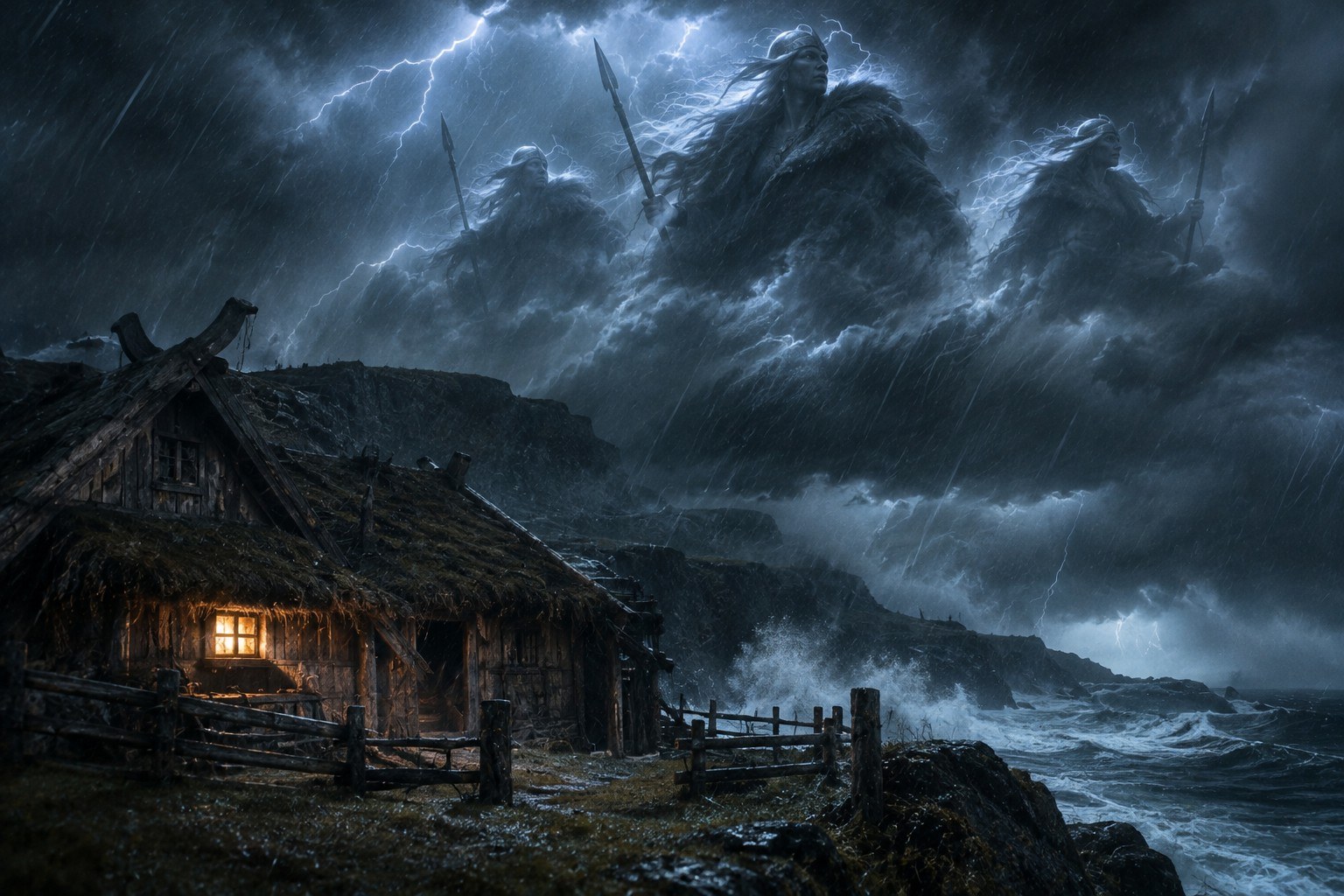
Eagles scream, holy waters pour down from the mountains of heaven, and in the night the Norns arrive: this is how the first heroic poem of the Codex Regius begins. In 56 stanzas, Helgakviða Hundingsbana in fyrri tells of Helgi's birth, his first victory, a voyage through a storm, one of the coarsest exchanges of insults in the Edda, and the battle that wins him Sigrún. We follow the Old Norse text closely – gaps, uncertainties and disagreements between the witnesses included.
Helgakviða Hundingsbana in fyrri, "the first lay of Helgi Hundingsbani", survives in a single manuscript: the Codex Regius of the Poetic Edda (GKS 2365 4to), written in Iceland around 1270. The manuscript heads it with the words "Hér hefr upp kvæði frá Helga Hundingsbana ok þeira Höðbrodds" – "Here begins the poem of Helgi Hundingsbani and Höðbroddr". Scholars usually call it HH I.
Its position is telling. In the Codex Regius it follows Alvíssmál, Thor's question game with the dwarf Alvíss, and so opens the part that modern scholarship classes as heroic poetry. What comes next is not the second poem about the same hero but Helgakviða Hjörvarðssonar, about a different Helgi. Only then does the second Hundingsbani lay follow. How the three poems hang together is covered in Helgi and Sigrún.
The first stanza opens in a past beyond dating: "Ár var alda", "It was early in the ages". Eagles scream, holy waters fall from the Himinfjöll, the "mountains of heaven", and Borghildr gives birth to the great-hearted Helgi at Brálundr. Henry Adams Bellows explains the screaming eagles and pouring water in his note as portents of a hero's birth.
In stanza 2 night falls on the homestead and the Norns come, "who shaped the life of the lofty one"; he is to be the most famous of princes. In stanza 3 they twist the örlögþáttu, the threads of fate, with all their strength while the strongholds of Brálundr break, and fasten golden cords in the middle of the "moon's hall", the sky. In stanza 4 they hide the ends in the east and the west, with the king's land lying between. One of them, "nift Nera", Neri's kinswoman, casts a fetter to the north and bids it hold forever.
Mightily wove they the web of fate,
While Bralund's towns were trembling all;
And there the golden threads they wove,
And in the moon's hall fast they made them.Helgakviða Hundingsbana I, st. 3, transl. Henry Adams Bellows, The Poetic Edda (1923), public domain
The passage is famous but uncertain. Bellows notes that line 2 of stanza 3 is largely guesswork because the manuscript is obscure. Nothing is known of Neri; the word may not even be a name. And the poem gives neither the number nor the names of the Norns – Urðr, Verðandi and Skuld come from the Völuspá. More on them in our article on the Norns. What matters for Helgi is the image: his fate is stretched across the world, with a special bond to the north.
After the Norns, the birds speak. Stanza 5 mentions a sorrow weighing on the scion of the Ylfingar – the poem's name for Helgi's kin – and on his mother; what it is, the text does not say. Then a hungry raven speaks to another: "I know something." Sigmund's son already stands in mail, half a day old ("dægrs eins gamall"; Bellows: "a half-day old"), his eyes as sharp as a warlord's; he is "varga vinr", friend of the wolves: "we two shall be glad" (st. 6).
Stanzas 7 and 8 tell of the naming. The king himself comes from the din of battle and brings the child an "ítrlauk", a noble leek; what the gift means, the poem does not explain. He names him Helgi and gives him land, among it Hringstaðir, Sólfjöll and Himinvangar, plus a "blóðormr", a blood-snake – a sword. The recipient is called "Sinfjötli's brother": Helgi is the half-brother of Sinfjötli, whom Sigmund fathered on his own sister Signý according to the Völsunga saga.
The young prince does not wait long for war. At fifteen winters he kills Hundingr, who had long ruled lands and men (st. 10). Hunding's sons then demand compensation for plunder and their father's death (st. 11). Helgi refuses all wergild and promises instead a great storm of "grey spears" and the wrath of Odin (st. 12).
The battle is fought at Logafjöll. Stanza 13 says the peace of Fróði was broken between the foes, and "Viðris grey", Viðrir's hounds, ran hungrily across the island. Viðrir is one of the names of Odin that Snorri lists in Gylfaginning, and Bellows reads the hounds as Odin's wolves. Of "Frothi's peace" he writes that the king's reign was so peaceful that the phrase became a by-word for peace of any kind. Simrock, incidentally, renders the passage as "Grani's grey hounds" – the Old Norse text on our source page has Viðrir.
Afterwards Helgi sits beneath the eagle-stone, having slain Álfr, Eyjólfr, Hjörvarðr and Hávarðr, the sons of Hunding – "the whole kin" has fallen (st. 14). That explains the poem's title: Hundingsbani means "Hunding's slayer".
Now the tone changes. In stanza 15 a light breaks over Logafjöll, lightning comes out of the light, and tall figures under helmets appear on Himinvangar; their mail is spattered with blood and rays stand out from their spears. In the middle of the stanza the text has a gap. Bellows suspects that something was lost which named the coming of the valkyries more clearly.
Early in the morning Helgi asks the "dísir suðrænar", the southern women, whether they will come home with the warriors that night (st. 16). The answer comes from horseback, from "Högni's daughter": she has other tasks than drinking beer with the ring-breaker (st. 17). Her father has promised her to Granmar's grim son Höðbroddr, whom she has called as fine a king as "a cat's son" (st. 18). He will come within a few nights unless Helgi challenges him (st. 19). Helgi replies that she should not fear the slayer of Ísungr (st. 20). Who Ísungr was is unknown.
What is missing is remarkable. At this point the woman Helgi chooses has no name; she is first called Sigrún in stanza 30. And the poem never uses the word valkyrja for her. The prose of the second lay, by contrast, says plainly that Sigrún was a valkyrie who "rode air and water". See also our article on valkyries.
Helgi sends messengers by land and sea and offers gold for followers (st. 21). Ships arrive from Heðinsey and Stafnsnes. Hjörleifr counts twelve hundred trusty men, with half as many again at Hátún (st. 22–25). Oars beat, iron clangs (st. 26–27).
The storm in stanzas 28 to 30 is a showcase of skaldic language. The waves are "Kólga's sisters"; Kólga is one of the daughters of the sea giant Ægir whom Snorri lists in Skáldskaparmál. Helgi has the sails hoisted higher, though "Ægir's daughter" wants to capsize the "stay-steering steeds", the ships. Then Sigrún protects the men "from above", and the king's ship tears free of the hands of the sea goddess Rán at Gnipalundr (st. 30). In the evening the fleet lies at Unavágar, watched with hostility from Svarinshaugr – Simrock turns the watchers into "Granmar's sons" (st. 31).
What follows takes up nearly a quarter of the poem. Guðmundr, a son of Granmarr, asks who is leading this fearsome host to land (st. 32). Sinfjötli answers, raising a red shield with a golden rim on the yard (st. 33). Bellows explains the red shield as the signal for war.
Such exchanges of abuse are called senna in Old Norse; the best-known example is Lokasenna. Sinfjötli opens: Guðmundr should tell it tonight when he feeds the swine; Helgi has often fed the eagles while Guðmundr was kissing slave-girls at the quern (st. 34–35). Guðmundr answers with Sinfjötli's own story: wolves' food, slain brothers, wounds sucked with a cold mouth (st. 36).
Sinfjötli turns the tables. Guðmundr was a völva on Varinsey who wanted no man but Sinfjötli (st. 37), a harmful valkyrie in Allfather's hall over whom the einherjar fought (st. 38), and with him Sinfjötli fathered nine wolves on Ságunes (st. 39). Guðmundr hits back: giant-women gelded Sinfjötli at Þórsnes; he is Siggeir's stepson and a fratricide (st. 40–41). Then come the mare of the stallion Grani at Brávöllr, goat-milking for Gullnir and the threat to feed the ravens at Frekasteinn with the opponent's corpse (st. 42–44).
Each denies the other's manhood – woman, mare, eunuch. On the weight of such charges see our article on insults and níð. Helgi ends the quarrel: it would suit Sinfjötli better to give battle and gladden eagles than to fight with empty words. He does not think well of Granmar's sons, but they showed courage at Móinsheimar (st. 45–46).
Who speaks which stanza is not certain everywhere. On our source page, Guðmundr is named as speaker before stanza 43 and Sinfjötli before stanza 44. Simrock gives no speaker for 43 and assigns 44 to Guðmundr. Bellows gives 43 to Sinfjötli and 44 to Guðmundr, noting that some editions reverse this. In the Völsunga saga (ch. 9) it is Sinfjötli who makes the goat jibe, and the threat to feed the birds on his opponent's corpse is spoken by Granmarr. Edward Pettit notes in his 2023 edition that the saga helps establish who says what.
The men from Svarinshaugr ride Svipuðr and Sveggjuðr to Sólheimar; "Mist's steed" shakes where they pass (st. 47). In Grímnismál Mist is a valkyrie's name; Bellows takes her "steed" to be the earth, though that is not certain. At his gate Höðbroddr asks why "the Hniflungar" look so angry (st. 48). Bellows remarks that the name recalls the Nibelungs, though Granmar's kin seems to have had no connection with them (for that material see our Nibelungenlied article).
The messenger reports keels on the beach: fifteen bands ashore, seven thousand out in Sogn (st. 49–50). Höðbroddr calls up everyone who can wield the "flame of wounds" – the sword – and summons Högni, the sons of Hring, Atli, Yngvi and Álfr the Old: "let us make a stand against the Völsungs" (st. 51–52).
Easily missed: Högni, Sigrún's father, is called up against Helgi. Whether he falls, the first lay does not say; only the prose of the second lay reports that Dagr, Högni's son, alone was spared and swore oaths to the Völsungs.
The battle needs just one stanza. The blades meet at Frekasteinn like a gust of storm, and Helgi is always first in the throng, "fierce in fight, loath to flee" (st. 53). From the sky come the "hjalmvítr", the helmed beings, to shield him (st. 54). Sigrún hails the victor as "áttstafr Yngva", offspring of Yngvi: red rings and the mighty maid are his, Högni's daughter and Hringstaðir, victory and land (st. 55–56). The last half-line reads: "Þá er sókn lokit" – "Then the fight is over."
HH I is full of kennings: the sword as "blood-snake" (st. 8) and "flame of wounds" (st. 51), the prince as "ring-breaker" (st. 17), the waves as "Kólga's sisters" (st. 28), the wolves as "Viðrir's hounds" (st. 13). In stanza 54 "the horse of the giantess" has had ravens' food; the wolf is probably meant, since in the prose of Helgakviða Hjörvarðssonar, too, a troll-woman rides a wolf.
In the introduction to his edition, Pettit notes that the poem has more kennings and other poetic terms than any other Eddic poem except Hymiskviða. He also quotes J. Harris's (1983) observation that its language is rich in new compounds whose closest parallels lie in skaldic poetry. Bellows, in 1923, already wrote of the "verbal intricacies" beloved of the skalds. Snorri later collected that imagery in Skáldskaparmál.
The metre, on the other hand, is Eddic. Most stanzas have eight short half-lines, bound in pairs by alliteration: "Borghildr borit / í Brálundi". That matches fornyrðislag, the commonest narrative metre of the Edda; see Dróttkvætt and the Eddic metres. Some stanzas are longer, such as stanza 36 with twelve half-lines, others shorter. Design or loss? That cannot always be decided.
The second Helgi lay (HH II) tells parts of the same story again, but differently. Its prose opens by saying that Sigmund and Borghildr named their son after Helgi Hjörvarðsson. There Sigrún is called "Sváfa endrborin", Sváfa reborn – Sváfa being the valkyrie of Helgakviða Hjörvarðssonar. The meeting with Sigrún after the fight with Hunding's sons is there too, as is the rescue in the storm, for which the prose names nine riding valkyries.
The kinship is closest in the flyting. The second lay contains a short version of it, and Helgi's peacemaking words are almost identical: HH I 45–46 corresponds to HH II 23–24 in the numbering of our source page. In Bellows' translation the prose of the second lay even points back, saying Guðmundr's words are "written before in the Helgi lay". The normalised Old Norse text of Guðni Jónsson does not contain this reference; the editions differ here. Pettit considers it likely that the two poems both borrow from each other and draw on shared oral tradition. Bellows thought the abusive dialogue "clearly was based on another and older poem".
The Völsunga saga follows the first lay remarkably closely in chapters 8 and 9, from the Norns at the birth to the battle at Frekasteinn. But it changes details. In the saga the flyting is conducted by Granmarr, not Guðmundr. Sigrún would no sooner marry Höðbroddr than "a crow's chick" – in the poem he is "a cat's son". Hunding's sons are called Hervarðr and Hagbarðr, Helgi's captain Leifr, and Ságunes becomes Láganes. And the saga takes leave of Helgi after the wedding: he has nothing more to do with this story.
The manuscript was written around 1270; the poem is older, but how much older is a matter of interpretation. Bellows held it to be "unquestionably one of the latest of the Eddic poems", probably not composed before the second quarter of the eleventh century. He also points out that narrative verse was a relatively late development in Old Norse poetry. Pettit reports the proposal that the poem was composed in the mid to late eleventh century at a royal court. Both are reasoned guesses. There is no secure date.
The geography is open too; Bellows spoke of "geographical confusion". According to the English Wikipedia article, some scholars place the action in Denmark, others – such as Birger Nerman (1925) – in Östergötland and Södermanland.
HH I is not a poem of love and death like its companion but a praise poem for a young warlord: portents, retinue, voyage, war of words, victory – told in images such as threads of fate beneath the moon's hall and a red shield raised on the yard.
You will find the full text in Old Norse, German and English in our source archive: Helgakviða Hundingsbana in fyrri. The second lay is there as well: Helgakviða Hundingsbana önnur.
What does "Hundingsbana" mean? Hundingsbani means "slayer of Hunding". Helgi bears the epithet because at fifteen winters he kills King Hundingr and then his sons Álfr, Eyjólfr, Hjörvarðr and Hávarðr (st. 10–14).
Where is the poem preserved? Only in the Codex Regius of the Poetic Edda, written around 1270. There it is the first of the heroic lays.
Who is Sigrún? In the poem she is "Högni's daughter", promised to an unwanted suitor, Höðbroddr, who asks Helgi for help. The text names her only in stanza 30, when she protects the fleet in the storm.
What is the quarrel between Sinfjötli and Guðmundr about? It is a senna, an exchange of insults before battle. Each accuses the other of unmanliness, of having been a woman or an animal, and of crimes, until Helgi ends the quarrel.
How old is the first Helgi lay? Only the writing down around 1270 is certain. Bellows thought of composition no earlier than the second quarter of the eleventh century; Pettit reports a proposal of the mid to late eleventh century. Neither can be proven.
Helgi and Sigrún – the valkyrie at the burial mound · Sinfjötli · The Norns · Valkyries · Kennings · Völsunga saga · Codex Regius · Shield-maidens · Lokasenna
Helgi and Sigrún – The Valkyrie Who Met the Dead in the Mound · Sinfjötli and the wolf-skins · The Völsunga saga · The Shieldmaiden · The Codex Regius.
A king's daughter promised to a husband she does not want picks a hero for herself. He wins her in war and dies at her …
Read more →The pyre has burned down, and Brynhild still has things to say. In a short poem of the Poetic Edda she rides down the …
Read more →Hermod (Old Norse Hermóðr) is the god who, after Baldr has been killed, rides Odin's eight-legged stallion Sleipnir for …
Read more →A sword that shines like a ray of the sun and brings no luck to anyone who carries it passes from hand to hand: from a …
Read more →