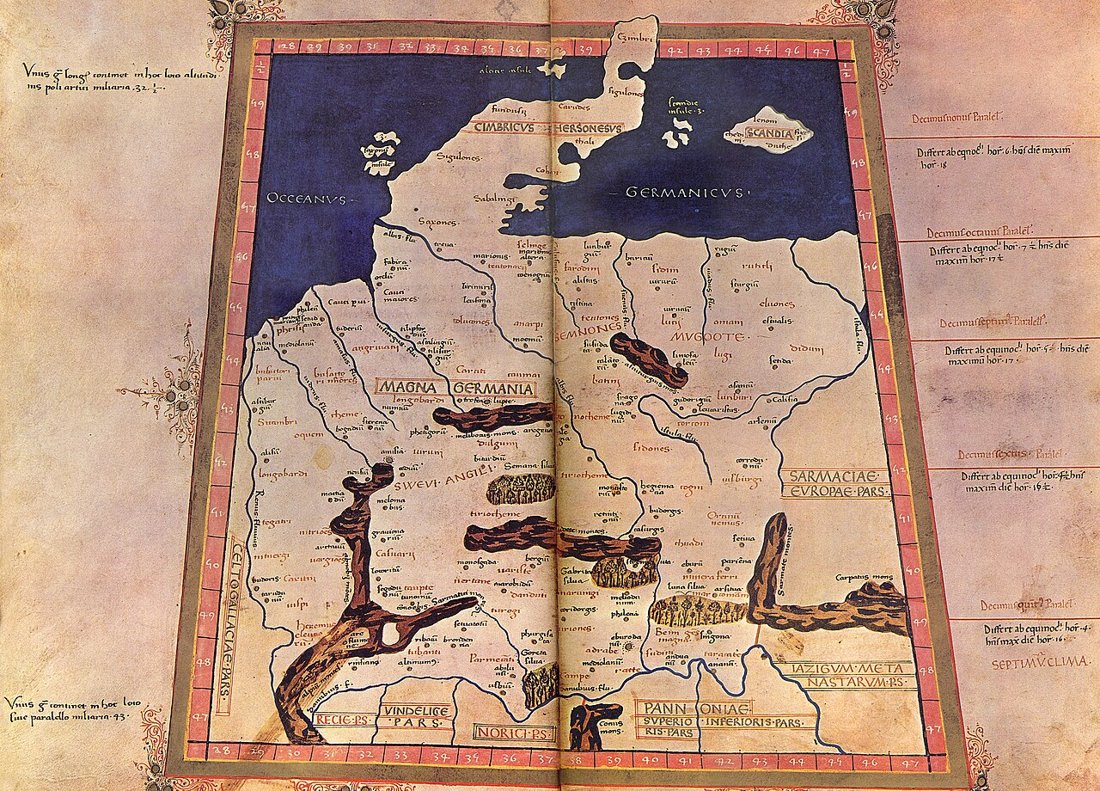
For some Germanic peoples we know kings, battles and laws. For the Sidini we know one word. Around the middle of the second century AD the Greek geographer Claudius Ptolemy placed it on the southern shore of the Baltic, somewhere between the Saxons and the Vistula. No other ancient author names them; no inscription and no find carries their name. This article shows what can be read out of a single passage, how Ptolemy came by his information, where scholars look for the Sidini, and why they should not be confused with the Sidones or with the city of Sidon.
In Ptolemy's Greek text the Sidini are called Sideinoi (Σιδεινοί); Latin editions and modern scholarship usually write Sidini. The German form "Sidiner" is a modern adaptation, as is common for tribal names known only from antiquity. There are no other name forms. That sets the Sidini apart from neighbours such as the Rugii or the Goths, whose names turn up in different sources over centuries.
Anyone writing about the Sidini is, at heart, writing about one line in a geography book. Single attestations like this show very clearly how ancient knowledge of the North came about, how much uncertainty it carries and how modern research deals with it. The Sidini are an exercise in source criticism: they teach you to take a statement seriously without making more of it than it can bear.
A note on the honesty of this text. I could not consult the original Greek wording of the passage in full for this article; the order of peoples and rivers given here rests on overviews and on an English version of Ptolemy read for another article on this site. Where a detail depends on that, I say so.
In the second book of his Geographike Hyphegesis ("Guide to Drawing a Map of the World") Ptolemy describes Germania Magna, the free Germania beyond the Rhine and Danube that never became a Roman province. In the usual numbering this is Book II, chapter 11. The paragraph containing the Sidini is mostly cited as II 11.7; since paragraph numbering varies between editions, take that without guarantee.
The chapter follows a fixed pattern. First come the coasts with river mouths and coordinates, then the peoples, ordered from the coast inland, and finally a list of places Ptolemy calls poleis. Along the northern coast he works from west to east. After the peoples on the North Sea come the Saxons on the "neck" of the Cimbric peninsula, that is, in southern Jutland. Then, in the usual reading, follow:
That is all. Ptolemy says nothing about the language, way of life, kings, gods or size of this group. He names no place that explicitly belongs to it. The Sidini are a stretch of coastline bounded by two rivers. Every further statement about them is already interpretation.
What the text does not say matters too. Ptolemy does not claim that the Sidini were Germanic in a linguistic sense. He lists them in Germania Magna because they live in the area he calls by that name. "Germanic" is first of all a geographical label for him. That the peoples on the southern Baltic coast spoke Germanic languages in the first and second centuries is assumed by scholars for other reasons, such as the names of neighbouring groups and the reports of Tacitus. For the Sidini themselves it remains an assumption.
Claudius Ptolemy lived in the second century AD in Alexandria in Egypt. He is best known for his great astronomical work, the "Almagest". His Geography is essentially a huge table of coordinates: for thousands of towns, river mouths, capes and mountains he gives longitude and latitude so that readers could draw a map for themselves. He counts longitude from a prime meridian at the far western edge of the known world, at the "Isles of the Blessed", usually taken to be the Canaries.
Ptolemy never went to Germania and surveyed nothing himself. He worked through existing material. In his first book he explains at length that he builds on the work of a predecessor, Marinus of Tyre, and corrects him in many places, for instance on distances and on the extent of the known world. To this came travel reports, route descriptions (itineraries), information from sailors and traders and probably material from the Roman army. For Germania one should imagine something like this: a trader or an officer reports that from a certain river mouth you sail so many days along the coast to the next. Ptolemy turns that into distances and the distances into coordinates.
This method explains why coasts are covered comparatively well in his work. Anyone fetching amber or other goods from the Baltic called at river mouths and remembered names. A people's name attached to a stretch of coast is exactly the kind of information you would expect in such a report: "Between this river and that one live the so-and-so." Whether the name was a self-designation, a name given by neighbours, or the name of a settlement that a traveller took for a people can no longer be established.
Ptolemy's Germania is famous for its distortions. Transfer his coordinates to a modern map and you get a country that looks too narrow and too stretched in the north. According to a 2010 report in "Der Spiegel" on a Berlin research team, Jutland and Schleswig-Holstein lie too far east. The individual parts of his map do not fit neatly together, even though he knew some fixed points.
There are several reasons for these errors. First, Ptolemy worked with a circumference of the Earth smaller than the real one, so distances in stadia produced shifted values in degrees. Second, many distances were based on travel times that varied greatly with wind, current and route. Third, he had to project the curved surface of the Earth onto a flat map, which produces especially strong distortion in the far north. Fourth, he combined material from different sources that relied on different reference points.
Duplicates are a particular problem. If two reports described the same people under slightly different names or from different starting points, it could appear twice in the list, in two different places. For the Langobards, for example, a widespread interpretation holds that they appear in Ptolemy in two forms and at two locations. Conversely, peoples well known to other authors could be missing: the Lemovii, whom Tacitus names on the Baltic coast, are nowhere to be found in Ptolemy.
For the Sidini this means three things. Their location depends on two rivers whose identification is itself uncertain. Their name could be a miscopying or duplicate of another name; that can be neither proved nor ruled out. And their absence from other authors may mean that they were a small group, that other writers knew them under another name, or that the entry rests on a misunderstanding. None of these possibilities is attested.
Then there is the transmission of the text itself. Ptolemy's Geography does not survive in the original but in medieval Byzantine manuscripts. The oldest surviving ones date only from around 1300, more than a thousand years after the work was written. Rare names that no copyist knew were especially prone to error.
In Ptolemy the Sidini live east of the Suebos and west of the Viadua. Anyone who wants to locate them must first identify the rivers. This is exactly where research has moved in recent decades.
For a long time one equation seemed obvious: Viadua sounds like "Viadrus", the Latin name of the Oder. Then the Sidini would sit west of the Oder, in Western Pomerania or Mecklenburg, with the Oder as their eastern border. But this equation has a catch. According to the English Wikipedia, which relies on onomastic literature here, the name "Viadrus" for the Oder is a coinage of Renaissance humanists from 1534. The humanists looked for ancient names for the rivers of their own day and found the Viadua in Ptolemy. The similarity is therefore no proof of an ancient equation; it may simply be the result of that very search.
In a now widespread interpretation, Ptolemy knew the Oder rather as the Suebos (Latin Suevus), a name apparently derived from the Suebi. Some suggest that it survives in the name of the Swine (Polish Świna), the outlet between the Szczecin Lagoon and the Baltic; I have not seen evidence for this. The Viadua would then be a smaller coastal river further east. The Berlin research team that corrected Ptolemy's coordinates with geodetic methods proposed the Wieprza, which reaches the Baltic at Darłowo (formerly Rügenwalde), because in Ptolemy the Viadua lies roughly a third of the way from the Suebos to the Vistula. I know this identification only from Wikipedia and the newspaper report of 2008 cited there, not from the scholarly publication itself.
If you follow this solution, the Sidini lived not west but east of the Oder, on the coast of Farther Pomerania between the Oder and the Wieprza. If you follow the older equation, they lie west of the Oder. Both variants share one thing: they put the Sidini on the southern Baltic coast around the Oder mouth or immediately east of it. The exact stretch remains open because it depends on interpreting two river names that both occur only in Ptolemy.
West of the Sidini Ptolemy places the Pharodini, between the rivers Chalusos and Suebos. They too are a pure Ptolemy name, and we know nothing else about them. Which modern river the Chalusos is remains disputed; proposals range across the area between Holstein and Western Pomerania. If the Suebos is the Oder, the Pharodini lived on the coast of Mecklenburg and Western Pomerania. West of them came the Saxons, for whom Ptolemy is, incidentally, the oldest surviving attestation.
East of the Sidini, between the Viadua and the Vistula, he names the Rhoutikleioi. This name has long been connected with the Rugii. A miscopying of "Rugikleioi" is suspected; Ptolemy also names a place Rugion on this stretch of coast. Around AD 98 Tacitus, in his "Germania", knows Rugii and Lemovii "from the Ocean", that is, on the coast. Unlike the Sidini, the Rugii are thus attested several times and independently.
Further east, beyond the Vistula, Ptolemy has the Venedai, and inland the Gythones, who are usually identified with the Gutones of Tacitus and the later Goths (see also Gutones). In the hinterland of the coast other authors place the Lugii and, depending on interpretation, early homes of the Burgundians and Vandals.
So the Sidini stand in a row in which two members are well known (Saxons in the west, Rugii in the east) and two are completely unknown (Pharodini and Sidini). That is striking. Perhaps Ptolemy had a source for this coast that knew more names than Tacitus; perhaps his source used labels for small groups that were later absorbed into larger confederations.
Three answers follow from all this, and they should be kept apart.
The first is the narrow reading. Ptolemy puts the Sidini on the coast between the Suebos and the Viadua. Whether they occupied only a coastal strip or reached far inland is open. Ptolemy often arranges coastal peoples only by their stretch of shore; he says nothing about the depth of their territory.
The second is the older location west of the Oder. It rests on equating the Viadua with the Oder. Older maps of early Germanic history therefore often show the Sidini in Western Pomerania, around the Oder mouth or on the mainland opposite Rügen. This was the standard solution for a long time and can still be seen in many popular accounts.
The third is the location east of the Oder, on the coast of Farther Pomerania roughly as far as the Wieprza. It follows from reading the Suebos as the Oder and the Viadua as a coastal river further east. This solution looks more consistent because it takes Ptolemy's proportions seriously. But it depends on the assumption that his coordinates are reliable enough at this point to distinguish rivers only a few dozen kilometres apart.
A common mistake in overviews is to state the location as fact: "The Sidini lived at the mouth of the Oder." Correct would be: "Ptolemy places the Sidini on a stretch of coast that scholars mostly look for around the Oder mouth or east of it."
The time depth is completely open as well. Ptolemy wrote around AD 150; his sources may be older. Whether the Sidini still existed in his day, whether they existed decades before, or whether a trader around AD 100 picked up a name that no longer applied a generation later, nobody knows. No date can be given for when the Sidini "lived" – only for when their name was written down.
Archaeology cannot find the Sidini. That is not an excuse; it lies in the nature of the evidence. Finds carry no tribal names. A pottery form, a burial custom or a brooch type reveals how people lived and with whom they were in contact, but not what they called themselves or what a Greek geographer called them. Anyone who equates an archaeological group with a name from Ptolemy is joining two kinds of source that do not answer the same question.
What archaeology can show is the setting. The coast between the Oder and the Vistula was settled in the Roman Iron Age, roughly the first to fourth centuries AD, and tied into long-distance trade. On the eastern Baltic coast amber was gathered that travelled long routes into the Roman Empire. Pliny the Elder reports a Roman knight who travelled to the Baltic under the emperor Nero to obtain amber. More on this in the articles on the amber trade and on the Aestii, whom Tacitus names as amber gatherers.
In today's West Pomerania lies Lubieszewo, formerly Lübsow, in Gryfice county (formerly Greifenberg). Richly furnished graves of the early Roman Iron Age were found there that gave archaeology the name for a whole group: the so-called princely graves of the Lübsow type. These are burials with Roman imports, such as bronze and glass vessels, interpreted as graves of an elite; comparable graves are known from wide areas of the Barbaricum. I have not rechecked the usual dating to the first and early second centuries AD against the specialist literature for this article. Lubieszewo lies on the Rega, that is, between the Oder and the Wieprza – in the area where the newer interpretation places the Sidini.
This is exactly where temptation lies. A rich grave in the territory of a people whose name we know: one would like to speak of "Sidinian princes". That would be dishonest. Neither is the boundary of the Sidini secure, nor can it be shown that the people of Lübsow saw themselves as Sidini or were called so by others. In the literature I have seen, I have not come across any attribution of the Lübsow graves to the Sidini. The site is context: it shows that on this coast, in the period before Ptolemy, there were elites with connections to the Roman Empire.
Further east, on the lower Vistula and in Pomerania, the Wielbark culture spread during the Roman Iron Age; many scholars link it with the Gutones and Goths. That too is an interpretation, not an equation. Researchers also distinguish smaller regional groups for Pomerania and the Oder region; I have not checked their boundaries and dating, and I know of no link between them and the Sidini.
Modern handbooks like to divide the Germanic peoples into North, West and East Germanic. This division is linguistic: it rests on features of later languages such as Gothic, Old English or Old Norse (see Germanic language). It cannot be applied to a people of which not a single word beyond its name survives. For the Sidini there is no linguistic evidence.
At most one can judge by neighbourhood. The Rugii to the east and the Goths on the Vistula are usually counted as East Germanic, the Saxons to the west as West Germanic. The Sidini lie in between, in the newer interpretation rather on the eastern side of the Oder. That is a geographical argument, not a linguistic one. An honest answer is therefore: the classification is open.
The name invites confusion. The Sidones are named by the Greek geographer Strabo as a sub-group of the Bastarnae, who lived far to the south-east of Europe, north of the lower Danube. They share only a similar sound with the Sidini on the Baltic; no identification is attested. In the "Germania" Tacitus names the Peucini among the Bastarnae, not the Sidones.
Sidon, in turn, is a Phoenician port city in today's Lebanon that reappears in the Viking Age: in 1110 a crusader army with Norwegian participation besieged it (see Sigurd the Crusader). And the Sidicini were an Italic people in Campania. Neither has anything to do with the Sidini.
Tacitus, writing some fifty years before Ptolemy, does not know the Sidini. But he is instructive on one point: he says explicitly where his knowledge ends. At the close of the "Germania" he writes about the most remote peoples:
"Cetera iam fabulosa: Hellusios et Oxionas ora hominum voltusque, corpora atque artus ferarum gerere: quod ego ut incompertum in medio relinquam."
"What lies beyond is already the stuff of fable: that the Hellusii and Oxiones have the faces and features of men but the bodies and limbs of beasts. This I shall leave open as unexplored."Tacitus, Germania 46; Latin text after the edition already read for this site, English translation: our own.
Ptolemy has no such warning. His lists set secure and insecure names side by side on equal terms, each with a coordinate. That is what makes his information so valuable and so deceptive at the same time.
The Sidini have no afterlife in the proper sense. They appear in no saga, no chronicle, no heroic poem. Their name lives on in historical atlases and tribal lists, where they have stood since the nineteenth century as a small entry on the Baltic coast.
Online one occasionally finds derivations of their name or identifications with later groups in the region, such as the medieval Slavic Pomeranians or settlements like Wolin. There is no evidence for this; centuries and a far-reaching change in settlement lie between Ptolemy and the Slavic strongholds.
Where are the Sidini mentioned? Only once, in Ptolemy's Geography (Book II, chapter 11), around AD 150.
Where did the Sidini live? On the southern Baltic coast between the rivers Suebos and Viadua. Scholars look for them around the Oder mouth or east of it in Farther Pomerania.
Were the Sidini Germanic? Ptolemy counts them as part of Germania Magna. Their language is unknown; whether they were West or East Germanic cannot be said.
Are there archaeological finds of the Sidini? No find can be assigned to them. Sites such as Lübsow only show what the region looked like in the Roman Iron Age.
Rugii · Lemovii · Saxons · Goths · Gutones · Bastarnae · Suebi · Amber trade · Pomeranians
The Rugii · The Lemovii · The Warni · The Burgundians · The Goths.
All History & Finds articles →
Around 1108 a young Norwegian king left home with a fleet and did not return for more than three years. In between lay …
Read more →Sigurd Snake-in-the-Eye is said to have been a son of Ragnar Lodbrok who bore a ring in his pupil that looked like a …
Read more →Silver was the money of the Viking Age, weighed rather than counted, chopped rather than struck. Three finds show how …
Read more →The Silingi appear once, in the second century, in a geographer's list of peoples. Then the sources fall silent for …
Read more →