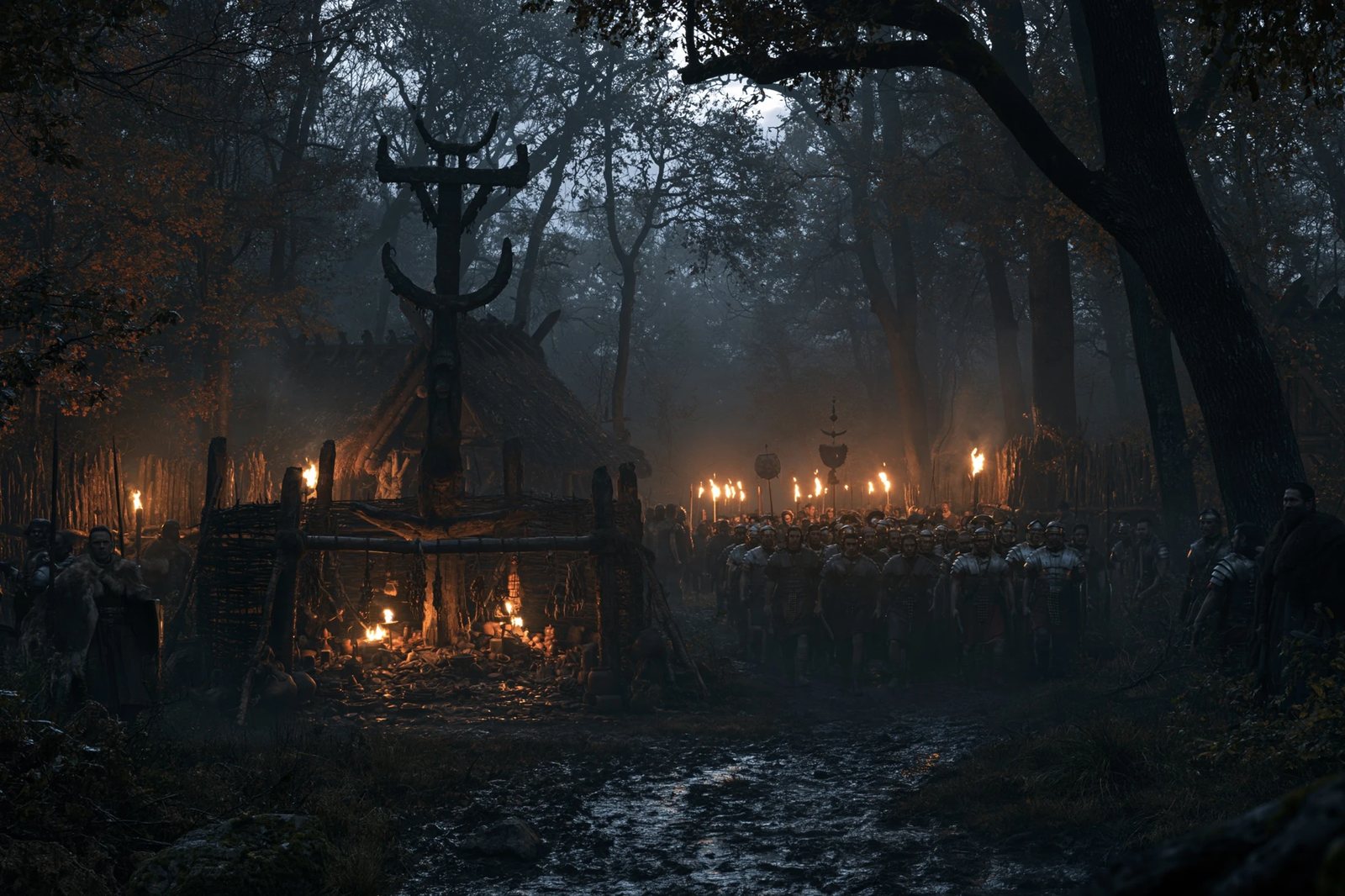
Tanfana was a Germanic goddess whose sanctuary stood in the land of the Marsi, between the rivers Ruhr and Lippe in today's western Germany. She is known from a single sentence: Tacitus (Annals 1.51) reports that in the autumn of AD 14 the Roman general Germanicus fell on the Marsi during a night festival and levelled her far-famed "templum" to the ground. No other ancient text names her. Everything else – harvest goddess, earth mother, lady of time – is interpretation. Here is what the evidence actually supports.
Picture a clear autumn night, the sky thick with stars. Somewhere east of the Rhine, a people are feasting. There is food, drink, games, the noise of a community celebrating something sacred. Nobody is keeping watch – why would they, on a holy night? Meanwhile, through the forest, some twelve thousand legionaries are closing in, with auxiliary cohorts and cavalry at their backs. By morning there is no feast, no village and no sanctuary. Of the goddess who owned that holy place, history keeps exactly one thing: her name. Tanfana.
We at Glanz & Gravur have a soft spot for figures like her. Not because there is so much to say, but because there is so little – and because that little deserves to be told honestly. Search for Tanfana online and you will meet fertility goddesses, moon goddesses, earth mothers and even "rediscovered" inscriptions. Almost none of it survives scrutiny. So we are going to work the other way round: start from the one sentence we actually have and move outwards, step by careful step.
Publius Cornelius Tacitus wrote his Annals in the early second century AD, roughly a hundred years after the events. He was no eyewitness. He drew on earlier writers – probably including the lost German Wars of Pliny the Elder, who had himself served on the Rhine. Keep that in mind: what we are reading is not a Germanic voice, nor even a soldier's memoir, but the polished retrospective of a Roman senator writing for Roman readers.
The key passage sits in chapter 51 of Book 1. Germanicus has split his legions into four columns, and they lay waste to a strip of country fifty miles wide with fire and sword. Then comes the line that preserves Tanfana:
"Neither sex nor age moved them to pity; things profane and sacred alike, and the temple most famous among those tribes, which they called Tanfana's, were razed to the ground."Tacitus, Annals 1.51 (own translation)
The Latin core runs celeberrimum illis gentibus templum quod Tanfanae vocabant solo aequantur. That is all. No cult image, no priests, no sacrifices, no myth, not a word about what the goddess was "for". Even her basic name form is reconstructed, since Tanfanae is a genitive or dative. That is why you will also see the spelling Tamfana in the literature; the entry in the standard German reference work, the Reallexikon der Germanischen Altertumskunde (RGA), carries both forms in its title.
One small word deserves a second look: illis gentibus, "among those tribes" – plural. The sanctuary was evidently not just a local Marsi affair but mattered to several groups. Hold on to that thought, because it explains what happened in the days after the attack.
To understand Tanfana's night, you need to know what had been going on in the Roman camps. Emperor Augustus died on 19 August AD 14. His successor Tiberius was not yet secure, and the legions on the Rhine and the Danube sensed an opening. On the Lower Rhine the troops mutinied, demanding shorter service and better pay, and threatening their officers. Germanicus – nephew and adopted son of Tiberius and commander on the Rhine – barely regained control. In the end the soldiers turned on their own ringleaders and killed them, a messy, bloody conclusion that Tacitus describes at length (Annals 1.31–49).
Tacitus then paints the mood almost like a psychologist: the men were burning to wash away their guilt in the blood of the enemy. Germanicus let them. According to Tacitus he led twelve thousand legionaries, twenty-six cohorts of allies and eight cavalry wings (alae) across the Rhine by a bridge. This was no long-planned war of conquest. It was a swift punitive strike, aimed as much at restoring discipline inside the army as at hurting the enemy.
Tacitus sketches the route in a few words. The army cut its way through the silva Caesia, the Caesian Forest, and along a frontier track (limes) begun by Tiberius – here meaning a cleared road or corridor, not the later fortified frontier. The legate Caecina went ahead with light cohorts to clear obstacles from the forest paths. Where exactly the Caesian Forest lay is unknown; plenty of identifications with modern woodlands have been proposed, none of them solid.
Here is where Tanfana becomes linked with a festival. Scouts reported, says Tacitus, that the Germans were celebrating a festive night "with solemn banquets and games" – festam eam Germanis noctem ac sollemnibus epulis ludicram. In his telling, the Marsi lay about carelessly, "without fear, without sentries posted ahead" (nullo metu, non antepositis vigiliis). The night was bright with stars, and the Romans reached the villages unseen.
A word of caution. Tacitus does not explicitly say the festival was held in Tanfana's honour. The festival appears in chapter 50, the sanctuary in chapter 51. Connecting the two is natural – a great feast, a famous sanctuary, the same district, the same night – but strictly speaking it is an inference. Nearly every modern account makes it, and we think it is a reasonable one. You just ought to know that it is an inference.
The drinking scene also carries a literary flavour. The boozing, careless German was a favourite Roman stereotype, and Tacitus himself pokes fun at long drinking bouts in his Germania. That the Marsi were celebrating, we can believe. How wild the party really was, we cannot know.
Germanicus divided the legions into four wedges so the devastation would cover as much ground as possible. Fifty Roman miles – roughly 70 to 75 kilometres – were put to fire and sword. The line "neither sex nor age moved them to pity" is not lurid storytelling; it states coolly what a Roman punitive expedition meant. Among the ruins lay profana simul et sacra, the everyday and the holy alike, and Tanfana's sanctuary at the end of the list, the climax of the sentence.
Whether the sanctuary was a deliberate target or simply caught up in the general destruction, Tacitus does not say. For the Marsi it must have been a blow to the heart: a place where people gathered, swore oaths, made offerings and feasted, now lay in ashes.
Then came the answer. The slaughter, Tacitus writes, roused the Bructeri, the Tubantes and the Usipetes. They occupied the forest passes the army had to march back through. Germanicus moved in battle order: cavalry and auxiliaries in front, then the First Legion, the Twenty-First on the left flank, the Fifth on the right, the Twentieth guarding the rear. The Germans hit the rearguard and things grew tense until Germanicus rode up to the Twentieth and told them this was their chance to wipe out the disgrace of the mutiny. The Romans broke through, reached open ground and marched off to winter quarters. Whether the Tubantes and their neighbours were among the gentes to whom the sanctuary was "most famous" remains open – but the idea suggests itself.
Now it gets tricky, and worth slowing down. Tacitus calls Tanfana's cult site a templum. Say "temple" and most of us picture columns, a roof and a statue. Yet the same author wrote in his Germania (chapter 9) that the Germans thought it beneath the greatness of the gods to confine them within walls or to give them human features: lucos ac nemora consecrant – "they consecrate groves and woods".
Is Tacitus contradicting himself? Not necessarily. Latin templum originally had nothing to do with buildings at all. It meant a marked-off, consecrated space – first of all the patch of sky or ground that a Roman augur (a priest who read omens from birds) defined for his observation. The word is usually traced to a root meaning "to cut, to mark off", and compared with Greek temenos, a "cut-off" sacred precinct. A templum could just as well be a fenced space, an enclosed grove or an open-air cult site.
Tacitus' own usage is revealing. Writing about Nerthus in the Germania (chapter 40), he describes a sacred grove on an island – and still says that the priest finally returns the goddess "to her temple" (templo reddat). For Baduhenna among the Frisians, on the other hand, he uses lucus, grove, in Annals 4.73. In other words, Tacitus switches terms freely, and for him a templum need not be a building.
Archaeology from the Roman Iron Age in Germanic lands does show cult sites with enclosures, post settings or small structures – see our article on Germanic sacrifices and sanctuaries. A stone temple on the Roman model, however, is very unlikely among the Marsi of AD 14. Think rather of an enclosed festival ground, perhaps with a grove, a timber building or carved wooden posts like those preserved in bogs. Which it was, we cannot say. How Germanic peoples depicted their gods, when they did, is the subject of our piece on Germanic god images.
A goddess's name without a myth attached is both a puzzle and a temptation for linguists. Since the Renaissance, scholars have read almost anything into it. A quick tour shows how easily interpretation slides into wishful thinking.
Older suggestions, now abandoned: the humanist Justus Lipsius (16th century) thought of a Celtic word for "fire". Others heard the German word for "fir tree". In the 19th century someone even reconstructed a "Wotanfana", a sanctuary of Woden with a mangled beginning. Jacob Grimm considered the name certainly Germanic but could not explain it; he compared its ending with other goddess names in -ana. Karl Müllenhoff, for his part, imagined a goddess of harvest plenty.
The derivation most often cited today goes back to an Indo-European root *temp-, "to stretch, to span". Alongside it scholars place Latin tempus ("span of time") and Old Icelandic þamb or þǫmb ("swelling, fullness, tautness", also "belly"). The ending -na is read as a suffix that, in divine names, marks a deity's sphere of power. Key milestones in this debate are an article by Hans Krahe (1934) and the work of Jan de Vries. Two very different readings grow out of it:
Both readings are linguistically possible; neither is proven. There is also a basic problem: we know the name only in a Latin rendering, copied by scribes over centuries. Even whether the third letter was an n or an m is not certain. Building a whole divine personality on such a narrow base would be dishonest. Anyone who tells you that Tanfana "means" moon goddess or forest mother is welcome to show you the source.
Sooner or later, every search for Tanfana turns up an inscription: TAMFANAE SACRVM, "sacred to Tamfana", supposedly found at Terni, ancient Interamna in Umbria. That would be sensational – a Germanic goddess on a stone in Italy, perhaps set up by a Germanic soldier or bodyguard in Roman service.
Sadly, it does not hold up. The inscription is regarded as a forgery and attributed to the antiquarian Pirro Ligorio (16th century). Ligorio was a gifted architect and student of antiquity – and one of the most prolific inscription forgers of his age. The great collection of Latin inscriptions, the Corpus Inscriptionum Latinarum (CIL), lists his inventions separately among the false inscriptions. No original stone is known. We have not been able to check the attribution against the stone itself and report it as the scholarly literature gives it; either way, the "inscription" tells us nothing about the goddess.
A second trail is just as cold: a supposed Old High German lullaby that surfaced in the 19th century and names a "Zanfana". Jacob Grimm initially took it seriously. Today the poem is considered a forgery; the Germanist Cyril Edwards has examined its curious history in detail. Charming, perhaps – but not a source.
Who were the people feasting that night? The Marsi turn up in the sources mainly because of the wars of the early first century AD. We cover them in more depth in our article on the Marsi; here are the essentials.
In the Germania (chapter 2), Tacitus lists them among the ancient tribal names that some Germans traced back to the sons of the god Mannus – alongside the Gambrivii, the Suebi and the Vandilii. The Greek geographer Strabo (Book 7) says the Marsi withdrew from the Rhine into the interior of Germania. Their territory is usually placed between the Ruhr and the Lippe, perhaps reaching the upper Lippe. Precise borders cannot be drawn.
The raid of AD 14 did not finish them. The very next year, Tacitus reports (Annals 1.56), the Marsi dared to attack Caecina and were beaten back. In AD 16 their leader Mallovendus surrendered to Rome and revealed that the eagle of one of Varus' legions lay buried in a nearby grove, lightly guarded (Annals 2.25). Germanicus had it recovered. So the Marsi had been keeping one of the trophies from the Varian disaster of AD 9 – more on that with the Cherusci and Arminius – and once again at a sacred place, a lucus.
That detail matters for Tanfana too. It shows that the Marsi used cult sites not only for feasting but also for depositing tokens of victory. A "most famous" sanctuary was therefore a political place as well, bound up with a group's memory and pride. Whether the Bructeri, Tubantes, Usipetes and Marsi formed an actual cult league, like the one recorded for the Nerthus league, is a widespread assumption that cannot be proven.
For centuries, local historians, scholars and enthusiasts have hunted for Tanfana's site. Nobody has found it. The sources simply say too little. At best they point to a broad zone, usually between the Ruhr and the upper Lippe.
Some proposals you will come across, and how we rate them:
To be blunt: every one of these locations is speculation. No find can be tied unambiguously to Tanfana's sanctuary – no inscription, no cult site with a burnt layer dated to AD 14. Treat any hiking map marked "Tanfana sanctuary" with a healthy pinch of salt. We see the same pattern with other supposed cult sites, such as the Externsteine.
Now to the date. Augustus died on 19 August AD 14. News had to reach the Rhine, the mutiny had to flare up, be negotiated and bloodily ended. Only then did Germanicus set out, and after the campaign the army went into winter quarters. The Marsi's festival must therefore have fallen in autumn – roughly between September and early November. It cannot be pinned down more closely, and Tacitus gives no date.
An autumn festival with banquets, games and a whole night of celebration fits what we know from many farming societies. After harvest there are stores to share; livestock that cannot be fed through winter is slaughtered; the community feasts. That is where the popular reading of Tanfana as a harvest goddess or goddess of plenty comes from – and it dovetails neatly with the þamb etymology.
Rudolf Simek points to a different parallel in his dictionary of Germanic mythology. An autumn feast, he notes, recalls the Old Norse dísablót, a sacrifice to the dísir, female guardian spirits, and the Scandinavian Winter Nights (vetrnætr) in mid-October. He suggests placing Tanfana within the worship of female deities that becomes visible in the Rhineland through the Matronae. It is a thoughtful classification – but a classification, not evidence. Almost a thousand years and several hundred kilometres lie between the Marsi and the Norse Winter Nights. We have shown in our overview of Germanic festivals how carefully such bridges should be built.
You could shrug and say: one name, one sentence, done. But Tanfana shows something true of Germanic religion as a whole. We know the gods of the continental Germans almost entirely through outsiders – Roman reports, altars set up by Germans in Roman service, late Christian notes. The great god stories of the Edda come from 13th-century Iceland. In between lie gaps, and names like Tanfana, Baduhenna and Nerthus rise out of them like islands.
Tanfana also stands for a pattern that runs through the centuries: whoever wanted to break a people struck at its holy places. Germanicus laid waste to the Marsi's sanctuary, Charlemagne felled the Irminsul of the Saxons, missionaries cut down sacred oaks – more in our article on sacred trees and groves. Cult sites were never just pious spots. They were meeting places, courts, treasuries for trophies and anchors for alliances.
And Tanfana is a fine exercise in critical reading. Telling her story means sorting carefully: what does Tacitus say? What is philological guesswork? What is 19th-century local romanticism? What is plain forgery? When we engrave a goddess like Tanfana on slate, we do it without invented attributes, using only what we can stand behind: her name, and the memory of a place wiped out on an autumn night.

Who was Tanfana? Tanfana (also spelled Tamfana) was a Germanic goddess whose sanctuary lay in the territory of the Marsi between the Ruhr and the Lippe. She is known from one passage only: Tacitus, Annals 1.51.
What did Germanicus do to the temple of Tanfana? In autumn AD 14 the Roman general attacked the Marsi during a night festival. His troops ravaged a strip of fifty Roman miles and razed Tanfana's famous sanctuary to the ground.
Was Tanfana a fertility or harvest goddess? That is often claimed but not attested. The idea rests on the autumn date of the festival and a possible link between the name and Old Norse þamb, "fullness"; other scholars think of "time" instead.
Is there an inscription to Tanfana? Not a genuine one. The often-quoted "Tamfanae sacrum" inscription from Terni is considered a Renaissance forgery attributed to Pirro Ligorio.
Where was Tanfana's sanctuary located? Nobody knows. The area between the Ruhr and the upper Lippe is the usual guess; specific places such as Marsberg, Welver-Fahnen or the Tankenberg in Twente are speculation without archaeological proof.
Was the sanctuary a temple building? Probably not in the Roman sense. Latin templum basically means "marked-off sacred precinct"; it could just as well have been an enclosure or a grove.
For courage. For remembrance. For legends that live on.
The Marsi · Nerthus – the earth goddess · Germanic Religion · Baduhenna · The Matronae.
All Gods & Goddesses articles →
No god was so beloved by ordinary people as Thor. With hammer, strength-belt and thunder-chariot he holds the powers of …
Read more →Tyr is the god who knew what order costs – and was willing to pay it with his own hand. Once perhaps the highest …
Read more →He is one of the best-known “unknown” gods: everyone who studies the mythology knows his name – and yet Ullr scarcely …
Read more →