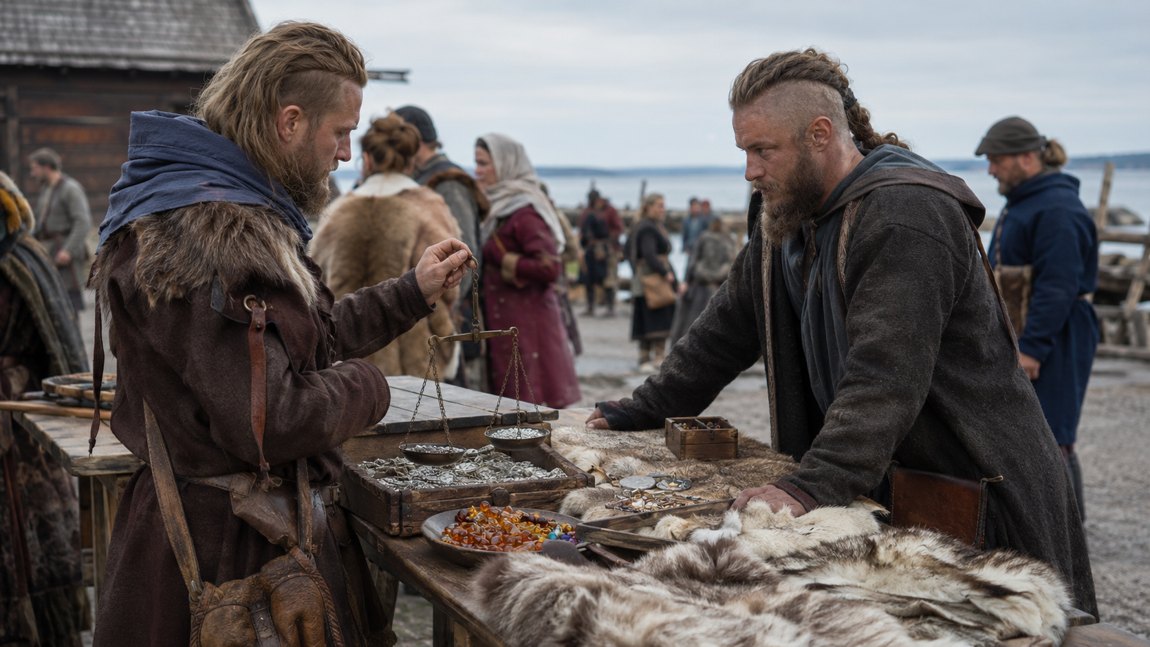
In the Edda, three gods have to fill an otter skin with gold to buy back their lives, and the man who receives it complains afterwards that these were not gifts from the heart. That small scene holds three ways of paying that the North kept apart: the price, the compensation and the gift. This article follows them through daily life, from marten skins and cows to Icelandic woollen cloth and weights built on an Arabic standard. It also shows where the familiar picture goes wrong: Iceland's famous cloth currency belongs largely to the period after the Vikings.
Regin tells the story to the young Sigurd. Odin, Hœnir and Loki come to the waterfall of the dwarf Andvari, where an otter is sitting. Loki kills it with a stone. That evening the gods lodge with Hreidmar and show off their catch. But the animal was Hreidmar's son Otr, Regin's brother, who fished in the shape of an otter. The family seizes the guests and names the price.
"Then we took them captive and laid on them, as the ransom of their lives, to fill the otter skin with gold and to cover it outside with red gold."Reginsmál, prose before stanza 1 (Codex Regius, c. 1270); Old Norse: "Þá tókum vér þá höndum ok lögðum þeim fjörlausn at fylla otrbelginn með gulli ok hylja útan með rauðu gulli." My own translation
Loki catches Andvari with the net of the sea goddess Rán and squeezes the hoard out of him. Andvari curses the gold when Loki takes his last ring as well. Back at Hreidmar's house the gods heap up the treasure. The old man steps forward, checks the work and finds a single whisker still showing. Odin brings out the ring Andvaranaut and covers it. The account balances, the curse starts running, and soon afterwards Fáfnir kills his own father for the treasure. The curse belongs to our article on Andvari; here we look at the bookkeeping.
The age of the text matters. Reginsmál sits on leaves 28v to 30r of the Codex Regius, and the name Reginsmál is not in the manuscript. At most a faded heading can be made out there, perhaps "About Sigurd"; later editors supplied the present name. The translator Henry Adams Bellows regarded it as a loose compilation of stanzas joined by prose. So this is a thirteenth-century Icelandic record of older material. How people actually paid has to come from other sources.
Popular retellings like to speak of the otter's "wergild". Wergild means the payment to a dead man's kin that ends a feud. That fits the situation, since Hreidmar has lost a son. But the prose names the demand on the gods differently: fjörlausn, literally "release of life", a ransom for three prisoners. The idea of compensation for a killing is still there. A little later Fáfnir and Regin demand niðgjöld from their father for their brother Otr, a kin-compensation. So the text knows both views, and "wergild" fits only part of the scene.
In the following stanzas the vocabulary shifts. Loki says: Gull er þér nú reitt, en þú gjöld hefir, the gold is now paid out to you, and you have your gjöld. That word covers payment, fee and requital. Hreidmar answers in stanza 7 (the attribution in Bellows's edition): Gjafar þú gaft, gaftattu ástgjafar, "gifts you gave, you gave no gifts of love".
Within a short space, then, we meet terms for three things that were different in daily life. A ransom is extorted. Compensation closes a dispute. A gift ties a relationship. Hreidmar knows that the gods have paid, and he still complains that nothing is right between them. The worth of a heap of gold did not depend on its weight alone, but also on the relationship in which it changed hands.
Snorri Sturluson takes up the story in his handbook of poetics, Skáldskaparmál, around 1220, to explain why poets may call gold "otter's payment" (otrgjöld).
The skin in the legend has a real counterpart in a source from the Viking Age itself. Around 890 the north Norwegian Ohthere tells the court of Alfred the Great how he makes his living. The Old English account lists what the Sami deliver to him as tribute, each according to rank. The highest-born gives fifteen marten skins, five from the reindeer, one bearskin, ten measures of feathers, a coat of bear or otter skin and two ship's ropes of sixty ells each, one of whale hide and one of seal hide. Our article on Ohthere of Hålogaland has more on him.
This is not barter in the schoolbook sense. It is a levy that flows from a relationship of power and is graded by rank. Goods like these later became silver at the markets. How those flows ran is covered in the article on Viking trade.
Direct exchange certainly happened, above all between neighbours and where no silver was to hand, but it leaves almost no trace. A calf swapped for a cloak does not turn up in the ground. Its share of daily life cannot be quantified. The word "barter" also hides the fact that goods in the North were very often valued against a unit of account: a deal could be settled in kind and still be reckoned in cow values or ounces.
The clearest case is the kúgildi, literally "cow value". The reference work A Lexicon of Medieval Nordic Law describes it as an early standard of legal currency in Iceland, and cattle probably served as a measure of value across Scandinavia for a long time.
For the unit to be any use, the cow itself had to be standardised. A legally valid cow is medium-sized, three to ten winters old, horned, without blemish and in milk. A compilation of the Icelandic Althing's price list of around 1200 equates three yearling cattle, two two-year-olds, a four-year-old ox or a four-year-old horse each with one cow, and likewise a two-year-old sow with nine piglets. Figures for sheep vary: the Lexicon gives twelve yearlings but notes fluctuations, and other compilations count far fewer grown animals.
Above all, the rates did not apply everywhere. Money equivalents were set at the spring assemblies, the várþing, and could differ between regions. For the period from about 1100 to 1300 the Lexicon, following Gelsinger, gives the cow value as at least 2 to 2.5 ounces of pure silver. A cow, however, is awkward to bring along to the assembly. So Icelanders paid more and more often with something that meant the same sum: a piece of cloth.
Vaðmál, in English wadmal, joins the Old Norse words for cloth and measure and means roughly "cloth measured to a standard". It was a woollen twill (a 2/2 twill, with a diagonal pattern), woven on farms across the country. The archaeologist Michèle Hayeur Smith carried out the first major study of the material, with thousands of fragments from Icelandic museum collections. According to her, Iceland was apparently alone among the North Atlantic settlements in making cloth into a highly standardised currency.
The dating is where common knowledge most often goes wrong. Hayeur Smith places the emergence of the cloth currency roughly at the end of the Viking Age, when silver had grown scarce. The earliest wadmal she dated directly comes from the Alþingisreitur site in Reykjavík, calibrated to 1020 to 1160, with the highest probability at 1082 to 1125. It becomes tangible in law through Grágás, the law of the Icelandic Commonwealth, written down from 1117/18 and surviving in thirteenth-century manuscripts. To say the Vikings paid with cloth moves a high medieval arrangement back in time. For an Icelander around 950, silver is likely to have been the more important means of payment.
Grágás requires cloth two ells wide, and Hayeur Smith gives six ells as the length of the legal piece. The usual figure for the Icelandic ell is 49.2 centimetres, so a web was nearly a metre wide. But the ell changed over time and was apparently aligned with English measures for a period. Any conversion into centimetres holds only for a particular era.
The large unit was the hundrað. That is the long hundred, 120 ells, and from 1186 at the latest it corresponded to the cow value. Smaller sums were reckoned in cloth ounces. An Althing price list from about 1200 sets six ells to one such ounce, according to the compilation mentioned above, and for fines and penalties Grágás applied a rate of 48 ells to the ounce of silver. Every sum in the sources raises the question of which ell and which ounce are meant.
Cloth money has a problem silver does not: every household can make it, and can make it badly. So it was policed. Grágás allowed no more than one ell of deviation at the selvage over twenty ells. Payment could be inspected, and penalties awaited poor cloth or false measures. Hayeur Smith draws on an episode from Ljósvetninga saga: a trader finds holes in the cloaks of a farmer called Thorir, and Thorir is outlawed. The saga is late, but it shows how seriously bad goods were taken.
Later legal sources distinguish grades. Helgi Þorláksson cites, for rules from around 1300 and again in the seventeenth century, the gjaldavoð or payment cloth with nine to ten warp threads per centimetre, and finer qualities with up to fourteen. The finds confirm the basic pattern. After about 1100 one standard dominates: 2/2 twill with five to twelve warp threads per centimetre and a fixed combination of spinning directions. In the Viking Age the values scatter far more widely, from six to twenty-five warp threads.
This money was spun and woven mainly by women. Hayeur Smith suspects that women had more influence over production than the law codes reveal, since these are silent on the matter. That is a thesis, not a recorded fact. The wadmal did not fade quickly: it stayed important to Iceland's economy until around the middle of the sixteenth century, and valuations in cloth still appear in the seventeenth.
For the Viking Age proper there is no way around silver. How dirhams came north from the Caliphate, and how people cut and tested with nicks, is explained in the article on hack-silver. We add one observation that appears there only in passing: anyone weighing in the North was weighing by a foreign measure. The small cubo-octahedral bronze weights, cubes with bevelled corners, and the oblate spheroid weights with flattened poles go back to models from the Islamic world. Scholars link the cubo-octahedra to the mithqal standard of about 4.23 to 4.25 grams. The folding balance follows the same model. The cubo-octahedra are attested by the 860s and 870s at the latest, at Birka and also around the Danish armies in England, the oblate spheroids from the 870s and 880s.
Practice is far less certain than tidy tables suggest. We know the Nordic units from later law: one mörk equals eight aurar (ounces) equals twenty-four ørtugar. But the gram figures for the mark, about 207 to 217 grams, come from charters of the thirteenth and fourteenth centuries. For the Viking Age itself there are only calculations from finds, and some of these contradict one another. Corrosion alters the pieces, and samples are small.
Nor was the foreign standard in use everywhere. Monika Maleszka reads a single 7.1-gram weight from Cleat on Westray (Orkney) as matching the Islamic system, and she is puzzled at how rare scales and weights are in northern Scotland, even though ring-money and hack-silver are plentiful there.
Another finding points to a gap between use and display, though it needs careful reading. According to a figure from the Kaupang project (Unn Pedersen, 2008), about 82 per cent of the weights from the Kaupang settlement are made of lead, and about 68 per cent at Birka, while copper alloy predominates in graves. I have not seen these figures in the original. In any case the contrast is not absolute: Aina Margrethe Heen-Pettersen counts 14 inset lead weights from eight burials in Norway, and the richly furnished grave at Kiloran Bay on Colonsay also held decorated lead weights. Plain lead evidently made a good working tool, while the more presentable pieces tended to go into the grave. So scales in a grave are also a statement about the dead.
The section of Grágás on sharing out killing payments among relatives is called Baugatal, the "ring list". Rings or pieces of rings really did serve as payment in the North, above all for killings, according to the Lexicon of Medieval Nordic Law. In Iceland, however, the baugar were calculated in ounces of silver. How reliable Baugatal is remains disputed; Christoph Kilger and Peter Foote consider it credible in its basic features. Whether real rings still changed hands when it was written down I cannot establish. That Odin completes the payment with a ring fits this, but it proves no legal custom.
For the ring as a display of wealth there is an outside witness. Ibn Fadlan reports in 922 that among the Rus on the Volga each woman wore a neck ring for every 10,000 dirhams her husband owned. This is a stranger's observation and need not be exact, but it shows how someone from a coin economy read these rings: as a wearable balance sheet. More under Ibn Fadlan.
The so-called ring-money, plain arm rings from Scotland and Ireland, raises the same double role. The debate over a target weight of about 24 grams is summarised in the hack-silver article, without a final verdict. For our question it is enough that such a ring could be worn, given, cut up or, as the article on oath rings shows, sworn on.
This is where Hreidmar's complaint makes sense. Hávamál, the collection of sayings in the Poetic Edda, puts it practically: friends should gladden each other with weapons and clothes (stanza 41), and a man should be a friend to his friend and gjalda gjöf við gjöf, repay gift with gift (stanza 42). Stanza 145 applies the same idea to sacrifice to the gods: better not to pray than to offer too much, for ey sér til gildis gjöf, a gift always looks to its return. Gjalda is also the word for compensation and payments. More on the sayings in the article on Hávamál.
A gift, then, was not a kindness without consequences. Santiago Barreiro has shown this through two scenes in Egils saga. In chapter 38 Thorolf gives his father Skallagrim an axe from King Erik Bloodaxe. Skallagrim ruins it while slaughtering cattle and sends it back with a mocking stanza. In chapter 78 the poet Einar leaves a splendid shield for his friend Egil while Egil is away from home. Egil flies into a rage and wants to pursue him, because Einar has taken away the chance to respond at once. In the end he composes a praise poem. Whoever cannot return a gift stands beneath the giver. Both are literary scenes of the thirteenth century, not reports.
The ruler's role follows the same logic. In poetry the lord is called a ring-breaker because he shares out silver and gold among his followers and binds them that way. Myth even knows a ring that multiplies itself, Draupnir. The archaeologist Lotte Hedeager has turned this into a pointed thesis: the Viking Age marks the transition from a gift economy to a monetised one, and raids served above all to obtain silver for this cycle of power and prestige. Her paper's claim that Vikings were not merchants, however, is a position and not a consensus. The finds at trading sites suggest both ran side by side.
The question of prices sounds simple and can hardly be answered for the Viking Age. The detailed price lists are Icelandic and date from around 1200. The best-known single example comes from Laxdæla saga, chapter 12: Höskuld buys a young woman, later revealed to be Irish, from a richly dressed trader, Gilli the Russian, for three marks of silver. Gilli offers the other eleven slave women at one mark each. He then weighs the silver from Höskuld's purse, and it comes to three marks. The scene was written in the thirteenth century. It is no market record, but it takes silver by the mark for granted, and shows people sold in that unit. How large this part of the money economy was is discussed in the article on slavery.
Closer to the time, Ibn Fadlan again describes a Rus trader asking at a carved post for a buyer with plenty of silver who will purchase without haggling.
Anyone looking for a conversion into euros or dollars will be disappointed. There is no reliable formula. Even the comparison between cow and silver holds only for the high Middle Ages and only for Iceland.
Coins did not simply replace scales and gifts. Coins are in fact present very early in the North: Ribe has eighth-century sceattas in the ground, and Hedeby struck coins in the ninth century. Yet weighed silver won out afterwards. The sequence "first barter, then hack-silver, then coin" does not hold.
Jane Kershaw shows this vividly for the Scandinavian-settled east of England, the Danelaw. Metal-detector finds there include more than 180 single finds of silver and weights, among them 44 ingots with signs of monetary use, 65 new dirhams, of which just under half of those examined are cut, and 34 oblate spheroid and 26 cubo-octahedral weights. According to Kershaw, two systems ran in parallel from about 865 to at least 930/940: locally struck coins that were counted, and silver that was weighed. The cut dirhams average 0.57 grams, a Danelaw coin about 1.35 grams. These are small amounts, so everyday business too.
Why keep weighing when coins existed? Kershaw discusses five reasons: large sums, long-distance trade, easy testing with stable value, avoiding the charges of recoinage, and finally Scandinavian identity.
In Scandinavia itself, kings strengthened their own coinage around and after the year 1000. Hedeager stresses that they could require fines and taxes in that coin. Whoever could decide what settled a debt held power. In Iceland that power lay not with a king and his coin, but with the law and its measuring rod. The hoards behind all this are covered under silver hoards.
Did the Vikings have money? Yes, if money means an accepted medium of exchange and measure of value. For long stretches it was silver by weight, alongside foreign and home-struck coins.
What was wadmal? Standardised woollen cloth that became a currency in Iceland from about the end of the Viking Age. It was counted in ells, with 120 ells making a hundrað, roughly the value of a cow. It served into the sixteenth century to pay debts, dues and the tithe.
Why does the Edda fill an otter skin with gold, of all things? Because the otter was Hreidmar's son Otr in animal form. The skin is the visible shell of the dead son, and the demand turns his loss into gold. The scene is legend, but furs really were tribute in the North: Ohthere even names a coat of bear or otter skin.
Were gifts free among the Vikings? No. Hávamál and the sagas assume that a gift must be returned. Failing that left you in the giver's debt, and rulers used this to bind followers.
Hack-silver: paying with the scales
Viking trade
Ribe and the first coins of the North
Andvari and the cursed gold
Law and Thing: compensation instead of revenge
Ohthere of Hålogaland
Silver hoards of the Viking Age
Oath rings

Hacksilver – silver as currency · Viking Trade · Ribe & the North's first coins · Andvari's cursed gold · Viking Law & Thing.
All Everyday Life & Craft articles →
Few objects sum up the popular image of a Norse feast like the drinking horn. Its history, though, starts long before …
Read more →An Ulfberht sword is a Viking Age and Carolingian sword whose blade carries the Frankish personal name +VLFBERH+T (or a …
Read more →No longship would ever have sailed, no warrior survived the winter, without perhaps the most important and most …
Read more →Only a handful of Viking-age ship vanes survive: crescent-shaped plates of gilded copper alloy, covered in …
Read more →