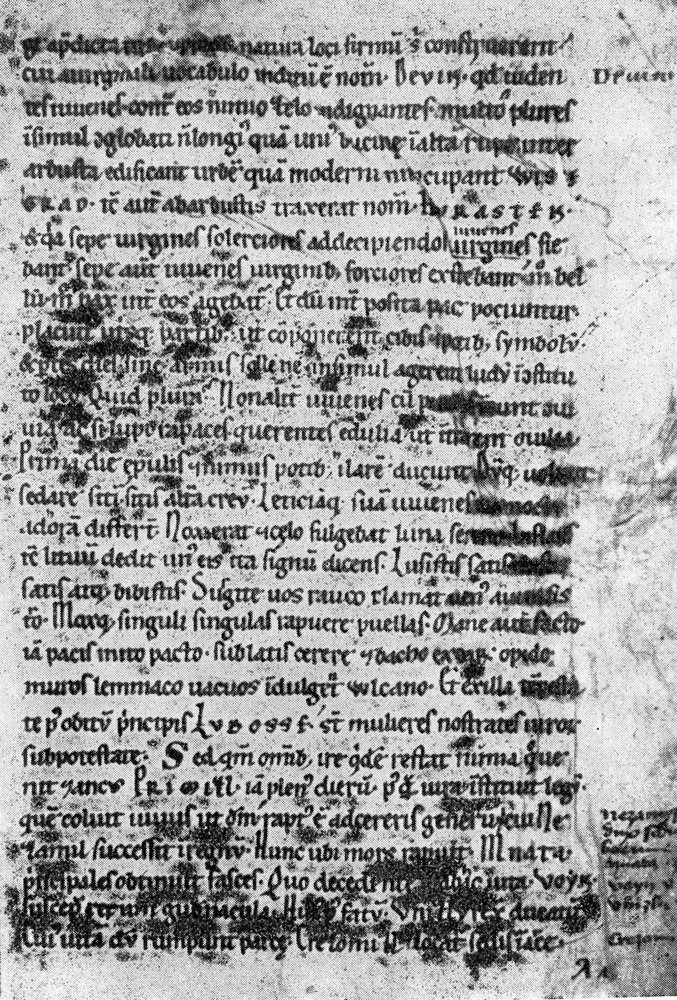
The Lučans (Czech Lučané, also Lutschanen or Lucanians in older German and English) are a tribe that may never have existed in this form. What is certain: around 1119 the Prague chronicler Cosmas tells of a “Lucko” in the land on the Ohře (Eger) centred on Žatec (Saaz), and of a war in which the Přemyslids subdue it. No contemporary source survives from the time of its supposed independence. This article sets Cosmas, Widukind, the hillfort finds and the Bavarian Geographer side by side and says at every step whether we stand on attestation, interpretation or conjecture.
Type “Lučans” into a search engine and a finished story appears: a West Slavic tribe in northwestern Bohemia, a prince Vlastislav, a war against the Přemyslids, a defeat on the field at Tursko. This is the story told by the Prague chronicler Cosmas (c. 1045 to 1125) in the first book of his Chronica Boemorum, completed in 1119. It is well told and was long believed. But it is not the same thing as history, and that gap is what concerns us here.
A few terms first. The Chronica Boemorum (“Chronicle of the Bohemians”) is the oldest substantial work of history from the Bohemian lands. Cosmas writes from the point of view of the Prague ruling house, the Přemyslids, and he writes centuries after the events his first book describes. A foundation legend is a story that explains how an order came into being, here: how the land came together under one dynasty. It may contain a core of real memory, but it need not. A Burgwall (Czech hradiště) is the archaeological remnant of a Slavic fortification, usually a rampart of timber, earth and stones. And dendrochronology is the dating of timber by its tree rings, which can often fix a felling year to within a few years.
Research has become cautious. According to the Wikipedia account, which relies among others on Dušan Třeštík, the existence of an independent tribe of Lučans rivalling the Přemyslids is now doubted, while the Lučans are still counted among the early Bohemian principalities. That is not a contradiction but a reminder that “tribe” and “principality” are two different things. Our article on the Czechs shows on a larger canvas how thin the picture of the Bohemian tribes is in the 9th and 10th centuries. The Lučans are the case where this is most visible.
By the accounts we could consult, Cosmas calls the people natio Luczano, roughly “the Luczan nation”, and the land Lucko or Luka (Latin Luca). There is an addition that says a great deal: in Cosmas’s own day, the early 12th century, the inhabitants were called “Žatčané” after the stronghold of Žatec. So Lučané is already, in Cosmas, a name from the past standing next to a current one. The English “Lucanians” turns up in older literature but is easily confused with the Italic Lucanians of southern Italy; English Wikipedia points out explicitly that the two are unrelated. Equally unrelated is the Croatian village of Lučane.
What the name means is not securely known. It is tempting to think of the Slavic word luka, which lives on in Czech as louka, “meadow”; the land would then be something like “meadowland”, and the Lučans “those from the meadowland”. This derivation is a guess based on resemblance. We found no source that explains the name this way, and so we give it expressly as an interpretation. Whether Lučané was ever a self-name or an outsider’s or landscape label used by Cosmas or his informants cannot be decided. That is no small matter: research now largely regards names of this kind as landscape designations rather than tribal names in the strict sense, as we noted in our article on the Czechs.
The location is easier to grasp than the tribe. According to the Czech and English Wikipedia, Lucko lay on the Ohře (German Eger), a tributary of the Elbe that rises in the Fichtelgebirge and joins the Elbe near Terezín. Its centre was Žatec, in German Saaz, the town now known above all for its hops. To the east, near present-day Lovosice, the area bordered the land of Litoměřice (Leitmeritz). The boundary with the Czechs proper ran, says Wikipedia, roughly along the Ohře to Žatec and then south towards the Mže. How far Lucko reached westwards is unclear; Wikipedia considers that the Sokolov area belonged to it but itself marks this claim as needing a source.
Cosmas, according to these accounts, divides the land into five districts: the one around the stream Guntna, the one around the river Uzka, the one around the brook Brocnica, a forest region (Silvana) and Lucko proper. Whether this division rests on local knowledge or on a source we do not know, and the watercourses are, as far as we can see, not all securely identified. As strongholds Wikipedia names, besides Žatec, the hillfort at Vlastislav near Třebenice and the vanished hillfort Drahúš in today’s Postoloprty, of which only a district name survives. These are places where something was later found or to which a tradition clings. That they belonged to one tribal union is an attribution from the literature.
The war that gave the Lučans their fame is known in Czech as the Lucká válka, the “Lucan War”. In Cosmas’s sequence of princes who rule before Bořivoj, the first Přemyslid we can grasp historically, it falls under Neklan, successor of Křesomysl. Neklan is portrayed as peaceable and cautious. Against him stands Vlastislav, the prince of Lucko seated in Žatec. According to English Wikipedia, Vlastislav breaks a peace, raids Czech villages and thereby triggers open war. A battle is fought at Tursko, the Czechs win, and Lucko falls, as Cosmas puts it, under Neklan’s rule.
The versions that grew from this carry more flesh. In English Wikipedia’s retelling it is not Neklan himself who fights but a commander wearing Neklan’s garments and riding his horse; he kills Vlastislav and falls himself. In the Chronicle of Dalimil (14th century) he is called Styr, in other accounts Tyr, and Čestmír in a disputed manuscript from Dvůr Králové (19th century) and in Alois Jirásek, whose Staré pověsti české (1894) fixed the story for modern Czech culture. Added are Vlastislav’s son Zbyslav, whom a guardian named Durynk drowns under the ice, and a burial mound on the mountain Krliš. Which of these features are already in Cosmas and which accrued later we could not check sentence by sentence without the Latin text. We therefore treat only the core (Neklan, Vlastislav, the battle at Tursko, the subjection of Lucko) as Cosmas’s material and everything further as later accretion that remains to be checked.
One feature deserves notice: the commander who fights in the prince’s garb leads English Wikipedia to see a parallel with Patroclus, who falls in Achilles’ armour in the Iliad. That is a narrative pattern, not evidence for or against a core. The Czech scholar Vladimír Karbusický even suggested in 1995 that Cosmas drew on an older, lost Old Czech heroic song whose structure recalls Frankish heroic epic such as the song of the death of Ermanaric. That is a hypothesis drawn from narrative construction, with no textual witness.
The same breath often brings in Libuše and Vlasta, the so-called “Maidens’ War”, and here too the two must be kept apart. Libuše, the seeress and princess who in the story foretells Prague and takes Přemysl the Ploughman as husband, stands at the start of the princely line. The Maidens’ War, which the warrior Vlasta wages against the men after Libuše’s death, belongs to the same early layer of narrative. According to English Wikipedia it is set legendarily in the 8th century, with Děvín as the scene and Vyšehrad opposite, and ends with Vlasta’s death and the burning of the fortress. It first appears in Cosmas and is retold in Dalimil. It has nothing to do with the Lučans: the Wikipedia page on the Maidens’ War does not mention them, and the Lučan War stands much later in the princely sequence, under Neklan. That the two stories blur in memory is due to the common source and to Jirásek’s collection. We assign both to legend, not history (more in the myth check below). For how to handle such stories, see our article on legend studies.
That a later event may lie behind the Lučan War has long been considered. Czech Wikipedia cites a passage in Widukind of Corvey (Res gestae Saxonicae, second half of the 10th century), the Saxon historian. In his second book Widukind tells of Otto I’s war against Boleslav of Bohemia. There is a sentence about a stronghold that Boleslav takes:
Pergensque inde ad urbem subreguli primo eam inpetu cepit et usque in hodiernum diem solitudinem fecit. (“And moving on from there, he took the stronghold of the sub-king at the first assault and made it a wasteland, which it remains to this day.”)Widukind of Corvey, Res gestae Saxonicae II 3; Latin sentence as given at jassa.org, the English translation is our own and literal. Who “he” is does not follow from the sentence itself; according to the English translation at that point it is Boleslav. Widukind does not name the prince.
That is all there is. Neither the name of the sub-king (subregulus, “petty king”, Widukind’s word for a prince of lower rank) nor the place nor a people is given. That this prince was a Lučan and the destroyed stronghold Vlastislav or Žatec is a hypothesis of scholarship, not a statement by Widukind. A dating problem is added: Czech and English Wikipedia speak of 936, while the English translation at JASSA places the episode in brackets at 950 by Otto’s regnal year. Which figure is right for the passage we could not decide, and we record it under “To verify”.
Wikipedia also links the story to Boleslav I’s consolidation of power after the murder of his brother Wenceslaus; the year of Wenceslaus’s death is itself disputed (929 or 935). In favour of this reading, the same page says, are finds at the hillfort of Vlastislav whose dating fits. That is thin: the Archaeological Atlas of the Czech Republic lists no finds at the Vlastislav hillfort (Litoměřice district) before the second half of the 9th century, and the fortification with a timber-and-earth rampart and a stone facing belongs after that, to the 10th century. That fits a stronghold of the 10th century, not an event that Cosmas places long before Bořivoj, that is before the late 9th century. Whoever reads the story as displaced memory of Boleslav’s time comes closer to the archaeological record than someone who takes it literally. It remains one reading.
English Wikipedia also says recent research thinks of a smaller historical clash behind the legend, possibly at Budeč, where archaeologists found a mass grave. Caution is needed. According to the report by Ivo Štefan and colleagues (Antiquity 2016), the mass grave at Budeč held between 33 and 60 people, mostly men struck down with swords, dated roughly to c. 900 to 950. The excavators tentatively connect it with the violence after Wenceslaus’s death, not with Lučans. We found no source tying Budeč to the Lučan War and therefore give this only as a loose side note.
Anyone searching for Lučans in the sources of the 9th century searches in vain. The Bavarian Geographer (Descriptio civitatum et regionum ad septentrionalem plagam Danubii) is a short register of peoples north of the Danube with the number of their civitates, their stronghold districts or fortified places. Its date is disputed: Bernhard Bischoff thought of a Reichenau monk of the 830s to 850s, Aleksandr Nazarenko considers the 870s more probable, and Henryk Łowmiański showed that the list may consist of two parts from different periods. We know it in the form English Wikipedia gives.
For Bohemia it has the Beheimare (“Bohemians”) with 15 stronghold districts, the Talaminzi (the Daleminzi) with 13 and the Surbi (Sorbs) with 50. An entry “Lucani” or “Luczani” is missing. Closest in form are Lucolane, without a number, which English Wikipedia classes as uncertain, and Lunsizi with 30 stronghold districts, linked there to the Lusatians (more at the Lusizi). Further there are Besunzane with 2 and Fraganeo with 40, interpreted as Pšovans and Prague respectively. Whether Lucolane really means the Lučans we found attested in no account. We could not retrieve the interpretation on the Czech side, so the question stays open. Whoever reads “the Bavarian Geographer knows the Lučans” sees a claim we cannot support. A comparison with the Smeldingi is worthwhile: there the same list at least provides a secure name.
The Frankish annals help little. They report for 805 a campaign by Charles the Younger into Bohemia in which he ravages the land and kills a leader named Lecho. The Chronicle of Moissac names, according to English Wikipedia, a river “Agara” for the same campaign, equated with the Ohře, and a stronghold Canburg whose location is unknown. Proposed have been Kadaň on the Ohře (from the similarity of the name), the hillfort of Divoká Šárka near Prague, the Hrádek at Libochovany on the Elbe, and the castle Kanina near Kokořín. None of these proposals is proven. These sources do not name a people of Lučans. Nor do the Annals of Fulda, which report in 845 the baptism of fourteen Bohemian dukes at Regensburg, give tribal names. The Franks saw “the Bohemians”. The internal division comes first with Cosmas.
Archaeology cannot supply names, but it can date strongholds. At Žatec, excavations since the 1990s showed, according to the summary of a talk by Petr Čech (2004, published on saaz.info, with evident flaws in the transcript), two building phases of the early medieval fortification dated by dendrochronology to about 925 to 935 and 925 to 937. That calls into question the older idea that the Přemyslids expanded north-westwards from a central Bohemian domain and subdued an existing “Lučan” territory. In this newer view the strongholds on the Ohře look rather like a frontier line against Saxony. From early medieval Žatec come Frankish belt fittings of around 850, remains of Great Moravian earrings, a goldsmith’s hoard of 1937 weighing about 2.75 kilograms of precious metal and signs of local coin production. A princely court of the first half of the 11th century was excavated in 1999 and 2000, and a church of the late 10th century counts among the oldest outside Prague. The stronghold itself was, according to the same talk, only about five hectares, and he estimates the number of inhabitants at a few hundred. We give this as a single voice; it has not been cross-checked in the specialist literature.
The hillfort of Vlastislav near Třebenice, which tradition makes Vlastislav’s seat, is according to the Archaeological Atlas a site of the 9th to 10th centuries, with finds only from the second half of the 9th century and a rampart with a stone wall from the 10th century. Here we have a reliable statement that contradicts the legend if taken literally: the name of the hillfort may come from the story or underlie it, but the finds do not reach back into the remote past in which Cosmas sets the war. Whether the name already clung to the site before Cosmas or was given to it later is not known.
The Hrádek at Libochovany lies high above the Elbe at the Bohemian Gate (Porta Bohemica), the river’s breakthrough through the Bohemian Central Uplands. The Archaeological Atlas describes two ramparts with ditches, an acropolis on the Tříkřížový vrch and use from the Bronze Age into the early Middle Ages; in the river below, Bronze Age swords were found, probably deposited as offerings. The site is linked with the 9th century and partly with the Lučans, and sometimes identified with Canburg. Both are attributions, not discoveries. The page did not give a precise dating of the early medieval phase.
For Kadaň on the Ohře we found no archaeological statement about a Lučan stronghold; the place appears only as a name proposal for Canburg. And Stadice does not belong in this land at all: it is a village in Ústí nad Labem district (part of Řehlovice), in legend the home of the ploughman Přemysl, hence a place of the Přemyslid legend, not of the Lučan land. A monument on the “Royal Field” commemorates Přemysl there. Whoever links Stadice with the Lučans mixes the origin story of the victors with the land of the defeated.
What ends up as history shows itself in the 10th and 11th centuries. As the summary of Bohemian hillfort research by Gojda describes, the Přemyslids built from the 920s and 930s under Boleslav a network of some fifteen administrative strongholds, the hradská soustava, which was completed under Oldřich and Břetislav I in the 11th century and from which many towns such as Mělník, Litoměřice and Žatec grew. A castellany is in this context the administrative district of such a princely stronghold, headed by a castellan. A source of 1130 mentions the castellany of Žatec as a reward for a planned murder of Prince Soběslav I, an early and unflattering written indication of the importance of the place.
On this view “Lucko” is not the land of a tribe that was subdued but an administrative space organised in the princely period around the stronghold of Žatec. Cosmas’s “Lučans” would then be the inhabitants of this space, whom he equipped with the image of a once independent people in order to tell the unification of the land under the Přemyslids. That is an interpretation, a plausible one, but it cannot be proved. An older local power may equally well have existed, appearing in Cosmas’s story as a tribe. For both, written witnesses from the time in question are missing, and the hillforts we know are younger than the story claims.
For placing the Lučans among their neighbours it is worth looking at the Zlicani, who are likewise known almost only from late texts, and at the Chutizi and Nisani across the border in Sorb country. For the wider setting of the Slavs on the Elbe and Saale our article on the Elbe Slavs helps, and for fortification in general the one on castle studies. The Saxon and Thuringian troops that appear in Widukind lead to the Saxons and Thuringians; the Frankish reach into Bohemia to the Franks and their military organisation.
We do not know whether the Lučans were ever a tribe of their own. We know no Lučan text, no Lučan coin and no name written down in a Lučan’s lifetime. We do not know whether Vlastislav lived, where his stronghold stood, and whether the war Cosmas describes took place in this form or at all. We do not know whether Cosmas’s source was a lost song, oral tradition or his own invention. We do not know what “Lučané” originally meant. And we do not know for certain how far Lucko reached to the west.
Just as little can be said about what the people on the Ohře believed, how they dressed or buried their dead. Statements about this are transfers from other West Slavic groups for which reports exist. For Lucko itself there are none. That the legend material became a part of Czech cultural heritage in Jirásek’s version changes nothing about that. In afterlife the word “Lučan” is alive to this day: the region had a newspaper of that name, and in Žatec a beer, a cinema and a sports club bear it. That says something about memory, not about the 9th century.
Secure is that Cosmas around 1119 tells of Lucko, Žatec and a war against Vlastislav, that Žatec was an important stronghold in the princely period and that the hillfort of Vlastislav was settled only from the late 9th century. Interpreted are the location and extent of Lucko, the equation of the Widukind passage with the story, the derivation of the name from luka and the link between the Hrádek at Libochovany and the Lučans. Conjectured is that a lost heroic song or a smaller historical clash stands behind the story, and that the Lučans were really an administrative space of the princely period. Whoever reads a sentence about the Lučans can check which of these steps it stands on.
Who were the Lučans? According to Cosmas, a people in the land of Lucko on the Ohře centred on Žatec. Whether they were ever a tribe of their own is uncertain; research considers it doubtful.
Where was Lucko? In northwestern Bohemia along the Ohře between Žatec and the Lovosice area. The western boundary is unclear.
What is the Lučan War? A narrative in Cosmas in which the Přemyslid Neklan and the Lučan prince Vlastislav met at Tursko and Lucko was subdued. It is regarded as legendary and is sometimes related to later struggles under Boleslav I.
Did Vlastislav exist? We do not know. The name clings to a hillfort that was settled only from the second half of the 9th century.
Are the Lučans in the Bavarian Geographer? Not securely. An entry Lucolane without a number is unclear, and its interpretation is open.
What did Libuše have to do with the Lučans? Nothing. Libuše and the Maidens’ War stand earlier in the princely sequence.
Which strongholds are linked with the Lučans? Žatec, Vlastislav near Třebenice, the vanished Drahúš near Postoloprty and occasionally the Hrádek at Libochovany. Stadice and Kadaň do not securely belong.

The Czechs & Bohemians · The Zlicans · The Nisans · The Sorbs · The Polabians.
All History & Finds articles →
The Lugii were not a single tribe but a league of several peoples in the east of Germania, between the Oder and the …
Read more →Lusatia owes its name to a people of whom we have little more than a number in a list of peoples, two chronicle …
Read more →In the autumn of 844 foreign ships sailed up the Guadalquivir, and for a week Seville was theirs. The people of the …
Read more →