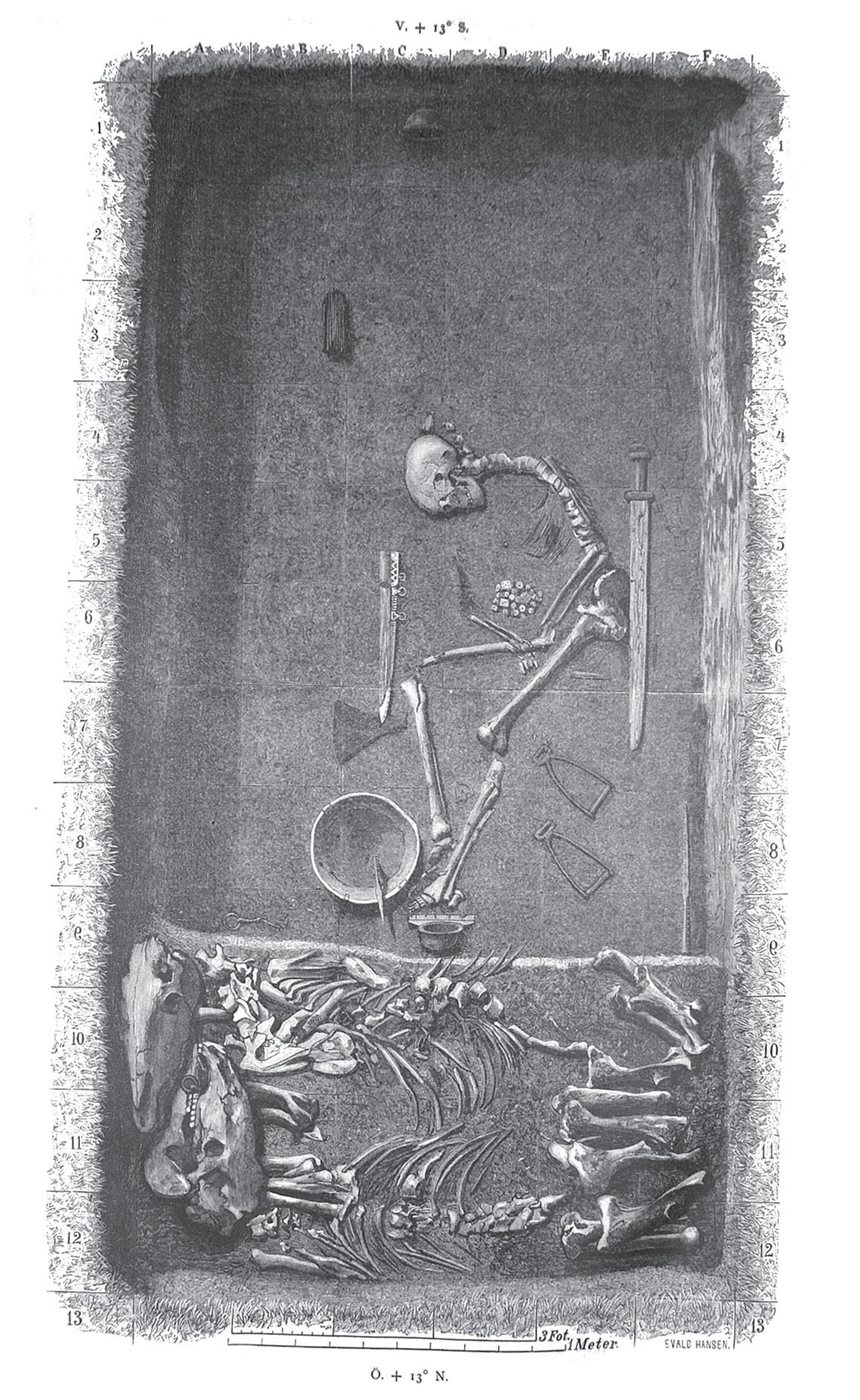
A grave full of weapons, a skeleton with two X chromosomes: since 2017, Birka Bj 581 has been the star witness for the Viking Age woman warrior. But what actually follows from the find? This article separates what is secure (the skeleton is female, the grave is richly furnished) from what is disputed (who wielded the weapons, what "warrior" means) and checks what can be said about other sites at all. Where gaps exist, I name them.
When news broke in September 2017 that a famous Viking warrior had in fact been a woman, an old problem was condensed into one sentence. Specialists had known weapon graves for over a century. What was new was that a genetic analysis determined the biological sex of a person in such a grave. Whether that proves the existence of women warriors is another matter. Two questions run together constantly in the debate and need to be kept apart: What biological sex did the buried person have? And what role did she hold in life that brought the weapons into her grave?
The first question can be answered by scientific methods if the material survives. The second cannot. Graves offer only indications. A grave shows how survivors wished to present a person, and that need not match the deceased's daily life. The whole article rests on this distinction. It draws on the specialist publications on Bj 581 as far as I could reach them through summaries and secondary literature (the full text of the original papers was not retrievable for me; the source list says so item by item), and it restricts itself to statements I can support.
Birka lay on the island of Björkö in Lake Mälaren in present-day central Sweden and was a trading place in the Viking Age. More in our article on Birka. The Swedish archaeologist Hjalmar Stolpe (1841 to 1905) excavated hundreds of graves there in the 19th century. The grave he recorded as Bj 581 was, according to the sources available to me, opened in the 1870s; the exact year is given inconsistently in the secondary literature (1878 in one place, 1889 for the documentation under its number). Holger Arbman published the Birka graves in 1943 as "Birka I: Die Gräber".
Bj 581 is a chamber grave: a wooden chamber of about 3.45 by 1.75 metres, marked by a large boulder, on a terrace close to the settlement's garrison. According to the summary I read, the grave goods include a sword of Petersen type E in its scabbard, an axe head, a seax (a single-edged fighting knife), a small iron knife, a whetstone, two spearheads, 25 arrowheads and two shield bosses. Add remains of silk with silver brocade, a hat with silver decoration, game pieces including a king piece, with dice and an iron frame (presumably for a board game in the hnefatafl family), weights, a bronze vessel and two bridled horses, a mare and a stallion. A silver coin, a quarter dirham from the reign of the Samanid ruler Nasr ibn Ahmad, gives a point of reference for dating the grave to the middle of the 10th century. Precise dating ranges should be checked in the original paper; I give only the order of magnitude.
Stolpe took the occupant for a man, a high-ranking warrior. That is understandable: he followed the principle that weapons point to a male dead. The bones, however, did not fit. According to the secondary literature, I could not check whether or when earlier examiners saw indications of a female skeleton. The osteologist Anna Kjellström, in a renewed examination (2016), likewise arrived at a female determination.
The key publication is Charlotte Hedenstierna-Jonson and colleagues, "A female Viking warrior confirmed by genomics", American Journal of Physical Anthropology 164 (4), 2017, pages 853 to 860. According to the summary, DNA was obtained from a tooth and from an arm bone. The result: two X chromosomes, no Y chromosome. The person was older than 30. Strontium isotopes in tooth enamel, which can point to a region of origin, and genetic data suggested, according to the authors, that she had not grown up in Birka but came from southern Sweden or Denmark and led a mobile life. How secure this origin is I cannot judge without the full text; strontium values often allow several regions of origin.
From this the team drew the interpretation that this was a high-ranking woman warrior and officer. The title of the study even speaks of the "first confirmed" high-ranking woman warrior of the Viking Age. That is a claim by the authors, not a neutral finding. The biological part is secure. The role "warrior" is a conclusion drawn from grave furnishing, location and comparisons that other specialists do not share in that form.
The study triggered an unusually broad scholarly discussion. From what I could confirm, four lines can be distinguished.
First, the question of whether the bones belong to the grave. The archaeologist Fedir Androshchuk criticised in 2018, in "Viking and Medieval Scandinavia" (volume 14, pages 47 to 60), that the study does not address that the grave was disturbed, what the removal of stones meant, and that Stolpe worked with non-professional helpers. The objection is that a skeleton from a chamber need not be the person to whom the weapons belonged. The archaeologist Martin Rundkvist argued, as reported in the secondary literature, on his blog in 2017 that the weapons cannot establish the skeleton's sex and that the authors should have discussed the possibility of a mix-up or a removed male burial.
Second, the meaning of "weapon grave". Anne-Sofie Gräslund had already pointed out in 1980, long before the DNA analysis, that a "warrior grave" suggests a professional warrior, whereas weapons may also indicate elite status. Rune Edberg published remarks on the interpretation of Bj 581 in "Marinarkeologisk Tidskrift" in 2019.
Third, the use of written sources. Judith Jesch, as reported in a History Extra piece in 2019, criticised the use of literary sources and the absence of a discussion of alternative interpretations. Elsewhere she has argued against applying the term "shield-maiden" to hypothetical Viking Age women, so as not to blur the literary figure with real women.
Fourth, the authors' answer. In 2019 "Antiquity" (volume 93, issue 367, pages 181 to 198) published "Viking warrior women? Reassessing Birka chamber grave Bj.581" by Neil Price, Charlotte Hedenstierna-Jonson and others. It gives more methodological detail and holds to the interpretation. According to the summary, the group stresses that Stolpe labelled the bones carefully with "Bj 581" in ink and that bone measurements speak against a mix-up with other Birka graves. It also points to the grave's position beside the garrison as an argument for a military context. Important: this paper is the reply of the excavators' side, not the criticism. Anyone citing "Price 2019" as evidence of doubt is reading it wrongly.
What the other side does not dispute, according to the accounts I saw, is the biological sex of the skeleton. The dispute concerns the link to the grave goods, the role and the choice of words. Further contributions, such as a 2023 book "The Bones of Birka" (author not verified), take up the question of what the grave means; I know them only as titles in a reference list.
The classic method is morphology. Pelvis and skull show features that differ on average between women and men. The pelvis is more informative than the skull, but overlaps remain here too, and the features depend on age and preservation. The outcome is a probability, never a certainty. In cremation burials, which were common in the Viking Age, burnt and broken bones are often so fragmented that the method fails. That is one reason why in some regions many graves remain without a sex determination.
The second method is ancient DNA (aDNA). The share of sequences lying on the X and Y chromosomes allows conclusions about chromosomal sex. This works only if enough DNA survives and contamination is controlled. The method records biological sex; it says nothing about roles, self-image or how society saw the person.
Archaeology therefore distinguishes between sex, biological sex, and gender, the social role. A grave shows gender insofar as survivors shaped it, and sex insofar as the skeleton survives. Reconciling the two is not a given. Older excavations often reasoned in a circle: weapons meant "man" and jewellery "woman". On this basis skeletons were assigned without being measured. That is exactly why a weapon grave with a female skeleton can come as a surprise: it shows how strongly the assignment once rested on the grave goods, and it urges caution with old excavations in which bones were lost or mixed.
What does a weapon in a grave mean? There are several readings that do not exclude each other. Weapons can be given to the dead as equipment because they carried them in life. They can show rank and wealth: a sword was expensive, a full set of sword, axe, spear and shield more so. They can belong to a ritual performed by the survivors, for instance to underline their own standing. And they can be symbols without the dead having been fighters. That weapons in graves were also ritually destroyed is covered in our article on ritually destroyed weapons.
For men's graves this caution was demanded earlier. Gräslund's remark of 1980 aims exactly at this: "warrior grave" is a label of research, not a term from the sources. Anyone reading weapons in a woman's grave faces the same question as with men, only without the practised reflex. If one says of a man that the weapons show status but of a woman that they show combat service, one applies two yardsticks. Conversely it is equally an error to assume symbolic use for the woman as a rule and real use for men. Without further evidence this cannot be decided the same way for both cases.
In Bj 581, further indications come in that may go beyond a mere status gift: the position next to the garrison, the combination of missiles (25 arrowheads), melee weapons and shields, the horses and a game set. The authors read this as a sign of officer rank. Sceptical voices see in horses and game set rather marks of status that need not say anything about command in the field; I give this as a possible counter-reading, not as the documented position of a particular person. Both are interpretations. Proof in the strict sense exists in neither case, nor for the counter-thesis.
The working title of this article named Kaupang and Gnezdovo alongside Birka. Here I am candid: for Kaupang and Gnezdovo I could not confirm in this research a reliable find report of a woman with weapon grave goods. Kaupang, an early trading place in southern Norway (founded around 800, abandoned in the 10th century, with 79 mounds excavated by Nicolaysen in 1867, according to Wikipedia), is covered in our article on Kaupang. That weapons lay in women's graves there could not be confirmed in the account I consulted. Gnezdovo, a large cemetery near Smolensk in the area of the early Rus, I do not know in connection with weapons in women's graves from any source I have read. I therefore do not cite either place as an example, and I advise taking statements about them only after checking the excavation publications.
A further case from Norway is documented in the summary I used: at Nordre Kjølen a woman's weapon grave was found in the early 20th century and labelled a "shield-maiden". I could verify no more than that sentence: neither dating nor extent of the goods nor the method of sex determination. With old excavations the sex determination is precisely the critical point. The summary also mentions evaluations from England (McLeod 2011) according to which graves and chemical analyses suggest a roughly equal distribution of men and women. That concerns population shares in settled areas and says nothing about weapon goods.
The honest balance is therefore: Bj 581 is the only case I can document in detail, and even it is a matter of debate. Whether there are a handful or dozens of comparable graves is a question of counting that the sources I could consult do not answer. Anyone who reads "hundreds of women warriors" in the media should ask for the find list.
Written sources know fighting women, but nearly all are literary or written from outside. The Byzantine chronicler John Skylitzes reports on the campaign of the Kievan prince Sviatoslav in Bulgaria in 971. After the fall of Dorostolon, according to the account in the secondary literature (Harrison and Svensson 2007, page 71), the victors found armed women among the fallen. But Skylitzes wrote more than a century later, and the events concern the Rus, not Scandinavia in the narrower sense. The report shows that in the 11th century people in Byzantium found such a thing worth reporting; details cannot be derived from it. More on the Rus in the article on the Kievan Rus.
The Danish historian Saxo Grammaticus, who wrote his "Gesta Danorum" around 1200, describes women as commanders at the battle of Bråvalla and names Hetha, Wisna and Webiorg. The battle itself is legendary; the dating to 750 in the secondary literature belongs to saga tradition, not to secure history. More on Saxo in the article on Saxo Grammaticus. The Hervarar saga, an Icelandic saga, knows Hervör, who wears men's clothes and robs travellers in the forest. That too is narrative.
Nature, Saxo says in effect, gave the souls of men to these women commanders, who had the bodies of women.
Paraphrase, not a quotation: the sense of the Saxo passage (Gesta Danorum, Bråvalla) after an English rendering I know only via Wikipedia; the wording of Elton's translation (1894) was not seen in full text and is therefore not quoted.
The sentence shows how Saxo writes: he explains fighting women as an exception to nature and praises them for exactly that. He does not confirm that there were women warriors in his own day. The scholar Hermann Reichert regards fighting women, as the secondary literature reports (edition 2010, first 1995), as probably exceptional cases rather than the rule.
The word "shield-maiden" (Old Norse skjaldmær) comes from literature. Our article on the shield-maiden separates what Saxo and the sagas tell from the archaeological record. Lagertha too is a figure in Saxo who later became the basis of a television character; her name cannot serve as evidence of a historical woman warrior. The valkyries are mythological beings who appear in poetry and images. Some researchers suspect that images of armed women on pendants and picture stones depict valkyries, not human beings. That is an interpretation, and a disputed one.
Important for the weighing: a grave like Bj 581 does not refute the assumption that the literary figures are invented. It shows only that at least once a woman was buried with the equipment of a high-ranking weapon bearer. And the sagas prove nothing in reverse about the grave find. Whoever links the two levels writes history that neither source supports.
Birka has many graves with weapons, and that one of the best-known cases concerns a woman raises the question of how many old excavations might hold similar surprises. That cannot be said without a systematic new determination of the skeletons. Research here depends on bone material that is often poorly preserved or incomplete. For more on the reach of genetic analyses among Vikings see our article on travelling Viking women and DNA.
For the role of women overall the case is only one building block. Legal and economic standing, running a household and property are better documented than a military role; see women and law and the overview women in the Viking Age. A weapon grave does not make a woman the normal case of a fighter, and conversely it does not relieve research of the duty to question its habits.
Is Bj 581 certainly a woman's grave? The skeleton was determined female by two methods. The open question is whether all grave goods belong to this person and what they mean.
Was the woman from Bj 581 killed in battle? That is not documented in the accounts I consulted.
Were there women warriors in the Viking Age? This cannot be clearly documented. There are indications from one grave and from late texts, but no broad, secure base of finds.
What does "grave goods are not a job description" mean? A grave shows how survivors presented a person. Equipment can express status, ritual or memory without the dead having been fighters.
Why is the sex of a skeleton not always settled? Cremation destroys features, and ancient DNA often does not survive well enough. Old excavations also lost or mixed bones.
Birka · The shield-maiden: did she really exist? · Lagertha · Valkyries · Women in the Viking Age · Women and law · Travelling Viking women and DNA · Ritually destroyed weapons · Saxo Grammaticus

Birka – the trading hub · Viking women · Did Viking women travel? · Lagertha the Shield-Maiden · Runes on Weapons.
All History & Finds articles →
Say "Viking" and most people picture a sword – yet the majority of warriors in the Viking Age never owned one. Spear …
Read more →The Wagrians lived farther northwest than any other Slavic tribe, in eastern Holstein between the Kiel fjord, the …
Read more →While some Norsemen sailed west, others rowed, poled and hauled their boats east: past Ladoga and Novgorod to the …
Read more →The Warni are one of those tribes that surface in the sources again and again over five centuries and still cannot be …
Read more →