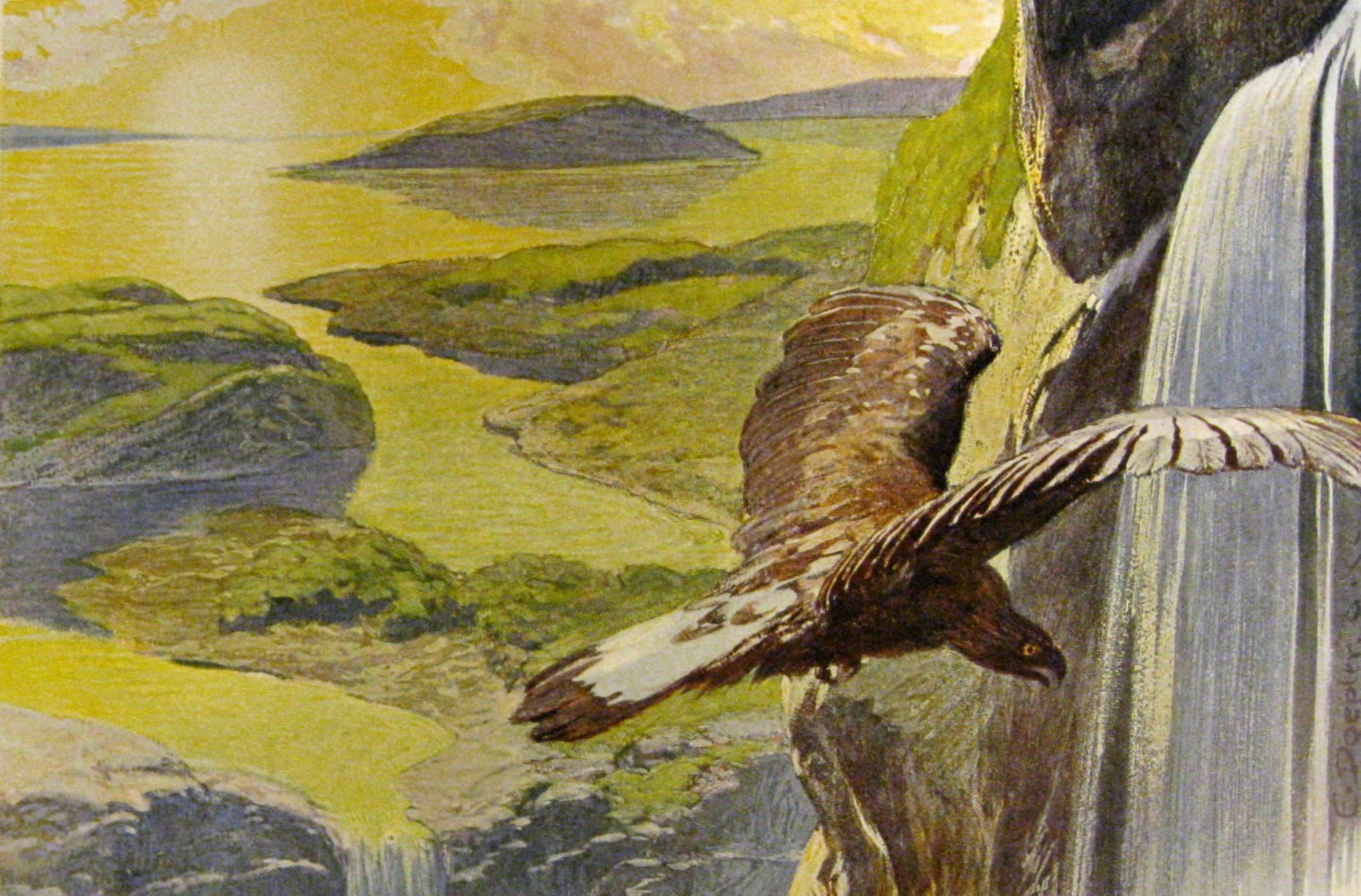
A hall fairer than the sun, roofed with gold, and in it companies who are happy for ever: that is very nearly how Völuspá ends. The name of the place, Gimlé, occurs once in the whole poem. Everything else comes from Snorri Sturluson, who moves the hall into a third heaven and lets light-elves live there for the time being. This article works through the four passages in turn, shows how differently the manuscripts already spell the name, and separates the evidence from what later readers have added to it.
The record for Gimlé is thin. The name stands in one stanza of Völuspá, the “Prophecy of the Seeress”, and in three places in Gylfaginning, the narrative core of the Edda written by the Icelander Snorri Sturluson. The dictionary of Cleasby and Vigfússon notes under the headword that the word occurs only in that one Völuspá passage and passed from there into the Edda. I did not find the name in the text of Skáldskaparmál as given in this site's source archive. I know of no rune stone, picture stone or saga that mentions Gimlé.
Chapter numbers here follow this site's source archive (Old Norse text after Guðni Jónsson): Gylfaginning 3, 17 and 52. The stanza is number 64 there.
In normalised spelling the archive gives the stanza as: Sal sér hon standa / sólu fegra, / gulli þakðan / á Gimléi; / þar skulu dyggvar / dróttir byggja / ok um aldrdaga / ynðis njóta. Literally, and with no claim to elegance: “She sees a hall standing, fairer than the sun, thatched with gold, on Gimlé; there loyal companies shall dwell and enjoy delight all the days of their lives.” Henry Adams Bellows put it into verse in 1923:
“More fair than the sun, a hall I see,
Völuspá, stanza 64, translated by Henry Adams Bellows, The Poetic Edda, 1923
Roofed with gold, on Gimle it stands;
There shall the righteous rulers dwell,
And happiness ever there shall they have.”
Two things stand out in the comparison. Bellows writes “I see”, while the Old Norse has sér hon, “she sees”: at this point the seeress speaks of herself in the third person. And “righteous rulers” is a strong choice for dyggvar dróttir, a phrase discussed further below. Karl Simrock's German version of 1851 goes another way and turns the place into “Gimil's heights” (Gimils Höhn), although the original has nothing but the preposition á, “on” or “in”.
The position in the poem matters more. Before it come the stanzas of the new world: the earth rises green from the sea (st. 59), the Æsir meet on Iðavöllr (st. 60), the golden gaming pieces lie in the grass (st. 61), Baldr and Höðr return (st. 62), Hœnir chooses lots (st. 63). Then the hall. After it the archive text has only the half-stanza about the “mighty one” who comes from above (st. 65) and the dragon Níðhöggr with corpses in his wings (st. 66). Gimlé is the last bright image of the poem.
Some two dozen stanzas earlier there is a hall introduced in almost the same words. Stanza 38 begins: Sal sá hon standa / sólu fjarri / Náströndu á, “a hall she saw standing, far from the sun, on Náströnd”, the corpse-strand. Its doors face north, drops of venom fall through the smoke-vent, the walls are woven of serpents' backs. Stanza 39 names the inmates: perjurers, murderers, and the man who seduces another's confidante. There Níðhöggr sucks the dead.
The two stanzas are built on each other. Sólu fjarri, far from the sun, answers to sólu fegra, fairer than the sun. Serpents' bodies are set against a roof of gold, oath-breakers against dyggvar dróttir, loyal companies. The tense changes as well: the seeress “saw” the venom hall, she “sees” the golden one, and its inhabitants “shall” dwell there only later. One belongs to the old world, the other to the world to come.
Unlike Náströnd, Gimlé is given no compass direction in the poem, no construction beyond the roof, no master of the house. Nor does the poem say that the hall stands in heaven. All of that arrives with Snorri.
In the poem the hall stands á Gimlé. Gimlé is therefore the place where it stands, and the hall itself has no name. The English Wikipedia states that Gimlé in the poem is probably a mountain and that Snorri transfers the name to the hall, citing Bellows's note to stanza 64. I have not read the wording of that note, only the verse: “on Gimle it stands”.
A mountain is already an interpretation, though. In Old Norse the preposition á goes with heights, but just as readily with fields, shores and districts: á Iðavelli, Náströndu á, á Ókólni, all in this same poem. The only firm point is that the poet means a place and not a building.
Snorri wavers. Chapter 17 says in so many words that at the southern end of heaven is “the hall that is called Gimlé” (sá salr … er Gimlé heitir). In chapter 3 the righteous are to be with All-father “where it is called Gimlé or Vingólf” (þar sem heitir Gimlé eða Vingólf), which fits a hall as well as a region. And in chapter 52 it is best to be á Gimlé á himni, “on Gimlé in heaven”: here the phrase of the poem survives. A consistent topography is not to be had from Snorri.
Völuspá survives complete in two medieval manuscripts: the Codex Regius of the Poetic Edda, usually dated to about 1270, and Hauksbók, an Icelandic compilation of the fourteenth century (AM 544 4to). To these must be added the stanzas Snorri quotes in Gylfaginning. The Gimlé stanza thus has three witnesses, and they do not agree in every detail.
A letter-for-letter transcript of the Codex Regius, which I consulted through a retrieval tool, reads Sal ser hon standa / solo fegra / gvlli þacþan / agimlé, with preposition and name written as one word. The stanza is number 62 there; Hœnir precedes it and the dragon follows at once. The same website gives a gimle without an accent for Hauksbók, as stanza 56, followed by Þa kemr hinn riki, the half-stanza of the mighty one. Edward Pettit's dual-language edition of 2023 likewise prints the Hauksbók version as stanza 56 with á Gimlé and stanza 57 with the mighty one, noting that this half-stanza is found in Hauksbók alone.
The form á Gimléi in this site's archive is therefore the normalised spelling of the editor Guðni Jónsson, a dative with an ending. Cleasby and Vigfússon enter the headword as gimli, quote á Gimli and call the gender of the word uncertain; they consider a dative of a masculine gimill, said to mean “heaven”. The stanza numbers vary by edition: 62 by the manuscript, 64 in Guðni Jónsson and Bellows, 63 in the dictionary.
Snorri quotes the stanza in chapter 17 with two differences. His version begins Sal veit ek standa, “a hall I know standing”, in the first person, and the place is á Gimlé. Rasmus B. Anderson's English translation of 1880 has “Than gold better, Gimle by name” at this point, that is, “better than gold” instead of “thatched with gold”.
There is no settled etymology. The derivation met most often is from gimr, “fire”, and hlé, “shelter, protected place”: Gimlé would be “the place protected from fire”. That is how the English Wikipedia has it, qualified by “likely”. In an essay of 2013 Kees Samplonius reports that Finnur Jónsson and Sigurður Nordal understood the name as “igni resistens”, fire-proof; I know this only from a summary of his text.
The translator Lee M. Hollander, according to Wikipedia, thought “gem-roof” more likely. Behind that lies gim- in the sense “gem”; I have not checked the origin of that word for this article. The third option is the dictionary's: a word gimill for “heaven”.
Ursula Dronke, again according to Wikipedia, suggested that the poet of Völuspá or his circle coined the name on purpose, as a refuge for the blessed from the fire of Surtr and from the Christian hell. If so, Gimlé would be a poetic invention and not an old cult name. None of these readings can be proved. The fire etymology fits Snorri's account, in which the hall survives the blaze, remarkably well. That may count in its favour. It may equally mean that Snorri already understood the name that way and shaped his account to match.
Gylfaginning is a teaching dialogue. King Gylfi, calling himself Gangleri, questions three figures named Hárr, Jafnhárr and Þriði: High, Just-as-high and Third. At the very start he asks who the highest god is and what he has achieved. Þriði answers that the greatest thing is that All-father made man and gave him a spirit that shall live and never perish, though the body rot to earth or burn to ashes. Then, in my own translation: “And all people shall live who are of right conduct, and be with him himself, where it is called Gimlé or Vingólf; but wicked people go to Hel and from there to Niflhel. That is down in the ninth world.”
Nothing here speaks of an end of the world. The sentence sounds as if the good went to Gimlé straight after death. That sits badly with chapter 17, where only light-elves live there for now, and with chapter 52, where Gimlé belongs to the dwellings after the fire.
The words “or Vingólf” cause trouble too. In chapter 14 the Æsir build a second hall after Glaðsheimr, which the Old Norse text calls a hörgr belonging to the goddesses, named Vingólf; Anderson translates “a home for the goddesses”. I have not looked up the usual rendering of hörgr as a cult site for this article. In chapter 20 Odin assigns the slain “to Valhalla and Vingólf” and calls them Einherjar. In Snorri the same name thus stands for a house of the goddesses, for a dwelling of fallen warriors and, equated with Gimlé, for the place of the righteous. Whether he is setting different traditions side by side or phrasing freely at this point cannot be established.
Finally, the sorting by merit. In chapter 34, on Loki's children, All-father sends to Hel those who die of sickness or old age (sóttdauðir menn ok ellidauðir). In chapter 3 it is “wicked people” who go there. These are two different systems: one asks how a person died, the other how a person lived. Chapter 3 is therefore regarded as the passage of Gylfaginning that sounds most like Christian teaching; the article How Christian is the Edda? treats it in context.
The fullest passage comes in the list of heavenly places. Hárr names Álfheimr, Breiðablik, Glitnir, Himinbjörg and Valaskjálf with the high seat Hliðskjálf. Last of all: “At the southern end of heaven is the hall that is fairest of all and brighter than the sun, which is called Gimlé. It shall stand when both heaven and earth have passed away, and good and righteous people shall inhabit that place through all ages.” The stanza from Völuspá follows as proof.
Gangleri presses the point with the question any reader would ask: what protects this place when Surtr's flame burns heaven and earth? Hárr's reply, in my own translation: “It is said that there is a second heaven to the south of and above this heaven, and it is called Andlangr, and that the third heaven is above those again, and it is called Víðbláinn, and in that heaven, we think, this place lies. But only light-elves, we think, inhabit those places now.”
The caution is striking. “It is said” (svá er sagt), “we think” (hyggjum vér), and that twice over: nowhere else in this chapter does the speaker hedge so much. Snorri does not present the three heavens as ancient knowledge but as a surmise of his speakers. The solution is also visibly built for the problem. The hall is to survive the burning of the world, so it has to lie higher than the heaven that burns.
That light-elves live in Gimlé “now” is stated in this one sentence only. The same chapter introduced them shortly before: in Álfheimr live the Ljósálfar, fairer to look upon than the sun; the Dökkálfar live down in the earth and are blacker than pitch. The light-elves are “fairer than the sun”, the hall is “brighter than the sun”. Snorri gives the residents and the house the same quality.
The neat division into light-elves and dark-elves is known in this form from Snorri alone. The article on the elves explains why many scholars see in it his own ordering, possibly coloured by the contrast between angels and demons. For Gimlé this means that the light-elves in the third heaven are no testimony of Völuspá. The poem names no present inhabitants.
Towards the end, after the account of Ragnarök, Gangleri asks what remains once the whole world is burnt and all the gods, all the Einherjar and all mankind are dead; it was said, after all, that every person shall live in some world through all ages. Þriði answers that there are then many good dwellings and many bad ones. “Best it is then to be on Gimlé in heaven.” Very good, too, is the hall Brimir for those who enjoy drinking, and good the hall Sindri of red gold on Niðafjöll. On Náströnd, by contrast, stands a large and evil hall, and worst of all is Hvergelmir.
Snorri here draws together stanzas that lie far apart in the poem: the two halls of stanza 37, the venom hall of stanzas 38 and 39, and Gimlé from stanza 64. In the poem Brimir's beer hall and Náströnd stand in the past tense and before the downfall. Only Snorri turns all four into a ranked register of otherworld destinations. How he handles the two drinking halls is shown in the article on Ókólnir and Brimir, which also deals with the variant reading in which Brimir stands “also in heaven”, as Simrock and Anderson translate.
First come the dwellings of human beings, Gimlé at their head. Only in the following chapter 53 does the earth rise from the sea, and the surviving gods live on Iðavöllr. In Snorri these are two separate settings: Gimlé in heaven for humans, the field on the new earth for the gods. Nowhere is it said that the gods build Gimlé or move into it. The wider frame is described in the article After Ragnarök.
The poem says dyggvar dróttir. Dyggr means “faithful, trusty” according to Cleasby and Vigfússon, who render the phrase itself as “worthy, good people” (an entry I know only through a retrieval tool). Drótt is used in the same poem of the dwarfs (dverga dróttir, st. 9, Bellows: “the race of dwarfs”) and there means a host or a people; the often-cited basic sense “a lord's retinue” I have not looked up. The translators handle it differently. Simrock writes “proven people” (bewährte Leute), Anderson “good people”, Bellows “the righteous rulers”.
It is not even certain that the poem means human beings. The stanza before speaks of Hœnir and the sons of two brothers, the one after of a “mighty one”. The loyal companies can therefore also be read as the following of the returning gods. Snorri committed himself: góðir menn ok réttlátir, good and righteous people (ch. 17), þeir er rétt eru siðaðir, those of right conduct (ch. 3). “Righteous” is a word the poem does not use.
Gimlé differs from Valhalla on every point the texts mention. Valhalla receives those who fall in battle; the selection is by manner of death. The Einherjar are Odin's warrior band, and Gangleri's question in chapter 52 assumes that in the end they are all dead. In Gimlé nobody fights, there is no host and no feast, and the stay has no end. Ursula Dronke nevertheless held, according to Wikipedia, that the idea of a heaven for hosts of the righteous was developed from Valhalla. That is a scholarly thesis, not something the text states.
A golden hall for the just, and beside it a place of punishment for perjurers and murderers: the closeness to Christian images of the afterlife has often been noticed. Lee M. Hollander and Rudolf Simek, according to Wikipedia, see in the description of Gimlé the influence of the heavenly Jerusalem of the Book of Revelation. Samplonius, as far as a summary of his essay shows, considers that the name may echo the concept of a third heaven. Henning Kure, as reported in a review of a 2013 essay collection, argues that it is Snorri who makes the stanzas resemble Revelation more than they do. The reviewer, Kevin J. Wanner, objects that several essays in the same volume assume a stable Christianity against which the pagan material is then measured.
Dating adds to the difficulty. Völuspá was long placed around the year 1000, the time of Iceland's conversion; that dating is not secure. A poet of that period could know Christian preaching without being a Christian. For Snorri, whose Edda was probably written in the 1220s, Christian learning is beyond doubt. What remains open is the level at which the influence sets in: with the poet, with the scribes, or only with Snorri. The text alone does not settle it.
The best-known place of this name was founded by Icelandic emigrants in Canada. According to The Canadian Encyclopedia some 200 people arrived near present-day Gimli on Lake Winnipeg in October 1875 to settle “New Iceland”, which came under Manitoba's jurisdiction in 1881. The English Wikipedia gives 21 October 1875 as the founding date, though without a citation, and speaks of 300 people who left Iceland. The figures therefore differ. The settlement, the same encyclopedia says, was named after the hall of the Edda. An Icelandic festival has been celebrated since 1890, according to Wikipedia, and has been held in Gimli since 1932.
What is Gimlé? In Völuspá, the place where a gold-roofed hall stands in which loyal companies live happily for ever. In Snorri the hall itself bears the name and lies in heaven.
Where is Gimlé mentioned? In Völuspá 64 and in chapters 3, 17 and 52 of Gylfaginning. I know of no other medieval attestation.
Is Gimlé the same as Valhalla? No. Valhalla receives the slain, and according to Gylfaginning 52 the Einherjar are dead in the end. Gimlé, Snorri says, shall stand when heaven and earth have passed away.
Do light-elves live in Gimlé? Snorri's speakers suppose so for the present (ch. 17). The poem knows nothing of it.
What does the name Gimlé mean? That is unresolved. Proposals include “place protected from fire”, “gem-roof” and a word for “heaven”; none of them can be proved.
After Ragnarök: the new world of the Edda · Iðavöllr, the field of the gods · Ókólnir and Brimir · Völuspá · How Christian is the Edda? · Elves · Hliðskjálf · Líf and Lífþrasir · Valhalla · Helheim
What comes after Ragnarök · Iðavöllr · Völuspá – the Seeress's Prophecy · Asgard – Home of the Norse Gods: What the Eddas and Sagas Really Say · Lif and Lifthrasir – the human pair who survive Ragnarök.
All The Nine Worlds articles →
Helheim – in the sources usually just “Hel” – is the realm of the dead in Norse mythology: a dark place beneath the …
Read more →Whoever sits down in Hliðskjálf sees everything: the worlds, the doings of men, a fugitive in the mountains, a girl at …
Read more →Jotunheim (Old Norse Jǫtunheimar, usually plural) is the land of the giants in Norse mythology – a wild borderland …
Read more →Lif and Lifthrasir (Old Norse Líf and Lífþrasir) are the two humans who, according to the Edda, survive Ragnarök, the …
Read more →