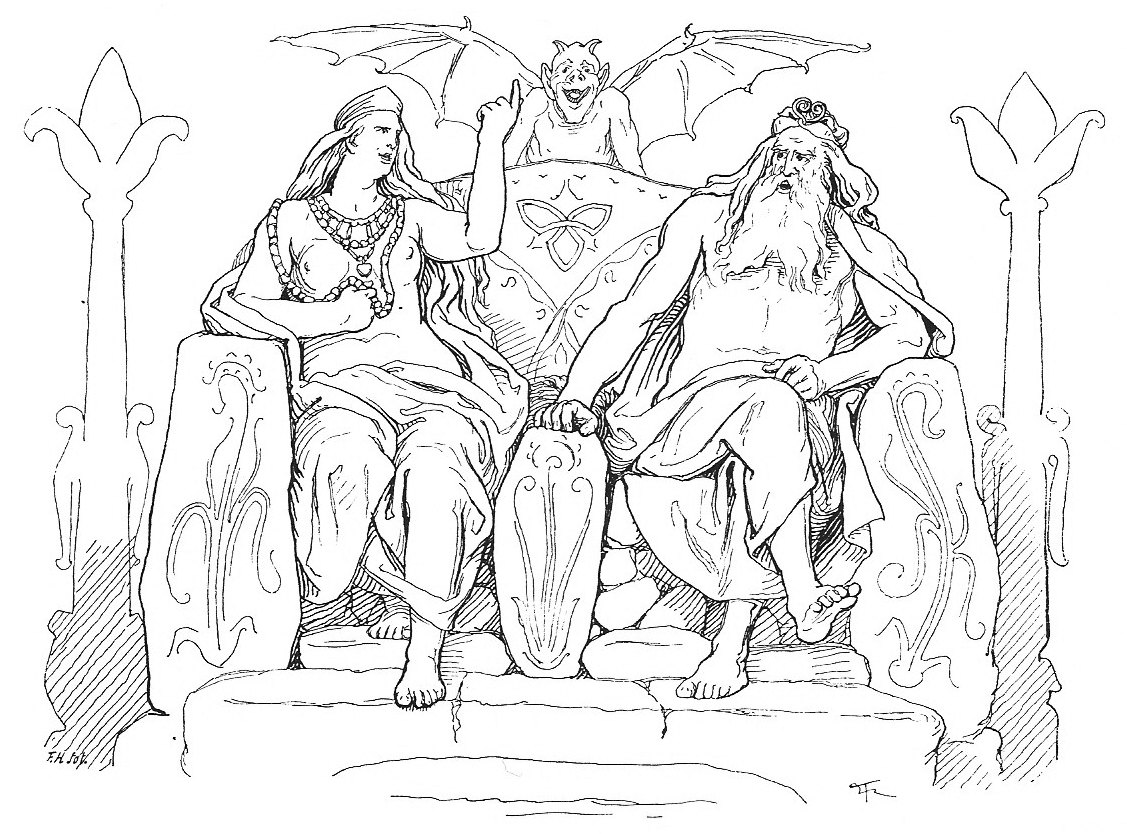
Whoever sits down in Hliðskjálf sees everything: the worlds, the doings of men, a fugitive in the mountains, a girl at a door in giant-land. That is what Snorri Sturluson says, and what two short prose passages in the Poetic Edda say. It amounts to a handful of sentences, and even those few do not agree on whether Hliðskjálf is a chair, a hall or a place. This article goes through every passage in turn, keeps the poems apart from Snorri and Snorri apart from modern interpretation, and says plainly where I have seen no source for a claim that is often repeated.
The popular picture is quickly drawn: Odin sits on a throne high above Asgard, ravens on his shoulders, wolves at his feet, surveying all nine worlds. That picture is assembled from several texts which never offer it together. The ravens and wolves appear in the stanzas of Grímnismál; the seat does not. The number nine occurs in none of the Hliðskjálf passages, which speak only of "all worlds" (heima alla).
For this article I went through the texts in this site's source archive, that is, the Old Norse wording after Guðni Jónsson's edition with the translations of Karl Simrock and Rasmus B. Anderson, together with the prose introductions to two eddic poems at heimskringla.no. I found the name in seven places: in the prose before Grímnismál, in the prose before Skírnismál, four times in Gylfaginning (chapters 9, 17, 37 and 50 in our archive's numbering) and once in a skaldic verse quoted in Skáldskaparmál. Further attestations may exist; I have not seen any.
That is not much. The detailed statements come from a single author, Snorri Sturluson, who wrote his Edda around 1220 to 1230.
The prose that precedes Grímnismál first tells of two king's sons, Agnarr and Geirröðr, who spend a winter as children with an old couple. Then it changes scene in a single sentence: "Óðinn ok Frigg sátu í Hliðskjálfu ok sáu um heima alla." In my own translation: Odin and Frigg sat in Hliðskjálf and looked over all worlds.
A marital quarrel follows. Odin asks Frigg whether she sees her foster-son Agnarr begetting children with a giantess in a cave, while his own foster-son Geirröðr is a king. Frigg replies that Geirröðr is stingy with food and torments his guests. They make a wager, and Odin, calling himself Grímnir, ends up between two fires.
Three observations matter for Hliðskjálf. First, two people sit there and both of them see; Odin expressly asks Frigg whether she sees Agnarr. Second, the preposition is í, "in" Hliðskjálf, not "on". Third, the name does not occur in the poem's 54 stanzas; I searched them in our archive. The high seat belongs to the prose frame. Whether that prose is as old as the stanzas cannot be established with certainty. What is certain is that both medieval manuscripts of the poem contain it: the Codex Regius, written around 1270, and the fragment AM 748 I a 4to from the early fourteenth century.
The second passage is built almost identically. The prose before Skírnismál begins: "Freyr, sonr Njarðar, hafði einn dag setzt í Hliðskjálf, ok sá um heima alla." Freyr, son of Njörðr, had one day seated himself in Hliðskjálf and looked over all worlds. He looks into Jötunheimr, sees a fair maiden walking from her father's house to an outbuilding, and falls gravely sick at heart. The maiden is Gerðr, daughter of the giant Gymir. How Freyr's servant Skírnir woos her is told in our article on the poem.
Here too the prose alone carries the name. In the stanzas Freyr himself tells what he saw and says nothing of where he was sitting. Stanza 6 reads in Bellows's translation: "From Gymir's house I beheld go forth / A maiden dear to me; / Her arms glittered, and from their gleam / Shone all the sea and sky." Such a glance presupposes a special vantage point, but the poem does not name it.
The poem's prose does not say that Freyr did anything forbidden: not a word that the seat belongs to Odin, not a word about punishment. That judgement first appears in Snorri.
In Gylfaginning, the narrative first main part of Snorri's Edda, the name occurs four times. The chapter numbers follow this site's source archive.
Chapter 9. After the creation of mankind the gods build a stronghold in the middle of the world, Asgard. Anderson translates the next sentence: "In Asgard is a place called Hlidskjalf, and when Odin seated himself there in the high-seat, he saw over the whole world, and what every man was doing, and he knew all things that he saw." In the original Hliðskjálf is "einn staðr", a place, and Odin sits down there "í hásæti", in the high seat.
Chapter 17. In his list of heavenly dwellings Snorri comes to Valaskjálf, Odin's hall, which the gods built and roofed with pure silver. Now Hliðskjálf is the seat itself:
And there is a great dwelling called Valaskjalf, which belongs to Odin. The gods made it and thatched it with sheer silver. In this hall is the high-seat, which is called Hlidskjalf, and when Alfather sits in this seat, he sees over all the world.Snorri Sturluson, Gylfaginning, ch. 17 (numbering of the source archive), translated by Rasmus B. Anderson, The Younger Edda (1880)
In the original the name carries the suffixed article here, Hliðskjálfin, "the Hliðskjálf", glossed as "þat hásæti, er svá heitir", that high seat which is so called. Snorri then turns to the hall Gimlé at the southern end of heaven.
Chapter 37. Snorri retells the wooing of Gerðr. Freyr "hafði gengit í Hliðskjálf", had gone into Hliðskjálf, looked over all worlds and saw in the north, on a farmstead, a large and beautiful house towards which a woman was walking. When she raised her hands and opened the door before her, sky and sea shone. Then comes the sentence the poem lacks: in this way his great presumption was avenged on him, that he had sat down "í þat it helga sæti", in that holy seat, and he went away full of grief.
Chapter 50. After Baldr's death Loki flees to a mountain and builds a house with four doors so that he can see in every direction. It does him no good: Odin "hafði sét ór Hliðskjálfinni, hvar hann var", had seen out of the Hliðskjálf where he was. See Loki's punishment.
Set side by side, the four chapters do not yield one consistent object. In chapter 9 Hliðskjálf is a place in Asgard containing a high seat. In chapter 17 it is the high seat, standing in a hall called Valaskjálf. In chapter 37 Freyr "goes into" it and then "sits down" in a holy seat, which fits either. In chapter 50 Odin sees "out of" it (ór), as one looks out of a room or from a lookout.
The eddic prose also says í, "in". That is not decisive, because in Old Norse one also sits "í hásæti", in the high seat; Snorri himself puts it that way in chapter 9. Grammar does not settle the question.
There is a further inconsistency in Snorri's own building plan. In chapter 14 the gods raise on Iðavöllr a temple-hall in which their twelve seats stand, "en hásætit, þat er Alföðr á", besides the high seat that belongs to All-father. This building is called Glaðsheimr. Three chapters later Odin's high seat stands in Valaskjálf. Whether Snorri means two different high seats or left two traditions side by side, he does not say.
Snorri's statement in chapter 17 clearly rests on a stanza of Grímnismál. Stanza 6 reads in Bellows: "A third home is there, with silver thatched / By the hands of the gracious gods: / Valaskjolf is it, in days of old / Set by a god for himself." Snorri took over the silver roof. The owner he supplied himself: the poem has only áss, "the god", with no name.
Who is meant remains open. John Lindow writes in his handbook of 2001 (p. 307, cited here from a compilation of commentaries on the stanza) that we do not know who "the god" is; Snorri inserts Odin. Andy Orchard in 2011 considers Váli the most obvious choice but objects that Váli is born only after Baldr's death. Rudolf Simek, according to the same compilation, thinks of a mythological place associated with Odin's son Váli. Lindow gives two possible renderings: "Vali's bench" or "bench of the slaughtered ones".
For Hliðskjálf this means: that the high seat stands in Valaskjálf is backed by no poem. It is Snorri's link between two names with the same ending.
The name has two parts, and both are disputed. The dictionary of Cleasby and Vigfússon lists skjálf as a feminine noun meaning "a shelf, seat", compares English shelf, and notes that the word "remains only in hlið-skjálf". It also records a personal name Skjálf from Ynglinga saga. A word that survives only in the name to be explained explains little.
E. O. G. Turville-Petre, in "Myth and Religion of the North" (1964, p. 64, again via the compilation mentioned), points to Old English cognates and cites for skjálf the readings "a steep slope" or a rock or pinnacle. The first element hlið- most probably means "opening, gap". Hliðskjálf might then originally have been a rock with an opening through which Odin looked out over the worlds. That is a tentative suggestion.
One also often reads that -skjálf is connected with the Skilfingar, a name for a Swedish royal line, and that Hliðskjálf should therefore be linked to kingship and cult sites in Sweden. I was not able to consult a scholarly source on this for the present article and pass the idea on only as an unverified pointer.
A similar-sounding word stands in Atlakviða. In stanza 14 of our archive text the Burgundians see "Land … Atla ok liðskjalfar djúpa"; Simrock translates "Warten" (lookouts), Bellows "watch-towers". Whether this liðskjalfar is the same word as Hliðskjálf or something else cannot be decided from the archive text.
Outside narrative prose I found the name once. In Skáldskaparmál, the part of Snorri's Edda on poetic diction, the chapter on names and circumlocutions for Odin quotes a half-stanza introduced by "Þat kvað Þórálfr", this Þórálfr composed. It contains the lines "Sagði hitt, er hugði, / Hliðskjalfar gramr sjalfum". In my own translation: the lord of Hliðskjálf told the man himself what he thought, where Hárekr's men were cut down. Gramr is nominative, so Odin is the speaker, not the one addressed.
"Hliðskjalfar gramr", prince or lord of Hliðskjálf, is a kenning, a poetic circumlocution; more on the technique in our article on kennings. I know nothing secure about the poet or the age of the verse and give no date.
The verse is nevertheless the most important single attestation. It shows that Hliðskjálf occurred as a fixed name in poetry and that an audience understood who its lord was. Odin as owner is therefore not Snorri's invention. Whether Hliðskjálf is a chair, and whether one sees everything from it, the verse does not say.
Every glance from Hliðskjálf sets a plot in motion. Odin and Frigg see their foster-sons, quarrel and wager, and at the end a king is dead. Freyr sees Gerðr and falls sick with longing. Odin sees Loki's hiding place, and the Æsir set out to catch him. The high seat explains how a character learns of something far away.
Snorri words it precisely. In chapter 9 Odin knows "alla hluti, þá er hann sá", all things that he saw. That is not omniscience, and Anderson keeps the restriction. It fits that, according to Grímnismál, Odin sends his ravens out every day (see Huginn and Muninn). How the ravens' flight and the high seat relate to each other, no source says.
The statement that Odin sees "hvers manns athæfi", what every man is doing, recalls a god who surveys everything from heaven. Snorri was a Christian. Whether Christian ideas coloured his wording is open; I have seen no study devoted to this passage. The outline of the debate is sketched in our article How Christian is the Edda?
An older text from the Continent tells a scene that recalls the frame of Grímnismál. The origin legend of the Lombards survives in two versions. In the Origo gentis Langobardorum of the seventh century, Godan, the Lombard form of Wodan, promises victory to those he sees first at sunrise. His wife Frea turns his bed in the night so that on waking he faces east, where the women of the Winnili stand with their hair tied before their faces. No window is mentioned there.
The window first appears in Paul the Deacon's History of the Lombards at the end of the eighth century (book I, chapter 8; I have not checked the passage against the Latin). According to William Dudley Foulke's English translation (1907), of which I have seen this chapter only in summary, the women are to place themselves where Godan was accustomed to look out through his window towards the east. The god, then, has a fixed spot from which he looks out.
That this window recalls Odin's Hliðskjálf, and that Frea outwits her husband as Frigg does in Grímnismál, has been noted more than once. I know the comparison only from the English Wikipedia article on Gambara and therefore name no names.
What the parallel proves is limited. Two texts far apart know a Wodan or Odin who looks out from a particular spot, and a wife who exploits that gaze. This suggests the pattern is older than the Icelandic manuscripts. The Lombard legend attests neither the name Hliðskjálf nor the view over "all worlds".
Snorri's word for the seat is hásæti, literally high seat. His audience knew the thing from their own houses. As our article on the longhouse describes, in houses of standing the householder's place of honour, Old Norse öndvegi, stood in the middle of one long wall, flanked by two carved posts. The Book of Settlements tells of Ingólfr Arnarson, who is said to have thrown his high-seat pillars overboard off Iceland and settled where they drifted ashore. Whether it happened that way, nobody knows.
Snorri builds the world of the gods out of such halls. In the second chapter of Gylfaginning King Gylfi enters a hall and sees three high seats one above the other, a man in each: Hárr, Jafnhárr and Þriði. Hliðskjálf looks like the householder's place raised to one from which the whole world can be overseen. That is an interpretation, not Snorri's statement.
Frigg's sitting beside Odin in Grímnismál has occupied recent scholarship. Seluvaia 'Ita argues in an article of 2023 (Granite Journal, University of Aberdeen) that the hásæti may have been a place shared by man and woman in pre-Christian Scandinavia. I know only the abstract of the article.
A possible pictorial witness has existed since 2009. According to the details given in our article on the Lejre figurine, Tommy Olesen found a cast silver figure on 2 September 2009 during an excavation by Roskilde Museum at Gammel Lejre on Zealand, about 18 millimetres high and weighing 9 grams, dated to around 900. It shows a figure on a chair with a high back, with two birds perched on the armrests; the back ends in two animal heads. The excavation director Tom Christensen published it under the title "Odin fra Lejre" and saw in it Odin in Hliðskjálf with his ravens and wolves.
Against this stands the clothing: floor-length garment, apron, strings of beads. Frigg or Freyja have therefore been proposed; Alexandra Pesch in 2018 also considers a bishop's vestment possible. I have not re-checked these details against the original publications.
The texts help little in deciding. According to the prose of Grímnismál Frigg sits in Hliðskjálf just as Odin does, and according to Skírnismál Freyr does for a time. A throne with birds excludes none of these persons and proves none. Whoever calls the figure "Odin in Hliðskjálf" is reading an image from around 900 through a text of the thirteenth century.
Ranked by weight, the skaldic verse comes first: it presupposes the name as known. Its age, however, I do not know. Next come the two prose introductions in the Poetic Edda, tangible in manuscript from about 1270, with the same formula: sitting in Hliðskjálf, looking over all worlds. The agreement shows a fixed notion but says nothing about its age.
Snorri comes last, although he tells the most. What he offers beyond the poems may derive from lost sources or may be his own arrangement. With Valaskjálf the process can be watched: he turns an unnamed god into Odin and two names with the same ending into a hall with a chair. That counsels caution with his other statements.
What remains open is what the word meant, whether people imagined a seat, a building or a height, and how old the notion is. The Lombard legend makes a considerable age likely for the motif of the god who looks out. More cannot honestly be said.
In our workshop in Alsdorf Hliðskjálf occasionally comes up as a requested motif; we then add that any depiction is a modern conception, because the sources hand down no appearance.
What does Hliðskjálf mean? That is unresolved. The second element is read as "shelf, seat" (Cleasby and Vigfússon) or as "slope, rock" (Turville-Petre), the first most probably as "opening, gap". No interpretation has convinced everyone.
Who sits in Hliðskjálf in the sources? Odin and Frigg together in the prose of Grímnismál, Freyr in the prose of Skírnismál and in Gylfaginning, Odin alone in three further passages in Snorri.
Is Hliðskjálf a throne or a building? The texts waver. Snorri calls it a place with a high seat in it in chapter 9 and the high seat itself in chapter 17. The eddic prose says "in Hliðskjálf" and does not commit itself.
Does Hliðskjálf occur in the eddic poems themselves? Not in the stanzas of Grímnismál and Skírnismál, only in the prose before them. A verse attestation is the half-stanza by a skald in Skáldskaparmál with the Odin kenning "lord of Hliðskjálf".
Does the Lejre figurine show Odin in Hliðskjálf? That is the excavator's interpretation. The figure wears a long garment and strings of beads; Frigg, Freyja or a Christian dignitary have also been proposed. The question is undecided.
Grímnismál – Odin between two fires · Skírnismál – Freyr's wooing of Gerðr · Asgard · Odin · Frigg · The silver figurine from Lejre · The Viking longhouse · The Lombards and Wodan · Gimlé · Treasures of the Edda
Odin · Frigg · Grímnismál: Odin between the fires · The Eddic poem Skírnismál · Asgard – Home of the Norse Gods: What the Eddas and Sagas Really Say.
All The Nine Worlds articles →
Jotunheim (Old Norse Jǫtunheimar, usually plural) is the land of the giants in Norse mythology – a wild borderland …
Read more →Lif and Lifthrasir (Old Norse Líf and Lífþrasir) are the two humans who, according to the Edda, survive Ragnarök, the …
Read more →Midgard (Old Norse Miðgarðr) is the world of humans in Norse mythology: the “enclosed place in the middle”, raised from …
Read more →Muspelheim is the realm of fire in Norse mythology: a bright, burning land in the south, impassable to outsiders and …
Read more →