Many manuscripts of Tacitus' Germania call them Gotini; most modern editions print Cotini. Both names refer to the same small people in the hills behind the Marcomanni and Quadi, who, according to Tacitus, spoke Gallic, dug iron and paid tribute. This article follows the name: through the transmission of the text, through inscriptions and Cassius Dio, and on to the stubborn confusion with Goths and Gotones. Where the sources fall silent, we say so.
Look up chapter 43 of Tacitus' Germania and, depending on the edition, you meet two names for the same people. Older translations write "Gotini" or "Gothini"; most current editions of the Latin text print "Cotini". The English translation that circulates on many websites speaks of the "Gotini", while Anton Baumstark's German version of 1876 calls them "Cotiner". This is not pedantry. For generations a single letter decided whether readers saw a relative of the Goths here or a people of quite different origin.
We already have a detailed article on the Cotini that tells their story from the age of Augustus to the Praetorian Guard of the third century: Cotini and Osi. This piece has a different focus. It takes the spelling "Gotini" seriously and asks where it comes from, how much weight it can bear and what misunderstandings it has caused. The history of the people itself is told as briefly as possible and as precisely as necessary.
The short version first: according to current scholarship, Gotini and Cotini are one and the same people. They lived in the uplands north of the middle Danube, in what is now Slovakia. Tacitus explicitly does not count them as Germans. As far as the evidence goes, they have nothing to do with the Gotones on the Vistula or with the later Goths.
To understand why two forms of the name exist side by side, you need to know how the Germania survived at all. Tacitus wrote the short book around AD 98. Not a single ancient copy survives. As far as we know, the text came through the Middle Ages in one Carolingian manuscript from the monastery of Hersfeld, which also contained other minor works by Tacitus. That manuscript reached Italy around the middle of the fifteenth century and was then lost.
What we read today rests on copies made by humanists in the fifteenth century, either from that exemplar or from copies of it. There are several dozen. Where they disagree, an editor has to decide which reading comes closest to the original. Proper names are especially tricky. A fifteenth-century scribe did not know the peoples beyond the Danube. He could not work out an unfamiliar name from its meaning; he could only copy it letter by letter, and slip.
For our people this means: every name in the Germania has passed through at least one stage of copying, probably several. A "G" or a "C" at the start of a word is therefore first of all evidence about scribes, not about the people.
According to the German-language Wikipedia article, which draws on the Reallexikon der Germanischen Altertumskunde, most manuscripts of Tacitus spell the name with an initial G, as "Gotini" or "Gothini". I have not examined the manuscripts myself, so I report this with its source. It does fit what older translations print: nineteenth-century English versions of the Germania often have "Gothini" or "Gotini".
So why do modern editions print "Cotini"? Because there is evidence that never passed through the hands of medieval copyists. Roman inscriptions call the people Cotini, among them inscriptions from Rome of the third century on which soldiers of the Praetorian Guard are described as "cives Cotini", "citizens of the Cotini". Inscriptions are cut in stone, not copied; they preserve the spelling used in the empire itself. On top of that, the Greek historian Cassius Dio, writing around AD 200, calls the people Kotinoi. Greek writes this sound with a kappa, which is hard to confuse with a G.
Editors follow these witnesses, and that is sound method: where a word in a late, repeatedly copied tradition differs from contemporary inscriptions in stone, the stone carries more weight. Whether the error already stood in the Hersfeld manuscript or crept in later cannot be established with certainty.
The confusion is plausible in any case. The Latin letter G developed out of C by adding a small stroke, and in many scripts the two differ only in that detail. A copyist who read "Gotones" a few lines further on may also have been inclined to bring the similar name into line. That is an explanation, not a proof. But it shows that the form "Gotini" needs no ethnic cause.
The Germania falls into two parts. The first chapters describe the land and customs in general; from chapter 28 onwards Tacitus goes through the peoples one by one, roughly from west to east. In chapter 42 he has reached the Danube and the Naristi, Marcomanni and Quadi, whose kings, he says, stand under Roman influence and are propped up with money more than with arms. In chapter 43 he looks "behind" them.
There he names four peoples in a row: Marsigni, Cotini (or Gotini), Osi and Buri. Two of them, the Marsigni and the Buri, resemble the Suebi in speech and way of life, according to Tacitus. The other two do not. In our own translation from the Latin, the key sentences run:
"The Cotini are shown by their Gallic language, the Osi by their Pannonian, not to be Germans, and by the fact that they put up with tribute. Part of the tribute is imposed by the Sarmatians, part by the Quadi, as on foreigners. The Cotini, to their greater shame, even dig iron."Tacitus, Germania 43; Latin text after The Latin Library, our own translation
The Latin verb is coarguere, "to convict", "to prove". Tacitus acts as a prosecutor here, with two pieces of evidence: language and tribute. A geographical remark follows. All these peoples, he says, hold little of the plain and live mostly in forested mountains and on ridges, because an unbroken range of mountains divides Suebia. Beyond it live many more peoples, the most widespread of whom are the Lugii.
That is all. Tacitus writes nothing more about the Gotini. Three sentences, the name twice, a note on language, a note on tribute and a mention of iron. Everything that popular accounts add beyond this comes from other sources, from archaeology or from guesswork.
The language note is the most valuable part of the passage. Roman writers liked to sort peoples by where they lived or how they looked. Here Tacitus draws a line straight through his own subject and justifies it by language. To a Roman, "Gallic" meant the language of the Gauls, what we now call Continental Celtic. The Gotini would then have been a Celtic-speaking people north of the Danube, with Germanic speakers to the west and north and Iranian-speaking Sarmatians to the east.
That is not unlikely in itself. In the centuries before Christ, Celtic groups had settled in the Danube region and in Bohemia, among them the Boii, who gave Bohemia its name, and the Taurisci further south. Tacitus himself tells in chapter 28 how Gauls once crossed the Rhine eastwards, and in chapter 42 he notes that the Marcomanni drove out the Boii. A Celtic-speaking remnant in the mountains fits this picture. Our article on the Celts gives the wider context.
Caution is still needed. We do not know where Tacitus got his information. His Germania draws on older books, most of which are lost, and on reports from traders, soldiers and officials. Whether anyone actually heard the Gotini speak Gallic, or whether an informant inferred the language from names and customs, the text does not say. The statement is a single witness, though a weighty one.
Name studies offer only clues as well. According to the English-language Wikipedia, citing work by Christian-J. Guyonvarc'h, Patrick Sims-Williams and Alexander Falileyev, scholars prefer a Celtic explanation of the name, for example from a stem *cot(t)o- meaning "old". There is also a proposal by the linguist Peter Anreiter deriving it from a different, "Pannonian" language. I have not read these studies myself and report them only as summarised scholarship. What matters for our question: none of these explanations starts from "Gotini". All of them assume the form with C that the inscriptions secure.
Tacitus' second argument is not linguistic but moral. In his view of the world, a people that tolerates tribute is no Germanic people. The Germania paints the Germans as free and warlike, a mirror held up to a Rome that Tacitus considers soft. The tribute is therefore not a neutral observation but an argument in a book with a purpose.
Tacitus names the overlords precisely: partly the Sarmatians, partly the Quadi. The Latin word alienigenis, "as on foreigners", is telling. The Quadi apparently did not treat the Gotini as part of their own community but as outsiders on whom burdens could be laid. Whether the dues were paid in cattle, metal, grain or people remains unknown.
Then comes the famous last sentence: Cotini, quo magis pudeat, et ferrum effodiunt, "the Cotini, to their greater shame, even dig iron". The thought behind it: iron is the stuff of weapons. Those who produce it could have defended themselves. That the Gotini paid all the same seems doubly shameful to Tacitus. The verdict is his, not history's. Whether a small mountain people caught between the Quadi and the Sarmatian horsemen had any choice, we do not know.
The fact behind the scorn: the Gotini obtained iron by digging. The verb effodere means "to dig out". Tacitus does not speak of mines in the sense of deep galleries; nineteenth-century English translations like to render it as "work iron mines", which claims more than the Latin does. How the Gotini extracted the ore, whether in open pits, from bog iron or from shafts in the hills, where they smelted it and who did the smithing, no ancient source says. According to the German-language Wikipedia, the geographer Ptolemy records iron workings south of the Quadi, which are often linked to the Cotini. I could not check that passage in the original.
Tacitus gives no borders, only a relative position: behind the Marcomanni and Quadi, in the mountains, by a range that divides Suebia. From a Roman point of view that means north and north-east of the lands known from the Danube frontier at Carnuntum. The current consensus places them in the uplands of the Western Carpathians, in what is now Slovakia.
Any closer than that, things quickly become uncertain. The English-language Wikipedia places the Cotini "about the upper Váh", the German-language one in the upper valley of the Hron (German Gran). The two statements do not entirely exclude each other, but a sharp location is not possible. The sources give different answers here, and I cannot say which reflects more recent research.
Older scholarship also looked for the Gotini further north, in present-day Poland. One reason is Ptolemy, who compiled a list of peoples and positions in the second century. According to the German-language Wikipedia, his description of Germania magna includes a people called Kōgnoi between the Sidones and the Visburgii, near the sources of the Vistula. Whether Kōgnoi is a corrupted form of Kotinoi is disputed. Another reason is iron: the Holy Cross Mountains (Polish Góry Świętokrzyskie) were one of the great iron-smelting centres of central Europe in the Roman period. Assigning it to the Gotini has been proposed but is regarded as unproven. Most scholars no longer hold the Polish theory.
Silesia and northern Moravia, which are sometimes mentioned, cannot be supported from the ancient texts. I have found no source that attests a Gotini territory there.
The form "Gotini" invites a shortcut. Doesn't the name sound like the Goths? The variant has indeed prompted repeated attempts to link the Gotini with Germanic peoples.
Tacitus knows a people that is often equated with the later Goths, and he describes it elsewhere and quite differently. Chapter 44 of the Germania says that beyond the Lugii the Gotones are ruled by kings, somewhat more tightly than the other Germans, but not yet to the point of losing their freedom. These Gotones live in the north, towards the Baltic, and Tacitus explicitly counts them as Germans. The Gotini, by contrast, live in the south, behind the Quadi, and for Tacitus are precisely not Germans. The same author separates the two groups by location, language and classification.
Tacitus mentions the Gotones in the Annals too. There (book 2, chapter 62) he tells of a young nobleman named Catualda who lived "among the Gotones", had once fled from the Marcomannic king Maroboduus and, around AD 19, worked for his overthrow. Rome afterwards settled the followers of Maroboduus and Catualda beyond the Danube between the rivers Marus and Cusus and gave them Vannius of the Quadi as king (Annals 2.63).
Scholars associate the Gotones with the Wielbark culture on the lower Vistula, and many see them as forerunners of the Goths who appear on the Black Sea and the lower Danube from the third century. That link is a research field of its own with open questions; we deal with it in our articles on the Gutones and the Goths. For the Gotini it is irrelevant. The shared "Got-" in their case very probably goes back to a copying error, not to a common origin.
The Gotini do not stand alone in Tacitus, and their neighbours help to make sense of the passage. The Marsigni are a people we know practically from this one sentence. The Buri reappear in later accounts of the Danube wars. Tacitus counts both as Suebian, that is, Germanic.
The Osi are the counterpart of the Gotini. Tacitus gives them a "Pannonian" language, and in chapter 28 he sets them beside the Aravisci south of the Danube, who are said to share the same language and customs. There, however, he calls the Osi a Germanic people, contradicting chapter 43. This shows that Tacitus worked with several informants or written sources that did not always agree.
Straight after the four peoples comes the remark on the mountain range and the Lugii beyond it, a widely scattered group between the Oder and the Vistula, to which Tacitus assigns the night-fighting Harii and the Naharvali with their sacred grove. Only after that come the Gotones. The spatial order of the chapters is clear: first the Danube peoples, then the mountains, then the north.
The spelling with C rests on sources that also say more than Tacitus. The earliest is a fragmentary honorific inscription from Tusculum near Rome, known as the elogium of Marcus Vinicius. It praises a commander of the age of Augustus who fought several peoples beyond the Danube, among them, on the usual reading, the Cotini and the Anarti. The commander's name is not on the surviving piece, and according to the German-language Wikipedia the line naming the Osi is restored. The attribution to Marcus Vinicius goes back to the epigraphist Anton von Premerstein (1904) and is still debated.
The fullest literary notice comes from Cassius Dio, whose history survives for this period only in Byzantine excerpts. In his account of the Marcomannic Wars under Marcus Aurelius (book 72, chapter 12 in the Loeb numbering), he reports, in paraphrase, that the Cotini made offers similar to those of the Astingi, a group of the Hasdingi. They received Tarrutenius Paternus, the emperor's secretary for Latin correspondence, on the pretext of campaigning with him against the Marcomanni. Instead they did not, but treated Paternus himself shamefully, and so brought about their own ruin later.
Dio does not say what the shameful treatment was. Paternus survived; Dio mentions him again later as commander of a large force. What "their ruin" meant, scholars infer from other evidence: parts of the Cotini were defeated and settled in Roman Pannonia. The date is usually given as 171 or shortly after; Dio's excerpts do not always allow a precise date.
In Pannonia the name left traces. According to the English-language Wikipedia, inscriptions from Rome dated to AD 223 and to the reign of Decius (249–251) name Praetorian guardsmen as "cives Cotini"; the numbers given there are CIL VI 32542, 32544 and 32557. Another inscription, CIL III 2831, reads "cives Cotini ex provincia" according to the German-language Wikipedia. I have not looked these up in the Corpus myself. Notably, most of these men bore Dacian-Thracian personal names. Either the ethnic name outlived a change of language and naming, or it covered a mixed population even earlier.
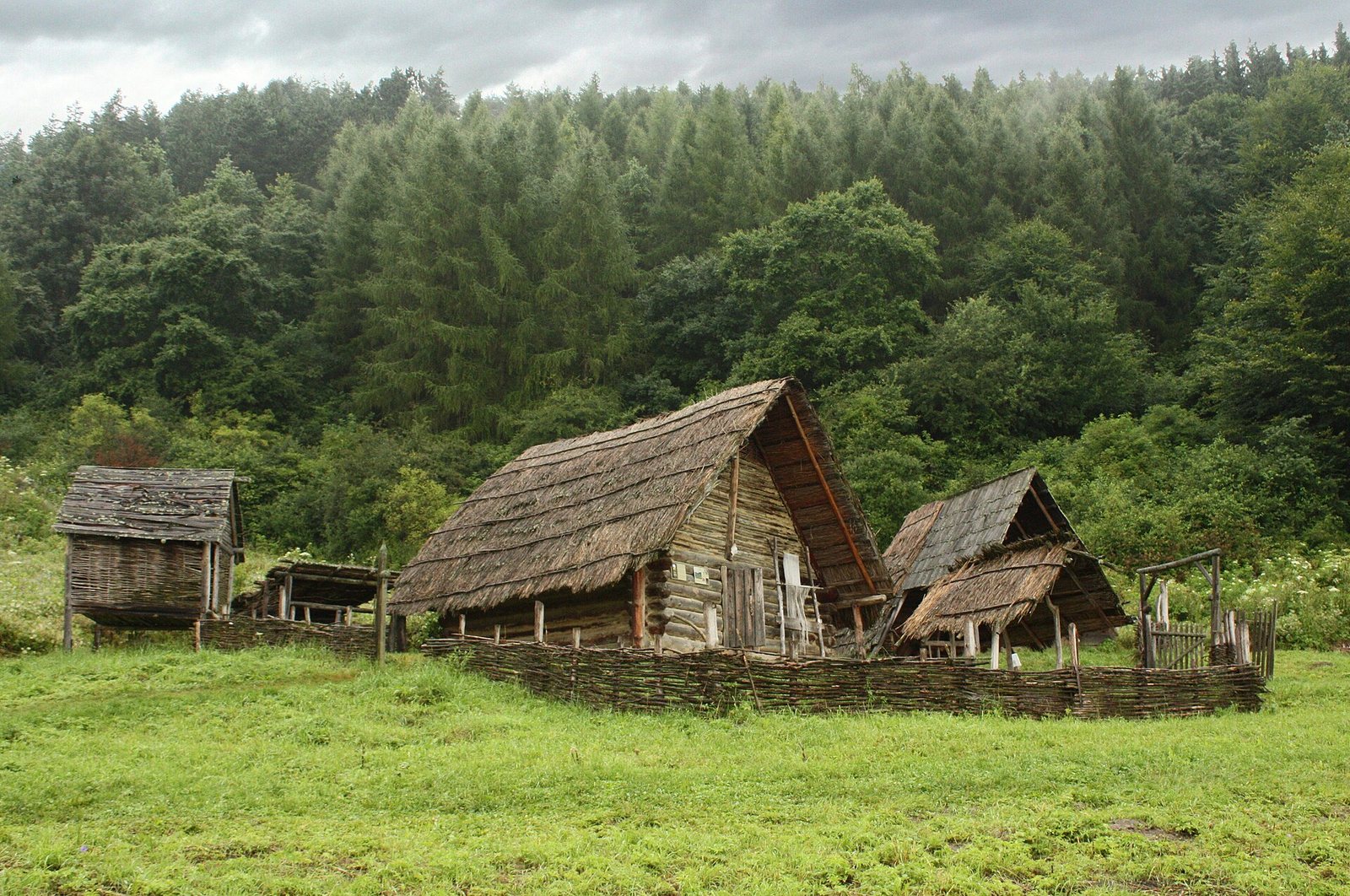
Archaeologists have long linked the Gotini with the so-called Púchov culture, named after the site of Púchov-Skalka in the Váh valley. An "archaeological culture" is a classification: a group of sites with similar pottery, ornaments and fortifications. The Púchov culture is seen as a late form of the La Tène culture, the Celtic material culture of the later Iron Age, and lasts in the Slovak uplands into the Roman period.
The link to Tacitus' language note is tempting: Celtic material culture in the mountains, a Celtic-speaking people in the mountains. Even so, the Slovak archaeologist Karol Pieta, as summarised in the English-language Wikipedia, warned against equating a people with a group of finds. It cannot be shown that the Cotini were the only bearers of this culture, much of the area is unexcavated, and pottery does not reveal a language. According to the German-language Wikipedia, the historian Bruno Bleckmann has considered assigning the Púchov culture to the Cotini rather than to the Buri.
The same holds for iron. The Western Carpathians are rich in ores, and ironworking is well attested archaeologically in the region. But a smelting furnace carries no label. Whether the people who dug ore there called themselves Cotini is something archaeology alone cannot decide.
Are the Gotini and the Cotini the same people? Yes, according to current scholarship. "Gotini" is the reading of many Germania manuscripts, "Cotini" the form found in inscriptions, which modern editions adopt.
Were the Gotini Germans? Not according to Tacitus. He bases this on their Gallic language and on the tribute they paid. There is no other evidence for their language.
Have the Gotini anything to do with the Goths? As far as the evidence goes, no. The similarity very probably goes back to a copying error; Tacitus describes the Gotones separately as a Germanic people in the north.
Where did the Gotini live? In the uplands of present-day Slovakia, behind the Marcomanni and Quadi. Whether nearer the upper Váh or the upper Hron is stated differently in the literature.
Cotini and Osi · Quadi · Marcomanni · Marsigni · Buri · Lugii · Gutones · Goths · Celts · Germanic languages

The Cotini & Osi · The Quadi · The Marsigni · The Lugii · The Marcomanni.
All History & Finds articles →
In July 1999 a metal detector on a farm near Othem gave a signal, then flashed "overload", then switched itself off …
Read more →Few stones shaped early medieval display art as strongly as deep-red garnet. Sawn into wafer-thin plates and set in …
Read more →Grágás means "Grey Goose" and names the law of medieval Iceland as preserved in two large thirteenth-century …
Read more →The Greuthungi are a name that almost only one author knows: Ammianus Marcellinus, a Roman officer and historian of the …
Read more →