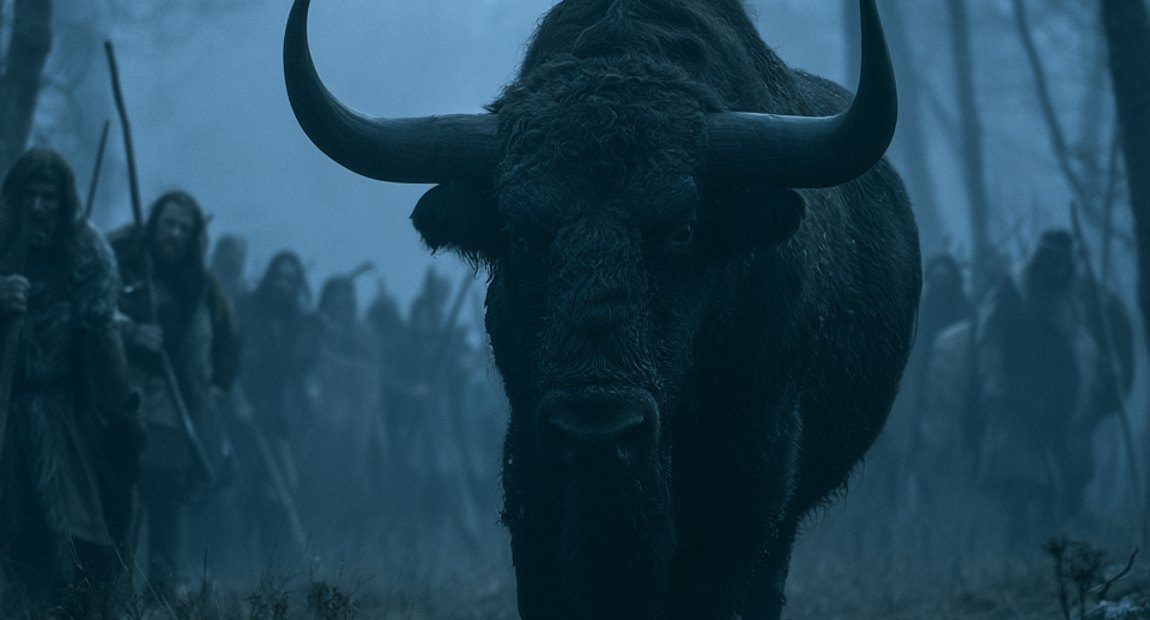
Picture a Viking autumn and you probably see smoking longhouses, cattle being butchered and a great feast at the start of winter. The picture is not wrong, but it rests on surprisingly few witnesses: on farm routines nobody at the time described, on sagas written in the thirteenth century, and on bones that speak less clearly than the cliché promises. This article separates what archaeology, laws, calendars and sagas actually yield from what we only infer from the logic of the farming year. That includes a refusal: I could not document an "autumn thing" as a fixed institution.
The Viking Age (roughly 793 to 1066) left travel accounts, annals and rune stones, but no farmer's diary. How a farm in Norway, Denmark or Iceland spent the autumn has to be pieced together from three groups of sources. First, archaeology: animal bones, plant remains, tools, house plans. Second, laws and calendars, almost all written down between the twelfth and fourteenth centuries and reshaped by Christianity. Third, the sagas, composed centuries after the events and describing the Viking Age through the eyes of their own present.
Each group has a weakness. Bones do not tell us when a feast took place. Laws say what should apply, not what happened. Sagas love the unusual, a quarrel at a drinking feast, a death on a winter night, and rarely mention the ordinary bringing in of barley. Wherever this article merely infers something, it says so.
The North knew, at its core, two seasons, summer and winter. The Old Norse word haust for "autumn" is related to German Herbst and English harvest, and it originally meant the harvest season rather than a season in the modern sense. As a calendar term it appears in the Icelandic month Haustmánuður, "autumn month", which the English Wikipedia entry on the Icelandic calendar places roughly from mid-September to mid-October. It is followed by Gormánuður, roughly mid-October to mid-November. That page offers two readings, "slaughter month" or "Gór's month", and does not decide between them. This is honest: deriving the name from slaughtering is widespread and plausible, but unproven. More on this calendar in our article on Germanic month names.
Winter began with the Winter Nights, Old Norse vetrnætr. For pagan times scholars reconstruct a date in the second half of October, possibly tied to the moon. For Christian Iceland the sources give a rule placing the start of winter on a Saturday between 10 and 16 October (Julian), which corresponds to 21 to 27 October in the Gregorian calendar that Iceland adopted in 1700. Both points are reported by the English Wikipedia after Gunnell (2000) and Nordberg (2006); I have not seen the scholarly literature itself. The difference matters: this is a church-calendar date, not a secured date of paganism. And a fixed 31 October, as modern Halloween comparisons like to have it, does not occur in the Norse sources.
The backbone of arable farming was barley, with oats beside it, rye gaining ground in southern Scandinavia, plus peas, beans and flax. That is how our article on Viking farming summarises it, and it fits the plant remains from settlements, though I did not check those against the originals in this round. Reaping was done with an iron sickle, stalk by stalk; the long-bladed scythe belonged more to the hay meadow. The grain then stood in sheaves under cover before threshing.
Exactly when in the year the harvest took place cannot be given in days for the Viking Age. It depended on latitude, summer weather and crop, and the sources name no dates. In the far north and in Iceland grain was a gamble anyway; pasture and hay counted for more. What can be said: harvest work lay between the hay harvest of high summer and the onset of winter, and it depended on the weather. A rainy late summer could spoil hay and shorten the grazing season, and so could an early frost.
In mountain regions there was also the bringing back of livestock from the summer pasture, the sæter or shieling. We know the system from the terrain and from later accounts; on what date in which region the herds came down, we do not know. Here too, the rhythm followed the grass, not the calendar.
The heart of the autumn calculation was winter fodder. Indoors or near the farm, livestock had to get through months on stored hay. If the supply did not cover every animal, the herd had to shrink. That yields the usual explanation for autumn slaughter: before winter you killed the animals you could not feed through it and put the meat aside in durable form.
The explanation is logical and fits the interpretation of Gormánuður. But it is first of all an inference from the farming economy, not a finding. How many animals were actually killed in autumn, whether there was a fixed day, whether cattle, sheep and pigs followed the same rhythm, cannot be derived from logic alone. For that we have to ask the bones.
Archaeologists can estimate an animal's age at death from tooth wear and bone fusion. That points to husbandry aims (milk, meat, traction) and, for young animals with a known birth season, to the season of death. One of the best-known studies for the Viking Age is Terry O'Connor's work on the animal bones from Anglo-Scandinavian York (2004), mainly from the Coppergate excavation. I read it through a retrieval tool that summarised the text, and I report it with corresponding caution.
The result fits the cliché only halfway. According to O'Connor the adult cattle were on the whole not particularly old, mostly about three to five or six years, with some second- and third-year animals; the profile does not suit a pure dairy or beef herd, and he thinks of mixed use including breeding, traction and dung. For sheep he cautiously suggests young ewes culled in their second year and wethers in their third or fourth, and he calls this speculative himself. Most pigs died in their second year; he sees no marked seasonal slaughter for them. A sharp autumn peak does not appear in this study.
That does not refute autumn slaughter. York was a town that bought its meat; a farm in western Norway or Iceland lived differently. But it shows how carefully the statement "animals were slaughtered in autumn" must be handled until it has been shown on site. The butchery traces are interesting too: cattle vertebrae were often split lengthwise, long bones split open, and the author infers little central control, with slaughter done in the household or neighbourhood. For Icelandic finds such as Hofstaðir there are ritual interpretations, which we present in our article on Viking customs.
Without a refrigerator, autumn was when the abundance of summer had to be made durable. The methods are known from finds and comparison: drying, smoking, souring and salting. Our article on Viking food describes them in detail. Smoking suggests itself because meat and fish hung in the roof above the long fire; that is inferred from house construction, and I have no direct evidence here for particular smoking practices. Butter and skyr, the thick soured-milk curd, also counted as stores laid in during summer.
One special case is stockfish, air-dried cod without salt. It does not belong to autumn, though. According to the English Wikipedia the fish is hung on wooden racks, hjell, from February to May because it needs cold, dry air, and drying removes about 80 percent of its water. As the earliest mention as a trade good the page names Egil's saga from the thirteenth century, in which Þórólfr Kveldúlfsson ships stockfish from Helgeland in Norway to Britain, and it dates that to 875. That year belongs to the saga's story, not to an archaeologically secured date. The autumn store therefore consisted of other things than the famous stockfish: grain, cheese, butter, salted and smoked goods, dried berries.
The best-attested autumn event is the Winter Nights. The sagas mention them so often that one might take them for a fixed date. According to the English Wikipedia, which relies on Gunnell (2000), Nordberg (2006) and Sundqvist (2015), it was probably a festival of about three days with a sacrificial meal, drinking and games. This is supported by Valla-Ljóts saga, which speaks of the "third winter night"; the length is not strictly proven by that.
What the sagas tell in detail is varied. In Eyrbyggja saga the chieftain Snorri holds an autumn feast with plenty of ale. In the longer version of Gísla saga, Þorgrímr holds a feast at the Winter Nights to welcome winter and to sacrifice to Freyr; the shorter version calls it a vetrnáttablót. In Víga-Glúms saga a man in Norway arranges a dísablót that everybody is expected to attend. In Gísla saga and Eyrbyggja saga the ball game knattleikr belongs to this season as well, and Vatnsdæla saga and Gunnlaugs saga ormstungu describe weddings around the Winter Nights.
"Then one should sacrifice toward winter for a good year, and at midwinter sacrifice for growth, the third in summer, that was the victory sacrifice."Snorri Sturluson, Ynglinga saga, ch. 8, from the Old Norse text on heimskringla.no (Linder/Haggson edition), own translation
This is the most famous passage on the sacrificial year. It has to be read in context: Snorri wrote around 1230 and portrays Odin as a king of the distant past who gives laws. The three sacrificial dates are therefore his picture of heathen times, not a record. Whether "í móti vetri" means exactly the Winter Nights, he does not say. As our article on Yule shows, the autumn sacrifice at Hlaðir that Snorri tells in the saga of Hákon the Good is likewise a thirteenth-century narrative. An overview of the festival names is in Germanic festivals.
The Winter Nights had a dark side. In Þiðranda þáttr from the Flateyjarbók, after the sacrifice of a special bull a young man, Þiðrandi, is killed by nine dísir, female fate beings, after he went outside despite a warning; so runs the summary on Wikipedia. In Gísla saga the hero has prophetic dreams after the feast, and a stanza from Bjarnar saga Hítdælakappa has a dís announce a death in an autumn dream. The skald Sigvatr Þórðarson, a Christian, was according to the verses of the Austrfararvísur turned away in the early eleventh century in Sweden from farms where an álfablót was going on. An álfablót, a sacrifice for the elves, is thus at least attested as a Swedish autumn custom.
Whether dísablót, álfablót and Winter Nights were one festival or three is unclear. Scholars consider it possible that the dísablót was in some regions another name for the autumn festival. A link to Bede's "Mothers' night" in winter is being considered, but that is a comparison, not proof. Equally open is whether the Winter Nights later merged into All Saints or Michaelmas. The Gulathing law required brewing ale at All Saints and placed it after the old time of the Winter Nights: a sign of church overlay, but not of cult content.
The working topic of this article named an autumn thing. I could not document a fixed institution under that name, and I did not read the legal texts that would settle it in the original during this research. That is the honest starting point. Independent of this: the thing was a place of law, not a harvest festival, and the sites are described in thing sites. Whether individual regional assemblies took place in autumn, say to settle questions about livestock after the descent from the pasture, is an obvious guess without a source that I would rather not state as fact.
Something else is better attested: laws regulated autumn through hunting rights. According to the Wikipedia summary (Nordberg 2006) the Swedish Dalalagen allowed hunting only in the winter half, between Winter Nights and Summer Nights, whereas Upplandslagen tied it to All Saints. Both manuscripts date from the late thirteenth and fourteenth centuries but may preserve older law.
Sociability evidently belonged to autumn, once the work was done. Whoever had harvested barley could brew ale; that ale appears so often in the saga scenes of the Winter Nights fits this. Weddings fall in this season in individual sagas. That the harvest was in and the stores were full is a natural explanation, but the sagas do not say so. These are saga scenes, not statistics. How people drank is explained under beer, mead and drinking horn; the ritual drinking bout is described in Blót and Sumbel.
It is often said that men went on voyages in summer and came home in autumn to slaughter. Our article on farming draws the same picture. As a rule of thumb it is usable, but as a rule it is too smooth. That Norse armies wintered in England and in the Frankish realm and sometimes stayed is generally known from the Anglo-Saxon and Frankish annals and speaks against a fixed return in autumn. I could not check the annals' wording in this round: the text version I retrieved only reached about the seventh century. Trading voyages and return depended on weather, commission and route. Crossing the open sea in winter was hard, and anyone wanting to return north had to consider that: this is a nautical consideration, not evidence for a particular date. On ships and seafaring see longships, on trade Viking trade.
Outside the North, Bede around 725 supplies a hint that our article on month names treats at length: he calls November Blodmonath, "sacrifice month", because cattle that were to be slaughtered were then dedicated to the gods, and October Winterfilleth, because winter began with the full moon of that month. I have not read Bede's full text: the name Blodmonath and its reading as the month of offerings of slaughter animals come from a Wikipedia summary, and Winterfilleth I saw only as a list entry; the full-moon explanation is given after our own articles and could not be checked. Note that Bede writes about the heathen Anglo-Saxons, a century after their conversion, not about Danes or Norwegians. His lines support the idea of an autumn slaughter and sacrifice season in the Germanic world, but they document no particular festival of the Viking Age.
That is the pattern running through the whole autumn: we have fragments from different centuries and regions that fit together well. Whether they belong together is an assumption. Whoever keeps them apart cleanly gets a more cautious but durable picture.
In Norse tradition autumn ends with the fear of winter. In myth that is the Fimbulwinter, the great winter before the end of the world, in which according to the Gylfaginning three winters follow one another without a summer. That is mythology in its thirteenth-century form, not a climate report. But it shows how seriously people took a winter in which hay or stores ran out. More in the article on Fimbulwinter.
For an article on autumn the source base is thin. Missing are age profiles of farm animals from Norway, Denmark and Iceland that would confirm or refute slaughter peaks, seasonal data from plant remains, and informative legal texts. The picture of autumn slaughter, stores and feast is a plausible mixture of economic logic and saga scenes. Anyone presenting it as secure goes beyond the sources.
When did the Winter Nights begin? For paganism a date in the second half of October is reconstructed, perhaps moon-bound. The rules of Christian Iceland give a Saturday date in October.
Was livestock really slaughtered in autumn? It is plausible because of winter fodder and fits the reading of Gormánuður. The bones from York show no sharp autumn peak; I have not seen other finds.
What is a dísablót? A sacrificial feast that the sagas place in autumn and, for the example given, in Norway. Whether it was identical to the Winter Nights is open.
Was there a harvest thanksgiving? A Germanic harvest thanksgiving is not attested in the sources; the sacrifices Snorri names were for the year and for growth.
Did Vikings eat only salted food in autumn? That cannot be said. It is certain that stores were laid in; which quantities came from which preserving method is not recorded.

Viking Farming · Viking food & drink · Forgotten Germanic month names · The Germanic feasts · The Thing.
All History & Finds articles →
The Hermunduri are the tribe to which Tacitus grants a special rank: alone among the Germans they were allowed to trade …
Read more →The Heruli are among the most puzzling peoples of late antiquity. A fleet from the Black Sea sacks Athens in 267, a …
Read more →The Hevelli lived on the middle Havel, around the fortress of Brandenburg. Nearly everything we can read about them …
Read more →In November 1872 one of the worst storm floods of the nineteenth century pushed the Baltic over the coasts from Denmark …
Read more →