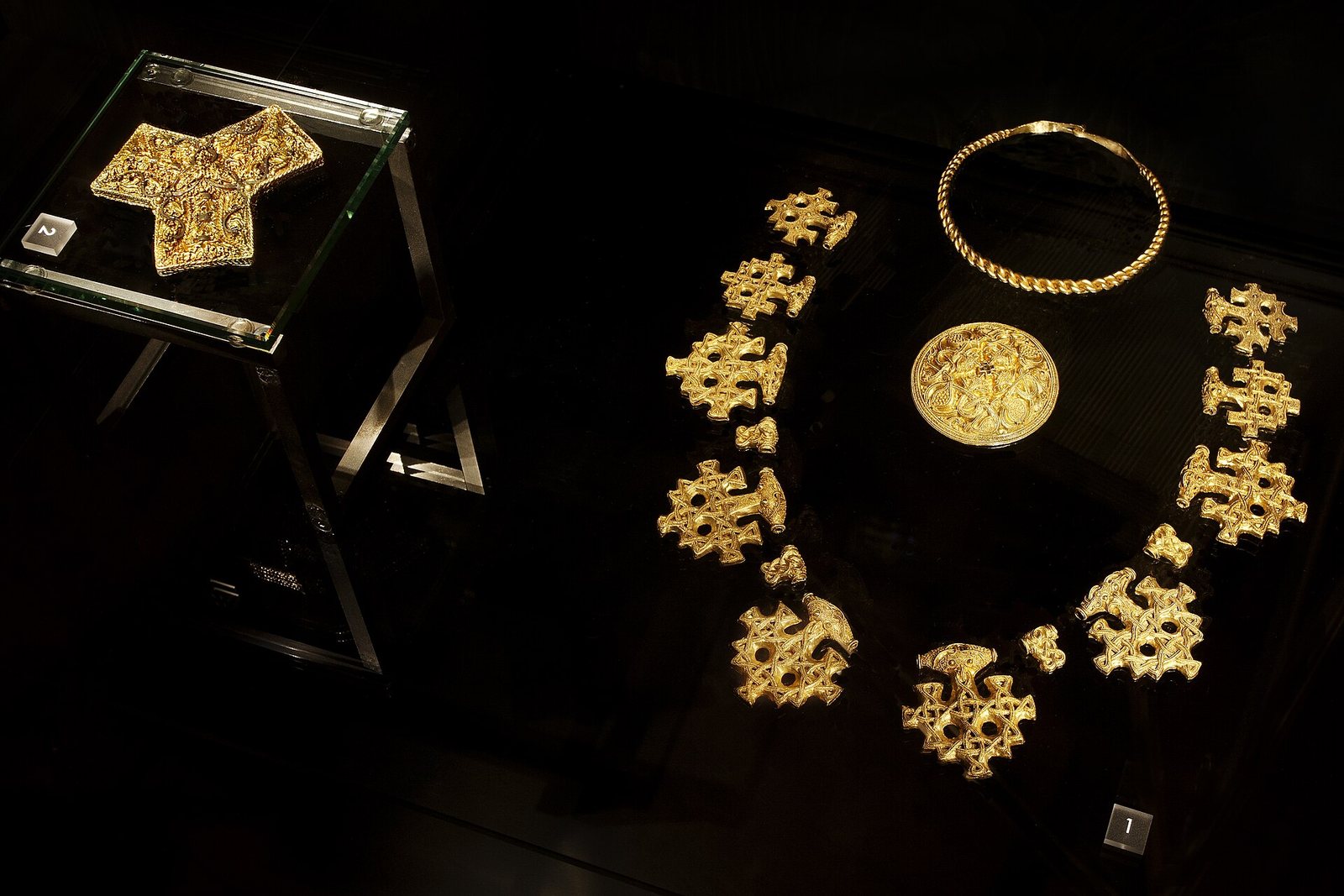
In November 1872 one of the worst storm floods of the nineteenth century pushed the Baltic over the coasts from Denmark to Pomerania. Over the following two years, islanders on Hiddensee picked up pieces of gold on the beach near Neuendorf, one after another: cross-shaped pendants with bird heads, a disc brooch, a heavy twisted neck ring. Together they make sixteen pieces and almost 600 grams of nearly pure gold, made in the late tenth century in a workshop within the Danish sphere of power. This article sets out what is established about the find, its manufacture and its date, weighs the readings between Thor's hammer and cross, between royal court and piracy, and says plainly where needed: this cannot be proven.
Hiddensee is a narrow island about 17 kilometres long, lying west of Rügen off Germany's Baltic coast. Here, in the south of the island near Neuendorf, the best-known Viking-Age gold on German soil came to light. The Stralsund Museum, which has owned it since 1873/74, describes it as the largest Viking gold treasure in Germany. I know of no larger Viking-Age gold find from Germany, though I have not seen a complete list. It is not the largest anywhere: the Hoen hoard from Norway contains considerably more gold.
What makes Hiddensee important is not its mass but its completeness. The Viking Age ran on silver. The North had no gold deposits of its own; gold arrived through trade, tribute and plunder and stayed in the hands of the very top of society. Researchers know around a hundred pendants and brooches in the same style, almost always smaller and mostly of silver. Hiddensee is the only known ensemble of its kind in gold. For an overview of the jewellery of the period, see our article on Viking jewellery.
It begins with the Baltic storm flood on the night of 12 to 13 November 1872. It devastated parts of Lolland and Falster and flooded much of Eckernförde. On Hiddensee dunes were shifted, and during rebuilding and along stretches of beach near Neuendorf islanders found the first pieces of gold. By their own account the finds came over two years; further storms evidently exposed more. The state museum of Mecklenburg-Western Pomerania names storm floods in both 1872 and 1874. According to Barbara Armbruster and Heidemarie Eilbracht, the finds were spread over a stretch of beach roughly 60 metres long.
Who exactly found the pieces is not recorded by name in the sources I could read. The provincial museum in Stralsund bought the pieces step by step in 1873 and 1874. Its director Rudolf Baier treated them as a genuine buried find. His successor Otto Gummel later put forward a quite different explanation: the jewellery had been stolen from the captain's cabin of the stranded schooner "Klara Karl". No evidence was ever produced, and the theory did not take hold.
Whether the sea washed the pieces onto the beach or the surf scoured them out of the dune sand is still undecided. One important clue comes from the neck ring: it was found coiled up. Armbruster and Eilbracht conclude that it was kept in a perishable container or a pottery vessel. No such vessel, however, was ever reported. Most researchers today assume the jewellery was buried as a group and laid bare by the floods.
The sixteen pieces fall into four groups.
The neck ring. It is made of four gold rods, twisted in pairs and plaited together. Cast terminals at the ends form a hook-and-eye clasp.
The disc brooch. A round dress fastener decorated with four interlaced animal bodies and a cross motif at the centre. The way the pin is attached shows that it was meant for a right-handed wearer.
The ten cross pendants. Six larger and four somewhat smaller pendants in the shape of a cross, the arms widening outwards, the surfaces covered with filigree, granulation and interlace. The suspension loops end in stylised bird heads. According to the "Viking Gold" exhibition, the large examples are almost seven centimetres long.
The four small pieces. Small triangular pendants that some descriptions interpret as spacers, pieces that sat between the large pendants on the chain. They were probably cast in reusable moulds.
This explains the different figures in circulation: sometimes you read of "fourteen pendants", sometimes of "ten pendants and four spacers". Both describe the same ensemble. Spherical beads, occasionally mentioned, do not appear in the specialist descriptions I have read. Armbruster and Eilbracht also consider the find incomplete. It may originally have contained further pieces, perhaps even a second neck ring.
You will find several values for the total weight, all close together. The regional tourism portal for Hiddensee gives 596.2 grams, the state museum of Mecklenburg-Western Pomerania 595.5 grams, Armbruster and Eilbracht in 2006 about 598 grams; the Berlin State Museums round it to about 600 grams. What is certain: just under 600 grams, a little over a pound of gold.
Purity matters more than weight. Synchrotron X-ray fluorescence measurements at the BESSY II light source in Berlin, taken at some 160 points, gave gold contents of about 92 to 96 per cent, roughly 22 to 23 carats. The neck ring sits at the top of the range, the brooch at the bottom. The composition is so consistent that Armbruster and Eilbracht conclude the treasure was made in one workshop from a single source of metal. Comparable pieces from Hedeby show a much wider spread of gold values.
In filigree, fine wires, plain, notched like a string of beads or twisted into cords, are set onto a base plate. Granulation adds minute gold granules, often less than a millimetre across. A single pendant can consist of several hundred separate parts, which is exactly why such pieces are so useful for studying what their makers knew.
The basic shape of the pendants and the brooch was formed on a press die, a kind of stamp of copper alloy with a raised relief. The goldsmith pressed a thin gold sheet over it, sometimes warmed, and obtained a domed surface with animal and interlace patterns. Wires and granules were then added to this surface. In her analysis Heidemarie Eilbracht describes a metallic solder applied in a single heating, since every further heating would have loosened joints already made. Teaching materials from the University of Greifswald put it differently: the granulation was fused on rather than soldered. So the accounts differ, and I cannot resolve the point from the texts available to me.
Mistakes are visible too: splashes of solder, shifted joints, a loose sheet re-attached with rivets. The neck ring and the clasp terminals were cast, the terminals joined on by casting-on. All the pieces show wear.
Archaeologists know tools of the same kind from several places. The largest known collection of press dies comes from the harbour basin of Hedeby on the Schlei, and some of them were made for brooches and pendants of exactly this style. Comparable tools are known from Staraya Ladoga and from the Mästermyr chest on Gotland. More on the craft in our article on Viking goldsmithing.
There is no inscription, coin or scrap of wood that could be dated to the year. The date rests on style. Armbruster and Eilbracht place the treasure in the last quarter of the tenth century, the state museum of Mecklenburg-Western Pomerania in the second half of that century. The style itself, often called the "Hiddensee style", was current in the tenth and early eleventh centuries. A narrower date such as "970 to 980" does not appear in the specialist sources I found. It would fit the stylistic dating, but it is more precise than the method allows.
As early as 1880 a Berlin exhibition presented the pieces as tenth-century Scandinavian gold jewellery; the jeweller Paul Telge later said he had seen the originals in the Prussian House of Representatives. The specialist literature I have read places the workshop in the Old Danish realm, in what is now Denmark and the then Danish province of Scania, not on the Slavic southern shore of the Baltic.
Hardly any text on the Hiddensee gold manages without Harald Bluetooth. Harald Gormsson ruled the Danes from about 958 to 986/87, was baptised, and boasted on the great runestone at Jelling that he had made the Danes Christian. In 2012 the Berlin State Museums wrote that the jewellery probably belonged to this king's family. The digital exhibition "Viking Gold" is a little more cautious: the treasure belonged to one or more women close to the king.
There are understandable reasons for this idea. Fine gold in this quantity and quality presupposes access to a centre of power. Press dies in this style are known from Hedeby and from ring fortresses built under Harald. And the dating fits his reign. Still, none of this proves an owner from his family. No written source mentions gold jewellery on Hiddensee, and no piece bears a name. The Greifswald teaching materials state explicitly that the attribution to Harald cannot be proven, and Armbruster and Eilbracht treat it as legend. It remains a plausible hypothesis built on style, material and date. More on the king himself in our article on Harald Bluetooth.
If the jewellery was made in Denmark, why was it lying in the sand of an island off Rügen? Researchers have offered several answers, which Armbruster and Eilbracht set side by side and all describe as speculative:
None of these explanations can be proven. The only clear thing is what the treasure is not: a store of value made of chopped-up precious metal. In that respect it differs sharply from the silver hoards and the hacksilver of the age, which were buried for their metal value. This was a complete set of jewellery that had been worn.
In the tenth century the coast between Kiel and the Oder was not Viking land but settled by Slavs. On Rügen lived the Rani, also called Rugians, later famous for their temple at Arkona and their seafaring. Hiddensee, which in the High Middle Ages belonged to the principality of Rügen, lay right on their doorstep. At the same time the southern shore was closely bound up with Scandinavia. On the Großer Jasmunder Bodden on Rügen lay the trading place of Ralswiek, on the Peene the site of Menzlin. At both, Scandinavian and Slavic traces lie side by side; at Ralswiek, for instance, boat graves and a hoard of Arabic silver.
The Rani themselves become clearly visible in written sources only later. Adam of Bremen mentions them around 1075; Helmold of Bosau around 1170 and Saxo Grammaticus around 1200 write about them at length. They wrote from a Christian, partly Danish viewpoint two centuries after the jewellery was made, so their picture of a feared sea people cannot simply be projected back to around 975. Anyone asking Filipowiak's question about "pirate loot of the Rani" is relying on a later image and on the island's location, not on any report about Hiddensee.
"The Rani, who are also called Rugians, the strongest people of the Slavs, who alone have a king." – "The Rani, however, who are called Runi by others, are a cruel people dwelling in the heart of the sea."Helmold of Bosau, Chronica Slavorum I, 2 and I, 36 (c. 1170). Latin: "Rani, qui et Rugiani, gens fortissima Slavorum, qui soli habent regem" and "Sunt autem Rani, qui ab aliis Runi appelantur, populi crudeles, habitantes in corde maris". Our own translation of the public-domain original.
Helmold writes as a missionary priest in Holstein, for whom the Rani were the last stubborn pagans of the North. "In the heart of the sea" refers to Rügen's island position. His chronicle is no evidence for who owned the Hiddensee gold. It does explain why the piracy theory arose at all. For the wider picture, see our article on the Vikings in the Baltic.
In the trade, replicas of the pendants are often sold as the "Thor's hammer of Hiddensee". The specialist literature almost always speaks of cross pendants. Armbruster and Eilbracht describe "cross-shaped pendants", and the archaeologist Jörn Staecker lists the type as "cross-shaped Hiddensee pendants" in his study of cross and hammer pendants. The "Viking Gold" researchers think the cross elements quite possibly carry a Christian meaning.
Where does the hammer reading come from, then? The arms of the pendants widen outwards. Anyone who pictures a Thor's hammer with flaring heads easily sees a related silhouette. Bird heads and interlaced animal bodies also come from the pre-Christian imagery of the North. The result looks like a hybrid.
That ambiguity is not just a trick of perception; it suits the period. In tenth-century Denmark both signs existed side by side. From Trendgården in northern Jutland we have a mould in which a craftsman could cast crosses and hammers at the same time. Whether a particular Hiddensee pendant meant Christ, Thor or both to the woman who wore it, we do not know. The shape is a cross, the ornament Nordic, and the workshop lay in the realm of a king who was just making Christianity the religion of state. Archaeology cannot say more than that.
Read this way, the Hiddensee gold becomes a witness to a time of transition. Harald Bluetooth's baptism, described in different versions by Adam of Bremen and Widukind of Corvey, is usually placed in the 960s. The Christianity of the Danish elite was at first a matter of court and display. Gold cross pendants decorated in the native animal style are a vivid example: the new religion appears in the old visual language of power. More in our article on the Christianisation of the Germanic peoples.
Staecker recorded another finding in his study. Of the cross-shaped Hiddensee-style pendants he counted in hoards, more than three quarters survive only as fragments. That the Hiddensee gold set survived complete makes it exceptional in this respect too.
As soon as the treasure became known, it was copied. From 1882 the Berlin jeweller Paul Telge advertised exact replicas of the Hiddensee jewellery along with costume jewellery in a "Nordic" style. The historian Charlotte Wenke devoted a study to these Telge copies in 2022. From the 1920s the Stralsund goldsmiths' workshop Stabenow made miniature replicas that were sold as souvenirs and jewellery.
The originals and the copies have histories of their own. At the end of the war in 1945 the original was first taken to Szczecin, then brought back and buried. In 1947 it was dug up, confiscated by the Soviet Kommandantura and later returned to the city of Stralsund. In East Germany it was shown every year until 1975 during the Baltic Sea Week in Stralsund, a state showcase event; the sources give 1958 or 1962 as the start of this series. In 1973 the SED district leadership in Rostock presented the party leader Erich Honecker with a replica in a casket; the friends' association of the Stralsund Museum acquired it in 2023. In 1976 a cross pendant appeared on an East German postage stamp.
Another copy, said to have belonged to the Stasi minister Erich Mielke and bought by the Stralsund Museum in the early 1990s, is surrounded by stories that Charlotte Wenke knows only from oral tradition.
Today Hiddensee pendants turn up at medieval fairs, in online shops and as a motif on mugs. The exhibition "Viking Gold. Treasure politics since 1800", curated by Isabelle Dolezalek and Charlotte Wenke, told this story of appropriation in 2025 and early 2026 at venues around the Baltic and in the Pomeranian State Museum in Greifswald; a digital version is available online. We engrave Nordic motifs after historical models ourselves and think it right to say openly which form an original had and which is a modern derivation.
The jewellery has travelled more often than you might expect of so valuable a find. In 1986 it was shown in Stockholm, and in 1992/93 in the Council of Europe exhibition "From Viking to Crusader", seen in Paris, Berlin and Copenhagen. In 2012 the Berlin State Museums displayed it for a few weeks in the Neues Museum as a forerunner of the major Viking exhibition that ran in Copenhagen, London and Berlin from 2013 to 2015. Since 2015 it had been on permanent display in the Stralsund Museum.
If you want to see it, check first. According to the regional tourism portal, the exhibition in the Katharinenkloster, the main building of the Stralsund Museum, is closed for renovation until March 2027. A dpa report from October 2025 had still announced the jewellery's return for the second half of 2026. So the information differs. A trip combines well: Stralsund, the ferry to Hiddensee, the replica in the museum in Kloster and the beach near Neuendorf where it all began. Further museums with finds from the period are covered in our overview of Viking museums, and where the Viking Age left traces across Germany is shown in our article Vikings in Germany.
Where is the Hiddensee gold today? The original belongs to the Stralsund Museum. Because the Katharinenkloster is being renovated, check before a visit whether and where it is on display. A replica is shown in the local history museum in Kloster on Hiddensee.
How much does the treasure weigh? Just under 600 grams. Figures of 595.5, 596.2 and about 598 grams are given, depending on the measurement and the source.
When was the jewellery found? After the storm flood of 12/13 November 1872, islanders found the pieces one by one on the beach near Neuendorf until 1874.
Who made the jewellery? An unknown goldsmith in a workshop in the Old Danish realm in the late tenth century. The uniform gold alloy suggests that all the pieces came from one hand, or at least one workshop.
Are the pendants Christian or pagan? The basic form is a cross; the decoration with bird heads and animal bodies is Nordic. They probably reflect a time when both existed side by side.

Viking jewellery · Viking Goldsmithing · Harald Bluetooth · Ralswiek on Rügen · Viking traces in Germany.
All History & Finds articles →
Ibn Fadlan was the secretary of an embassy sent by the Abbasid caliph al-Muqtadir from Baghdad to the Volga Bulgars in …
Read more →Around the year 965 a stranger came to the Schlei. He came from Tortosa in al-Andalus, Muslim Spain, was Jewish, a …
Read more →Few peoples of Iron Age Britain left so many traces and at the same time vanished so completely behind a single person …
Read more →Soon after the year 205, a defeated army did not march home – it sank to the bottom of a quiet lake in eastern Jutland …
Read more →