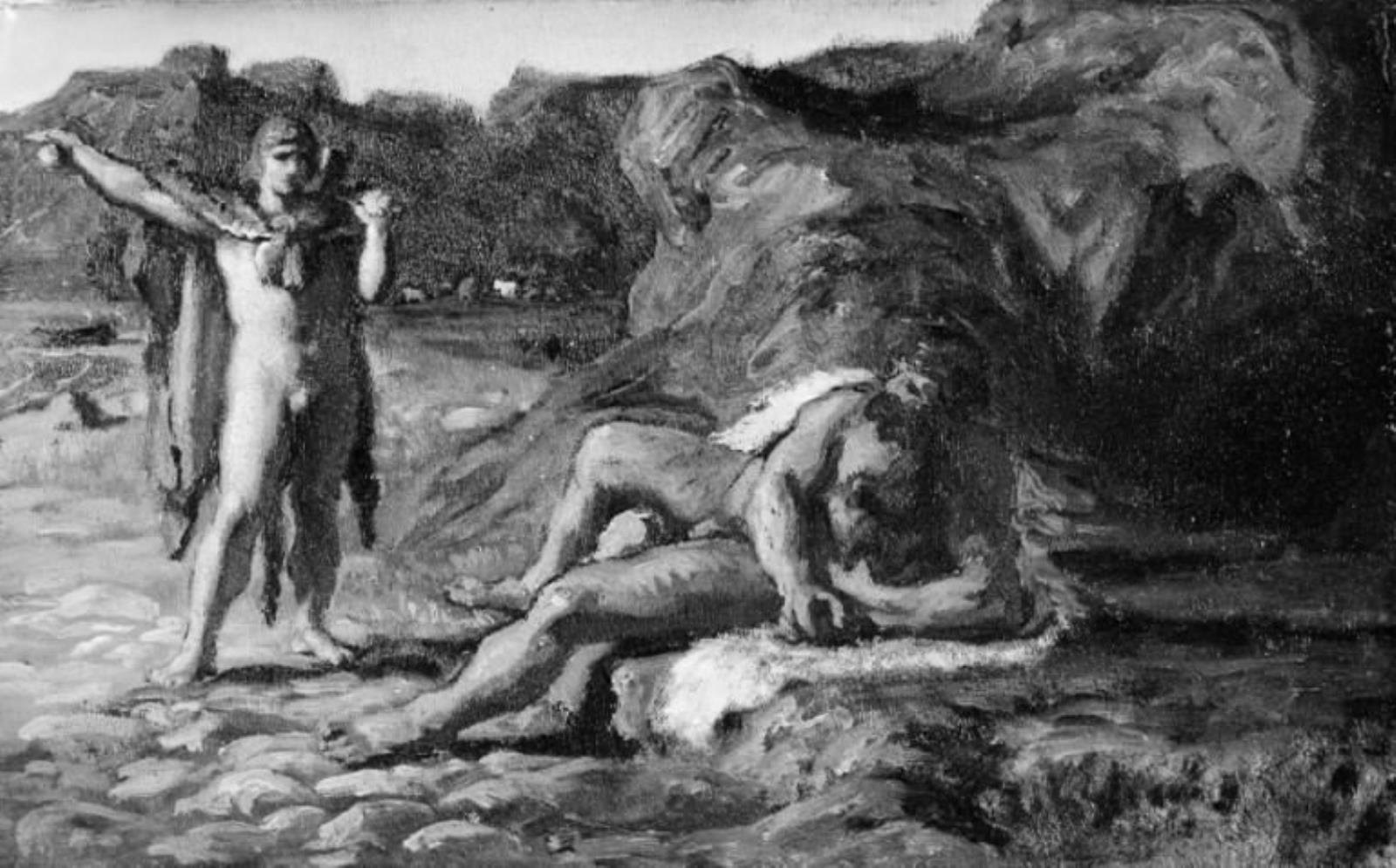
His beard is frozen, his glance splits a beam, and his skull is harder than any cup. Hymir is one of those giants everyone has met who has heard of Thor's fishing trip – and about whom surprisingly little is known. One Eddic poem, one chapter in Snorri, one insulting stanza and a handful of skaldic verses that never use his name: that is the whole record. This article sets the witnesses side by side and asks what kind of figure emerges.
Hymir turns up in four places. The fullest is Hymiskviða, a mythological poem of the Poetic Edda in 39 stanzas. There he owns an enormous cauldron that Thor and Týr fetch for the feast at Ægir's. The second is chapter 48 of Gylfaginning, where Snorri Sturluson tells in the thirteenth century how Thor rows out to sea with Hymir and hooks the Midgard Serpent. The third is a single stanza of Lokasenna in which Loki taunts the god Njörðr with “Hymir's daughters”. The fourth is a group of skaldic verses about the fishing trip, usually dated to the ninth and tenth centuries. A giant who fits Hymir appears in them, but none of the surviving verses names him.
That is all. Hymir has no part in the creation story, no role at Ragnarök and no genealogy. Bellows noted in 1923 that the figure occurs only in this one episode. Our article on Hymiskviða follows the poem stanza by stanza; this one is about the character.
Hymiskviða gives the giant an address. In stanza 5 Týr says that Hymir lives “east of Élivágar”, “at the end of heaven” (at himins enda). Élivágar is known from the creation narrative: in Gylfaginning (chapter 5) these are the primeval rivers whose venom hardens into ice, and in Vafþrúðnismál (stanza 31) the drops that grow into the first giant spurt out of them. Hymir sits where the world of the giants begins.
He is not a poor giant. He has a hall with pillars and a cross-beam where the cauldrons are kept. He has a herd of cattle, three of which are slaughtered in the evening, and in the wood stands an “all black” ox whose head Thor tears off. He owns a boat, a prized drinking cup and the one cauldron nobody else has. By day he hunts; he rows out to fish himself and hauls up two whales at once.
Of all Eddic poems, Hymiskviða has most in common with skaldic verse; that is Edward Pettit's assessment in the introduction to his dual-language edition of 2023. For Hymir its epithets add up to a small collection:
Wise and foolish, old and powerful: the epithets do not fit together neatly. Skaldic poets also choose such words for the alliteration. Anyone who turns hundvíss into a giant of wisdom is reading more into the one passage than it will bear.
What Hymir does is more telling. His entrance in stanza 10 is one of the densest images in the poem:
“Late to his home the misshapen Hymir,
The giant harsh, from his hunting came;
The icicles rattled as in he came,
For the fellow's chin-forest frozen was.”Hymiskviða, stanza 10, translated by Henry Adams Bellows (The Poetic Edda, 1923; from this site's source archive)
The “chin-forest” (kinnskógr) is his beard. Bellows's “icicles” render Old Norse jöklar; Simrock makes them glaciers. A moment later Hymir looks at the beam behind which the guests are sitting: the pillar bursts, the beam breaks, eight cauldrons come down, and only one, “hard-hammered”, stays whole (stanzas 12 and 13).
Without the cauldron there would be no Hymir in the poem. Ægir, who is to brew ale for the gods, demands a vessel big enough from Thor. None of the gods knows of one until Týr speaks: his father owns a cauldron rastar djúpan, “a röst deep”. The röst is a measure of travelling distance; Bellows renders it “a mile in depth”. For the poem it is enough that the cauldron is absurdly large.
How large becomes clear at the end. Týr tries twice to shift it and it does not move (stanza 33). Thor grips the rim, steps through the floor of the hall as he does so, and lifts the vessel on to his head – and the rings clatter about his heels (stanza 34).
Unlike the fishing trip, this scene is barely attested outside the poem. Pettit cites an example sentence in the First Grammatical Treatise, an Icelandic text from the middle of the twelfth century, in which the handle can be heard “when Thor carried the cauldron”, together with later kennings and the prose at the head of Lokasenna. In Bellows's translation that prose says Ægir had prepared ale for the gods after he had got “the mighty kettle”. What became of the cauldron is told in our article on Ægir's feast.
Before Hymir comes home the guests meet two women. Stanza 8 says that the young man – Týr, according to Pettit – found his amma, his grandmother, “whom he greatly loathed”; she had nine hundred heads. Nothing more is said. That she is Hymir's mother follows only if Hymir is Týr's father and the grandmother is on the father's side. Bellows read it that way; the poem never calls her “Hymir's mother”. She never speaks and does not appear again.
Many heads are a mark of giants that the poetry uses more than once: in Vafþrúðnismál (stanza 33) the primeval giant begets a six-headed son. Hymiskviða returns to it at the end, when the host pursuing Thor is called “many-headed” in stanza 35. Bellows, who counted the poem among the latest of those about the gods, singles out the nine-hundred-headed figure in Hymir's home in his introduction.
The second woman is her opposite. She comes forward “all golden”, bright-browed, and brings beer “to her son”. Pettit identifies her as Hymir's wife and Týr's mother. Stanza 30 calls her Hymir's frilla, a word Bellows paraphrases as “the loved one”. She has no name. Bellows guessed, and called it a guess, that she belonged to the gods rather than the giants.
For the plot she is the most important person in the house. She hides the guests under the cauldrons because her husband is often wrathful towards guests (stanza 9), and she tells Thor the trick with the cup: he should throw it at Hymir's skull, which is harder than any goblet.
“My father”, says Týr of Hymir in stanza 5. In stanza 11 the woman announces to the giant that “the son” has come to his hall. Pettit states that only in Hymiskviða is Týr said to be the son of a giant.
Snorri says something else. Skáldskaparmál lists among the ways of referring to Týr: the one-handed god, fosterer of the wolf, god of battles, “son of Odin” (son Óðins). In Gylfaginning (chapter 25), where Snorri introduces the god, there is no statement about his parentage at all.
Several solutions have been proposed. Finnur Jónsson changed “father” to “grandfather”; Bellows reports this in his note and adds that little is gained by it. Another approach reads týr here as the ordinary word for “god”; our article on Hymiskviða summarises it from Pettit. The third accepts both statements: Norse tradition had no binding list of gods, and a poem could preserve a parentage that Snorri did not know or did not need. It cannot be decided.
The direction of the kinship is worth noting. Unions between gods and giantesses occur repeatedly in the tradition; a giant as father of a god is rare. According to the English Wikipedia, citing John Lindow, the case may be unique. I have not checked Lindow's handbook, and it is not quite alone: Snorri calls Loki the son of the giant Fárbauti in Gylfaginning (chapter 33). More on the god in the article on Týr.
Hymir entertains his guests uneasily. When he sees Thor, “much sorrow his heart foretold” (stanza 14, Bellows). He has three steers boiled, and Thor eats two alone. Hymir's reply is dry: tomorrow they will have to live on what they catch (stanza 16).
On the water he pulls up two whales on one hook, a feat the poem reports without mockery. He will not row farther out (stanza 20). When Thor drags the Midgard Serpent up to the gunwale and the “fish” sinks again, Hymir does nothing in the poem. He cuts no line. On the way back he is “joyless” and says not a word (stanza 25).
Ashore he starts making demands. Thor is to carry the whales home or make the boat fast; he carries boat and catch together. Then the cup: only a man who can break it counts as strong. Thor hurls it through the pillars and it stays whole – until the throw against Hymir's head shatters it. Hymir laments that he has lost a great treasure (stanza 32) and sets the last condition: if they can get the cauldron out of the hall, that will do.
Only after that does he become an open enemy. Thor looks back and sees a many-headed host coming out of the caves “with Hymir from the east”. He sets the cauldron down, swings the hammer and kills “all” the hraunhvalar, “lava-whales” – a poetic term for giants, Pettit notes (stanza 36). Hymir, who leads the troop, is probably among the dead, but the stanza does not name him.
Snorri's Hymir is a different figure. In Gylfaginning 48 there is no cauldron, no Týr, no wife and no mother. Thor wants to make good his humiliation at the hands of Útgarða-Loki, sets out without chariot or goats, “like a young lad”, and in the evening comes to a giant “who is called Hymir”.
In the morning Hymir wants to go fishing. He thinks his guest too small and too young; he will get cold so far out. Thor is to find his own bait, and he tears the head off the biggest ox in the herd. In the Old Norse text of our archive the ox is Himinhrjóðr; Anderson's translation of 1880 writes “Himinbrjot”, Simrock “Himinbriotr”. Simrock's German text in the archive even calls the giant of this chapter “Ymir” – an example of how easily the two names run together.
Hymir rows in the bow, Thor sits in the bailing-space (austrrúm). The giant says they have reached his usual ground for flatfish, then warns that farther out the Midgard Serpent makes it dangerous. When Thor hauls it up and drives his feet through the bottom of the boat, “the giant Hymir changed colour, grew pale and was afraid”, because he saw the serpent and the sea washing in and out of the boat. At the moment Thor raises the hammer he fumbles for the bait-knife (agnsax) and cuts the line at the gunwale.
Payment follows at once. Thor plants his fist by the giant's ear so that he goes overboard “and the soles of his feet are seen”; then Thor wades ashore. Snorri does not say whether Hymir drowns. The poem's Hymir is a strongman who sets tests and loses. Snorri's is an experienced fisherman who panics and costs Thor his catch.
Older than poem and prose, on Snorri's attributions, are some skaldic verses on the fishing trip. Snorri quotes them in Skáldskaparmál as examples of kennings. Three concern the companion in the boat:
The name Hymir stands in none of these verses. The glosses “= Hymir” in translations are editors' additions, drawn from Snorri's prose and the Eddic poem. They are well founded, since the details agree, but they remain an inference. That the frightened giant in the boat was already called Hymir in the ninth century cannot be proved from the verses.
According to Anthony Faulkes the manuscripts do not all assign the half-stanza about the “thick-grown one” to the same poet but waver between Úlfr and Bragi; I know this only at second hand, through our article on Húsdrápa. And all these verses survive only because Snorri copied them in the thirteenth century.
In Lokasenna Loki tells Njörðr (stanza 34) that he was sent east as a hostage to the gods; “Hymir's maidens” (Hymis meyjar) used him as a chamber pot and urinated into his mouth.
No other source says who these women are. Bellows writes in his note that we have no clue, though Hymir is doubtless the giant of Hymiskviða. Hymiskviða knows of no daughters.
Two readings suggest themselves. Either the daughters of a particular giant are meant and Loki alludes to a lost story, or “Hymir's maidens” stands for giantesses in general, just as “Hrungnir's friend” can stand for any giant. Which of the two is right cannot be decided. More on the god is in the article on Njörðr.
What “Hymir” means is unresolved. The English Wikipedia sums up the position as follows: according to John Lindow (2001) the etymology remains unclear; Jan de Vries (1962) considered a relation to Norwegian humen (“limp, weary”) or humre (“whinny”); Andy Orchard (1997) proposed the translation “creeper”. I have consulted none of the three. Pettit likewise calls the etymology “uncertain”; among the possibilities he mentions a relationship to Old English heamol, “niggardly”, which would suit Hymir's stingy character.
Pettit adds that a folk-etymological link between Hymir and himinn, “heaven”, appears likely. The giant lives “at the end of heaven”, and in Snorri his ox is called Himin-hrjóðr. That shows how medieval listeners may have understood the name, not where it comes from.
The German Wikipedia translates the name as “der Finstere”, “the dark one”, without a reference. Hymir should also be kept apart from Ymir, the primeval giant of the creation story, and from Gymir, a byname of Ægir in the prose to Lokasenna.
Four carvings are connected with Thor's fishing: the Altuna runestone in Uppland, the Hørdum stone in Jutland, the Gosforth Fishing Stone in Cumbria and the Gotland picture stone Ardre VIII. None carries a caption with a name.
Hørdum and Gosforth are the candidates for Hymir, because two figures sit in the boat there. Pettit describes on both “a figure, presumably Hymir, about to cut Þórr's fishing line with an axe”. The identification rests on Snorri's prose and Bragi's verse; the images fit Hymiskviða, where nobody cuts the line, less well.
On the Altuna stone only one figure sits in the boat; Hymir is missing. The English Wikipedia counts Ardre VIII among the stones that show Hymir; that too is a reading without a caption. Details are in the article on Hymiskviða and the overview of picture stones.
Like Þrymr in Þrymskviða, Hymir owns something the gods need, and loses it. Pettit too draws on Þrymskviða for comparison in his introduction. Like Hrungnir he has a stone-hard head; Pettit notes the comparison at the throwing of the cup.
Other traits set him apart. Hymir steals nothing and challenges nobody. The gods come to him, and with cunning, as stanza 6 says openly. He has a wife who works against him and – taking the poem at its word – a son among the Æsir. From his side, Hymiskviða tells of a home invaded: two guests eat his stores, break his cup and carry off his cauldron. The comedy depends on the giant being a harassed householder, not a monster.
How old this figure is can only be narrowed down. According to Pettit the date and place of composition are uncertain, though scholars incline to the twelfth century; in 1923 Bellows still thought of the first half of the eleventh. Myths about Thor's fishing go back at least to the eighth century in Scandinavia, Pettit says, on the evidence of images. The frightened companion in the boat appears early, in the skaldic verses. The owner of the cauldron, with wife, mother and son, is attested only in the poem – whether the poet found him or elaborated him remains open.
Readings that see winter or the winter sea in Hymir can point to the frozen beard and the rattling ice. They have nothing beyond those images; the sources give Hymir no domain. More in the overview of the giants.
Who is Hymir? A giant of Norse mythology. In Hymiskviða he owns the cauldron Thor fetches for Ægir's feast; in Snorri he rows Thor out to sea, where Thor hooks the Midgard Serpent.
Is Hymir the father of Týr? According to Hymiskviða, yes: Týr calls him “my father” in stanza 5. Snorri calls Týr a son of Odin in Skáldskaparmál. The contradiction is unresolved.
Who cuts the fishing line? In Snorri's Gylfaginning it is Hymir, with the bait-knife. A skaldic verse attributed to Bragi also knows the cut line. In Hymiskviða nobody cuts it; the serpent sinks after Thor's hammer blow.
Does Hymir die? No source says so in as many words. In the poem Thor kills “all” the giants of the host that comes with Hymir. In Snorri Hymir goes overboard after a blow of the fist, and the story ends.
What does the name Hymir mean? That is unresolved. Links to Norwegian words for “weary” or “whinny” and the translation “creeper” have been proposed. Medieval listeners may have connected the name with himinn, “heaven”.
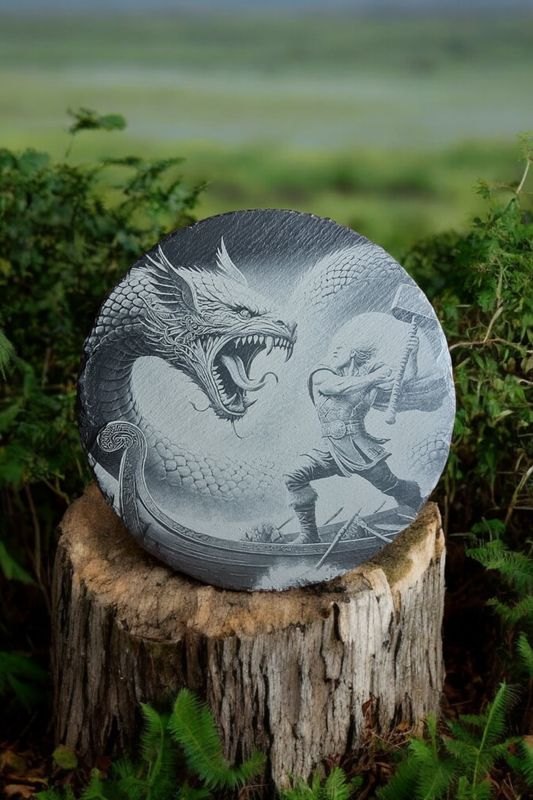
Hymiskviða: Thor fishes for the serpent · Thor · Týr – the god who gave his hand · Jörmungandr – the World Serpent · Ægir's feast & the Lokasenna.
A god tears the head off a black ox, rows further out than the boat's owner likes, and moments later has the creature …
Read more →A goddess wakes a giantess in the middle of the night to squeeze a family tree out of her. Her mount is a boar with …
Read more →A ship that no god can budge, a giantess on a wolf bridled with vipers, sparks from the rollers and a trembling earth …
Read more →The gods of Völuspá begin their story on a field, and the survivors return to the same field once the world has burned …
Read more →