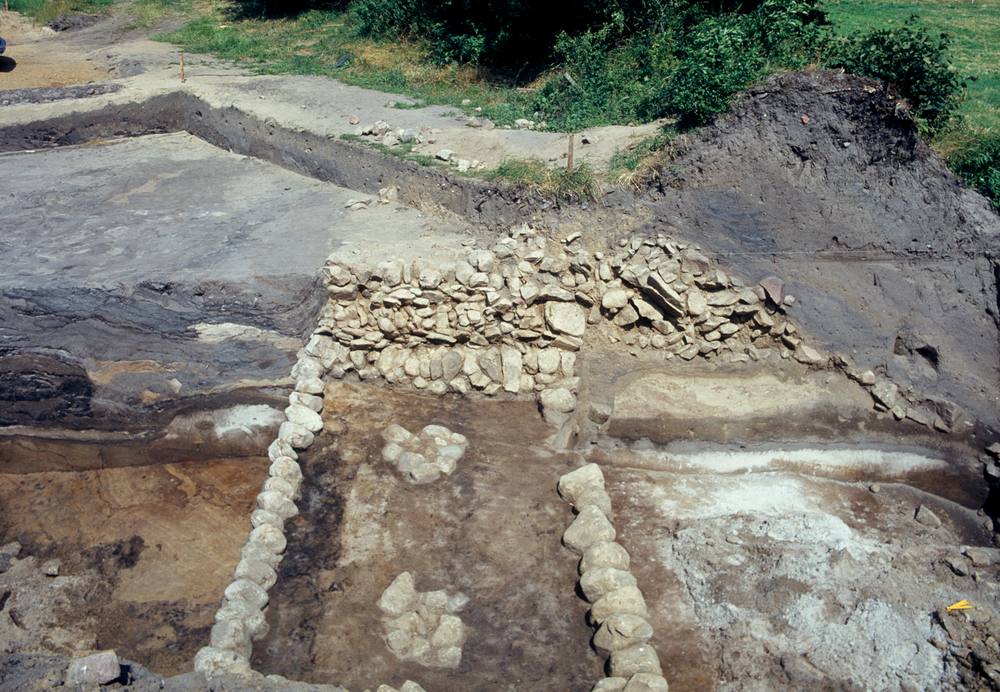
Godfred is the first Danish king we know from records written in his own lifetime. Those records, however, come from his opponents, the scribes at Charlemagne's court. They show a ruler with a fleet, cavalry and a border policy of his own, who kept Abodrites, Saxons and Frisians on edge between 804 and 810 and was then killed by a man of his own retinue. This article follows the sources year by year, separates annals, biography, archaeology and later legend, and says plainly where we know nothing.
Say "Viking king" and most people think of sagas, raids and nicknames like Bluetooth or Snake-in-the-Eye. Godfred fits that picture only loosely. He plays no part in any saga, and no runestone names him. What we know comes from Frankish texts: the so-called Royal Frankish Annals, the Annales regni Francorum, and Einhard's biography of Charlemagne. There he is the rex Danorum, king of the Danes, a neighbour and rival on the empire's northern frontier.
Godfred can be traced with confidence only between 804 and 810. When he was born, who his parents were and when his reign began are not recorded. Some have suggested he was a son or relative of the Danish king Sigifrid, who appears in the annals in the 770s and 780s. That cannot be proven. His end, by contrast, is dated: he was killed in the summer of 810.
What territory he ruled is also an open question. The annals call him king of the Danes, but they do not say whether "Denmark" around 800 already covered the later kingdom with Jutland, the islands and Scania, or whether Godfred's power lay mainly in southern Jutland, on the Saxon border. No map of his realm can be drawn. For the wider background, see the article on the Danes.
On the name: Latin texts write Godofridus; modern literature uses Godfred, Gudfred or the German Göttrik. The form Gudrød belongs to a very uncertain identification that we return to at the end.
The key source is the Royal Frankish Annals, a year-book kept at the Frankish court and covering 741 to 829. For the years around 800 the entries are regarded as near-contemporary, written months or a few years after the events. Their authors are anonymous. They write from the emperor's point of view: Charlemagne's successes come first, setbacks are brief or missing, enemies appear faithless or arrogant. Godfred appears in the entries for 804 and 808 to 810.
The second source is Einhard's Vita Karoli Magni, the Life of Charlemagne. Einhard knew the court at first hand but wrote after Charlemagne's death in 814; exactly when is debated, with proposals ranging from the late 810s to the 830s. In chapter 14 he treats the Danish war as Charlemagne's last war. The image of a king who promised himself mastery of all Germania comes from him.
Other annals such as the Annals of Fulda offer, as far as I know, nothing independent for 804 to 810; I have not consulted the Annals of Metz.
Then there is archaeology. It knows no Godfred, but it does know places in his story: the Danevirke, the trading site of Hedeby, and the site of Groß Strömkendorf near Wismar, which is very probably the Reric of the annals.
Godfred's story makes sense only against the Saxon Wars. From 772 Charlemagne fought the Saxons for three decades. The Saxon leader Widukind took refuge with the Danes in 777, where a king named Sigifrid then ruled.
By 800 Saxony was largely subdued. North of the Elbe, in Nordalbingia, Saxon groups still evaded Frankish rule. To the east lived the Slavic Obodrites (Abodrites in the sources), allies of the Franks, and beyond them the Wilzi, old enemies of the Obodrites. Every Frankish step north now touched Godfred's position.
In the summer of 804 Charlemagne led an army into Saxony. According to the annals he deported the Saxons living beyond the Elbe and in the district of Wihmodia, between the lower Elbe and Weser, with their wives and children into Francia, and gave the land north of the Elbe to the Obodrites. He himself camped at a place the annals call Holdunsteti, usually identified with Hollenstedt south-west of Hamburg.
At the same time Godfred came with his fleet and all his cavalry to Sliesthorp, on the border between his kingdom and Saxony. The name means roughly "village on the Schlei"; whether it meant Hedeby, a site near Schleswig or the area in general is answered differently by scholars. Godfred had promised to come to a meeting with the emperor. He came no closer, because, the annals say, the advice of his men frightened him off. He sent envoys instead. Charlemagne in turn sent a legation demanding the return of fugitives, probably Saxons who had fled. The annals report no result. By mid-September Charlemagne was back in Cologne.
"At the same time Godofrid, king of the Danes, came with his fleet and all the cavalry of his kingdom to the place called Sliesthorp, on the border between his kingdom and Saxony."
Annales regni Francorum, year 804 ("Eodem tempore Godofridus rex Danorum venit cum classe sua necnon et omni equitatu regni sui ad locum, qui dicitur Sliesthorp, in confinio regni sui et Saxoniae"), my own translation from the Latin
The sentence shows a king who can raise ships and horsemen at once, who regards the border as his own and who will not be summoned to the emperor like a petitioner. What actually made him hesitate we do not know; we only have the Frankish view.
For four years the annals are silent about Godfred. In 808 the conflict returns in force. Godfred crossed with an army into Obodrite territory. Charlemagne sent his son and namesake, Charles the Younger, to the Elbe with Franks and Saxons, with orders to resist if Godfred attacked the Saxon frontier.
Godfred camped on the coast for some days and took several Slavic strongholds by force. The annals list what he achieved. He drove out the Obodrite leader Thrasco (also Drasco or Thrasuco in modern literature), whose own people no longer trusted him. A second leader, Godelaib, he captured by treachery and hanged. Two thirds of the Obodrites he made tributary. The price was high. According to the annals Godfred lost his best warriors, among them his nephew Reginold, who fell with many Danish nobles while besieging a fortified settlement.
Godfred did not fight alone. The Wilzi joined him willingly, out of old hostility to the Obodrites, and went home with plunder. Two smaller Slavic groups on the Elbe, the Linones and Smeldingi, had also gone over to him. Charles the Younger bridged the Elbe, laid waste their fields and returned unharmed.
Before returning home, Godfred destroyed a trading place on the coast which in the Danish tongue was called Reric and which had brought his kingdom great profit through dues. He took the merchants away, set sail and came with his whole army to the port of Sliesthorp.
Today the site of Groß Strömkendorf on Wismar Bay is regarded as very probably Reric. Excavations there uncovered an eighth-century settlement of traders and craftsmen; details are in the article on Reric. The identification is well founded but remains an inference from location and date.
It is often said that Godfred settled the merchants of Reric at Hedeby and so launched its rise. The annals do not say that. They say he took the merchants away and sailed to Sliesthorp. That the traders stayed on the Schlei and strengthened a market there is an obvious and widespread interpretation, not a literal statement. Archaeology shows Hedeby growing strongly in the ninth century; how much of that goes back to Godfred cannot be measured.
At Sliesthorp, the annals continue, Godfred decided to protect the border of his kingdom against Saxony with a rampart. It was to run from the eastern bay the Danes called Ostarsalt, the Baltic, to the western sea, along the northern bank of the Eider, with a single gate through which wagons and horsemen could pass in and out. Godfred divided the work among the leaders of his troops and went home.
For a long time this entry was treated as the founding charter of the Danevirke. Excavation has changed that picture. Timbers from the main rampart and other sections have been dated by dendrochronology, the study of the growth rings in the oak used, to 737 and the following years. Radiocarbon dates point to even older phases; how far back they reach is reported differently in the literature, with periods from the fifth to the seventh century mentioned. What is certain is that the Danevirke is older than Godfred. What he had built in 808 was an extension or a renewal, not a work begun from nothing.
Which section goes back to Godfred is unresolved. One candidate under discussion is the Kovirke (German Kograben), a straight earthwork south of the main rampart whose own dating is disputed. More on the construction history is in the article on the Danevirke.
In 809 Godfred sent word to the emperor through some merchants that he had heard Charlemagne was angry about the attack on the Obodrites. He claimed the treaty had first been broken by the Franks and proposed a meeting of counts from both sides beyond the Elbe, on the edge of his kingdom. The meeting took place at Badenfliot, usually identified with Beidenfleth on the Stör. Nothing was settled.
Meanwhile Thrasco, the expelled Obodrite leader, had handed his son to Godfred as a hostage, as demanded. He then gathered his people, ravaged the land of the Wilzi with Saxon help and took the largest stronghold of the Smeldingi. Soon afterwards, the annals say, he was treacherously killed at the trading place of Reric by Godfred's men. Two things follow: Reric apparently survived the destruction of 808 in some form, and Godfred's reach extended to Wismar Bay.
Charlemagne responded, according to the annals, to Godfred's "boasting and arrogance" by ordering a fortified settlement north of the Elbe, garrisoned by Franks. Count Egbert occupied Esesfelth on the Stör, modern Itzehoe, around mid-March and began to fortify it. The sentence still stands in the entry for 809; whether March 809 or, as often assumed, March 810 is meant depends on how one reads the structure of the entry. Two fortifications now faced each other: Godfred's rampart in the north, Charlemagne's stronghold in the south.
In the summer of 810 news reached the emperor at Aachen that surpassed everything before. A fleet of 200 ships from Nordmannia had landed in Frisia, laid waste all the islands off the Frisian coast, defeated the Frisians in three engagements on the mainland and imposed a tribute on them. The Frisians had already paid a hundred pounds of silver. Godfred himself, the annals add, was at home.
Caution is needed. The figure of 200 is a report, not a count. The annals name no commander of the fleet; that it sailed on Godfred's orders is suggested by the context but not stated. And a pound was a unit of weight, not a coin; a hundred pounds of silver was a substantial amount of precious metal.
Frisia was no backwater for the Franks. Through ports such as Dorestad ran much of the trade between the Rhineland, England and Scandinavia. Two generations later a Dane, Rorik, would even hold parts of Frisia as a Frankish fief.
For the Aachen region 810 matters, because according to the annals the news of the raid reached Charlemagne in his palace at Aachen. The emperor had troops raised throughout the empire and set out himself. He wanted first to meet the fleet and crossed the Rhine at a place called Lippeham, usually sought at the mouth of the Lippe near Wesel. There he waited for his forces.
During these days the elephant that Harun al-Rashid, in the annals "Aaron, king of the Saracens", had sent to the emperor died suddenly at Lippeham. An earlier entry of the annals is commonly said to call the animal Abul Abaz; I have not checked that passage myself for this article.
Einhard adds a threat that the annals lack. In his account Godfred boasted that he would soon come with a great force to Aachen, where the king held his court. Some believed it, Einhard writes, and it was thought that Godfred would have attempted something of the sort had he not been prevented by a sudden death. Whether Godfred ever said this we do not know. The line makes Charlemagne's last enemy loom large and his bloodless victory all the more impressive.
With his army assembled, Charlemagne marched to the Aller and camped where it joins the Weser, near Verden. There he waited for Godfred, who according to the annals had announced he would meet him in open battle. The battle never happened. Instead several reports reached the camp: the fleet had left Frisia, Godfred was dead, the Wilzi had taken the Frankish fort of Hohbuoki on the Elbe (at the Höhbeck), and Charlemagne's son Pippin, king of Italy, had died on 8 July. In October the emperor was back in Aachen.
Seventy-one years later, in the winter of 881/82, Northmen really did come to Aachen and plundered the palace; that story is told in Vikings in Aachen 881. It has nothing to do with Godfred.
On Godfred's end the annals give only half a sentence: he was killed by a man of his own retinue. The Latin word satelles means a companion or bodyguard, someone from his closest circle. Einhard agrees. Neither source gives a name, a place or a motive.
A later story, usually attributed to Notker the Stammerer and his "Deeds of Charlemagne" from the 880s, turns the killer into one of Godfred's sons avenging his repudiated mother. I have not checked this passage in the original. It is some seventy years younger than the event and therefore legend, not evidence.
After Godfred's death Hemming became king, the son of one of Godfred's brothers. According to the annals he made peace with the emperor. Because winter closed the roads, the peace was at first only sworn on weapons. In spring 811 twelve nobles from each side met on the Eider and confirmed it with mutual oaths. The Eider was thereby confirmed as the border.
Hemming died as early as 812. The succession was fought over by Sigifrid, a nephew of Godfred, and Anulo, a relative of an earlier king named Heriold. Both fell. According to secondary literature the annals give 10,940 dead, a strikingly precise figure. Anulo's side won, and Harald, later called Harald Klak, became king with his brother Reginfrid.
Godfred's line was not finished. According to the annals, Godfred's sons drove out Harald and Reginfrid in 813. The turmoil that followed is told in the article on Harald Klak. One of the sons, Horik, prevailed in the long run. Under him the missionary Ansgar obtained permission around 852 to build a church at Hedeby.
The sources reveal little about Godfred's rule, but it is concrete. He could bring a fleet and cavalry to the border together. He could mount a campaign across the Baltic, besiege strongholds and win allies such as the Wilzi. He could demand tribute from subject groups and draw dues from a trading place. And he could order major building works by dividing the labour among the leaders of his troops. At the same time he had to listen to his nobles: in 804 their advice kept him from meeting Charlemagne.
His warfare shows caution towards the Franks. He attacked their allies, not the empire itself. The raid of 810 struck Frisia, where a fleet could strike fast and vanish again. The pitched battle against the Frankish army that he had supposedly announced never took place.
What stands out is how closely war and trade are tied together in his story: messages travelled through merchants, a market was destroyed and its traders taken away, an enemy died in a trading place. Godfred appears less as a plunderer than as a ruler who wanted to control borders, routes and markets.
In Danish and German memory Godfred became above all the builder of the Danevirke, a role the tree-ring dates have since put into perspective. Later Danish historiography, including Saxo Grammaticus around 1200, knows a king of this name who fights Charlemagne. I have not checked the details in Saxo; for the events around 810 a work written almost four centuries later is of little use anyway.
In the nineteenth century the historian Henry Howorth, according to secondary literature, proposed identifying Godfred with the Norwegian petty king Gudrød, whom the Heimskringla knows as the father of Halfdan the Black. This Gudrød, too, is killed in the saga by a man from his own circle. The similarity is not enough for an identification: the saga was written in the thirteenth century, places Gudrød in southern Norway and knows nothing of Charlemagne, Reric or Frisia. Recent accounts mostly reject such links and stick to the annals.
Godfred is also easily confused with the Viking leader Godfrid (likewise Godofridus), who was baptised in 882 after the siege of Asselt (Ascloha) and received Frisia as a fief. More than seventy years separate the two, and no kinship is attested.
Who was Godfred? A Danish king who appears in the Royal Frankish Annals from 804 to 810. He faced Charlemagne on the northern frontier of the Frankish empire and was killed in 810 by a man of his own retinue.
Did Godfred build the Danevirke? Not from scratch. In 808 he ordered a border rampart to be built or renewed, but tree-ring dates take parts of the Danevirke back to at least 737. Which section goes back to him is unclear.
Did Godfred really plan to march on Aachen? Only Einhard reports it, and as a boast. What is attested is that Charlemagne learned of the raid on Frisia at Aachen and launched a campaign from there.
How did Godfred die? According to the annals and Einhard he was killed in 810 by a man of his own retinue. Name and motive are unknown; the story of a son as the killer is a later anecdote.
Who succeeded Godfred? His nephew Hemming, who made peace with the Franks on the Eider in 811 and died in 812. Later Godfred's sons prevailed against Harald Klak, most lastingly Horik.
The Danes · The Danevirke · Hedeby · Reric · The Obodrites · Nordalbingia · Harald Klak · Vikings in Aachen 881 · The Frisians · Dorestad

The Danes · Hedeby · Reric · The Vikings before Aachen · The Frisians.
All History & Finds articles →
Exactly one line about the Golensizi survives: a name and a number in a Latin list from the 9th century. An unknown …
Read more →One entry in a short Latin list, barely a handful of words, earned the Goplans a fixed place in the early history of …
Read more →Gorm the Old is the first king of Denmark whose existence is proven by a monument of his own: in the mid-10th century …
Read more →The Goths are the best-documented of the East Germanic migrating peoples. They appear on the lower Vistula in the first …
Read more →