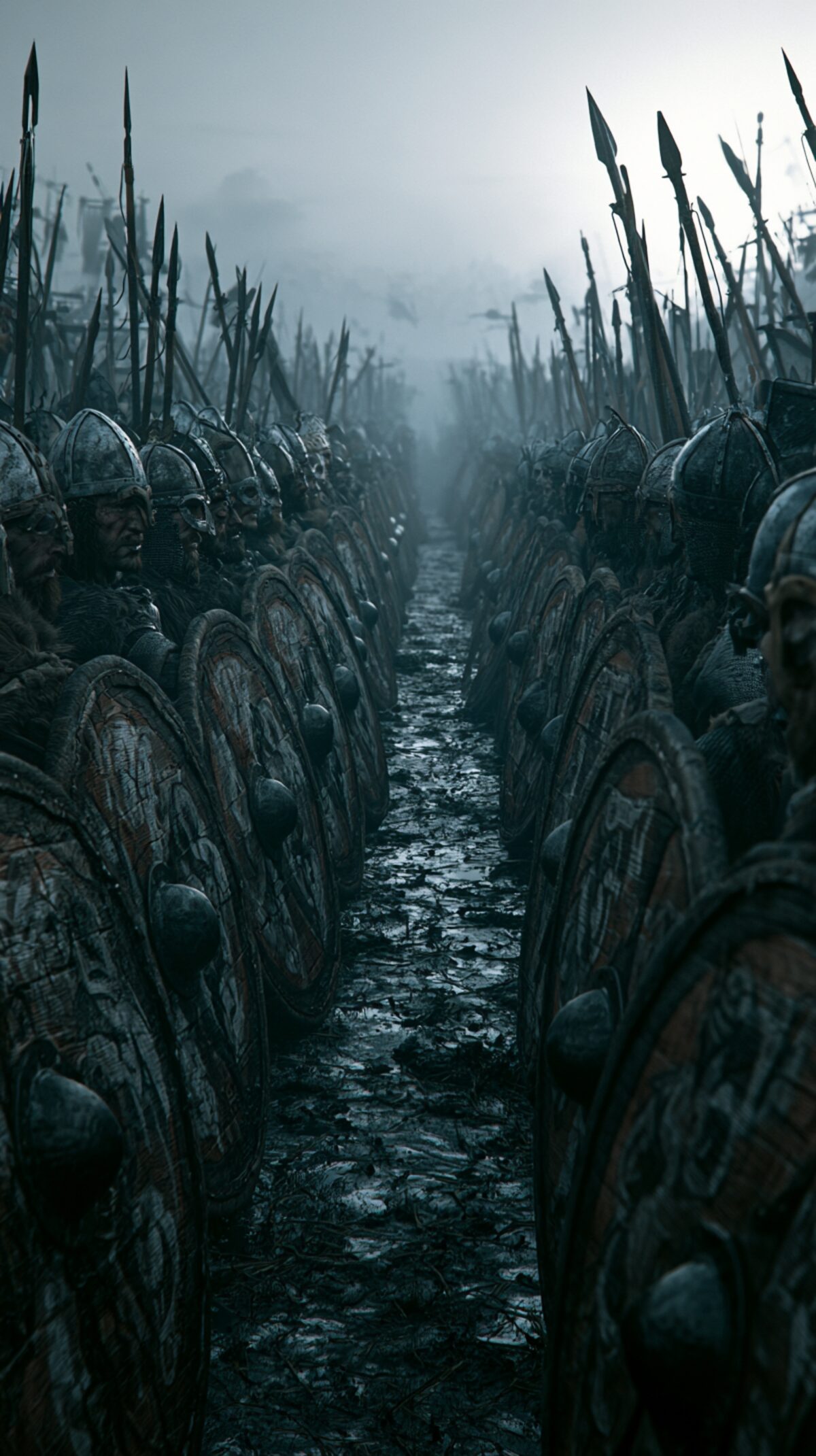
No Viking training manual has come down to us. No text of the Viking Age explains who put a sword in a boy's hand, how often he practised or when he counted as fit to fight. What survives is fragments: wooden swords from settlement layers, a poem about how a jarl was raised, sagas that celebrate child prodigies centuries later, a Norwegian instruction book from around 1250, and a handful of young skeletons with visibly stressed bones. This article sets those pieces side by side and asks how much weight each can bear. A “warrior school” is not among them.
Ask about Viking training and most people picture something like the Roman legion or a late medieval fencing manual: drill grounds, instructors, grades, tests. For the North between the 8th and 11th centuries the sources offer none of this. People of the time wrote no handbooks. Runestones name men who fell in the west or the east and say nothing about how they learned to fight. Frankish and English chroniclers saw only the result, from the viewpoint of those on the receiving end.
The fullest modern study of the subject I have found is by the archaeologist Ben Raffield, published in 2019 in Current Anthropology as “Playing Vikings”. He does not ask about training in the narrow sense. He asks about enculturation, the way children absorb the values and expectations of their society, and argues that everyday things such as toys, games and stories kept confirming a martial hierarchy among men. He calls his paper a prompt for debate and not a final assessment, and the comments printed with it disagree with him on several points. Much of what follows rests on this one paper, because it gathers the scattered material.
Our article on children in the Viking Age covers everyday life on the farm, and the one on glíma and knattleikr covers the games themselves. The question here is narrower: what can actually be shown about the road from child to fighter?
The best-known description of martial skill in the North belongs to Olaf Tryggvason. In Snorri Sturluson's Heimskringla from the 1230s (chapter 92 in Laing's numbering) he is the most accomplished man the sagas know of in Norway. He climbs the Smalsarhorn and fixes his shield at the top, runs along the oars outside his ship while the crew rows, juggles three daggers, fights equally well with either hand and throws two spears at once.
The passage mentions neither teacher nor practice. It lists what a king ought to be able to do when he is being praised a good two centuries after his death at Svolder (around the year 1000), then moves without a break to his generosity, his clothes and his cruelty.
The older version is more revealing still. The saga by the monk Oddr Snorrason, written in Latin in the 12th century and surviving in Old Norse, shows in chapter 8 a nine-year-old Olaf in the land of the Rus beheading his foster-father's killer with an axe. The saga calls it a great stroke of renown for one so young. The same chapter says that in a short time he had learned “allan riddarligan hátt ok orrostuliga speki”, all knightly manners and the wisdom of battle, and speaks of his grasp of riddaraskapr. That is the vocabulary of European chivalry from the pen of a high medieval Icelander, applied to a boy of the 10th century. Anyone reading these lines as a report on Viking Age upbringing is reading the wrong period.
The second famous childhood is in Egils saga, whose hero has his own article here. Chapter 31 makes the three-year-old as big and strong as a boy of six or seven, sharp with words and hard to handle when playing with others. In chapter 40 the seven-year-old loses at a ball game to an older boy called Grímr, gets a bearded axe from Þórðr Granason and kills his opponent. His mother calls him víkingsefni, the makings of a Viking; his father is unimpressed. By twelve, the saga goes on, Egill is so big that he outdoes most men at games.
What is missing matters here. Nobody teaches Egill to use an axe. The scene is about rage and the tension between parents and son, and it belongs to a literary character who is always ahead of his years. It does carry one useful piece of information, but that information belongs to the time of telling: the audience found it conceivable that boys fought out rank among themselves and that an adult might hand a child a weapon. Whether that ever happened in the 10th century cannot be shown.
Raffield handles such scenes with similar caution. He accepts that the sagas were written down between the 12th and 14th centuries and are not reliable records, but treats them as evidence of what counted as believable behaviour. His commentator Lewis-Simpson stresses instead that they are literary constructs. With no Viking Age source to check against, the dispute cannot be settled.
The closest thing to a description of learning is a poem. Rígsþula, the “Lay of Ríg”, tells how a wanderer fathers three social orders: slaves, free farmers and nobles. Each grows up with its own tasks, and weapons appear only with the third.
Up grew Jarl there in the house; he began to swing the linden shield, to lay on bowstrings, to bend the elm bow, to shaft arrows, to hurl the javelin, to shake spears, to ride horses, to set on hounds, to draw swords, to practise swimming.Rígsþula, st. 35, my own translation from the Old Norse text (voluspa.org)
Karl, the farmer's son, learns in stanza 22 to manage oxen, ready the plough, build houses and barns and make carts. The slave hauls loads and binds brushwood. Jarl's own sons later train in turn: they tame horses, bend shields, scrape shafts and shake ash spears (st. 42), and before that they are said to have taken up play, “sund ok tafl”, swimming and board games (st. 41). This is the programme modern accounts like to present as a training plan.
Three caveats belong with it. First, the poem names no teacher at this point. Ríg himself appears only in the next stanza and teaches the boy runes, not arms. Second, the date is open. The poem survives only in the 14th-century Codex Wormianus, and proposals run from the 10th to the 13th century. The translator Henry Adams Bellows placed it in the first half of the 10th century and noted that editors reject two lines of the weapons stanza as later additions, including the one with sword and swimming. Third, the lay explains the social order and builds towards kingship; its ending is lost. It does not follow that farmers' sons never carried weapons: the oldest Norwegian law texts assume free men had the right to own them. The poem shows how an upper class imagined its childhood, not how the average person grew up.
The finds are more tangible, with a geographical catch. Most of the wooden swords Raffield cites are from Novgorod and Staraya Ladoga in Russia, dated to the 10th to 12th and the 8th to 9th centuries respectively. Their blades often measure 50 to 60 centimetres, the grips 5 to 6 centimetres, which in his view suits children of about six to ten. Their shape copies full-sized swords. A small wooden sword from Fishamble Street in Dublin resembles Petersen's type O, a particular sword form. Toy boats, little horses and miniature quernstones are known too, so children played at work as well as war.
A wooden sword proves play, and play is not yet training. The object cannot tell us whether a father showed his son how to strike or whether children simply thrashed each other in the yard. Novgorod, moreover, was a largely Slavic town with Scandinavian contacts, and its finds do not transfer automatically to a farm in Trøndelag.
A second group is miniature weapons in metal. A 76.3-centimetre sword from Lough Gur in Ireland, 10th century, is described by the sword specialist Ian Peirce as a prestige weapon for a high-born child. Small axes and spearheads are reported from Straumur and Grímsstaðir in Iceland. That sounds like practice gear, but research tends to read such pieces as status symbols. Full-length wooden practice swords for adults have been proposed for early medieval Poland. I cannot point to a secure parallel from Scandinavia itself, in part because wood rarely survives there.
It is often claimed that games shaped fighting spirit. The evidence is indirect. Hnefatafl, the board game of a king and his retinue against superior numbers, comes from sites such as Valsgärde, Birka and the ship burial at Salme. Raffield sees it as a model of loyalty to a leader. That is an interpretation, and the rules themselves are only partly known. Gaming pieces also turn up in graves with young people, such as the boy at Balnakeil in Scotland. In the boat burial at Scar on Orkney, shared with a woman and a child of ten or eleven, they lay beside the man.
For ball games and wrestling we are back with the sagas. At fourteen Grettir picks a fight with an older boy during knattleikr (Grettis saga, chapter 15), and in chapters 59 and 60 of Laxdæla saga a mother goads her sons of twelve and sixteen towards revenge and shames them for their childish pursuits. In all these scenes rank among boys is being negotiated, or an adult is applying pressure. Stamina and toughness may have been gained this way; weapons technique is not mentioned.
Also telling is what the Orkney earl Rögnvaldr Kali lists in the 12th century as his nine accomplishments: board games, runes, books, craftsmanship, skiing, shooting, rowing, harp-playing and poetry. The literary scholar Erin Goeres shows that he is picking up an older stanza attributed to Haraldr harðráði and casting himself in a royal light. The sword is not on the list; of weapons, only shooting appears. This verse displays versatility and does not praise fighting, as plenty of other skaldic verse does.
Bones ought to be the independent check on the texts, since repeated strain can leave its mark on a growing skeleton. Raffield himself notes that the great majority of excavated burials have never been examined in osteological detail. The cases below are individual examples, not statistics.
The boy from Balnakeil. In northern Scotland a twelve- to thirteen-year-old was buried with sword, throwing spear, shield and gaming pieces, the weapons full-sized. His right collarbone, upper arm and ulna are enlarged, possibly from one-sided overuse. Raffield compares this to professional tennis players and asks whether the boy was preparing for a warrior's life. He frames it as a question. The grave also held yarn and a needle case, otherwise almost exclusively female goods. One-sided labour or simple right-handedness could explain the finding too; the bones do not say what the arm did.
The adolescents at Ridgeway Hill. The mass grave near Weymouth holds over 50 decapitated individuals interpreted as Vikings. Eight were aged between 13 and 17. Five of them had Schmorl's nodes on the vertebrae, four osteochondritis dissecans, which can result from repeated small injuries, and one os acromiale, a change in the shoulder that Raffield links to heavy strain during adolescence. Similar findings are known from the dead of Towton and from the ship Mary Rose. This points to hard physical work at a young age. Whether that work was at the oar, under loads or with weapons is more than such findings can say.
The age of the dead. The mean age in the Viking Age mass graves was about 25 at St John's College, Oxford, and about 26 at Ridgeway Hill, against around 30 at Towton and 27.7 at Uppsala. Of the groups Raffield compares, only the Viking Age graves include people under 16. A mean from massacred or executed people need not describe a typical army, though: someone seized and killed need not have stood in a battle line.
Birka, grave Bj 581. This famous case shows the method's limits from the other side. The person in the Birka chamber grave, identified genetically as a woman in 2017, was over 30 and lay with a full set of weapons and two horses. Charlotte Hedenstierna-Jonson's team reports no pathological or traumatic changes on the skeleton and adds that weapon wounds are rare at Birka generally. The reading as a warrior therefore rests on the grave goods. A skeleton can neither prove nor rule out a martial career.
Birka, grave Bj 977. Here a child of about nine lies with full-sized war gear and a bridled horse. The child cannot have used the equipment. Raffield reads the grave as an image of the future mounted warrior, of what the child should have become. Lewis-Simpson objects that a child's sex cannot be determined without genetic testing and that the “boy” in this case is an assumption. For 5th- to 7th-century Anglo-Saxon England, Heinrich Härke found that roughly one in twelve people buried with weapons was under 14, the youngest twelve months old. A weapon in a grave evidently often marks a family's rank, not the skill of the dead.
The Icelandic law code Grágás, recorded in the high Middle Ages, gave a person legal capacity at 16 but held a boy responsible for crimes from 12. From this and the sagas Raffield concludes that a boy could socially count as a man at around twelve. That does not give us a minimum age for war.
The sagas vary widely. In Jómsvíkinga saga Sveinn starts raiding at 15, and Vagn joins the Jomsvikings at 12 even though their rule admits men only from 18. In Vatnsdæla saga Ketill rebukes his 18-year-old son for not having gone raiding, while Þórólfr in Egils saga sets off only at 20. These numbers serve characterisation. A twelve-year-old who breaks a rule is a good story, not a service regulation.
Raffield draws a clear line: he finds it inconceivable that children and most young adolescents could have functioned effectively as fighters or crew in a raiding fleet. Full participation was not unusual only by late adolescence. For the younger ones he takes up Alex Woolf's suggestion that they may have come along as cooks or to look after weapons, with older adolescents as weapon-bearers. As a possible hint he points to double graves at Repton and Île de Groix. At Repton graves G511 and G295 lie side by side: a man of 35 to 45 with a sword and a fatal thigh wound, and a seventeen- to twenty-year-old with only a knife. That the younger served the older is a guess, but the picture fits learning on the job.
The most plausible answer to the title question is therefore this: you became a warrior among the men you followed. A leader's band, Old Norse lið, is visible on runestones and in skaldic verse, and our article on lið, hirð and leiðangr covers its forms. The stone DR 295 from Hällestad, for instance, honours a lord named Tóki on behalf of his followers. It says nothing about training. That newcomers learned from experienced men is an inference from the situation: they sailed on the same ship, stood in the same shield wall and faced the same enemy. Raffield also notes the cost, since an untried man facing better-trained opponents often did not survive his first campaign.
Fosterage, fóstr, is another possible route, since a son raised in another household formed ties with it. I have seen no direct testimony that weapons were systematically practised there. Raffield does not treat fosterage as an institution.
A view from outside at least supports the weight placed on the weapon. The Persian geographer Ibn Rustah writes in the 10th century that among the Rus a father throws a sword down before his newborn son and says he leaves him nothing but what he can win with it. I know the passage only from an English rendering in a reference work. It also concerns the Rus in the east, comes from an outsider, and is about inheritance and expectation, not instruction.
The only Northern text known to me that gives concrete advice on arms practice is the Norwegian Konungs skuggsjá, the King's Mirror, from around 1250. In chapter 37 a father tells his son what a king's man should do. Where horses are available he should practise a firm seat, with a curved shield covering breast and limbs. Where they are not, he puts on heavy armour and drills thrusts and counterstrokes with a skilled partner behind a weighty shield, twice a day if convenient and at least once a day except on holidays. Archery in company counts as a pleasant pastime, as do slinging and throwing stones.
That is real training, but from a different world. The text was written nearly two centuries after the end of the Viking raids at a royal court with household offices, and its translator Larson sees the military material as describing the art of war of Europe, not of the North. The Hirðskrá, the retinue law of the 1270s, likewise describes an ordered court with ranks. Inferences from here back to the year 900 are guesswork. The dialogue leaves the practice to the king's man himself and sends him to a partner; even here there is no mention of an instructor or a school.
Raffield's paper deals almost entirely with boys, a point Leszek Gardeła raises in the same issue. Gardeła refers to graves of women, some in their teens, with weapons or weapon miniatures, and warns against one-sided judgments. Grágás threatens women who carry weapons with lesser outlawry (fjörbaugsgarðr), which at least shows that the lawmakers thought the case worth regulating. Whether girls were ever taught arms cannot be said from these pieces. There is more in the article on the shield-maiden.
Were there warrior schools among the Vikings? None is attested. The sources suggest learning within family, household and retinue, but that too is inferred, not described.
At what age did boys practise with weapons? This cannot be clearly shown. Wooden swords suit children of about six to ten according to Raffield, but whether that was practice or play stays open. He considers full participation in raids usual only from late adolescence.
Can training be recognised on a skeleton? Only the strain, not its cause. An enlarged right arm or damaged vertebrae can come from weapons, rowing or heavy work.
Is the story of seven-year-old Egill true? Nobody knows. It appears only in the 13th-century saga and draws a literary character.
Children in the Viking Age · Lið, hirð and leiðangr · Glíma and knattleikr · Egill Skallagrímsson · Olaf Tryggvason · Bow and arrow · Viking weapons · Holmgang

Viking Childhood · Lið, Hird & Leiðangr · Glíma & Knattleikr · How did Vikings really fight? · Egill Skallagrímsson.
All History & Finds articles →
Does mitochondrial DNA "prove" that Viking women colonised new lands? A 2014 headline said so. The study behind it …
Read more →In the summer of 789 Charlemagne led the only army of his reign that he personally took deep into Slavic territory …
Read more →In 1979, excavators on Kanonicza Street in Kraków uncovered something that surprised even specialists: 4,212 iron bars …
Read more →The Vyatichi lived on the upper Oka and the Moskva, paid tribute first to the Khazars and then to Kiev, and resisted …
Read more →