A Cheruscan boy raised by Varus like a son, a chieftain’s daughter who steals a Roman eagle, and a childhood friend who becomes a rival: this is how the German Netflix series “Barbarians” tells the road to the battle of AD 9 in which three Roman legions were destroyed. The ancient accounts of that battle fit on a few pages. This article sets both seasons beside Velleius Paterculus, Tacitus, Cassius Dio, Florus, Strabo and Suetonius, and beside the finds from Kalkriese. It shows where the script fills a gap in the sources, where it contradicts them, and where it is surprisingly close. The history of the Cherusci themselves is covered in our main article on Arminius and the Cherusci; this one is about the series.
“Barbarians” (German title “Barbaren”) is a German production by Gaumont GmbH for Netflix. The first season of six episodes was released on 23 October 2020, the second, also six episodes, on 21 October 2022. Arne Nolting and Jan Martin Scharf created the first season and wrote it with Andreas Heckmann; most of the second season was directed by Stefan Ruzowitzky. Filming took place in Hungary and Poland.
Three characters carry the story: Laurence Rupp plays Arminius, usually called Ari in the series, Jeanne Goursaud plays Thusnelda and David Schütter the warrior Folkwin. Gaetano Aronica plays Varus and Bernhard Schütz the Cheruscan chief Segestes. Season two adds Daniel Donskoy as Flavus, Murathan Muslu as Marbod, Alessandro Fella as Germanicus and Giovanni Carta as Tiberius.
There is no third season. In March 2024 the site What’s on Netflix reported that Laurence Rupp had answered a fan’s question by saying there would be no third season “soon”, and that the production company described the series as not officially cancelled but with production concluded. I know of no later change.
There is not a single Germanic account of the battle. Everything written comes from Romans and Greeks, and none of them was there.
The earliest author is Velleius Paterculus, an officer under Tiberius who wrote around AD 30. He describes Varus and Arminius in a handful of sentences (2.117–119). The geographer Strabo, a contemporary, mentions the Cherusci breaking their treaty and the triumph of Germanicus in AD 17. Tacitus, writing about a century later, covers mainly the campaigns of Germanicus in books 1 and 2 of the Annals. The only continuous narrative of the fighting comes from Cassius Dio (book 56), in the early third century. Florus, a second-century author, offers a short and highly rhetorical version, and Suetonius in his life of Augustus records the emperor’s reaction.
That is hardly enough for twelve episodes. The writers had to invent.
The series opens with a child. The son of the Cheruscan chief Segimer is handed to the Romans as a pledge, grows up with Varus and returns home as a Roman officer. Varus treats him like a son, and that gives the series its sharpest conflict: Ari betrays not a superior but a foster father.
Part of this is attested. Velleius calls Arminius a young man of noble birth, brave and quick of mind, son of Sigimer, a chief of his people. He had been a constant companion of Rome’s earlier campaigns and had gained Roman citizenship and equestrian rank. The Latin calls him “adsiduus militiae nostrae prioris comes”, a steady companion of our earlier campaigns. Tacitus adds that Arminius had commanded his countrymen in the Roman camp and therefore slipped Latin words into his exchange with his brother (Annals 2.10).
What is not attested is a childhood as a hostage. No ancient source says that Arminius was taken to Rome as a boy. The idea is common, since Rome often bound chiefs’ sons to itself, but it remains an inference. Varus only took over Germania around AD 7, and no acquaintance from childhood is recorded anywhere. Cassius Dio says only that Arminius and Segimerus were among Varus’ constant companions and often shared his table.
The name “Ari” is also an invention. “Arminius” is the Latin form the Romans used. His Germanic name is unknown.
The series makes Thusnelda its real lead. She steals a legion’s eagle with Folkwin, confronts Varus, is revered by others as a seeress and helps forge the alliance of the tribes. She loves Folkwin and marries Ari for political reasons.
The sources give her a different role. Only Strabo records her name. Tacitus never names her; he speaks of the daughter of Segestes and the wife of Arminius. He reports that Arminius had carried off Segestes’ daughter, who was promised to another man (“filiam eius alii pactam rapuerat”, Annals 1.55). Tacitus does not say when this abduction took place, before or after the battle, and scholars disagree on it. Who the other bridegroom was is unknown. The series fills that gap with the invented Chattan chief Hadgan.
In AD 15 Germanicus rescued Segestes, who was being besieged by his own people. With him came members of his family, among them Thusnelda, who was living with her father at the time, against her will according to him. Tacitus describes the scene like this:
inerant feminae nobiles, inter quas uxor Arminii eademque filia Segestis, mariti magis quam parentis animo, neque victa in lacrimas neque voce supplex, compressis intra sinum manibus gravidum uterum intuens.
“There were noble women among them, and among these the wife of Arminius, who was also the daughter of Segestes, more of her husband’s mind than her father’s: not overcome to tears, not pleading with her voice, her hands clasped within the folds of her dress, her eyes on her pregnant womb.”Tacitus, Annals 1.57; Latin wording read in fragments through a retrieval tool from The Latin Library, not from a critical edition; English version my own translation
Tacitus draws a captive, not a warrior or a seeress. The son she bore in Roman captivity was, according to Tacitus, raised at Ravenna. Strabo calls him Thumelicus and says he was three years old at the triumph of Germanicus on 26 May AD 17. Tacitus promised to tell what later became of the boy “in its proper place”; that part of the Annals is lost. The often repeated claim that Thumelicus became a gladiator cannot be proven.
There is no evidence that Thusnelda took an active part in the war. A chieftain’s daughter who stole a legionary eagle is not something Roman authors would have passed over. Her capture at the end of season two moves closer to the record, but shifts it in time and has it ordered by Tiberius rather than Germanicus. More on women in the sources can be found in our article on Germanic women.
Folkwin Wolfspeer, the series’ second hero, is entirely fictional. He stands for those Cherusci who distrust Arminius because he is too Roman. Tacitus reports that Arminius was later killed by his own kinsmen because he aimed at kingship (Annals 2.88). A love affair between Folkwin and Thusnelda, however, is pure fiction. Making Folkwin the father of Thusnelda’s child contradicts the sources, which clearly name the boy as the son of Arminius.
Equally invented are the seeress Runa, Thusnelda’s mother Irmina, her younger brother Ansgar and the Chattan chief Hadgan. The name Ansgar is best known from the ninth-century missionary. Historically Thusnelda had a brother called Segimundus who, according to Tacitus, had been a priest at the altar of the Ubii, tore off his priestly fillets in AD 9 and went over to the rebels.
Segestes, Thusnelda’s father, appears in the series as an opportunist who informs the Romans about Folkwin and finally betrays his own daughter. The picture has a true core. Velleius reports that Segestes, “a loyal man of that people”, warned Varus of the conspiracy and demanded that the plotters be put in chains, but Varus did not believe him. Tacitus confirms this (Annals 1.58). Segestes was no turncoat, then; he consistently stood on Rome’s side.
His execution by Tiberius at the end of season two is invented. After AD 15 Segestes lived at a residence that Germanicus assigned him in the Roman province west of the Rhine, and two years later he watched as a guest of honour while his daughter and grandson were led in the triumph. More on that frontier in our article on Germanic peoples in the Rhineland.
Segimer, Arminius’ father, dies in the first season, and his death clears Ari’s path to leadership of the Cherusci. There is no evidence for this. When and how the father died is not recorded. Cassius Dio even names a Segimerus alongside Arminius as a leader of the conspiracy; whether he means the father or a relative of the same name cannot be settled.
Gaetano Aronica plays Varus as a hard governor convinced of his own superiority, who collects heavy tribute and punishes resistance brutally. In the series he has Folkwin’s family crucified. The harsh tax policy matches Cassius Dio, who says Varus gave the Germans orders as if they were slaves and exacted money as from subject peoples.
The other sources paint a less sinister picture. Velleius describes him as a mild, quiet man, slow in mind as in body, and adds the famous jibe that he entered rich Syria a poor man and left poor Syria a rich one. Both wrote after the disaster, and an incompetent Varus conveniently absolved everyone else, including Tiberius, under whom Velleius had served.
The series gets Varus’ death essentially right. Velleius and Dio report that he killed himself when defeat was certain. The Germans mutilated his body, and his head was sent via Marbod to Augustus. According to Suetonius, Augustus would beat his own head against a door and cry: “Quintilius Varus, give me back my legions!”
The theft of the eagle with which Thusnelda and Folkwin set the first season in motion appears in no source. The series does capture what the eagle meant. The aquila was a legion’s most sacred standard, and losing it was a disgrace. All three eagles, of the 17th, 18th and 19th legions, were lost in AD 9. Getting them back took decades: one, according to Tacitus that of the 19th legion, was found among the Bructeri in AD 15, a second among the Marsi in AD 16, buried in a grove. The third was recovered, according to Cassius Dio, only in AD 41 under Claudius, from the Chauci.
In the season one finale, Ari lures Varus into an ambush with a report that a tribe has risen against Rome. The allied tribes wait in the forest, the legions are destroyed in one long, bloody sequence, and Varus falls on his sword. The basic pattern matches the sources. Cassius Dio says the conspirators staged a revolt at some distance so that Varus would march out, escorted him for a while and then attacked him on the march.
The main difference is duration. In Dio, the fighting drags on for several days. The column was weighed down with wagons and baggage, and Dio mentions “not a few women and children”. Storms and rain made the ground slippery; the Romans built a camp, burned wagons and fought their way on. On the fourth day Dio again describes heavy rain that soaked the shields and made bows and javelins hard to use. Only then did Varus and his senior officers take their own lives.
Six years later, Tacitus describes the battlefield as Germanicus’ soldiers found it: Varus’ first camp, which still showed the work of three legions; a half-collapsed rampart with a shallow ditch where the remnants had gathered; bones scattered and heaped; skulls nailed to tree trunks; and in nearby groves the altars at which tribunes and senior centurions had been slaughtered.
How many Romans died is unknown. Three legions are certain, plus, according to Velleius, three cavalry units and six auxiliary cohorts. Estimates of 15,000 to 20,000 men rest on paper strengths. How the Germanic side fought is covered in our article on Germanic warfare.
Reviewers spotted stirrups on Roman riders; they reached Europe only centuries later.
The series names no exact location, and none has been proven. The name “Teutoburg Forest” goes back to Tacitus, who speaks of the “saltus Teutoburgiensis”. The hill range near Detmold received that name only in the early modern period.
The most important site lies further north-west, at Kalkriese near Bramsche, north of Osnabrück. Since 1987 archaeologists have recovered thousands of Roman objects in a narrow passage between the Kalkriese hill and the Great Bog: coins, weapons, pieces of equipment, parts of segmented armour, an iron face mask, mule remains and pits with human bones. A rampart long interpreted as a Germanic barrier may, after excavations in 2016 and 2017, have been part of a hastily built Roman defensive position.
Kalkriese is still debated. A minority of scholars think the finds could come from one of Germanicus’ campaigns in AD 15 or 16, for instance from the fighting of his legate Caecina. In 2022 the Kalkriese museum presented metal analyses in which non-ferrous finds matched material from Dangstetten, an earlier base of the 19th legion. That supports the Varus identification but, by the researchers’ own account, does not prove it conclusively.
Season two begins a year after the battle. New legions are on the march, Ari seeks an alliance with Marbod, and his brother Flavus fights for Rome. In the end Folkwin dies on the battlefield, Flavus sacrifices himself for Marbod, and Tiberius has Thusnelda’s parents executed and takes her and her child into his power.
Some of this is well chosen. Tiberius really did campaign on and beyond the Rhine in AD 10 and 11 to secure the frontier after the disaster, and Germanicus was with him at least in AD 11. The great campaigns of Germanicus that Tacitus describes at length, however, belong to the years 14 to 16.
Marbod is a historical figure, but the series places him wrongly beside Arminius. Marbod, in Latin Maroboduus, had been king of the Marcomanni in Bohemia since about 9 BC and had built a large realm. After the battle Varus’ head was sent to him, probably as a bid for an alliance; Marbod did not join and forwarded it to Rome. In AD 17 the two went to war. Tacitus calls the battle indecisive, but Marbod lost support and in AD 19 went into Roman exile at Ravenna. Having him proclaimed king during the series turns the situation upside down. More in our article on the Marcomanni.
Flavus, Arminius’ brother, is attested too. In AD 16 the brothers face each other across the Weser, one on each bank. Flavus, who has lost an eye in Roman service, lists his decorations; Arminius mocks them as the wages of servitude. A change of sides by Flavus, as shown in the series, is unknown to the sources, and so is his death. What is known is that his son Italicus was sent by Rome to the Cherusci as king in AD 47.
Experts praised the production design with reservations. The prehistorian Karl Banghard criticised numerous inaccuracies in clothing and diet in the FAZ, and the archaeologist Matthias Wemhoff the image of a dark, impenetrable forest.
On clothing the series gets a lot right: trousers, tunics and cloaks in various colours rather than furs and rags. In the Germania Tacitus describes a cloak fastened with a brooch or, failing that, a thorn; mostly later bog finds such as the Thorsberg trousers show woven, dyed wool. The Suebian knot, hair tied at the side of the head, is well attested by Tacitus and by the Osterby head, and it appears in the series.
Body paint is trickier. Tacitus reports that the Harii blackened their shields and bodies and attacked at night. That attests war paint for a single tribe, not permanent tattoos among the Cherusci. There is no evidence for tattoos among Germanic peoples around the turn of the era; what is known about later centuries is discussed in our article on Viking tattoos.
The series fills Cheruscan religion with images from much later Norse tradition. According to an English-language review, Thusnelda injures her own eye to gain the gift of sight, an echo of Odin’s eye sacrifice from Eddic poems written down in the 13th century (see Odin’s eye). Nothing of the kind is attested for first-century Germania.
Seeresses as such are well attested. Tacitus writes that the Germans believed women had something holy and prophetic about them, and he names Aurinia and Veleda. Veleda of the Bructeri played a political role in the Batavian revolt of AD 69/70, some sixty years after the Varus battle. Runa is therefore not implausible, merely invented; see Veleda.
Sacred groves are attested as well. Tacitus reports groves where the Germans worshipped their gods, the grove of the Semnones with human sacrifice, and the altars at the battlefield where Roman officers were killed. The details of the series’ rituals, however, are staging. Background is in our articles on sacred trees, the grove of the Semnones and Germanic sacrifice.
One decision was praised almost unanimously: the Romans speak Latin, in a form based on classical pronunciation. The Germanic characters, by contrast, speak modern German. The Cherusci spoke an early Germanic language that was never written down and can only be reconstructed by linguists; no viewer would have understood it as German.
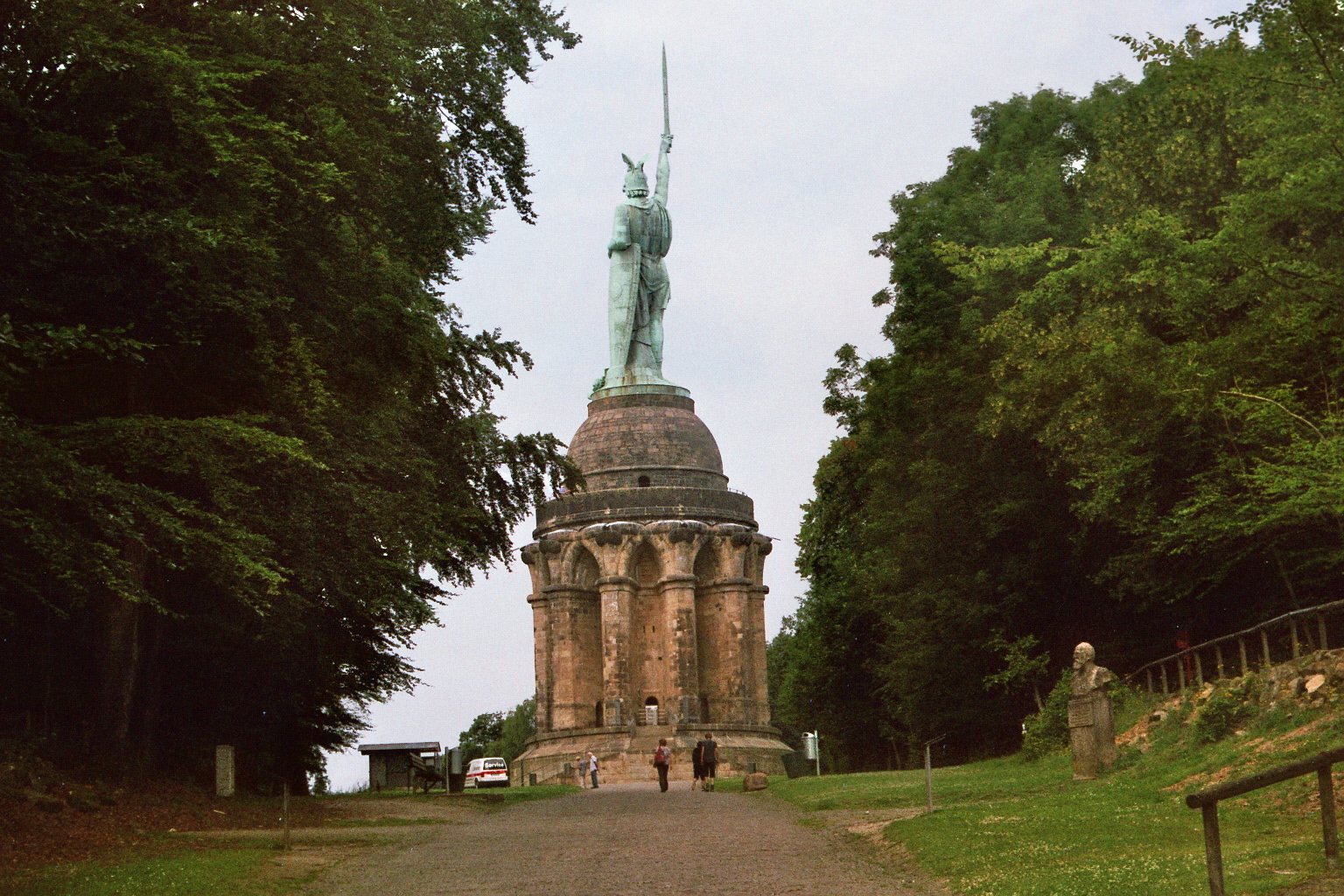
The series is noticeably restrained when it comes to heroic pathos. The image of Arminius as “Hermann”, liberator of the Germans, arose only from the 16th century onwards, after the rediscovery of the Annals. In the 19th century Hermann became a national figure, visible in the Hermann Monument near Detmold, by Ernst von Bandel, inaugurated in 1875. Tacitus calls Arminius “liberator haud dubie Germaniae”, undoubtedly the liberator of Germania, but he means a geographical area, not a people or a state. The series turns Ari not into a national hero but into a man torn between two worlds.
Is there a third season of “Barbarians”? No. According to a report by What’s on Netflix from March 2024, production has concluded and Netflix has not ordered a third season.
Did Folkwin really exist? No. Folkwin Wolfspeer is a fictional character, as are the seeress Runa and the Chattan chief Hadgan.
Was Arminius really raised by Varus? That is not recorded. His service in the Roman army and his closeness to Varus shortly before the battle are attested, not an upbringing by him.
What became of Thusnelda? She came into Roman hands pregnant in AD 15, was led with her son Thumelicus in Germanicus’ triumph in AD 17, and then disappears from the sources.
Where did the Varus battle take place? Most specialists consider Kalkriese near Osnabrück the most likely site. Final proof is lacking.
Arminius and the Cherusci · Germanic women · The Marcomanni · The Chatti · Germanic warfare · Germanic religion · Germanic priests · Germanic peoples and Vikings compared · “Vikings” fact-checked · Vikings on film

The Cherusci & Arminius · Warfare · Women among Germanic Peoples & Vikings · Viking films and series · Germanic Peoples & Vikings.
Few images of the Viking Age disturb like the “blood eagle”: the victim’s ribs supposedly severed from the spine and …
Read more →A scrawny boy, a father built like a boulder, a village full of horned helmets and a black dragon who becomes his best …
Read more →To some an ancient Germanic sun-sanctuary, to others a Christian place of pilgrimage – the Externsteine in the …
Read more →When snow falls thickly, some people in Germany still say: "Frau Holle is shaking out her beds." It is a nursery …
Read more →