A scrawny boy, a father built like a boulder, a village full of horned helmets and a black dragon who becomes his best friend: since Cressida Cowell's first book in 2003 and the DreamWorks films from 2010 onwards, How to Train Your Dragon has shaped the Viking image of a whole generation of children. Since 2025 the story has also existed as a live-action film. This article takes the series seriously without spoiling the fun. It tests names, helmets, beards and dragon ships against finds and texts, sets the film dragons beside the dragons of Norse tradition and shows what Viking Age children actually held in their hands. Where the evidence is thin, it says so.
It began with a children's book. The British author Cressida Cowell published How to Train Your Dragon in 2003. It grew into a series of twelve novels, the last of which appeared in 2015. They follow Hiccup Horrendous Haddock the Third, the rather unheroic son of a chief, who has to get by in his own way.
DreamWorks Animation made the story famous worldwide. The first animated film reached cinemas in 2010, directed by Chris Sanders and Dean DeBlois. How to Train Your Dragon 2 followed in 2014 and How to Train Your Dragon: The Hidden World in 2019, both directed by DeBlois, along with short films and television series.
In 2025 came the live-action remake. Dean DeBlois wrote and directed it, the same man who had co-directed the 2010 animated film. Mason Thames plays Hiccup, Nico Parker plays Astrid, and Gerard Butler, who had voiced the chief in the animated films, now plays the role in person. The film opened in the United States on 13 June 2025 and in Germany a day earlier. It was shot mainly in Belfast, Northern Ireland, with cliffs in the Faroe Islands used for flying scenes. A sequel, the live-action version of part 2, is scheduled for 11 June 2027 in the US. According to reports, filming ran from January to May 2026 at Sky Studios Elstree near London, and Cate Blanchett returns as Hiccup's mother Valka. An announced date is not a guarantee, though.
One distinction often gets lost: the books and the films tell quite different stories. In Cowell's novels Toothless is a small, green, rather cheeky common dragon with no teeth; in the films he is a large black Night Fury. There is no Astrid in the books; her role is partly filled by the heroine Camicazi from another tribe. Here, "the series" mostly means the films.
The island of Berk does not exist. No place of that name is recorded from the Viking Age. In British English, "berk" is also slang for a fool. Whether Cowell meant this on purpose is not documented as far as I know, but it would fit her humour.
The true core lies elsewhere. Cowell writes on her website that as a child she spent her summers on a tiny, uninhabited island off the west coast of Scotland. She imagined dragons living in the caves in the cliffs, and her father told her about the Vikings who had come to these islands some twelve hundred years earlier. That part is well founded: from the late eighth century, Scandinavians, mostly from Norway, sailed to the coasts of Scotland. They settled permanently in the Hebrides, Orkney and Shetland. Many place names there still go back to Old Norse, and graves with Scandinavian grave goods are known from several islands.
So Berk is not a portrait of any particular settlement, but it does echo the North Atlantic island world in which Vikings really lived: windy, rocky and dependent on the sea. The film's houses are freely designed; excavated Viking Age dwellings were mostly long, fairly low longhouses of timber, turf or stone.
The hero is called Hiccup, after the hiccup; in German he is Hicks. His father is Stoick the Vast, in the German films Haudrauf, roughly "Hit-hard". In the first film Hiccup explains, in effect, that parents believe a hideous name frightens off gnomes and trolls. That is a joke, not a custom known from the sources.
What were people in the Viking Age really called? We know their names mainly from runestones and later Icelandic texts. Typical are compounds such as Þorsteinn ("Thor-stone") or Ásgeirr ("god-spear") and simple animal names such as Ulfr ("wolf"), Bjǫrn ("bear") or Ormr ("serpent, worm"). Usually the father's name was added: a son of Stoick would be something like "Stoicksson" in Norse fashion. A number such as "the Third", as in Cowell's Hiccup Horrendous Haddock III, is unknown in the Viking Age. It plays on the regnal numbers of later European kings.
The nicknames are a real point of contact. The Norse loved bynames that captured someone's looks, character or a memorable event: Sveinn tjúguskegg, "Forkbeard", Haraldr hárfagri, "Fairhair", or the legendary Ragnarr loðbrók, "Hairy-breeches". A chief nicknamed "the Vast" would not be out of place in that world. A name like "Hiccup" is not attested, though bynames could certainly be mocking. More in our article on Viking names.
Astrid is the name with the firmest historical footing. It goes back to Old Norse Ástríðr, in eastern Scandinavia also Æstriðr, and is well attested on runestones. Particularly well known is an Estrid of the eleventh century who lived near Täby, north of Stockholm. Several runestones name her, among them stones commemorating bridges and roads she had built together with her grandson Jarlabanke. Anyone who names a daughter Astrid is choosing a name that really existed a thousand years ago. More examples are in our article on Norse girls' names.
Toothless, on the other hand, is a modern pet name. In the books the little dragon really has no teeth; in the films he can retract and extend them. Dragons of Norse tradition carry no such nicknames but proper names with a darker ring: Fáfnir, Níðhöggr, Jǫrmungandr. More on them below.
In Berk almost every adult wears horns, Stoick first among them. The horns are a badge that tells children at once that "Vikings" are on screen. They have nothing to do with the Viking Age. Only one reasonably complete Viking Age helmet is known from Scandinavia so far, the Gjermundbu helmet from Norway, found in 1943 and dated to the tenth century. It is a rounded iron cap with a spectacle guard around the eyes. It has no horns. More in our article on the Gjermundbu helmet.
Horned helmets do exist in Scandinavia, but from a completely different era. The two bronze helmets from Veksø in Denmark date to the Bronze Age, around 900 BC, almost two thousand years before the Vikings. The horned helmet entered the public imagination in the nineteenth century: Romantic painters put it on their Germanic warriors and Norsemen, and in 1876 Carl Emil Doepler gave the Bayreuth premiere of Richard Wagner's Ring cycle horned and winged helmets. The full story is in our article on the horned helmet myth.
In the films the adults wear thick furs over their shoulders, fur boots and leather straps. The basic materials of the Viking Age were wool and linen. Grave finds, for example from Birka in Sweden, show dyed fabrics, tablet-woven bands and even silk from long-distance trade. Men usually wore a tunic and trousers, with a cloak pinned at the shoulder by a brooch in cold weather. Women often wore a strap dress fastened with two oval brooches.
Fur was of course used, as lining, trim or cloak, and pelts were an important trade good. But the all-over fur cape as everyday wear is a film convention meant to signal wildness. For an overview, see our article on Viking clothing.
Stoick is a giant with a mighty red beard, and his men are hardly smaller. What do skeletons say? Anthropologists estimate height from the long bones of the leg. For Viking Age men in Scandinavia this gives averages of around 170 to 176 centimetres, for women around 157 to 161 centimetres. Not giants, then. When the Arab traveller Ibn Faḍlān described the Rus on the Volga in the tenth century as tall as palm trees, that tells us mostly about the people he was comparing them with.
Hair deserves a second look too. A large genetic study published in Nature in 2020 analysed the genomes of more than 400 people from the Viking Age and also inferred probabilities for hair colour. The result is mixed: blond was common, but not universal, and darker shades were widespread too. Red hair existed, but no evidence makes it the hallmark of "the" Vikings.
So where does the red beard come from? One trail leads into medieval literature. In Icelandic texts of the thirteenth and fourteenth centuries the god Thor appears as a red-bearded man, for instance in an encounter with the Christian king Óláfr Tryggvason. The red-bearded strongman is indeed an old figure, but that of a god in late tradition, not a portrait of the average farmer. Beards were common, yet fashions changed: on the tapestry from the Oseberg burial of 834 the men have no recognisable beards. More in our article What did Vikings look like?
The ships of Berk carry carved dragon heads at the bow. Here the series is closer to history than with the helmets, with some caveats. The stem, the upswept timber at the front or back of the ship, could indeed end in an animal head. The finest example is the Oseberg ship from Norway, in which two women were buried in 834. Its prow curls into a spiral ending in a serpent's head. The original was recovered in fragments in 1904 and survives only in part. X-rays show that the snout, for instance, is modern restoration, and the ship on display has carried a copy since 1927. The same grave also held several carved animal-head posts whose purpose is still unclear.
The written sources know such heads as well. The Old Norse word dreki, "dragon", was used in the sagas for large, splendid warships. The Icelandic Book of Settlements, Landnámabók, in the Hauksbók version from the end of the thirteenth century, preserves a clause from what is said to be Iceland's oldest law: anyone arriving on a ship with a head on the stem should remove it before land came into sight, and not sail towards the coast with gaping heads and yawning snouts, so that the land spirits, the landvættir, would not be frightened. Whether this law really applied in the tenth century is disputed, but it shows the heads imagined as removable, fear-inspiring signs. On the Bayeux Tapestry from the late eleventh century, seen from the Norman side, many ships also carry animal heads on their stems.
One famous object, however, has to be struck from the Viking Age: the carved animal head from the River Scheldt near Appels in Belgium, now in the British Museum. A radiocarbon date obtained by the museum, however, points to the fourth to sixth century, long before the Viking Age, and the museum attributes it to late Roman or Germanic craftsmen. The idea of an animal head on a ship is therefore older than the Viking Age. How the ships themselves were built is explained in our article on longships.
The films show dozens of dragon species with wings, fire breath and fanciful names, neatly sorted in a Book of Dragons. Norse tradition knows nothing of the kind. Its main word for the great monsters is ormr, which simply means "worm" or "serpent". Alongside it stands dreki, a loanword from Latin draco. The native idea was that of a gigantic venomous serpent that crawls on the ground, coils and wraps itself around treasure or roots. Wings and fire belong rather to dragon images that reached the North through learned and church culture. For an overview, see our article The dragon in the North.
Three dragons stand out. According to the Edda and the Völsunga saga, Fáfnir was originally a man who turned into a serpent out of greed for a cursed hoard of gold. He spews poison, not fire, and is killed by Sigurd, who hides in a pit and drives his sword into him from below. More in our articles on Fáfnir and Sigurd.
Jǫrmungandr, the Midgard Serpent, lies in the world ocean and encircles the inhabited world until it bites its own tail. In the Edda Thor tries to fish it up, and at the end of the world the two kill each other. Níðhöggr, finally, gnaws at the roots of the world tree Yggdrasil and sucks the corpses of the dead in the underworld. Both are cosmic beings, not animals one could feed or ride. They are covered in detail in our articles on Jörmungandr and Níðhöggr.
Níðhöggr in particular offers a surprising bridge to Toothless. In the last stanza of the Völuspá, the "Prophecy of the Seeress" in the Poetic Edda, he flies. After the end of the world, when the earth has turned green again, the dark dragon appears once more:
Þar kemr inn dimmi / dreki fljúgandi, / naðr fránn, neðan / frá Niðafjǫllum; / berr sér í fjǫðrum / – flýgr vǫll yfir – / Níðhǫggr nái. / Nú mun hon søkkvask.
"There comes the dark dragon flying, the gleaming adder, up from below, from Niðafjöll, the dark mountains. In his feathers he carries – he flies over the plain – corpses, Níðhöggr. Now she will sink."Völuspá, stanza 66 in the usual numbering (Poetic Edda, Codex Regius, 13th century), Old Norse text in the public domain, English translation our own
So here a dark, feathered dragon really does fly over the land, and the word dreki even appears in the text. Yet he has nothing in common with a loyal companion: he carries the dead, and scholars disagree about who "she" is who now sinks, the seeress herself or the dragon. The Völuspá survives in manuscripts of the thirteenth and fourteenth centuries. Its exact age is uncertain.
A legend about Ragnar loðbrók comes closer to Berk's dragon hunts. According to Saxo Grammaticus around 1200 and the Icelandic Ragnars saga, the Swedish noblewoman Þóra receives a small serpent from her father as a gift. It grows into a huge lindworm that coils around her bower. Ragnar defeats the beast wearing shaggy breeches treated with tar to protect him from its venom, and so wins the bride. The motif of a pet dragon that gets out of hand does exist. It just ends with a spear rather than friendship. The tale is a legend, not a historical report. More in our article on Ragnar Lodbrok.
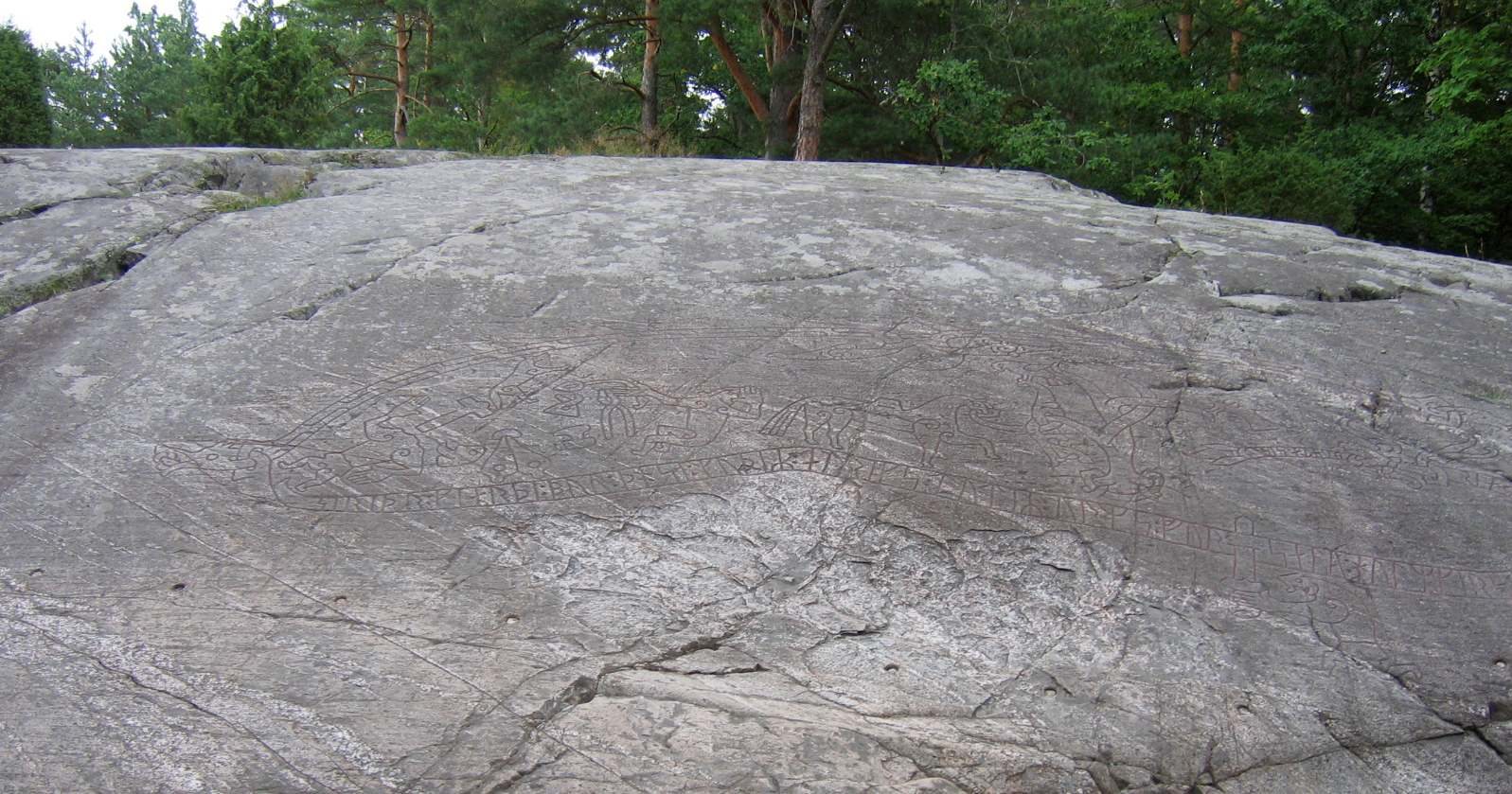
Where texts fall silent, images speak. Serpent and dragon creatures run through the whole art of the Viking Age. On many runestones the inscription runs inside the body of a stylised serpent; the text literally sits in the dragon. On the great Jelling stone, raised by King Harald Bluetooth around 965, a large beast wrestles with a serpent. At Ramsund in Sweden the story of Sigurd and Fáfnir was carved into a rock face around 1030: the dragon's body carries the runic inscription, and below it Sigurd thrusts his sword in. The Altuna runestone in Uppland shows Thor fishing for the Midgard Serpent.
At the end of the Viking Age this art culminates in the Urnes style, named after the stave church of Urnes in western Norway. Its carved portal boards from the eleventh century show slender quadrupeds and thin serpents looping around and biting each other in elegant figures of eight. Whether these animals tell a story or are pure ornament remains open. Tellingly, they survived on a Christian church. More in our articles on the Urnes portal and the Viking art styles.
The heart of the series, the friendship between human and dragon, is nowhere to be found in the sources. No Viking Age text or image shows a tamed dragon or a person riding one. In the legends the dragon is almost always an enemy whose death makes a hero a hero. Cowell writes on her website that the Vikings believed in dragons. What is true is that dragons played a large part in their myths and legends. Whether people thought of them as animals one might meet in everyday life cannot be established with certainty.
Hiccup and his friends learn to fight in a dragon arena. How did children really grow up? They helped early on, girls mostly with spinning, weaving and dairying, boys with livestock, fields and fishing. Sons were often sent to a foster family for years, Old Norse fóstr. There was still time to play. A miniature sword found at Hedeby is on display today at the Viking Museum Haithabu. In Dublin, excavations in Winetavern Street turned up a wooden boat about 37 centimetres long that is interpreted as a child's toy. A carved toy boat from a well comes from Ørland in central Norway, and a little wooden horse from Kvívík in the Faroe Islands. Add to these gaming pieces for board games such as hnefatafl and skates made of bone. Wood rarely survives, so these are only a fraction of what existed. More in our articles on children in the Viking Age and Vikings explained for kids.
For all its liberties, the series captures some things remarkably well: life on windswept islands, dependence on the sea, a community in which the chief counts for a lot but cannot decide everything, and women who carry themselves with confidence. Its strongest historical point may be unintended: Hiccup does not defeat the dragons, he understands them. That is the opposite of the Norse dragon legend, and it is a good way to show children how stories change over the centuries. Our family workshop in Alsdorf engraves Norse dragon loops after models such as Urnes, and the same applies there: the model is old, the interpretation new.
Did the island of Berk really exist? No. Berk is invented. Cowell was inspired by a small island off the west coast of Scotland where she spent her childhood summers. Vikings really did settle on the Scottish islands.
Is the name Astrid really Norse? Yes. It goes back to Old Norse Ástríðr and is attested on eleventh-century runestones, for instance for Estrid from the Täby area in Sweden.
Did Vikings believe in dragons? Dragons and giant serpents play a large part in myths, legends and art. Whether they were thought of as real animals cannot be said with certainty.
Did Viking ships have dragon heads? Some did. The Oseberg ship has a serpent's head on its prow. According to Landnámabók, such heads were taken down before landing.
Is there a sequel to the live-action film? The live-action version of part 2 is scheduled for June 2027 in the US, again directed by Dean DeBlois. It was filmed in 2026.

Dragons of the North · Fafnir – the Dragon · The horned-helmet myth · Viking Childhood · Viking films and series.
To some an ancient Germanic sun-sanctuary, to others a Christian place of pilgrimage – the Externsteine in the …
Read more →When snow falls thickly, some people in Germany still say: "Frau Holle is shaking out her beds." It is a nursery …
Read more →Friday is named after Frigg, Odin's wife – known on the Continent as Frija and in Old English as Frīg – not after …
Read more →God of War (2018) and God of War Ragnarök (2022) have introduced Norse mythology to millions of players. But how much …
Read more →