A chieftain who talks about raids like quarterly targets, a slave who would rather stay a slave, and a Roman actor determined to bring culture to a Norwegian village: "Norsemen", originally "Vikingane", runs on the collision between Viking cliché and modern office talk. The show has no intention of being a history lesson. Even so, many of its jokes contain a grain of truth, and elsewhere it turns history inside out on purpose. This article takes the running gags at their word and sets them beside what law books, eyewitness accounts, sagas and excavations actually tell us – seriously, but without spoiling the fun.
"Vikingane", literally "The Vikings", is a Norwegian comedy series written and directed by Jon Iver Helgaker and Jonas Torgersen. It was produced by the company Viafilm for the Norwegian public broadcaster NRK. The first season aired on NRK1 in autumn 2016, the second in autumn 2017 and the third in spring 2020. Each has six half-hour episodes. The third season is a prequel that tells the story leading up to the first, which is why it is sometimes called "season 0". A fourth season never materialised.
The production had one unusual feature: every scene was filmed twice, once in Norwegian and once in English, with the same cast. The English version reached an international audience on Netflix as "Norsemen" from 2017. The Scandinavian accents are intentional.
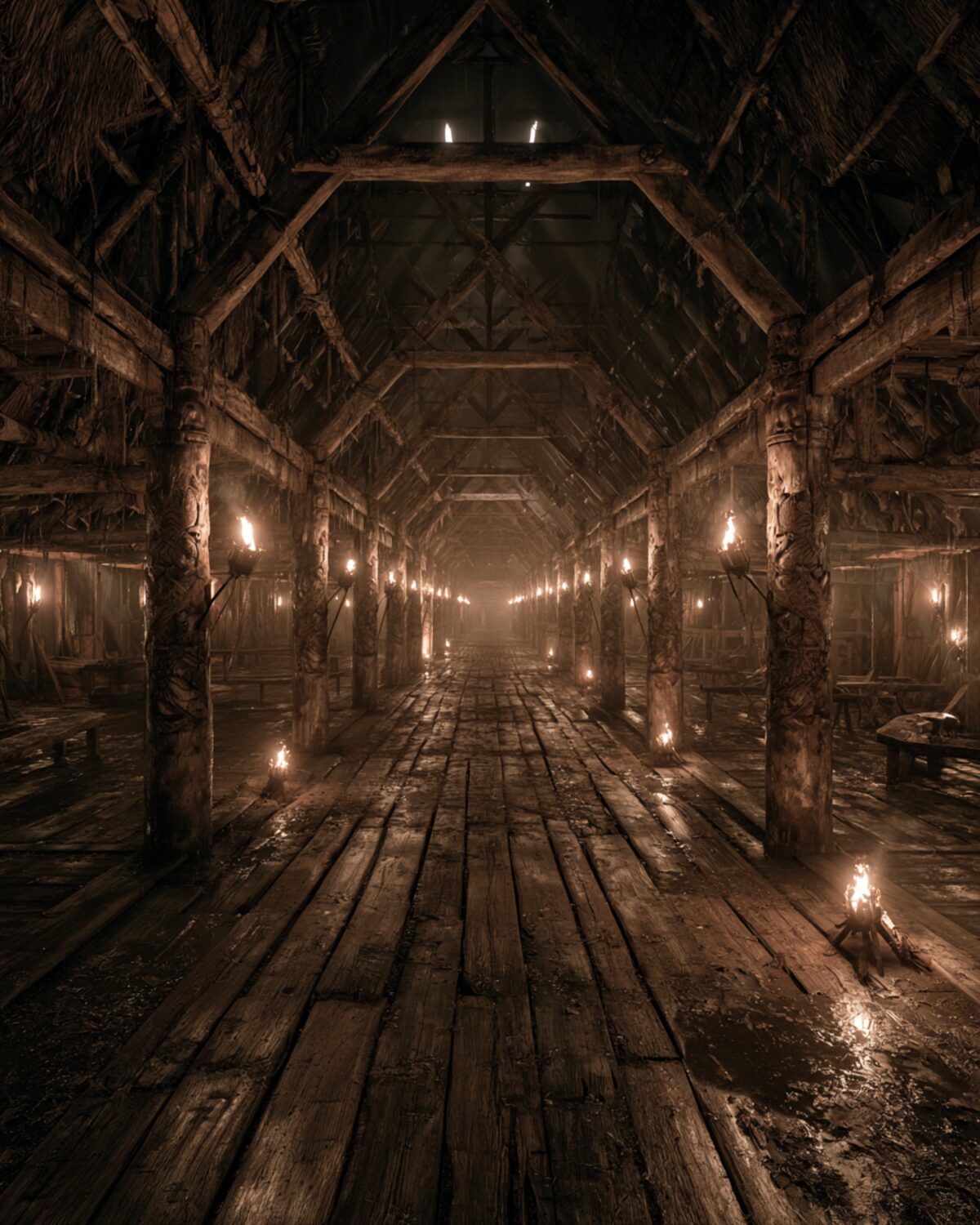
Filming took place at Avaldsnes on the island of Karmøy in Rogaland, on Norway's west coast. Avaldsnes is regarded as an old seat of power on the "North Way", the sea route said to have given the country its name; archaeologists have found rich graves there, and later sagas link it with Harald Fairhair. The comedy's backdrop stands on genuine Viking Age ground.
At the centre is the fictional village of Norheim. Chieftain Olav returns from a raid with a Roman slave, Rufus. His brother Orm, cowardly and artistically ambitious, waits for his chance; Arvid is the seasoned warrior who would rather farm, Frøya the shield-maiden, Kark the slave with little appetite for freedom, and Jarl Varg the feared regional overlord. The humour lies in the tone: brutal things are discussed in the language of team meetings and staff appraisals. The Guardian summed it up as "Monty Python meets Game of Thrones".
The series is set around 790, almost exactly when the Viking Age begins by the usual reckoning. The best-known landmark is the attack on the monastery of Lindisfarne in 793. A little earlier, around 789, the Anglo-Saxon Chronicle reports three ships landing at Portland on the south coast of England; their crews killed the royal reeve who tried to take them to the king's estate. Some manuscripts of the Chronicle name the men's homeland as "Hæreðaland", usually read as Hordaland, the region just north of Rogaland.
Olav's knowledge of a sea route west reflects something real: around 790 the North Sea crossing was new and profitable. The map everyone is chasing, however, is invented. No drawn sea charts survive from the Viking Age; sailors navigated by coastlines, the sun, wind, birds and knowledge passed on by word of mouth.
At the end of the second season the people of Norheim move to England to settle. For the 790s that is too early; the early voyages were raids with a return ticket. Permanent Scandinavian settlement in England follows the arrival of the so-called Great Army in 865, and the Chronicle records the first sharing out of land in 876. Some eighty years separate Norheim's emigration from the historical settlement.
Power in "Norsemen" changes hands the way partners do in a soap opera, and above it all looms Jarl Varg. As a rough pyramid this is not wrong. Around 790 Norway was not a kingdom but a patchwork of lordships held by powerful families. A jarl was a high-ranking lord with his own sphere of power; as the Earls of Lade in Trøndelag show, jarls could be more powerful than some kings.
What the show misses is the mechanics of power. A chieftain, in Old Norse roughly hǫfðingi, did not hold an office that had to be refilled when he died. Power rested on property, kin, generosity and followers. Killing a rival did happen, but it triggered the vengeance obligations of his kin and seldom made the killer his natural successor.
Later sources, such as Snorri Sturluson on Hákon the Good, have kings "accepted" at great assemblies. How a village chieftain gained his position around 790, no contemporary source records. It cannot be established with certainty, and this is exactly the gap into which the show slips its intrigues.
Recurring motifs include village votes on matters best not put to a vote, and a lawspeaker who in the second season declares two main characters slaves. The model is the thing, the assembly of free men where disputes were heard and law was spoken. The word survives in the Norwegian Storting and the Icelandic Alþingi.
Votes with a show of hands and a counted majority are hard to find in the Viking Age. Later sources mention the vápnatak, the brandishing or clashing of weapons by which an assembly signalled assent; the word survives in the English "wapentake". Decisions came about through the consent of the powerful and loud approval rather than counting. A roaring village meeting is not far from the sources.
The lawspeaker, Old Norse lǫgsǫgumaðr, is above all an Icelandic institution of the Althing, founded according to tradition around 930. Norway's great regional things, such as the Gulathing to which Rogaland belonged, are known to us only from law books of the twelfth and thirteenth centuries. An official lawspeaker in a village of 790 is a projection backwards. More on that in the article on Viking law.
One verdict in the series does hit home: in the second season Arvid is declared an outlaw. Outlawry, Icelandic skóggangr, "going to the woods", was the harshest penalty Norse law knew. An outlaw lost all legal protection; anyone could kill him, and anyone who helped him became liable. There were no prisons; the community enforced its law by casting the offender out.
In the first season Arvid wins another man's farm in a duel, and his wife along with it. The joke works because the whole thing is treated as an ordinary legal transaction. The duel has a historical model: the holmgang, the regulated duel named after the hólmr, the small island on which it was originally fought. The sagas describe fixed rules: a marked-out space, a set number of shields and a ransom paid by the loser once blood was drawn.
The motif of a challenger demanding another man's farm and wife by duel is common in the sagas too. Usually it is a berserker who forces a farmer into a holmgang and is then killed by the hero; Egils saga and Grettis saga both tell such stories. These thirteenth-century Icelandic texts cast the challenger as the wrongdoer. The series turns the saga villain into an ordinary neighbour, and that is the joke. In Iceland, according to tradition, holmgang was banned around 1006.
Hardly any theme gets as much airtime in "Norsemen" as slavery. Rufus insists on wages and a say in matters, and is told that slaves are entitled to neither. Kark, for his part, was freed, could not cope with freedom and went back into servitude of his own accord. In the second season even Orm and Rufus are captured and declared slaves by judgement. It sounds like satire. In substance it is the most uncomfortable truth the show tells.
The unfree were called þræll in Old Norse, a woman ambátt. In law they were property: the later law books of Norway and Iceland regulate their purchase, their inheritance and the compensation for a slain slave, which went to the owner. The article on Viking slavery goes through the sources one by one.
A literary picture of this order is found in the Rígsþula, an Eddic poem preserved in a single fourteenth-century manuscript. In it the god Ríg fathers the three ranks of society: Þræll the thrall, Karl the free farmer and Jarl the noble. Þræll is dark-skinned, bent and coarse-boned, he hauls brushwood, and his children bear names one might render as "Lump" or "Stinker"; they dung the fields, herd goats and cut peat. Its date is disputed, but its contempt for the unfree is plain. The series reverses this: its slaves are often the most sensible people in the village.
Kark's return to servitude has a serious background. Freedmen, leysingjar, remained bound to their former masters under the Norwegian law books; according to the Gulathing law a freedman had to host a "freedom ale" to secure his new status. Freedom without land or kin was precarious. A case like Kark's is not recorded; the unfree themselves almost never speak in the sources.
The name Kark has a model, incidentally: the kings' sagas mention a slave called Þormóðr karkr who is said to have killed his master, Jarl Hákon, in 995. Whether the writers had him in mind, I do not know.
Rufus is the show's most enjoyable character and its least historical. An educated Roman actor who wants to bring theatre and the arts to a Norwegian village. In the third season we learn that Olav captured him during a raid on an English monastery.
First, the plausible part. Monasteries really were the first targets, and the people in them could read Latin. Later English chroniclers say the raiders at Lindisfarne carried off not only treasure but monks as well. A Latin-speaking captive in Norway around 790 is therefore conceivable.
The rest does not fit. The Western Roman Empire had been gone since 476; around 790 Rome was governed by the popes and stood in the shadow of Charlemagne, who would be crowned emperor there in 800. Ancient theatre with stage and professional actors had died out by the sixth century; there were minstrels and jugglers, but no theatre culture of the kind Rufus embodies. His attitude is modern anyway: he talks like an arts administrator. The anachronism is deliberate. Rufus stands in for today's audience, tumbling into a Viking village with its own idea of civilisation.
Raids in "Norsemen" are treated like business trips. People plan them and review afterwards whether the haul met expectations. Violence is routine, plundering a trade, and anyone who, like Arvid, would rather stay at home has some explaining to do. Here the show is closer to the sources than one might think. For many men of the Scandinavian elite and their followers, the expedition, Old Norse víking, was a source of income. Rune stones proudly commemorate men who travelled far for gold or took Danegeld in England.
The loot consisted of silver, gold, church plate, livestock, food and people. The Irish Annals of Ulster record for 871 the return of the Dublin Vikings with a great number of captives from Britain, "Angles, Britons and Picts". Many captives were sold on, via Dublin, Hedeby or the eastern rivers as far as the Islamic world. Anyone laughing at the slave jokes in "Norsemen" is laughing at a real branch of the economy.
What the show leaves out is the breadth of this society. Most people in the North never went raiding; they lived as farmers, fishermen and craftsmen, as the article on everyday Viking life shows. Arvid, who would rather grow cabbages, is probably the most realistic character in the cast.
Sacrifices are as much a part of village life in "Norsemen" as the washing-up. They are carried out with the routine of a maintenance job, and failures are met with a shrug. The image behind this comes almost entirely from outsiders.
The Old Norse word for sacrifice is blót. According to the sagas it consisted mainly of slaughtered animals whose blood was sprinkled and whose meat was eaten at a shared feast. Animal sacrifice is well attested archaeologically; on Frösön in Jämtland excavators found beneath the church chancel the remains of a birch surrounded by the bones of bears, elk, pigs and other animals. A sacrifice was usually a feast, not a bloodbath. More under Germanic sacrifice.
The human sacrifices of popular imagination come mainly from two Christian texts. Thietmar of Merseburg wrote around 1015 that at Lejre in Denmark 99 people used to be sacrificed every nine years in January, together with as many horses, dogs and cockerels. Adam of Bremen, writing around 1075, described the temple at Uppsala and a festival also held every nine years:
"The sacrifice is of this kind: of every living thing that is male, nine heads are offered, and it is the custom to appease the gods with their blood. The bodies, however, are hung in the grove that lies nearest the temple. […] There dogs and horses also hang together with men."
Adam of Bremen, Gesta Hammaburgensis ecclesiae pontificum IV.27 (c. 1075); own translation from the Latin as quoted by Anders Hultgård
Neither author ever visited the place he describes. Adam relies on a Christian who claimed to have seen 72 bodies, Thietmar places his account before 934, and both churchmen had reason to paint paganism as cruel. The historian of religion Anders Hultgård considers the cult site, the sacred grove, the offerings from across the land and the ruler's role credible, but the human sacrifices doubtful. More in the article on Adam of Bremen.
That does not make human sacrifice disappear altogether. Ibn Fadlan witnessed the funeral of a Rus chieftain on the Volga in 922 and describes how an enslaved girl was taken onto the ship with the dead man, abused and killed by an old woman. The grave at Ballateare on the Isle of Man, where a woman with a severe blade wound to the skull lay above a man's burial, is read in a similar way. The best-attested victims were thus often the unfree – historically, the bill for the sacrifice jokes was usually paid by slaves.
Marriages in Norheim are alliances of convenience: in the third season Orm is told to marry Frøya, and Liv plans her choice of husband like a financial adviser. That fits the sources well. A marriage was a contract between families, with a bride price, mundr, and a dowry, heimanfylgja. The Old Norse word for wedding, brúðkaup, literally means "bride purchase", though the bride did not become a commodity like a slave.
Women had more room to manoeuvre than the cliché suggests. They could own property and, according to Icelandic law and the sagas, declare a divorce on certain grounds; Laxdæla saga tells several such cases. Liv's portrayal as a calculating wife who coolly weighs her position is a distorted mirror of real female agency. More in the article on women in the Viking Age.
Frøya as a fighting shield-maiden is one of the most contested images of the period. The sagas and Saxo tell of women warriors, mostly in legendary settings, and since 2017 there has been debate over grave Bj 581 at Birka, in which a woman was buried with a full warrior's kit. The article on the shield-maiden sets out the arguments.
Orm keeps his attraction to men hidden. What we know about same-sex relationships comes almost entirely from insults: argr and ragr denoted a man regarded as unmanly and were among the worst slurs of all; the Icelandic law books even allow killing in response to some such accusations.
Viking parodies love the filthy, smelly Norseman. The finds disagree. The comb is among the most common personal objects of the entire Viking Age. At Hedeby, Birka and York archaeologists have found thousands of combs and comb fragments of antler and bone, often with cases worn on the belt, some decorated, some carrying runes. Making them was a specialised craft; see comb makers. Add small bronze toilet sets: ear scoops, tweezers and picks read as nail cleaners or toothpicks.
The calendar offers a linguistic hint: Saturday was laugardagr in Old Norse, "washing day", and is still lørdag or lördag in Scandinavia today. A thirteenth-century English chronicle attributed to John of Wallingford even complains that the Danes seduced English women because they combed their hair every day, bathed on Saturdays and changed their clothes often. A late, pointed source, but one that turns the cliché upside down.
And then there is Ibn Fadlan. He calls the Rus the filthiest of God's creatures, who did not clean themselves after relieving themselves or after intercourse. But he also describes how they washed their faces and heads every morning, one after another in the same bowl, into which each also blew his nose and spat. For a Muslim scholar whose religion requires running water, this was an abomination; for the Rus it was evidently the morning routine. More in the article on Viking hygiene.
Much of the comedy comes from the calm with which the characters treat violence: warriors look forward to the next massacre like a team outing. Is there a historical core?
Partly. Norse poetry openly celebrates battle and fame, and honour was a currency won or defended by violence. Yet this society worked hard to contain violence, with compensation tariffs, settlements at the thing and witnesses. The show barely touches this laborious side.
Its real trick lies elsewhere: people of the eighth century talk like people of the twenty-first, with feedback rounds and self-improvement. Vanity, envy and cowardice surely existed in Norheim too, just not in the tone of a middle manager.
Is "Norsemen" historically accurate? No, and it does not try to be. Many of its jokes, however, build on real elements: slavery, holmgang, outlawry, sacrificial feasts, raids and arranged marriages are all historically attested, if not in the way the show presents them.
Why do the Vikings speak English in the Netflix version? Every scene was filmed twice, in Norwegian for NRK and in English for international viewers; it is not dubbed.
Were there really slaves like Kark and Rufus? The unfree existed in large numbers, many of them taken on raids. A freedman who voluntarily returned to slavery, like Kark, is not recorded as an individual case, but given how dependent freedmen remained, it is not far-fetched. A Roman actor like Rufus is a deliberate anachronism.
When is the series set? Around 790, at the very start of the Viking Age, shortly before the Lindisfarne raid of 793. The settlement in England at the end of the second season comes some eighty years too early.

Viking films and series · Typically Viking? · Viking Body Care · Slavery among the Vikings · The Thing.
No ancient source mentions a Germanic goddess called "Ostara". That name was worked out by Jacob Grimm in 1835. What we …
Read more →A teenager moves to a Norwegian factory town, develops powers he does not understand and discovers that the richest …
Read more →It is one of the most persistent pictures of the "wild Viking": the bearded warrior slurping mead from the hollowed …
Read more →The sun wheel is one of humanity's oldest signs – around the world, since the Stone Age. Precisely for that reason …
Read more →