"Bajuwaren" sounds like a tribe that came out of Bohemia around 500 and stayed in what is now Bavaria. The sources do not carry that picture: the name appears for the first time in Jordanes in 551, the group formed in the sixth century between the Danube and the Alps under Ostrogothic, Frankish and Lombard influence, and its ducal house, the Agilolfings, lost office to Charlemagne in 788. This article goes through the evidence in order, separates record from interpretation and legend from finding, and says openly what I saw in the original wording and what only through summaries.
Scholars mostly write "Baiern" or "Baiuvarii". "Bajuwaren" is the popular form that lives on in exhibitions and books; the German Wikipedia calls it historically incorrect. The "y" in "Bayern" goes back, in the account I follow, to King Ludwig I; linguists still distinguish the people and the dialect ("Baiern", "bairisch") from the political entity ("Bayern").
The people meant are the population of the early medieval duchy between the Lech in the west, the Danube in the north and the Alps in the south, plus the area along the Inn and Salzach, in parts of today's Austria and South Tyrol. That territory does not coincide with the modern Free State: Franconia and Swabia, the Frankish and Alemannic west and north of the state, are not part of it. The Alemanni are a separate group: Alemanni.
Who the Bajuwaren are not: they are not the Celtic Boii (see the section on legends and the article Boii), not simply the Marcomanni (Marcomanni), and not a tribe with one secure origin. Scholars understand them as a group that formed within the land itself over a few generations. How many people came from outside and how many were already there cannot be established with certainty.
From the Baiuvarii themselves there is no text from the early period. Everything we know up to about 600 comes from outside authors, and it is little.
Jordanes wrote the Getica in 551, probably in Constantinople. In a description of the Suebian country he names the "Baibari" (the manuscripts vary between Baibaros, Baiobaros and Baioarios); this is the oldest mention that can be tied to the Baiuvarii. The quotation is below.
The Frankish Table of Nations (about 520, after the English Wikipedia) links the Baiuvarii with Burgundians, Thuringians and Lombards, not with the Alemanni. Venantius Fortunatus, a poet from Italy working in Gaul, travelled across the Alps in 565 and in his verse names a land "Baivaria" and a "Baiovarius" who might block the road (the phrase is neque te Baiovarius obstat); the lines stand in the fourth book of his Life of Martin (title of the work to be checked). From this one reads an early location on the Lech; it is no more than a hint.
Silence belongs to the record: the Life of Saint Severin by Eugippius (about 511), which describes Noricum, does not mention the Baiuvarii; nor, according to the English Wikipedia, does a letter of Theudebert I to Emperor Justinian (534) list them.
Later come texts from Frankish and Bavarian pens. Fredegar (chronicle, seventh century) tells of the murder of Bulgars in Bavaria (see chronology), Jonas of Bobbio (about 640) equates Boii and Baiuvarii. Paul the Deacon wrote the Historia Langobardorum between 790 and 799 and reports on Garibald's daughters and grandsons. The Annales regni Francorum record Tassilo's fall, after 788 in a revised version favourable to the Carolingians. From Bavaria itself come the saints' lives by Bishop Arbeo of Freising (Vita Haimhrammi, Vita Corbiniani), the Salzburg sources (Notitia Arnonis 788/90, Breves Notitiae after 798, Gesta sancti Hrodberti about 798, Conversio Bagoariorum et Carantanorum) and the Lex Baiuvariorum.
"Regio illa Suavorum ab oriente Baibaros habet, ab occidente Francos, a meridie Burgundzones, a septentrione Thuringos."
"That land of the Suebi has the Baibari to the east, the Franks to the west, the Burgundians to the south, the Thuringians to the north."Jordanes, Getica 280 (chapter 55), about 551, public domain. Latin text after the edition in the Monumenta Germaniae Historica (Auctores antiquissimi 5,1). I saw the sentence only as a quotation in a blog post (Mainzer Beobachter, 2 September 2025); the Gutenberg version of Mierow's translation could not be retrieved as far as chapter 55, and a check against Mommsen is still to be done. The English translation is mine.
Ethnogenesis means that a group develops a shared self-understanding and a name. It is not about descent in the sense of a bloodline but about when people began to see themselves, and to be called, "Baiuvarii". The state of research can be sorted into three layers, and for each I say what it rests on.
The older idea that a people migrated from Bohemia into an empty land ("Landnahme") is regarded among specialists as outdated. Hubert Fehr and Irmtraut Heitmeier, editors of the volume "Die Anfänge Bayerns" (2012, after a conference in 2010), call the picture spread by a state exhibition in 1988, of a "core of tradition" that came from Bohemia, outdated; early history is "more open than ever". The reviewer Stephan Freund (2013) notes that the Romance population largely stayed and mixed with newcomers. The name formed in the sixth century, in an area touched by Romans, Ostrogoths, Franks and Lombards.
Herwig Wolfram describes the Baiuvarii as a mixed group of immigrants into Raetia, provincials, Heruli, Alemanni, Thuringians and Lombards, formed out of political and military necessity when central power in Italy no longer reached them ("foundlings of the Migration Period", in Roland Steinacher's 2018 rendering). Stefan Esders and Jörg Jarnut instead see the Franks as organisers of a Bavarian duchy that continued the late antique military order of Raetia; shared tasks, shared law, Roman Christianity and loyalty to the ducal family carried the identity, set against Slavs and Avars. Ludwig Rübekeil reads "Baiovarii" not as a name of origin but as a term from a military root, possibly given from outside.
What was meant to support the Bohemia hypothesis is above all pottery. Ware of the Friedenhain-Přešťovice type, named after cemeteries near Straubing and in southern Bohemia, was tied by Christlein and Fischer (1980) to immigration from Bohemia. Jochen Haberstroh (2019) objects: the type is methodically loosely defined, was made outside the Roman provinces from the late third to the first half of the sixth century, and does not work as an index fossil for a migration model; criticism also came from Fehr and Heitmeier. Fischer reaffirmed the original thesis in 2018. On the basis of the Altenerding cemetery, Hans Losert and Andrej Pleterski (2003) suggest that the founding community may have had the status of foederati or dediticii (Roman auxiliaries and subjugated people), that the name may have been chosen by a scribe in an Ostrogothic or Frankish chancery, and that continued immigration from Bohemia may have played a part.
In the nineteenth century Johann Kaspar Zeuß saw the Baiuvarii as descendants of the Marcomanni who pressed into the Romanised land. Karl Bosl called the migration a legend in 1971; Walter Goffart (2010) needs no single large immigration. Stefanie Hamann (2018) considers that groups of Celtic descent stayed in Noricum and Raetia and gave the mixed population its name (single position, known only from a summary).
The name is a compound. The first element Baio- is usually traced to the Celtic Boii, who live on in the name Boiohaemum ("Bohemia"), which Velleius Paterculus, Strabo and Tacitus transmit in various forms. The second element -varii goes back to a Germanic word for "inhabitants" or "defenders"; whether the whole population or only a military body was meant is disputed. The reading "men from Boiohaemum", that is "men from Bohemia", is a proposal that the 1988 exhibition made popular; Rübekeil and others consider it not compelling, and the English Wikipedia notes that the word haim does not appear in the Bavarian name. The sources do not allow a decision.
With the end of Roman administration in Raetia and Noricum the situation changes. Odoacer takes parts of the Romance population to Italy in 488; Theoderic rules the area as king of the Ostrogoths (493 to 526); when the Ostrogoths come under pressure they cede their rights north of the Alps to the Franks in 536 (after the German Wikipedia). The Frankish kings Theuderic I (died 534) and Theudebert I (died 548) exert influence from a distance. How much power they held in practice cannot be said. More at the Norici and the Ostrogoths.
The first Bavarian duke the sources name is Garibald I. Gregory of Tours knows him; that a Frankish king installed him as dux is the usual account; who and when is reported differently. Some name Chlothar I after the death of Theudebert (548), another account Theudebald in 548. Whom Garibald married is also transmitted differently: according to the German Wikipedia it was Waldrada around 555, widow of Theudebald, who had earlier been married to Chlothar I; the English summary speaks of the widow of Theudebert. The two do not fit together, and I do not decide it. His seat was Augsburg or Regensburg (Diesenberger, 2018). His daughter Theudelinde became queen of the Lombards in 589, first as wife of Authari, then of Agilulf, and so secured the link to Italy. That the family supplied the dukes of the Baiuvarii can no longer count as certain: Kägler questions the assumption that Bavaria's dukes were always Agilolfings from the mid-sixth century.
With Tassilo I (591 to 610) a son of Garibald appears whom Childebert II is said to have installed as rex. His son Garibald II was defeated by the Slavs at Aguntum (Lienz), as Paul the Deacon (IV,39) writes. Which of these dukes are historically traceable, and in what order, is uncertain; the German Wikipedia explicitly lists earlier dukes named Theodo (508 to 565) as probably legendary.
Of the period from about 610 to 680 we know little; the rulers of these years are inferred from deductions and scattered Frankish mentions. Fredegar tells of a massacre: the Frankish king Dagobert I is said to have had Bulgars, who fled the Avars and at first received land, cut down in one night; according to the English Wikipedia only 700 of 9,000 survived. One study places the "Bavarian murder of the Bulgars" in 631/632. The role of the Bavarian dukes is not apparent from it.
With Theodo II (about 680 to 717, also counted as Theodo V in the older numbering) the record improves. According to the German Wikipedia he governs the duchy almost like an independent prince. In 715 (other accounts: 716) he travels to Rome and negotiates with Pope Gregory II about a Bavarian church organisation. He divides the land among his sons Theudebert, Theudebald, Tassilo and Grimoald, with seats in Salzburg, Regensburg, Passau and Freising (the assignment of Tassilo II to Passau is uncertain). In 725 the Frankish mayor of the palace Charles Martel installs Hugbert (duke from 724 to 736).
Odilo, from a side line of the Agilolfings (according to the German Wikipedia a son of Gotfrid from the Alemannic branch; unchecked), succeeds in 736. In 739, together with Boniface, he arranges the dioceses of Regensburg, Freising, Passau and Salzburg, but keeps church government in the land. When Charles Martel dies in 741, his daughter Hiltrud flees to Odilo and the two marry; the exact order of marriage, flight and Tassilo's birth is not clear in the account I read. In 743 Odilo loses a battle on the Lech at Epfach against Carloman and Pippin; in 744 he confirms Frankish overlordship in the peace but keeps the duchy. He dies on 18 January 748.
After Odilo's death Grifo, Pippin's half-brother, and Count Swidger abduct the widow and son. Pippin wins in 749 and installs the still underage Tassilo (Wikipedia calls him seven years old but gives "about 741" as his birth year; the two fit only roughly). At first Hiltrud holds the guardianship, after 754 Pippin. Tassilo's own rule begins in 757; that year at Compiègne he swears an oath to Pippin and his sons, which the Frankish side read as vassalage. Here the questions begin, for the Royal Frankish Annals report that in 763 Tassilo left a Frankish army in Aquitaine. That account arose only around 790 and is doubted, for instance by Matthias Becher ("Eid und Herrschaft", 1993). In 764 he married Liutperga (also Liutberga), daughter of the Lombard king Desiderius; in 774 Charlemagne conquered the Lombard kingdom and Tassilo lost his most important support. He founded Kremsmünster in 777, subdued the Carantanians in 772 (see Carantanians) and had his son Theodo baptised in Rome.
In 787 Charlemagne downgraded Tassilo to a vassal. In 788 the trial followed at Ingelheim: the Royal Frankish Annals open their report with the note that the king assembled a synod at the said palace of Ingelheim ("Tunc domnus rex Carolus congregans synodum ad iamdictam villam Ingilenhaim"; I saw only the beginning of the sentence). The verdict was first death, then mercy and a monastery (Jumièges). The annalist holds Tassilo and Liutperga responsible for fighting with the Avars; scholars also discuss the link to the Lombards and Charlemagne's wish to secure a staging area for the Avar campaign. Proof is lacking; the annals give the victors' view. In 794 Tassilo had to confess guilt at the imperial synod of Frankfurt and renounce the duchy. He died around 796; place and date are uncertain, and a grave inscription in Lorsch names 11 December (transmitted through the Kremsmünster annals and Georg Helwich, 1615). The tribal duchy was thereby at an end. Whether that was also the end of the Baiuvarii as a group is another question; the name and the dialect remained.
The Lex Baiuvariorum (law of the Baiuvarii) is the oldest law book of the duchy and has 23 titles: church and clergy (title 1), the duke (2), the noble families (3), free, freed and unfree persons (4 to 6), then criminal and private law from theft and arson to witnesses, dogs, hawks, bees and pigs. The bulk consists of fixed fines. Besides the Agilolfings, title 3 names five further houses: Huosi, Trozza (also Drozza), Fagana, Hahilinga and Anniona. They may have been the leading strata of former groups; that is an interpretation. According to the German Wikipedia Romans received no separate law, which points to extensive integration, and Latin-Romance personal names stayed frequent into the eighth century.
The dating is disputed. The sixth to the eighth century are named. The widespread view links the recording to Abbot Eberswind of Niederaltaich around 741/743 and Duke Odilo (about 748); the English Wikipedia reasons from the dependence on the Lex Alamannorum and the revolt of 743 that the text falls between 743 and 749. That King Dagobert gave the book its final form is doubted; Niederaltaich, St Emmeram in Regensburg and Freising are named as places of origin. Parts agree with the Alemannic law and with the Visigothic law of Euric (for comparison see Germanic tribal laws); the English Wikipedia also notes a closeness to Thuringian law, which I have not checked. The oldest manuscript dates from about 800 (the Ingolstadt manuscript), and the book is said to have been in force until 1180. My own conclusion: the book cannot be read as an unaltered record of an "ancient folk law", since it contains borrowed material and was written down in a Christian duchy.
The usual picture: pagan Baiuvarii, converted by Rupert, Emmeram and Corbinian, organised by Boniface. Recent scholarship doubts it. Roman Deutinger calls the mission accounts of the seventh and eighth centuries a "master narrative"; the Baiuvarii were already Christian in the sixth century, and only the quality of their Christianity is in question. Christian Later reads the cross pins of Aschheim as a local Christian form, and Brigitte Haas-Gebhard the Unterhaching cemetery (around 500) as evidence of a high-ranking, probably Christian group. The Arian form of Christianity spread from the Goths to neighbouring groups; the German Wikipedia sees traces, for example, in the Bavarian weekday names Ertag (Tuesday) and Pfinztag (Thursday), which go back to Greek. Irish-Scottish monks were active from 615; names such as Eustasius, Agilus and Emmeram stand for them. Concrete pagan cults of the Baiuvarii are not described in the sources I saw; the idea that remnants of non-Christian tradition survived under a Christian surface remains a conjecture. For the gods of the Germanic world in general see Wodan, Donar and Ziu, for the mission Christianisation of the Germanic peoples.
Emmeram came, according to Arbeo, his only biographer, to Regensburg under Duke Theodo. Arbeo gives 22 September 652; other accounts say 685, 692 or about 715. According to Arbeo Emmeram took the blame for the pregnancy of the duke's daughter Uta and was killed at Kleinhelfendorf by her brother Lantpert. An anthropological examination of the bones found traces of severe mistreatment, which supports a historical core; the motive remains unclear. Rupert, bishop of Worms, worked at Theodo's request in Regensburg, Lorch and Salzburg, founded St Peter there and Nonnberg in 711/12; the version I read gives 696 to 718, and no divergent dating appeared in it, but his lifetime should be checked in the literature. Bishop Virgil moved his remains into the new cathedral (774 or 784). Corbinian, according to Arbeo's Life (written about 50 years afterwards), came to Freising around 720 at Duke Grimoald's wish and fell out with him over his marriage to Pilitrud, the widow of his brother; he died on an 8 September between 724 and 730. The episode of the bear carrying his luggage is a later addition from a tenth-century revision; it is legend.
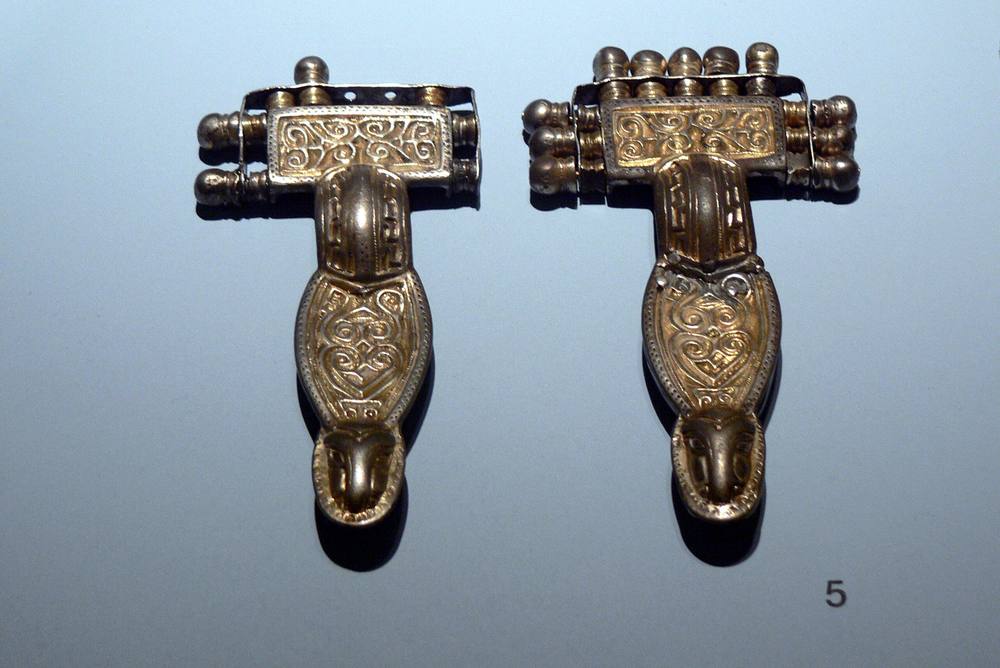
Most of what we know about daily life comes from graves. Row-grave cemeteries (Reihengräberfelder) are burial grounds with graves laid out in rows, usual in early medieval southern Germany. After about 530 the grave-goods custom changed in Bavarian graves: women were buried with jewellery, men had weapons placed in the grave from the fifth century on, a custom not usual in the old Germanic settlement area (German Wikipedia). The largest early medieval cemetery in southern Germany is Altenerding, discovered in 1965 during construction and excavated by Walter Sage in 1966 to 1969 and 1973; burial began before 450 (project page of the University of Bamberg). For Straubing, Unterhaching and Aschheim I saw no figures. For women's dress one account names bow brooches and bead necklaces; on weapon types I read nothing reliable and therefore do not describe them.
On settlement: according to the German Wikipedia the Roman-period evidence points to a thinly settled land; from the mid-sixth century a "founding period" begins that reshapes the settlement landscape. Place names in -ing (a kin group's farm), -heim and -hofen, and Romance names such as Marzoll and Gnigl bear witness to it. At Kirchheim stands a reconstructed Merovingian-period farm (so the Bavarian Wikipedia). Artificially deformed skulls are striking, mostly among women; Hakenbeck (2011) argues that these women were treated as locals in death.
On genetics: Veeramah and colleagues (PNAS 2018) sequenced DNA from about 40 people from Bavarian graves around 500, from Altenerding and Straubing according to the press release. The men were genetically uniform and related to Central and Northern Europeans, the women with deformed skulls more varied and similar to today's south-eastern Europeans, some with Central Asian ancestry. The study found no large share of Roman army ancestry; Celtic and Roman ancestry needs further study, say the authors. My assessment: the sample is small, the graves date from before the duchy, and the data say nothing about who called themselves "Baiuvarii". I have not seen the study itself in full text.
A direct link between the Baiuvarii and Aachen is not attested. The trial of Tassilo took place in 788 at Ingelheim, a palace in Rhenish Hesse, not at Aachen; in the sources I saw, Aachen does not appear in the Tassilo story as a place of proceedings. A connection lies in the family: Tassilo was a cousin of Charlemagne, for his mother Hiltrud was a daughter of Charles Martel, thus a sister of Charlemagne's father Pippin. The Tassilo Chalice, a gilded copper chalice from Kremsmünster Abbey (inscription "TASSILO DVX FORTIS + LIVTPIRC VIRGA REGALIS"), was on show in Aachen in 2014, the first time outside Austria since 1946 (German Wikipedia; I have not identified the exhibition). On the Franks in the region read Franks, on the Rhineland Germanic peoples in the Rhineland, and on the battle where Alemanni and Franks met, Zülpich.
The Boii legend is the toughest: Jonas of Bobbio equated Boii and Baiuvarii around 640, the idea shaped the view of history into the early nineteenth century, and Johannes Aventinus carried it into the modern era. The resemblance of the names is probable; descent is not attested. The origin story from Armenia (Veit Arnpeck, fifteenth century) is no historical source; Alheydis Plassmann considers the tribal legend of the twelfth century useless for the early period. I read nothing on today's Bavarian identity and make no statement about it. On the method of checking legends see Legend studies; on the Celts Celts.
The origin. How many people immigrated, from which regions and when, is not settled.
The name. Whether "Baiovarii" means "men from Bohemia", "men of the army" or something else is not decided by the sources.
Garibald. Who installed him and when, and whether the early dukes were Agilolfings, is disputed.
The Lex. Date, place and author are open.
Tassilo's fall. How much lay behind the oath-breaking of 763 and the Avar contacts we know only from the victors' side.
Related articles: Alemanni, Franks, Lombards, Thuringians, Marcomanni, Boii, Quadi, Saxons, Carantanians, Norici, Juthungi, Ostrogoths, Germanic peoples in the Rhineland and Zülpich.

The Alemanni · The Franks · The Lombards · The Thuringians · The Boii.
All History & Finds articles →
The Bastarnae enter history in 179 BC as mercenaries and settlers on the Balkans, more than two centuries before …
Read more →The Batavi lived in the Rhine delta, on the "island of the Batavi" in today's Gelderland. They paid no taxes, supplied …
Read more →Of the Slavic groups that become visible around the Aegean in the seventh century, we usually know little more than …
Read more →When Caesar marched into northern Gaul in 57 BC, his allies the Remi named one tribe as the strongest of the Belgae …
Read more →