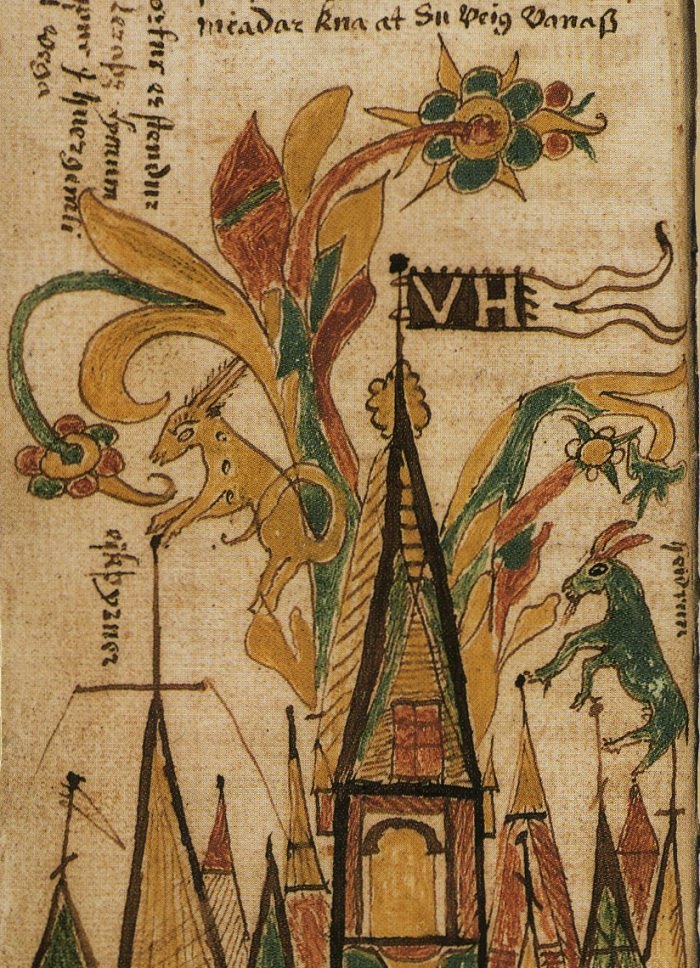
A single eddic stanza names Hvergelmir, and it needs only two lines to do so: drops fall into it from the antlers of a hart, and from there all waters take their course. Everything else comes from Snorri Sturluson, who mentions the spring in five chapters of his Edda and gives it three roles: source of the rivers before creation, snake pit beneath a root of the world ash, and worst of all places for the dead. This article goes through the six passages one by one and separates what the wording says from what only appears once the passages are read together.
Every overview of Norse mythology knows Hvergelmir: one of the “three wells beneath Yggdrasil”, home of the dragon Níðhöggr, source of the primeval rivers. The evidence behind this is small. In the eddic poems the name occurs in one stanza, Grímnismál 26. In Gylfaginning, the narrative core of Snorri’s Edda, it stands in chapters 4, 15, 16, 39 and 52 (numbering of Guðni Jónsson’s edition, as in our source archive). The reference works consulted list the same passages and no others. The name does not occur in the text of Skáldskaparmál as it stands in our archive.
Anyone writing about Hvergelmir is writing about six short passages in two works: a poem whose age nobody knows precisely and which was written down around 1270 in the Codex Regius, and a handbook composed by Snorri Sturluson around 1220 to 1225. Snorri knew the poem and quotes it, so he is not an independent second voice.
We treat the river names under Élivágar, Snorri’s threefold scheme under the three wells, the hart under Eikþyrnir. This article asks whether the six passages describe the same place at all.
The first element is not in dispute. Old Norse hverr means “cauldron”. The dictionary of Cleasby and Vigfússon gives “a cauldron, boiler” as the basic sense and notes that in volcanic Iceland the word also denotes hot springs; it lists places such as Reykjadalr, Reykjanes and Haukadal with Geysir and Strokkr.
The second element, -gelmir, is harder. According to the German Wikipedia article, which cites Jan de Vries’s Altnordisches Etymologisches Wörterbuch, de Vries connected gelmir with Old Norse galmr (“sword”) and translated Hvergelmir as “the roaring cauldron”. Henry Adams Bellows wrote “the Cauldron-Roaring” in the notes to his 1923 translation. Andy Orchard, according to the English Wikipedia, renders the name “bubbling boiling spring”; John Lindow, according to the German Wikipedia, understands it roughly as “hot-spring cauldron”. A different derivation comes from Adolfo Zavaroni, who links gelmir to galli (“vice, harm”) and translates “the evil cauldron”. I know these positions at second hand only.
The uncertainty concerns the exact rendering, not the general direction: a cauldron that makes a noise or seethes. Cleasby and Vigfússon paraphrased Hver-gelmir as the “local name of the northern Tartarus, the abyss”. That is a nineteenth-century reading of Snorri, not the meaning of the word.
Rudolf Simek, according to the German Wikipedia (citing his Lexikon der germanischen Mythologie), considers the name Hvergelmir not particularly old.
Grímnismál is a poem of knowledge. Odin sits between two fires as a stranger called Grímnir and lists what he knows about the world of the gods: dwellings, Valhalla, animals, rivers, the world tree, and finally his own names. Stanza 25 introduces the goat Heiðrún, who feeds on the branches of a tree called Læraðr and yields mead. Stanza 26 sets a second animal beside her:
Eikthyrnir is the hart who stands by Heerfather’s hall
And the branches of Lærath he bites;
From his horns a stream into Hvergelmir drops,
Thence all the rivers run.Grímnismál 26, translated by Henry Adams Bellows (The Poetic Edda, 1923)
The Old Norse text in our archive reads: Eikþyrnir heitir hjörtr, / er stendr höllu á / ok bítr af Læraðs limum; / en af hans hornum / drýpr í Hvergelmi, / þaðan eigu vötn öll vega. Literally: “Eikþyrnir is the name of the hart that stands on the hall and bites from Læraðr’s limbs; and from his horns it drips into Hvergelmir; from there all waters have their ways.” Three points stand out against the translations. In our text the hart stands höllu á, “on the hall”; Bellows’s “by Heerfather’s hall” and Simrock’s “vor Heervaters Saal” move him beside it. The owner is not the translators’ addition: according to a manuscript synopsis available online, the poem’s second manuscript, AM 748 I 4to, reads heria föðrs, “of Heerfather”, here, while the Codex Regius does not. The verb drýpr means “drips”; Simrock keeps that, Bellows makes it “a stream”. And vötn are “waters” in general, not only rivers.
The stanza says nothing more. It gives no location, does not say that Hvergelmir lies under a tree, and connects the spring neither with serpents nor with the dead. Only the direction of the water is fixed: it comes from above and spreads from Hvergelmir into all waters. Hvergelmir is here a collecting basin, not a primal ground.
The two stanzas that follow consist almost entirely of names. Stanza 27 opens with Síð and Víð, Sækin and Eikin, Svöl and Gunnþró, Fjörm and Fimbulþul, Rín and Rennandi; stanza 28 ends with Slíð and Hríð, Sylgr and Ylgr, Víð and Ván, Vönd and Strönd, Gjöll and Leiftr. The text in our archive has 37 names, with Víð appearing twice. One group is said to flow around the hoard of the gods (þær hverfa um hodd goða), the last to fall “near to men” and “from here to Hel”. Stanza 29 names four more waters, Körmt, Örmt and two Kerlaugar, through which Thor wades daily to judgement at the ash. The poem does not say that these come from Hvergelmir.
The list follows stanza 26 as if it spelled out what “all waters” are. That connection is not certain. Bellows called the whole passage from stanza 27 to 35 “confused” and pointed out that Bugge regarded stanzas 27 to 30 as an interpolation; the spelling of the names, he added, varies between manuscripts and editions.
Snorri introduces Hvergelmir in a quite different place, at the beginning of the world. In chapter 4 of Gylfaginning, Gangleri asks what there was at the start. Jafnhárr answers that many ages before the earth was made, Niflheim came into being, ok í honum miðjum liggr bruðr sá, er Hvergelmir heitir, “and in the middle of it lies the spring called Hvergelmir”. From it fall the rivers Svöl, Gunnþrá, Fjörm, Fimbulþul, Slíðr and Hríð, Sylgr and Ylgr, Víð, Leiftr; “Gjöll is nearest to the gates of Hel”.
The word bruðr is a by-form of brunnr. Anderson translated “the well called Hvergelmer” in 1880.
Three things in this chapter are new compared with the poem. First, the location: in the middle of Niflheim, a world that does not occur under this name in the eddic poems. Second, the time: Hvergelmir is older than the earth. Third, the selection: from the poem’s 37 names Snorri takes eleven, four from stanza 27 and seven from the end of stanza 28, where the rivers are said to fall to Hel. He gives no number. Simrock and Anderson split Fimbulþul into two names and arrive at twelve.
In the next chapter Hárr tells of the rivers called Élivágar, whose venom hardens into ice far from their source and fills Ginnungagap with rime. Hvergelmir is not mentioned there, and chapter 4 does not use the word Élivágar. That the eleven rivers are the Élivágar is an obvious inference, since the chapters are adjacent and chapter 5 speaks of “sources” (uppsprettur) of the Élivágar without naming them. It is a reader’s inference, not Snorri’s statement.
Hvergelmir appears a second time when Gangleri asks about the holiest place of the gods. The answer describes the ash Yggdrasil and its three roots: one is with the Æsir, one with the frost giants, “where Ginnungagap once was”, in þriðja stendr yfir Niflheimi, ok undir þeiri rót er Hvergelmir, en Níðhöggr gnagar neðan rótina, “the third stands over Niflheim, and under that root is Hvergelmir, and Níðhöggr gnaws the root from below”. Under the giants’ root lies Mímir’s well, under the root of the Æsir the well of Urðr.
Snorri’s own text is not entirely smooth here. After the passage on Mímir it continues: Þriðja rót asksins stendr á himni, “the third root of the ash stands in heaven”, and under it lies Urðr’s well. This is the root of the Æsir, which came first in the list just before. “Third” here probably means no more than “the remaining one”.
Chapter 16 adds the animals: the eagle in the branches, the squirrel Ratatoskr, the four harts. Then comes the sentence: En svá margir ormar eru í Hvergelmi með Níðhögg, at engi tunga má telja, “so many serpents are in Hvergelmir with Níðhöggr that no tongue can count them”. As evidence Snorri quotes two stanzas of Grímnismál, stanzas 35 and 34 in our numbering. They say something different: the serpents lie und aski Yggdrasils, “beneath the ash Yggdrasil”, and Níðhöggr “harms it from below”. Hvergelmir occurs in neither stanza. The step from “beneath the ash” to “in Hvergelmir” is Snorri’s and follows from his own scheme: Níðhöggr gnaws the third root, Hvergelmir lies under it, so the serpents belong there too. See also the serpents beneath Yggdrasil.
The same chapter says of Urðr’s well that the norns draw its water every day and pour it over the ash so that its branches do not wither or rot. Nothing of the kind is said about Hvergelmir, whose root is gnawed, not watered.
Chapter 39 is about life in Valhalla. Gangleri asks what the einherjar drink, and Hárr tells of the goat Heiðrún. More remarkable still, he says, is the hart Eikþyrnir, who stands on Valhalla and feeds on the same tree, en af hornum hans verðr svá mikill dropi, at niðr kemr í Hvergelmi, “and from his horns comes so great a dripping that it reaches down into Hvergelmir”. From there the rivers fall, and a list of 25 names follows.
This is Grímnismál 26 to 28 in prose. Snorri adds two small things: the word niðr, “down”, and the quantity of water. Both fit his location: if Hvergelmir lies in Niflheim, the drops from Valhalla’s roof must fall a long way and be large enough to feed rivers. The list itself matches the poem only in part. Rín and Rennandi are missing, as is the closing group with Slíð, Hríð, Sylgr, Ylgr, Gjöll and Leiftr, which Snorri has already used in chapter 4. Four names, Svöl, Gunnþró (spelt Gunnþrá in chapter 4), Fjörm and Fimbulþul, stand in both chapters. Ván, Vönd and Strönd do not appear in the text of our archive at all.
One book thus contains two accounts of the same spring. In chapter 4 Hvergelmir exists before the earth and gives water of its own accord. In chapter 39 it is fed by a hart standing on a hall of the gods, in a finished world. Snorri does not reconcile the two.
The last passage stands near the end of the book. Gangleri asks what remains after the burning of the world and receives a list of good and bad abodes. It is good to be in Gimlé and in the halls Brimir and Sindri. The hall on the Nástrandir, the corpse shores, is bad: woven of serpents’ backs, its doors facing north, streams of venom on the floor through which oath-breakers and murderers wade. Snorri quotes two stanzas of Völuspá and ends with the lines: En í Hvergelmi er verst: Þar kvelr Níðhöggr nái framgengna, “But in Hvergelmir it is worst: there Níðhöggr torments the corpses of the departed.”
A comparison with Völuspá as our archive gives it in Guðni Jónsson’s edition shows two differences. Stanza 39 there reads: þar saug Niðhöggr nái framgengna, sleit vargr vera, “there Níðhöggr sucked the corpses of the departed, the wolf tore men”. “There” refers to Náströnd and the heavy streams; the name Hvergelmir does not occur anywhere in the Völuspá of our archive. And the verb is saug, “sucked”, not kvelr, “torments”. Anderson translates the Gylfaginning line with “tortures”. Whether Snorri knew a version with different wording or reshaped the line himself, I cannot decide from the texts available to me. A transcription of the Hauksbók version of Völuspá available online also has savg; I have not checked the manuscripts of Snorri’s Edda.
The transfer is consistent: if Níðhöggr sits in Hvergelmir, as chapters 15 and 16 say, the dead he torments must be there too. The source of the rivers thus becomes the outermost place of punishment. How far this picture of graded abodes has a Christian colouring is debated among scholars (see the article on Níðhöggr). Hvergelmir has its role as a place of punishment in Snorri alone.
Set poem and handbook side by side, and the location remains open. In the poem Hvergelmir is fed by an animal that stands on a hall and browses on a tree called Læraðr. In Snorri the spring lies in the middle of Niflheim beneath a root of Yggdrasil. Neither source says whether Læraðr and Yggdrasil are the same tree. According to the German Wikipedia, which relies on Simek, scholarship assumes that Læraðr is merely a variant of Yggdrasil. The hart would then stand in the crown of the world tree and the spring at its foot: a coherent picture, but one assembled from two texts.
Grímnismál 31 speaks against a simple merger. The stanza names three roots of the ash: under one dwells Hel, under the second the frost giants, under the third mankind. It does not mention springs, and it has Hel where Snorri has Niflheim. Snorri kept the frost giants, replaced Hel with Niflheim and mankind with the Æsir. He puts Hvergelmir where the poem has the ruler of the dead. It fits that most of his rivers in chapter 4 fall to Hel in the poem, and that he calls Gjöll “nearest to the gates of Hel”. Snorri’s Hvergelmir thus borders on the realm of the dead, though he never places the spring in Hel outright. More under Helheim.
Taken by itself, the poem tells us only one thing about where Hvergelmir is: lower than the roof of a hall.
Snorri’s scheme assigns a body of water to each root: Urðarbrunnr, Mímisbrunnr, Hvergelmir. The poems do not have this triad. Völuspá knows Urðr’s well beneath the evergreen ash and Mímir’s well, in which Odin’s eye lies; Grímnismál knows Hvergelmir. Völuspá names its two wells in separate stanzas (19 and 28) and does not relate them to each other. No poem names all three or counts them.
Some scholars have concluded from this that the three names originally referred to one and the same mythical spring at the world tree, which Snorri then distributed over three places. The German Wikipedia article names Jan de Vries, René Derolez and Rudolf Simek for this view and notes that François-Xavier Dillmann is critical of it in the entry “Mimir” of the Reallexikon der Germanischen Altertumskunde. What the text shows is that the three waters do different things in Snorri. The gods hold court at Urðr’s well, and its water preserves the tree. Knowledge is drunk from Mímir’s well. From Hvergelmir water flows away, into the world and to Hel. Whether this division of labour is old or whether Snorri put three inherited names in order cannot be established with certainty.
Hvergelmir is often described as part of a water cycle: dew and rain fall from the world tree, gather in the spring, flow through the world as rivers and return to the depths. Bellows supposed that the hart Eikþyrnir stands for the clouds.
The texts contain the first half of this. Water drips from above into a basin, all waters go out from there, and some fall to Hel. No source says that it rises again, and nowhere is it stated that the hart means cloud or rain. Grímnismál does not explain its images; it lists them.
For sacred springs in northern Europe there is archaeological evidence. I know of nothing comparable for Hvergelmir: no find, no inscription, no place name, no image that can be securely assigned to it. In the texts nobody sacrifices at Hvergelmir, nobody drinks from it, no god visits it.
On this evidence Hvergelmir is a building block in a description of the world, not a demonstrable object of religious practice. Grímnismál uses the name for the origin of all waters. Snorri uses it to anchor three things that would otherwise hang in the air: the rivers of the creation story, the dragon at the root and the harshest punishment after the end of the world. These do not add up to a map.
I know of no medieval drawing of the spring. Anyone depicting Hvergelmir can rely on what Grímnismál 26 contains: a hart, antlers, drops.
What does the name Hvergelmir mean? The first part, hverr, means “cauldron” and in Iceland also denotes hot springs. The second part is harder; the renderings consulted are “der brausende Kessel” (roaring cauldron; de Vries, according to Wikipedia) and “the Cauldron-Roaring” (Bellows). That rendering is not certain.
Where is Hvergelmir? According to Snorri, in the middle of Niflheim and beneath the third root of Yggdrasil. The only poem that names the spring gives no location.
How many rivers rise from Hvergelmir? That depends on the passage. Grímnismál lists 37 names in the text of our archive; Snorri names eleven in chapter 4 and twenty-five in chapter 39. None of the sources states a number itself.
Is Hvergelmir the same as Urðr’s well or Mímir’s well? In Snorri they are three different places with different functions. Some scholars suspect that the three names originally meant one spring; others disagree. No poem names all three.
Does Hvergelmir occur in Völuspá? The name does not stand in the text of Völuspá as our archive gives it. In chapter 52 of Gylfaginning Snorri attaches it to a line that belongs to the description of Náströnd in Völuspá.
The three wells · Niflheim – the Mist World of the North: what Snorri says, what the poems say, and why Niflheim is not Hel · Niðhöggr – the gnawer at the root · Yggdrasil – the world tree · Élivágar: the primeval waters.
A god tears the head off a black ox, rows further out than the boat's owner likes, and moments later has the creature …
Read more →A goddess wakes a giantess in the middle of the night to squeeze a family tree out of her. Her mount is a boar with …
Read more →A ship that no god can budge, a giantess on a wolf bridled with vipers, sparks from the rollers and a trembling earth …
Read more →The gods of Völuspá begin their story on a field, and the survivors return to the same field once the world has burned …
Read more →