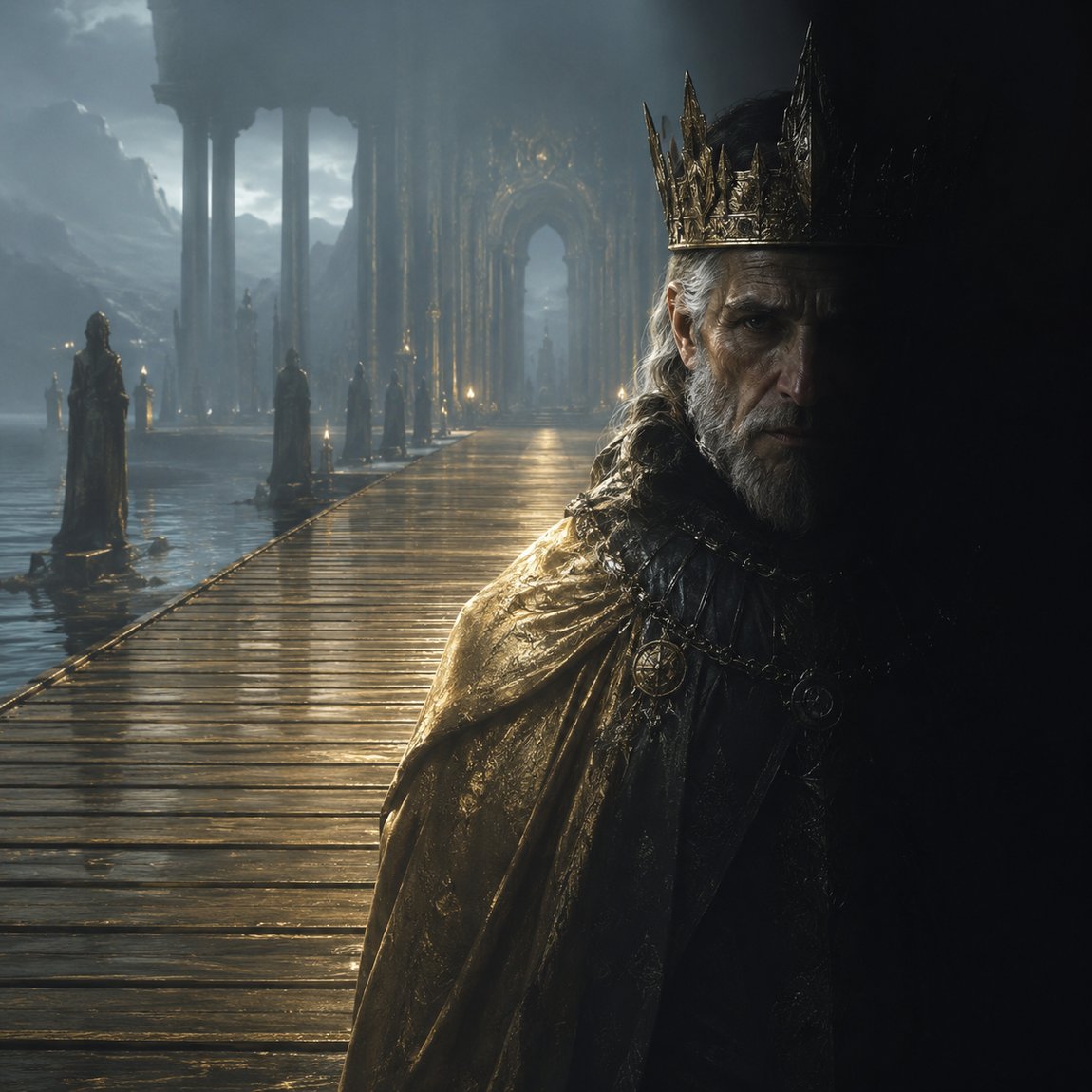
A young warrior from Orkney carries the head of her dead lover through a world of fire giants, a god of illusion and a goddess of the dead, and in the sequel she sails with slavers to Iceland, where giants are ravaging the land. Ninja Theory's two games borrow freely from the Eddas, from folklore and from archaeology. This article goes through them figure by figure: what goes back to medieval sources, what comes from much later, and what the studio made up. Along the way it also asks how little we actually know about the Picts.
“Hellblade: Senua's Sacrifice” came out on 8 August 2017 for PlayStation 4 and Windows, and later for Xbox, Switch and PlayStation 5. It was made by Ninja Theory, a studio based in Cambridge, England, with a core team of about twenty people; Tameem Antoniades directed and wrote it. The lead actress, Melina Juergens, had been working at the studio as a video editor and had no acting experience.
The sequel, “Senua's Saga: Hellblade II”, was released on 21 May 2024 for Windows and Xbox Series X/S, and on 12 August 2025 for PlayStation 5. By then Ninja Theory belonged to Microsoft. The first game is set in the late eighth century, the second in ninth-century Iceland.
Neither game tries to re-enact history. Both tell the story of a woman who hears voices and reads her world through the stories she knows. So the useful question is not “Is this historical?” but “Where does this motif come from, and how old is it really?”
In the first game Senua is a Pict living on the Orkney Islands off the north coast of Scotland. Northmen raid her village and kill her lover Dillion in a gruesome way. Senua sets out for Helheim to reclaim his soul from the goddess of the dead. In the sequel, her Orkney origin is the starting point: Norse slavers carry people off from the islands, and Senua lets herself be taken in order to free them.
Does that fit the history? Broadly, yes. Orkney was part of the Pictish world. Adomnán, abbot of Iona, writing his Life of Saint Columba around 700, mentions a sub-king of the Orkneys staying at the court of the Pictish king Bridei, which points to a local lordship dependent on Bridei. Pictish settlement on Orkney is well attested archaeologically, for example on the tidal island of the Brough of Birsay, an important Pictish site in the seventh and eighth centuries. A warrior from Orkney around 790 therefore has a plausible background. Senua and her village are invented, though, and no specific raid on Orkney is recorded in writing for this period.
The Picts are among the hardest peoples of early medieval Europe to pin down. The Latin name “Picti” first appears in a Roman panegyric of 297 and is usually taken to mean “the painted ones”. No Pictish histories survive. What we read was written by others: Bede, Adomnán, Irish annalists, and later king lists. Their language was probably Celtic, related to Brittonic, the ancestor of Welsh. It survives in place names, personal names and a handful of inscriptions in ogham, an early medieval stroke alphabet of Irish origin whose readings on Pictish stones remain disputed.
The most striking evidence is the symbol stones, with their recurring signs: crescent and V-rod, double disc and Z-rod, mirror and comb, the so-called Pictish beast, eagles, fish. Later stones combine them with a cross. Nobody knows for certain what the symbols mean; names, ranks and kin emblems have all been proposed. An Orkney example is the slab from the Brough of Birsay, early eighth century: three men with spears, swords and square shields, with four symbols above them. The original is in Edinburgh, with a replica on site.
After the ninth century the Picts vanish from the record. On the mainland they merged into the kingdom of Alba and their language gave way to Gaelic. On Orkney the Norse took over. Whether by violent displacement or gradual mixing is one of the big open questions of early Scottish history. At the Brough of Birsay, Pictish objects turned up in Norse houses, which could mean coexistence, or simply loot. The twelfth-century “Historia Norwegie” recalls the first islanders only as a tiny people hiding underground at midday and priest-like “Papae”, probably a distorted memory of Picts and Irish clergy.
Hellblade exploits this gap: almost nothing about Senua's life or beliefs can be checked against Pictish sources, because there are none.
According to the developers, Senua's name comes from a goddess who became known in 2002 through a Roman-period hoard found near Ashwell in Hertfordshire. Her name was first read as “Senua” and later corrected to “Senuna”. So the goddess belongs to Roman southern England, not to eighth-century Orkney.
The same goes for the blue face paint. It draws on the popular idea that the Picts painted themselves with woad, and on the name “Picti”. Nothing is known about actual patterns, and the studio says it took that into account by keeping the paint simple enough for Senua to have applied it herself.
Her father Zynbel is more problematic. In the game he is a druid who has his wife Galena burned and torments his daughter with religious mania. Druids are attested by classical authors for pre-Roman Gaul and Britain, but not for eighth-century Orkney. By then the Pictish kingdom was Christian. Columba had visited Bridei in the sixth century, and place names such as Papa Westray recall the “papar”, as the Norse called the clergy they met. A druid as village leader around 790 is a dramatic invention. For what is actually known, see the article on Celtic religion.
The game places the meeting of Picts and Northmen at the end of the eighth century, which fits the known chronology. The raid on Lindisfarne in 793 is the first dated Viking event in Britain, and attacks on Iona and other islands soon followed. On Orkney, excavations at the Brough of Birsay show Norse settlement from the early ninth century; Birsay later became a seat of the earls of Orkney. When exactly the first Norse arrived, and whether short raids came before permanent settlement, cannot be determined with certainty.
In the first game the Northmen appear mainly as menacing, mask-like warriors from Senua's nightmares. She knows their myths through Druth, a man who was long a slave of the Northmen and told her their stories. Druth is invented, but he neatly explains why a Pict thinks in terms like Helheim and Surtr. Trading in people was part of many Viking voyages, as the article on slavery in the Viking Age shows.
The sequel adds settlers who suffer from the giants themselves, closer to reality than the image of the pure plunderer.
The goal of the first game is Helheim, the realm of the dead. In the Old Norse sources both the place and its ruler are called Hel. The game calls the goddess “Hela”. That is not the usual Old Norse form; it was popularised mainly by later retellings and by the Marvel comics character Hela, created by Stan Lee and Jack Kirby in 1964.
The fullest description comes from Snorri Sturluson's “Gylfaginning”, the first part of his Prose Edda, written in Iceland around 1220. According to chapter 34, Hel is a child of Loki and the giantess Angrboda, sister of the Fenris wolf and the Midgard serpent. Odin casts her into Niflheim and gives her power over nine worlds; she is to receive all who die of sickness or old age. Her hall is called Éljúðnir, her dish “Hunger”, her knife “Famine”, her bed “Sick-bed”. She herself is half black or blue and half flesh-coloured, and looks grim and gloomy. Hellblade turns this into a gigantic woman with one half of her face apparently rotting, a free but recognisably source-based treatment.
Her role is less faithful. In the Eddas she rules the dead; she does not fight with a sword. In Hermóðr's ride to Hel (chapter 49) she bargains: Baldr may return if all things weep for him. Hermóðr crosses the bridge Gjallarbrú; Hellblade, too, has a bridge before Helheim. That the goddess of the dead ends up as a mirror of Senua's own loss is entirely the game's reading.
One of the two great trial sections belongs to Surtr, the fire giant. In Gylfaginning he guards the border of Muspelheim, the blazing primeval realm in the south, with a flaming sword. At Ragnarök, the doom of the gods, he leads the sons of Muspell, kills Freyr and flings fire over the world. The basis for this is the “Völuspá”, the Prophecy of the Seeress, which opens the Poetic Edda.
“Surt fares from the south with the scourge of branches, / The sun of the battle-gods shone from his sword; / The crags are sundered, the giant-women sink, / The dead throng Hel-way, and heaven is cloven.”Völuspá, stanza 52, translated by Henry Adams Bellows, The Poetic Edda, 1923
The stanza shows how closely the fire giant, the giantesses and the road to Hel belong together. Hellblade keeps Surtr as the warden of a realm of fire but leaves out the end of the world. One detail points ahead to the sequel: Iceland has a lava cave called Surtshellir. The Landnámabók, the Icelandic Book of Settlements, already tells of a young man who went there to recite a praise poem to the giant in the cave. Animal bones from the cave suggest ritual activity in the Viking Age; whether it was a cult of Surtr is interpretation, not established fact.
The second great opponent in the first game is Valravn, presented as a god of illusion who leads Senua astray with mirages and reflections. Measured against the Viking Age, this is the clearest misstep: the valravn is not Old Norse. It is a figure of Danish folklore, known above all from the folk ballad “Valravnen”, number 60 in the collection “Danmarks gamle Folkeviser”. The oldest version is in a song manuscript of Jens Bille from 1555 to 1559. In the ballad a cursed raven demands a girl's child; only through a child's blood can it throw off the curse and become human again.
The link with battlefields is younger still. In 1893 the folklorist Evald Tang Kristensen recorded a tale in which ravens that feed on the unburied dead become valravne, and a valravn that eats a heart gains human understanding and superhuman strength. That record appears to be the only source for the idea. Nowhere is the valravn a god of illusion.
So the game borrows a figure whose tradition begins some 700 years after Senua's time. The idea is not plucked from nowhere: ravens are firmly part of the Norse imagery of war and death, from Odin's ravens Huginn and Muninn to skaldic verses in which ravens feast on the fallen. See Huginn and Muninn and the raven in the North.
In the dark halls of Helheim, Senua is hunted by a huge beast. She survives only by staying in the light; at times the screen goes completely black and you have to steer by sound. What the creature is called is reported differently. Reviews and walkthroughs mostly speak of Fenrir, while the fan wiki and several retellings call it Garm. I have not been able to check the name used in the game itself. Its shape is striking: not really a wolf, but a rotting, half-skeletal animal that some descriptions liken to a boar.
Both names are genuine. Garmr is a dog, according to Grímnismál the best of hounds. In Völuspá a refrain returns: Garmr bays loudly before Gnipahellir, the fetter breaks and the wolf runs free. In Snorri, Garmr and the god Týr kill each other at Ragnarök. Fenrir is the wolf the gods bind, costing Týr his hand, and who swallows Odin. Whether Garmr and Fenrir were originally the same figure is debated. See also the article on Fenrir.
Along the way Senua gains a sword she recognises as Gramr. The name is genuinely Norse: Gram is the sword with which Sigurd kills the dragon Fafnir in the Völsunga saga, reforged by Regin from the shards of his father Sigmund's blade. In the sources it has nothing to do with Hel or Helheim. For background see the article on Sigurd.
In the first game runes serve as puzzles. Locked gates bear a rune, and Senua must find the same shape in her surroundings, in branches, rock clefts or shadows. Historically, though, runes were above all a script; most inscriptions name owners, makers or the dead, and magical formulas are the exception. The Picts did not write runes. On Orkney they appear only in the Norse period, most famously the carvings in the chambered tomb of Maeshowe from the twelfth century; about fifty genuine runic finds are counted from the islands.
“Senua's Saga: Hellblade II” opens with a shipwreck. Senua has let Norse slavers take her from Orkney, a storm smashes the ships off Iceland, and she forces the slave master Thórgestr to guide her. On the way she finds settlements haunted by giants and a stronghold the game calls Borgarviki, whose goði needs the giants as a means of power.
By Icelandic tradition the island was settled around 870. An ash layer known as the settlement tephra has been dated through Greenland ice cores to 871, plus or minus two years, and the oldest traces of settlement lie just above or below it. A ninth-century Iceland is therefore a land in the first decades of settlement. The Althing, the island's general assembly, was founded only around 930. Goðar, chieftains with priestly and legal duties, existed from the start, but a goði ruling a fortress and terrorising a whole district is the game's dramatisation. How assemblies worked is explained in the article on the thing.
What is well attested is that people from the British Isles were brought to Iceland, many against their will. The Landnámabók tells of Hjörleifr, foster-brother of the settler Ingólfr, who was killed by his Irish slaves; they fled to islands that have since been called Vestmannaeyjar, the “islands of the Westmen”, meaning the Irish. A genetic study led by S. Sunna Ebenesersdóttir in 2018 found a roughly even mix of Norse and Gaelic ancestry in 27 early Icelanders. Not everyone of Gaelic descent was a slave, but the game's scenario is credible. For the early settlement see the article on Flóki Vilgerðarson.
Ninja Theory names the coast at Reykjanestá and the hot springs of Fosslaug as models for locations. The stronghold recalls Borgarvirki, a basalt formation in north-west Iceland that was turned into a fortification at an uncertain date.
The giants of the sequel are called Illtauga, Sjávarrisi and “the Tyrant”. These names and their stories are invented. In the plot, an eruption of the volcano Askja opened the way for giants from Jötunheim into the human world. Askja is a real volcano in the highlands; its best-known major eruption was in 1875. I know of no specific ninth-century eruption. Eldgjá, around 935, is attested.
Some of it does have roots in tradition. Giants, Old Norse jötnar, are the gods' great adversaries in the Eddas, often linked with rock and wilderness; their land is Jötunheim. At the end the defeated giants turn to stone. In the Eddic poem Alvíssmál, Thor keeps the dwarf Alvíss talking until sunrise, which is usually read as petrification, and in modern Icelandic folk tales trolls turn to stone in daylight. A forest in the game is called Járnviðr, “Ironwood”: according to Völuspá, an old giantess there raises Fenrir's brood.
The game's draugar are feral, cannibal raiders. In the sagas of Icelanders a draugr is something else: a dead man who returns from the grave, kills livestock and people, and is laid to rest only by beheading or burning. Examples are Glámr in Grettis saga and Thórólfr Lame-foot in Eyrbyggja saga. The game uses a real term for an invented group.
The “hidden folk” who reveal to Senua, underground, where the giants come from draw on the Icelandic huldufólk, invisible beings living in rocks and hills. Their tradition is known mainly from the modern period, written down in the nineteenth century by Jón Árnason. Related ideas about elves exist in medieval texts, but the image of the huldufólk is clearly younger than the Viking Age.
Both games are told from the perception of a woman with psychosis, who hears voices the studio calls the “Furies”. Cambridge psychiatrist Paul Fletcher, who researches psychosis, was credited as an adviser. The Wellcome Trust, a British science charity, gave a starter grant and later contributed to production costs. Through Fletcher, people with lived experience at Recovery College East in Cambridgeshire described their experiences and reviewed the results. The voices were recorded binaurally, that is, spatially. For the sequel, Fletcher and people with lived experience of psychosis were consulted again.
For this fact check that means: the Norse figures are not meant as reality but as images through which Senua makes sense of loss, guilt and fear. The medical side is beyond the scope of an article about mythology.
Is Senua a historical person? No. Senua, Dillion, Druth and Zynbel are invented. Her name goes back to a goddess from Roman Britain whose name was first read as “Senua” and later corrected to “Senuna”.
Did Picts really come into contact with Northmen? Yes. On Orkney, Norse settlements of the ninth century followed Pictish ones, for instance at the Brough of Birsay. Whether the Picts there were driven out or mixed with the newcomers is disputed.
Where do Hel, Surtr and Garmr come from? From the Poetic Edda and Snorri Sturluson's Prose Edda, both written down in Iceland in the thirteenth century. They contain older tradition, but they are not witnesses from the period in which the game is set.
Is the Iceland of Hellblade II realistic? The landscape is modelled on real places. The giants, the powerful goði and the Askja eruption are invented; it is plausible, however, that slaves from the British Isles were brought to Iceland.
Were experts involved in the games? Yes, for the portrayal of psychosis: Cambridge psychiatrist Paul Fletcher, the Wellcome Trust and people with lived experience of psychosis. I am not aware of historical advisers for the Norse side.
On the goddess of the dead and her realm: Hel and Helheim. On the fire giant: Surtr and Muspelheim. On the wolf: Fenrir. On the end of the world: Ragnarök. On Orkney: The earls of Orkney and Viking islands. On unfreedom: Slavery in the Viking Age. More games fact-checked: God of War and Valheim.

Hel – goddess and realm of the dead · Helheim · Surtr – the Fire Giant Who Burns the World: Edda, Cave Finds and Iceland's Volcanoes · Valheim fact-check · God of War fact-check.
No – there is no evidence that any Viking ever wore a horned helmet in battle, neither in the ground nor in any …
Read more →A heavy grey slab covered in runes, said to have been dug out from under the roots of a poplar in Minnesota. Its …
Read more →Few characters have made the thunder god as famous as Marvel's Thor – and few have spread as many misunderstandings …
Read more →Two spells on the blank leaf of a missal, entered in Old High German in the tenth century, discovered in 1841 by Georg …
Read more →