Norse god of thunder (4)? THOR. Thor's golden-haired wife (3)? SIF. This page collects around 160 Norse mythology crossword clues with their answers and letter counts, sorted into gods and goddesses, giants and other beings, worlds and halls, objects and animals, and the words around the Edda. You also get the spelling rules that decide whether your answer is MJOLNIR or MJOLLNIR, and an honest look at the clues setters keep recycling.
Crossword setters love the Norse gods for a simple reason. The names are short, packed with vowels and built from letters that cross easily. ODIN, THOR, LOKI, EDDA, YMIR, ULL, TYR: you can drop them into almost any grid. Open a scholarly edition, though, and you meet Óðinn, Iðunn and Mjǫllnir, and suddenly nothing fits.
Every table below gives the answer as it appears in a grid: capital letters, no accents, special Old Norse letters resolved. In British cryptics and American puzzles alike, the number in brackets after a clue gives the length, so "Norse god of thunder (4)" means a four-letter answer. That number sits in our third column. Where several spellings are in use, we list them all, each with its own count, in the same order. The first is the one we see most often in English puzzles. Where we have a full article on a figure, the answer links to it.
One honest warning. Crossword clues are not sources. Some are loose, some owe more to Wagner or Marvel than to the medieval texts. We checked every answer against the Poetic Edda, Snorri Sturluson's Prose Edda from the 13th century and Rudolf Simek's standard Dictionary of Northern Mythology. Where puzzle convention and the sources part ways, we tell you.
The single most useful word in this whole field is AESIR, the family of gods around Odin, Thor, Frigg and Tyr. Five letters, three vowels, and a near-guaranteed guest in American grids. Its partner is VANIR, the gods of fertility and wealth: Njord, Frey and Freyja, who joined the Aesir after the war between the two families.
Variants are the classic trap. Odin appears as WODEN in Old English and as WOTAN in Wagner, both five letters, and the Anglo-Saxon form survives in Wednesday. The thunder god has the German form DONAR and the Old English THUNOR, which is why we have Thursday. Neither DONAR nor WODEN appears in the Edda. If a clue specifically asks for a god "in the Edda", THOR or ODIN is the safe call. Freyja splits into FREYA and FREYJA, and Frey into FREY and FREYR; the final -R is just an Old Norse grammatical ending, and setters drop it when they need one letter less.
Marvel has added its own layer. HELA, the villain of the films, is a comic invention built on HEL, the ruler of the dead in Norse myth. If the clue says "Norse goddess of the dead", the answer is three letters. Loki is another case: in the comics he is Thor's adopted brother, in the medieval sources he is the son of a giant and Odin's blood-brother. The grid does not care, but quiz questions sometimes do.
For "Norse goddess of the hunt" the answer is almost always SKADI. The North had no Diana, but Snorri describes Skadi going about on skis with a bow, shooting game. Her male counterpart is ULL, the archer god, three letters with two of them the same. Setters adore him.
| Clue | Answer | Letters |
|---|---|---|
| Norse All-Father | ODIN, WODEN, WOTAN | 4, 5, 5 |
| One-eyed Norse god | ODIN | 4 |
| Odin's title, the High One | HAR | 3 |
| Odin in disguise, the Masked One | GRIMNIR | 7 |
| Norse god of thunder | THOR | 4 |
| Germanic thunder god | DONAR, THUNOR | 5, 6 |
| Thor's golden-haired wife | SIF | 3 |
| Wife of Odin | FRIGG, FRIGGA | 5, 6 |
| Norse goddess of love | FREYA, FREYJA | 5, 6 |
| Norse god of fertility | FREY, FREYR | 4, 5 |
| Norse god of light | BALDER, BALDUR, BALDR | 6, 6, 5 |
| Blind god who killed Balder | HOD, HODER, HODUR | 3, 5, 5 |
| One-handed Norse war god | TYR, TIW | 3, 3 |
| Watchman of the gods | HEIMDALL, HEIMDAL | 8, 7 |
| Norse trickster god | LOKI | 4 |
| Norse god of poetry | BRAGI | 5 |
| Keeper of the golden apples | IDUN, IDUNN, IDUNA | 4, 5, 5 |
| Norse god of sea and wind | NJORD, NJORDR | 5, 6 |
| Norse god of justice | FORSETI | 7 |
| Norse god of archery and skis | ULL, ULLR | 3, 4 |
| Norse goddess of the hunt | SKADI | 5 |
| Norse goddess of the dead | HEL | 3 |
| Silent god, Odin's avenger | VIDAR | 5 |
| Avenger of Balder | VALI | 4 |
| Balder's wife | NANNA | 5 |
| Loki's faithful wife | SIGYN | 5 |
| Odin's mother | BESTLA | 6 |
| Odin's father | BOR, BORR | 3, 4 |
| First god, licked from ice | BURI | 4 |
| Goddess who ploughed Zealand | GEFJON, GEFION | 6, 6 |
| Thor's strong son | MAGNI | 5 |
| Thor's daughter | THRUD | 5 |
| God who rode to Hel for Balder | HERMOD | 6 |
| Norse sun goddess | SOL, SUNNA | 3, 5 |
| Norse moon god | MANI | 4 |
| Freyja's wandering husband | OD, ODR | 2, 3 |
| God sent as hostage to the Vanir | HOENIR | 6 |
| Earth goddess in Tacitus | NERTHUS | 7 |
| Norse gods collectively | AESIR | 5 |
| Norse fertility gods | VANIR | 5 |
No giants, no world. Odin and his brothers built earth, sea and sky from the body of the primeval giant YMIR, who was fed by the cow AUDHUMLA. She licked the first god, BURI, out of the salty ice. These creation clues are friendly because the names are short and stable.
For "giant" in general, English puzzles have a secret weapon: ETIN or ETTIN, an old English word from the same root as Old Norse jötunn. It is not a Norse term in the strict sense, but it is a real English cognate, and it turns up in grids far more often than JOTUN. The Midgard Serpent is JORMUNGAND or JORMUNGANDR, ten or eleven letters, mostly seen in themed puzzles. The fire giant SURT also appears as SURTR.
AEGIR is a puzzle favourite and a small trap. Many clues call him a sea god, but the sources make him a giant who hosts the gods at feasts in his hall, together with his wife RAN. The god of sea and wind among the Vanir is NJORD. Both answers have five letters, so check the crossings. The Norns are URD, VERDANDI and SKULD. Calling them past, present and future is a modern shorthand; the Völuspá only names them and says they lay down the lives of men.
VALKYRIE is the standard spelling, with VALKYR as a rarer variant. Individual valkyries appear in the Eddic poem Grímnismál, but in puzzles the famous one is BRYNHILD from the Volsung legend, also spelled BRUNHILD in the German Nibelung tradition.
| Clue | Answer | Letters |
|---|---|---|
| Primeval frost giant | YMIR | 4 |
| Primeval cow | AUDHUMLA, AUDUMLA | 8, 7 |
| Norse giant | JOTUN, ETIN, ETTIN | 5, 4, 5 |
| Fire giant of Muspelheim | SURT, SURTR | 4, 5 |
| Monstrous wolf, son of Loki | FENRIR, FENRIS | 6, 6 |
| Midgard Serpent | JORMUNGAND, JORMUNGANDR | 10, 11 |
| Giantess, mother of Fenrir | ANGRBODA | 8 |
| Giant who abducted Idun | THJAZI, THIAZI | 6, 6 |
| Stone-hearted giant | HRUNGNIR | 8 |
| Giant king of Utgard | UTGARDLOKI | 10 |
| Giant who stole Thor's hammer | THRYM | 5 |
| Giantess guarding the mead | GUNNLOD | 7 |
| Sea giantess with a net | RAN | 3 |
| Norse sea giant, host of the gods | AEGIR | 5 |
| Giantess who wed Frey | GERD, GERDA | 4, 5 |
| Wise being made from spittle | KVASIR | 6 |
| Wise head at the well | MIMIR | 5 |
| Norse Fates | NORNS | 5 |
| A Norse Fate | NORN | 4 |
| Eldest Norn | URD, URDR | 3, 4 |
| Norn named Becoming | VERDANDI | 8 |
| Youngest Norn | SKULD | 5 |
| Chooser of the slain | VALKYRIE, VALKYR | 8, 6 |
| Valkyrie of the Volsung legend | BRYNHILD, BRUNHILD | 8, 8 |
| Norse seeress | VOLVA | 5 |
| Elves in Old Norse | ALFAR | 5 |
| Dwarf who forged Mjolnir | EITRI, SINDRI | 5, 6 |
| Dwarf who bet against Loki | BROKK, BROKKR | 5, 6 |
| Dwarf with the cursed ring | ANDVARI | 7 |
| Dragon slain by Sigurd | FAFNIR, FAFNER | 6, 6 |
| Dragon-slaying hero | SIGURD, SIEGFRIED | 6, 9 |
| Legendary smith | VOLUND, WAYLAND, WELAND | 6, 7, 6 |
| Guardian spirit | FYLGJA | 6 |
| Norse undead | DRAUGR, DRAUG | 6, 5 |
| Scandinavian folk creature | TROLL | 5 |
| First man | ASK, ASKR | 3, 4 |
| First woman | EMBLA | 5 |
| Survivors of Ragnarok | LIF, LIFTHRASIR | 3, 10 |
| Frey's servant | SKIRNIR | 7 |
| Thor's servant | THJALFI | 7 |
The Völuspá speaks of nine worlds beneath the World Tree YGGDRASIL but never lists them. The tidy roster of Asgard, Midgard, Vanaheim and the rest is a modern assembly from several sources. Puzzles do not care: ASGARD (6) and MIDGARD (7) are among the most common Norse answers in any language.
The ending -heim, "home" or "world", gives setters long words from short roots: NIFLHEIM, MUSPELHEIM, VANAHEIM, JOTUNHEIM. For the realm of the dead, HEL is often enough; it is the name of both the goddess and her domain. HELHEIM dominates in modern books and games, while the medieval texts usually just say Hel.
VALHALLA is the usual English form, eight letters. It comes from Old Norse Valhǫll, "hall of the slain", which gives the shorter VALHALL (7). Both are fair. If you want to know who actually went where after death, read Valhalla or Hel.
The halls of the gods, such as HLIDSKJALF, BILSKIRNIR and BREIDABLIK, mostly turn up in large themed puzzles and quiz rounds. Nearly all come from Grímnismál, the poem in which Odin, tortured between two fires, recites the homes of the gods.
| Clue | Answer | Letters |
|---|---|---|
| Home of the Aesir | ASGARD | 6 |
| World of humans | MIDGARD | 7 |
| Home of the Vanir | VANAHEIM | 8 |
| Land of the giants | JOTUNHEIM, UTGARD | 9, 6 |
| Norse underworld | HEL, HELHEIM | 3, 7 |
| World of mist and ice | NIFLHEIM | 8 |
| World of fire | MUSPELHEIM, MUSPELL | 10, 7 |
| Realm of the light elves | ALFHEIM | 7 |
| Realm of the dark elves | SVARTALFHEIM | 12 |
| Void before creation | GINNUNGAGAP | 11 |
| World Tree | YGGDRASIL, YGGDRASILL | 9, 10 |
| Rainbow bridge | BIFROST | 7 |
| Hall of the slain | VALHALLA, VALHALL | 8, 7 |
| Freyja's field of the slain | FOLKVANG | 8 |
| Frigg's hall | FENSALIR | 8 |
| Thor's hall | BILSKIRNIR | 10 |
| Balder's hall | BREIDABLIK | 10 |
| Heimdall's fortress | HIMINBJORG | 10 |
| Njord's home by the sea | NOATUN | 6 |
| Odin's high seat | HLIDSKJALF | 10 |
| Plain of the final battle | VIGRID | 6 |
| Golden hall after Ragnarok | GIMLE | 5 |
| River on the road to Hel | GJOLL | 5 |
| Spring in Niflheim | HVERGELMIR | 10 |
Thor's hammer is Mjǫllnir in Old Norse. English grids give MJOLNIR (7), the form made famous by comics and films, or MJOLLNIR (8), which keeps the double L of the original. Snorri tells how it was made. Loki had cut off Sif's hair and had to replace it. The sons of Ivaldi forged new golden hair, plus the folding ship SKIDBLADNIR and the spear GUNGNIR. Then Loki bet his head with the dwarf Brokk that Brokk's brother Eitri could not do better. Eitri produced the boar GULLINBURSTI, the ring DRAUPNIR and the hammer. Six crossword answers from a single story.
Animals come in pairs, which suits symmetrical grids. Odin's ravens are HUGIN and MUNIN, "thought" and "memory", or HUGINN and MUNINN in fuller form. His wolves are GERI and FREKI, Thor's goats TANNGRISNIR and TANNGNJOSTR. Odin's eight-legged horse SLEIPNIR is, oddly, Loki's child by the stallion SVADILFARI, who helped a giant build the wall of Asgard.
A Wagner trap waits here too. Sigurd's sword is GRAM in the Edda. Wagner calls it Nothung, and the cursed ring of the Old Norse tale is ANDVARANAUT, not "the Ring of the Nibelung".
| Clue | Answer | Letters |
|---|---|---|
| Thor's hammer | MJOLNIR, MJOLLNIR | 7, 8 |
| Odin's spear | GUNGNIR | 7 |
| Odin's gold ring | DRAUPNIR | 8 |
| Freyja's necklace | BRISINGAMEN | 11 |
| Fetter of Fenrir | GLEIPNIR | 8 |
| Frey's folding ship | SKIDBLADNIR | 11 |
| Balder's funeral ship | HRINGHORNI | 10 |
| Ship of dead men's nails | NAGLFAR | 7 |
| Heimdall's horn | GJALLARHORN | 11 |
| Thor's belt of strength | MEGINGJORD | 10 |
| Thor's iron gloves | JARNGREIPR | 10 |
| Sigurd's sword | GRAM | 4 |
| Andvari's cursed ring | ANDVARANAUT | 11 |
| Vessel of the mead of poetry | ODRERIR | 7 |
| Mill of Fenja and Menja | GROTTI | 6 |
| Odin's eight-legged horse | SLEIPNIR | 8 |
| Odin's ravens | HUGIN, MUNIN, HUGINN, MUNINN | 5, 5, 6, 6 |
| Odin's wolves | GERI, FREKI | 4, 5 |
| Thor's goats | TANNGRISNIR, TANNGNJOSTR | 11, 11 |
| Frey's golden boar | GULLINBURSTI | 12 |
| Goat on Valhalla's roof | HEIDRUN | 7 |
| Stag on Valhalla's roof | EIKTHYRNIR | 10 |
| Boar eaten nightly in Valhalla | SAEHRIMNIR | 10 |
| Golden-combed rooster | GULLINKAMBI | 11 |
| Squirrel on the World Tree | RATATOSK | 8 |
| Dragon gnawing the World Tree | NIDHOGG | 7 |
| Wolf chasing the sun | SKOLL | 5 |
| Wolf chasing the moon | HATI | 4 |
| Hound of Hel | GARM, GARMR | 4, 5 |
| Sigurd's horse | GRANI | 5 |
| Stallion that sired Sleipnir | SVADILFARI | 10 |
| Horse of night | HRIMFAXI | 8 |
| Horse of day | SKINFAXI | 8 |
EDDA may be the perfect crossword word: four letters, symmetrical, two vowels. Originally only Snorri's handbook for poets, written around 1220, carried the name. When the manuscript of the old mythological and heroic poems surfaced in 1643, scholars gave it the same title, and since then we speak of the Prose Edda and the Poetic Edda. More in our article on the Edda.
A SKALD is not an anonymous Eddic poet but a named court poet who praised kings and jarls in intricate verse. The skalds worked with the KENNING, a compressed image: "Sif's hair" for gold, "Ymir's skull" for the sky. Setters should feel at home, because a kenning is itself a small cryptic clue.
THING is the assembly of free men where law was spoken; its echo survives in the English word "thing" and in place names such as Tynwald on the Isle of Man. Iceland's ALTHING met from 930 at Þingvellir. MEAD fills four squares neatly. The mead of poetry, brewed from the blood of the wise KVASIR, was carried off by Odin in eagle form from the mountain where the giantess Gunnlöd guarded it.
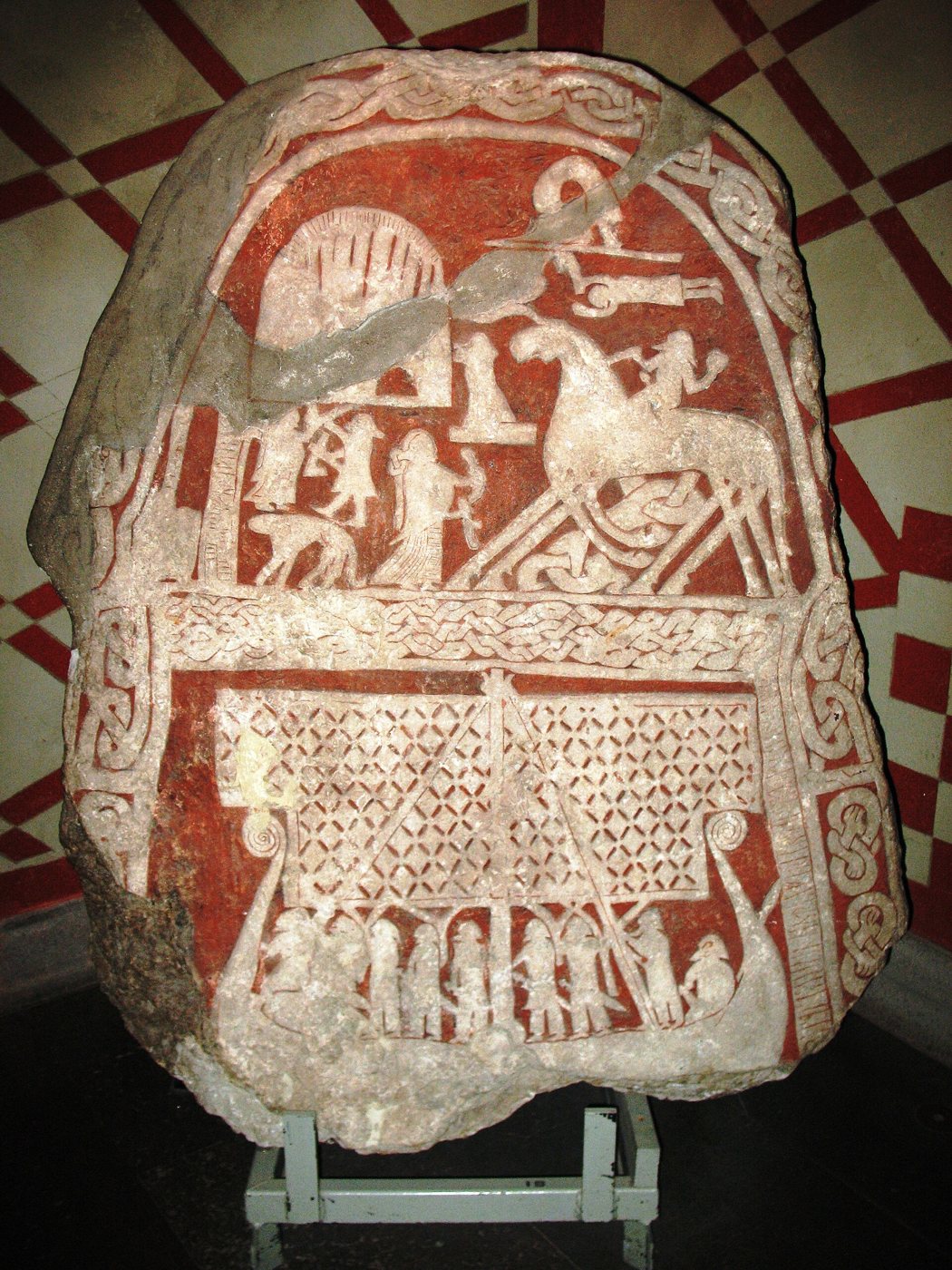
Two answers deserve a myth check. VALKNUT, the three interlocked triangles, is a modern name for a motif on picture stones; nobody knows what the Viking Age called it. And GOTTERDAMMERUNG, Wagner's twilight of the gods, goes back to the form ragnarøkkr, "darkening of the gods", found in the Lokasenna. The older ragnarǫk means "fate of the gods".
| Clue | Answer | Letters |
|---|---|---|
| Old Norse poetic collection | EDDA | 4 |
| Author of the Prose Edda | SNORRI | 6 |
| Prophecy of the Seeress | VOLUSPA | 7 |
| Sayings of the High One | HAVAMAL | 7 |
| Loki's flyting poem | LOKASENNA | 9 |
| Norse court poet | SKALD | 5 |
| Poetic circumlocution | KENNING | 7 |
| Icelandic prose tale | SAGA | 4 |
| Runic letter | RUNE | 4 |
| Runic alphabet | FUTHARK, FUTHORC | 7, 7 |
| Norse assembly | THING | 5 |
| Iceland's assembly since 930 | ALTHING | 7 |
| Honey wine | MEAD | 4 |
| Norse sacrifice | BLOT | 4 |
| Ritual toast | SUMBEL | 6 |
| Norse sorcery | SEIDR, SEID | 5, 4 |
| Valhalla's warriors | EINHERJAR | 9 |
| Frenzied warrior | BERSERKER, BERSERK | 9, 7 |
| Wolf-skinned warriors | ULFHEDNAR | 9 |
| Twilight of the gods | RAGNAROK, GOTTERDAMMERUNG | 8, 15 |
| Great winter before the end | FIMBULWINTER | 12 |
| Norse chieftain | JARL | 4 |
| Seafaring raider | VIKING, NORSEMAN | 6, 8 |
| Viking cargo ship | KNARR | 5 |
| Viking warship | LONGSHIP | 8 |
| Three interlocked triangles | VALKNUT | 7 |
Some clues reach us again and again, often straight from a half-finished grid. Here are the likeliest answers.
| Clue | Answer | Letters |
|---|---|---|
| Norse god of thunder | THOR | 4 |
| Norse father of the gods | ODIN, WODEN | 4, 5 |
| Thor's golden-haired wife | SIF | 3 |
| Norse goddess of hunting | SKADI | 5 |
| Realm high above Midgard | ASGARD | 6 |
| Rumble over Midgard | THUNDER, THOR | 7, 4 |
| God in an Eddic poem | ODIN, THOR, LOKI, TYR | 4, 4, 4, 3 |
Norse god of thunder (4): THOR. His name literally means "thunder". If you have five squares and the clue says "Germanic", try DONAR.
Norse father of the gods (4): ODIN, also clued as "All-Father". With five squares, WODEN or WOTAN.
Thor's golden-haired wife (3): SIF. Her hair is the starting point of the smithing contest above. Read more in our article on Sif.
Norse goddess of hunting (5): SKADI. If the clue says god rather than goddess, it is ULL.
Realm high above Midgard (6): ASGARD. Watch the wording: if the clue says "their realm lay high above Midgard", it is asking for the people, and AESIR (5) fits better. Snorri, strictly speaking, places Asgard in the middle of the world in one passage, while elsewhere the bridge Bifröst climbs from earth to heaven. The puzzle does not mind.
Rumble over Midgard: Here we have to be honest. This is not a fixed mythological term and does not appear in the reference works. The most likely answer is the sound itself, THUNDER (7). If the setter wants the one causing it, THOR (4).
God in an Eddic poem: deliberately open, a joker clue for short divine names. Three letters: TYR, ULL or BOR. Four: ODIN, THOR or LOKI. Five: BRAGI or FREYR. Six: BALDER. Eight: HEIMDALL. ODIN is the most frequent answer in our experience. WODEN and DONAR cannot be right, since neither name occurs in the Edda.
Old Norse uses letters that no crossword has room for. Setters resolve them by fixed rules, and once you know them you will find the right spelling faster.
That fourth rule is the big difference from German puzzles, which spell the umlaut out as OE: MJOELNIR, RAGNAROEK. If an answer you found online is one letter too long, it probably comes from a German list. The other common trick is the final -R. Freyr, Surtr and Baldr carry a grammatical ending that setters drop when convenient, which is why FREY and FREYR, SURT and SURTR, BALDR and BALDER all appear. Modern Icelandic turns that ending into -UR, which gives BALDUR.
What is the Norse god of thunder in 4 letters? THOR. The continental Germanic form DONAR has five letters, the Old English THUNOR six.
Who is Thor's wife in a crossword? SIF, three letters. She is the golden-haired goddess whose hair Loki cut off, and the mother of the archer god Ull.
Is it Valhalla or Valhall? Both appear in puzzles. VALHALLA has eight letters and is the usual English form, VALHALL has seven and is closer to the Old Norse.
What is the Norse word for giant in crosswords? JOTUN in Norse-themed puzzles, but the English cognates ETIN and ETTIN turn up more often in general crosswords.
Who is the Norse goddess of hunting? SKADI, five letters. Snorri describes her hunting on skis with a bow.
Is Hela a real Norse goddess? No. The mythological ruler of the dead is HEL; Hela is the Marvel version.
And if you would rather carry one of these names in slate or wood than in pencil, that is what our workshop is for.
For courage. For remembrance. For legends that live on.

Odin · Thor · The Norse pantheon · The nine worlds · The Edda · Norse Mythology – Introduction.
Where does poetry come from? The North had an uncannily beautiful answer to this: from the blood of a wise being …
Read more →„Did this actually happen?" – few questions come up in the workshop more often when we engrave a dragon, a smith or a …
Read more →A feast of the gods, ale in plenty – and a guest who exposes every single one of them. The Lokasenna („Loki’s flyting") …
Read more →Every misdeed has its price, and Loki’s bill is settled all at once. After the death of Baldr and his merciless mockery …
Read more →
